Only Two Lips – A Spring Poem

Floriade is the name of the  spring flower festival in Canberra in the Commonwealth Gardens near the centre of the city. Mainly a showing of bulbs including of course tulips. It is quite a tourist attraction and many come to Canberra to see the displays.

OLYMPUS DIGITAL CAMERA

The U3A ‘Arts’ Exhibition had a theme of tulips, poppies and spring. I wrote the following poem for the opening day (see the previous post) …

Tulips in a vase, focus on flower in foreground

Only Two Lips

who do you think you are
standing so pert and penal
asserting yourself in rich colour
arrogant, obvious
demanding my attention

well I’m not falling for it!
such a brazen showing
with your closed-mouth talk
I will give you what you deserve –
lip service, and just you wait

your day will come
believe me, you will bend
becoming quite dishevelled
falling to kiss the ground
in total disarray

Richard Scutter  2 August 2014

It is always very interesting when you read a poem in public because you never quite know what reception will follow. The audience was mainly  women and  in the older bracket, so that was appropriate. A few realized that I was not actually talking about tulips so much and there were a couple of wry smiles – which was encouraging!

There were a few hangups on the word ‘penal’. Well penal = punishing – and from a male perspective the beautiful can be quite punishing in many ways especially when young, ‘manipulative’ and of a demanding nature.

U3A – Art/Poetry/Music Exhibition – Promoting Poetry

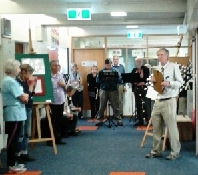
An Exhibition of Art, Poetry and Music was held by Canberra University of the Third Age (U3A) Groups on 20 October.

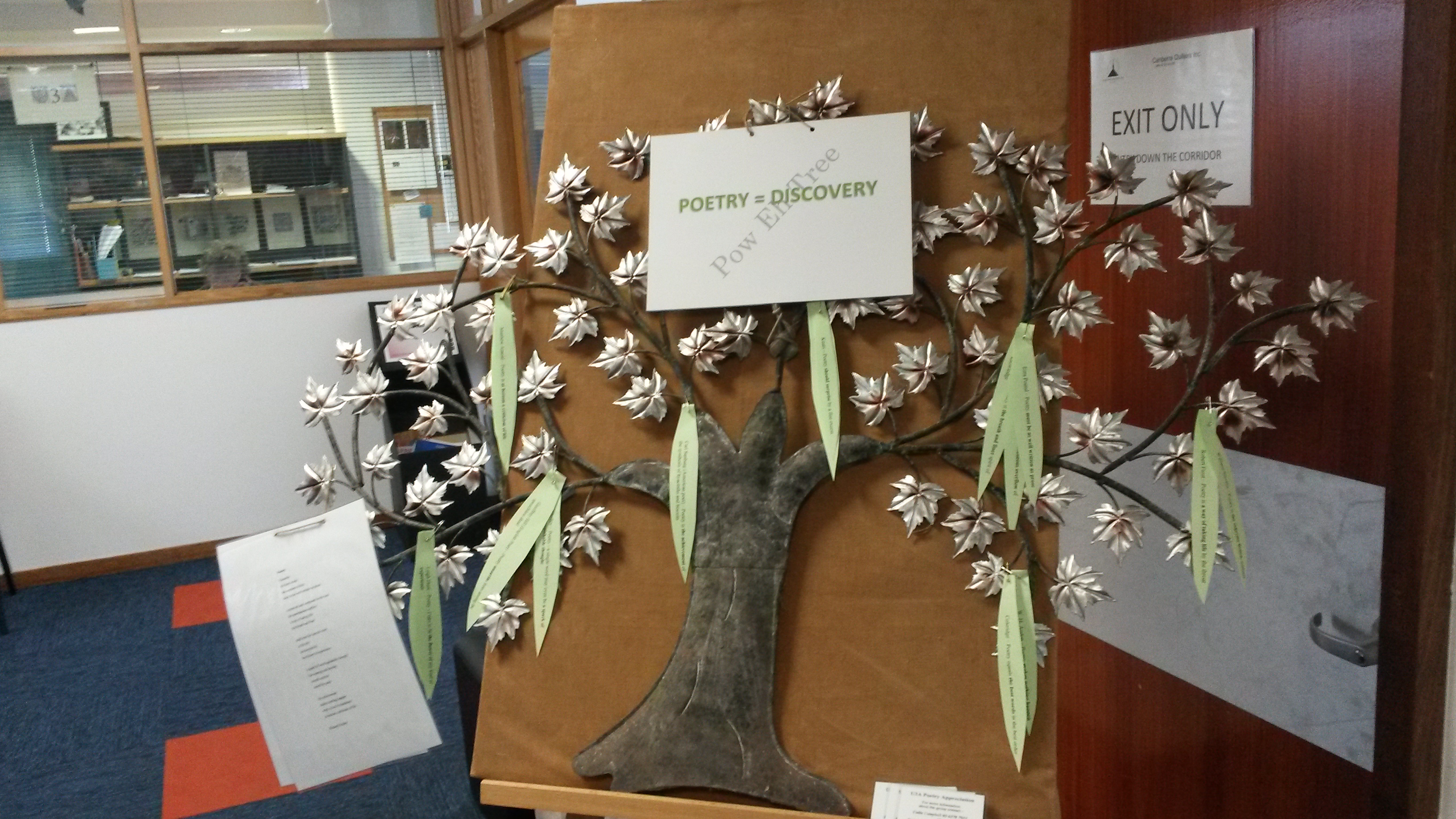
For interest, and to promote the Poetry Appreciation Group I created a POETRY TREE and attached twenty quotes on the nature of poetry by famous poets – Keats, Wordsworth, Auden, Frost, Owen, Hunt, Pound, Coleridge, Finch, Shelley, Sandburg, Arnold, Hill and Stevens.

PoetryTree
The Poetry Tree:   Poetry = Discovery

… and then a ‘Cento poem’ where each line takes text taken from the quotes –

Poetry

Unearths
the best words
the supreme fiction
must be as well written as prose

conceived and composed in the soul
the spontaneous outflow
a way of taking life
the breath and finer

shall tune her sacred voice
in the pity
the feverish fit
the flower of experience

a spark of inextinguishable thought
the opening and closing
should surprise
should be great

the achievement
makes nothing happen
what is lost in translation
at bottom a criticism

Richard Scutter

Context  – from the quotes …

Geoffrey Hill (English Poet) – Poetry unearths from among the speechless dead
Coleridge – Poetry equals the best words in the best order
Wallace Stevens – Poetry is the supreme fiction, madame.
Ezra Pound – Poetry must be as well written as prose
Mathew Arnold – Poetry is conceived and composed in the soul
Wordsworth – Poetry is the spontaneous overflow of powerful feelings
Robert Frost – Poetry is a way of taking life by the throat
Wordsworth – Poetry is the breath and finer spirit of knowledge
Samuel Johnson – Poetry shall tune her sacred voice, and wake
from ignorance the Western World
Wilfred Owen – Poetry is in the pity of war
Anne Finch (English Poet) Poetry’s the feverish fit, the overflowing of
unbounded wit
Leigh Hunt – Poetry – I take to be the flower of any kind of experience
Shelley – Poetry – a single word may even be a spark of inextinguishable thought
Carl Sanburg (American poet) – Poetry is the opening and closing of a door, …
Keats – Poetry should surprise by a fine excess
Keats – Poetry should be great and unobtrusive
Carl Sanburg (American poet) – Poetry is the achievement of the synthesis
of hyacinths and biscuits
W. H. Auden – Poetry makes nothing happen
Robert Frost – Poetry is what is lost in translation
Matthew Arnold – Poetry is at bottom a criticism of life

R-SpeakingTalking Poetry

In one word Poetry = Discovery … the poet discovers something in the creation process –  apart from the fact that achievment was possible! – perhaps a deeper personal understanding of experience … the reader discovers something of life disclosed by the poet and always something of the nature of the poet. And if art = looking and seeing and the repeat of this again and again then poetry = reading and absorbing and then repeating this again and again. Discovery is not a simple process. The U3A Poetry Appreciation Group hopefully helps insight by sharing within the group – especially where poems are a little difficult on first readings.

London Rain – Louis MacNeice

This year many of the the poets visited in our U3A (University of Third Age) sessions have had some connection with religious ministry. When you come to think about it it is not surprising. Ministers are thought-full people – don’t you think!

Louis MacNeice was no exception. His father was a Protestant minister who later became a bishop of the Anglican Church of Ireland. Below is Louis MacNeice’s poem ‘London Rain’, written at a time of conflict in Europe. He wrestles with thoughts on God as he looks out late at night on the rain. Sharing my comments which are shown in italics after each stanza.

 London Rain

The rain of London pimples
The ebony street with white
And the neon lamps of London
Stain the canals of night
And the park becomes a jungle
In the alchemy of night.

London night-time rain … I love that word pimples and the catch of light in the pimple from the street lamps … ebony = rich dark black wood … giving a little gloss to the dark … and there is a whole new mapping of the streets … as in a chemical reaction …the light staining, leaving it’s mark

My wishes turn to violent
Horses black as coal–
The randy mares of fancy,
The stallions of the soul–
Eager to take the fences
That fence about my soul.

This looks like dissatisfaction on where he is in life … in terms of violent horses … he wants to break free … and this may be a spiritual unrest when we look at later stanzas

Across the countless chimneys
The horses ride and across
The country to the channel
Where warning beacons toss,
To a place where God and No-God
Play at pitch and toss.

Well his thoughts travel across the channel to the war and this occupies his mind … God and No-God (the Good and the Bad) playing pitch and toss = a game of skill and chance

Whichever wins I am happy
For God will give me bliss
But No-God will absolve me
From all I do amiss
And I need not suffer conscience
If the world was made amiss.

He is talking about the God/No-God battle going on in his mind. If there is a God – everything will be OK and if No-God then it doesn’t matter about all the conscience problems … these are his on-going thoughts as he watches the rain … his logic…dare I say late-night logic!

Under God we can reckon
On pardon when we fall
But if we are under No-God
Nothing will matter at all,
Adultery and murder
Will count for nothing at all.

Expounding his thoughts from the previous stanza … bad behaviour will not matter … no accountability… and under God we will be absolved of all our missdemeanours.

So reinforced by logic
As having nothing to lose
My lust goes riding horseback
To ravish where I choose,
To burgle all the turrets
Of beauty as I choose.

So his logic suggests to him that this horse can ride amuck with no consequence … taking the No-God ride so to speak … and using this to justify any course of action

But now the rain gives over
Its dance upon the town,
Logic and lust together
Come dimly tumbling down,
And neither God nor No-God
Is either up or down.

It looks as though it has stopped raining for a while … and in sync. with this his God/No-God thinking seems to fall away too … well it is late night and he is a little confused

The argument was wilful,
The alternatives untrue,
We need no metaphysics
To sanction what we do
Or to muffle us in comfort
From what we did not do.

The argument was very wilful = headstrong … and indeed ‘we need no metaphysics = abstract thinking’ … and in his case no ‘God/No-God’ thoughts to work out what we should be doing or to justify our actions. (I might add that those that shout God is on our side are often using God to justify their ungodly actions.)

Whether the living river
Began in bog or lake,
The world is what was given,
The world is what we make.
And we only can discover
Life in the life we make.

Bog and lake are references to his Irish / English heritage. For me this is the key stanza … it is up to us to make what we will of the world, of this gift … and we can only discover how we should live in living life. In a sense it is up to us – our responsibility to create our own God (and if we do happen to believe in an external God then perhaps our understanding of God may come clearer). Focus on the gift of the present, the here and now…don’t worry about what is happening overseas!

So let the water sizzle
Upon the gleaming slates,
There will be sunshine after
When the rain abates
And rain returning duly
When the sun abates.

Well, rain and sun one will follow the other in an endless cycle (good and bad) – that is the way of the world and we have to accept it – (hopefully life improves over time!)

My wishes now come homeward,
Their gallopings in vain,
Logic and lust are quiet,
And again it starts to rain;
Falling asleep I listen
To the falling London rain.

His mind is now back on where he is … in his room looking out on the falling rain … the logic/lust distraction of thought in vain … and the wild horses that took his thoughts away at the beginning of the poem bring him home again … he notices it has started to rain again … falling rain and enough thinking for one night falls asleep… let’s hope he has pleasant dreams!

(The rhyming scheme is a b c b d b – with a repeat end word in lines four and six of each stanza).

New Fruit – Ann Drysdale

New Fruit

In the last knockings of the evening sun
Eve drinks Calvados. Elsewhere in her life
She has played muse and mistress, bitch and wife.
Now all that gunpoint gamesmanship is done.
She loves the garden at this time of day.
Raising her third glass up to God, she grins;
If this is her come-uppance for her sins
It’s worth a little angst along the way.
A fourth. Again the cork’s slow squeaky kiss.
If, as the liquor tempts her to believe,
The Lord has one more Adam up His sleeve
He’s going to have to take her as she is—
Out in the garden in a dressing-gown
Breathing old apples as the sun goes down.

Here is a very entertaining sonnet from Ann Drysdale. We were looking at poetry from Wales at a U3A session and a member brought in this poem. Ann Drysdale is now living in Wales but previously spent much of her life in north Yorkshire.

Last knockings = the final stages of something … it is not just the evening sun as we will see later in the poem – a very apt choice of words

Calvados = an apple brandy from France – again later in the poem we will see how apt it is that it is apple brandy – Eve being connected with apple and seducing.

And Eve has obviously led quite an abundant life in a number of relationships including wife and mistress – but all that ‘gunshot gamesmanship’ is over – to me this implies a lack of effort now due to current circumstances – a feeling that she can’t be bothered in making the play of previous years.

She is in the garden by herself, apart of course from the gin bottle – raising her third glass she grins – well how can she do otherwise after drinking gin – and she contemplates her sins and thinks if this is the outcome it’s not too bad – it’s Ok to sin if this is all that happens, but of course there is the downside that she is alone and needs someone.

The fourth gin gives new hope that perhaps there is another Adam to be caught (looking hopefully to God who has supplied previous opportunities) – I love the ‘squeaky kiss’ of the cork bottle – but she lets a future Adam now that she is to be taken as she is, undressed – well apart from her dressing gown and breathing old apples  … the wounds of past relationships  … and you have the distinct feeling she is not what you might call a fresh young pippin – not new fruit!

What a wonderful witty entertaining poem with such well-chosen words.

Here is a link to more of her poetry.