‘Tsanga’ – Book Launch Poem

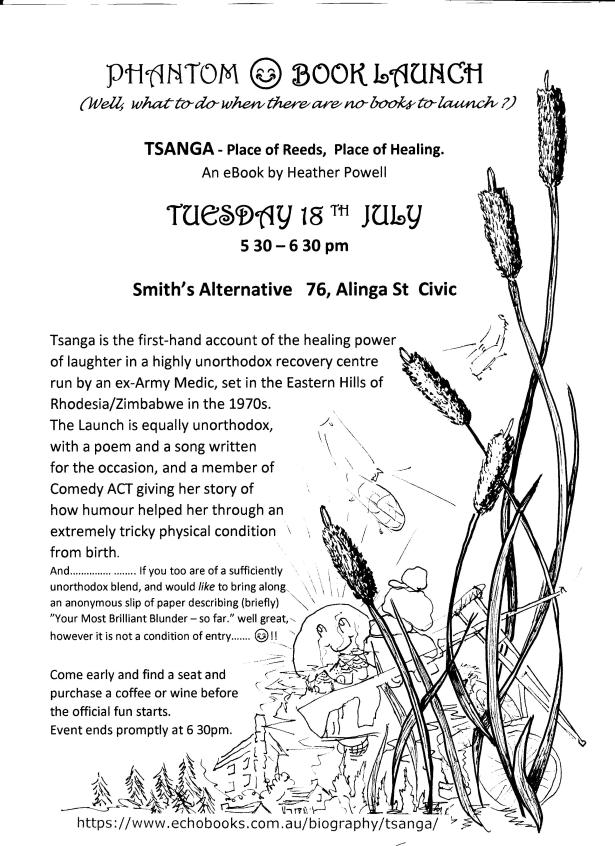
The following poem was written specifically for the Ebook launch of Tsanga in Canberra on 18 July. This book by Heather Powell describes her life in a Rhodesian recovery centre while working there in the years 1975-1979. This was during the Bush Wars when Ian Smith had declared independence and before the establishment of present-day Zimbabwe by Robert Mugabe. Tsanga was located in the beautiful eastern highlands of the country. Many of those treated at Tsanga were the result of landmines planted by those opposing the minority white rule of Ian Smith. An unorthdox approach based on laughter was part of the way taken to aid recovery (see the Lauch Invite below the poem).

At Tsanga1 (1976-1979)

pain is not black or white
pain has mutuality that threads its thorns
beyond the superficiality of colour and age

the war wounded and suffering disabled
had a commonality of understanding
that defined a special communion

damaged and partial, bodies without limbs
were challenged in the enormity of physical change
to find a unique resource in tragic adversity

Imagine being twenty and living in Africa
when a ‘biscuit tin’2 explodes in your face.
You wake up in a medical centre to be
discharged with paralysis in the left leg
and a brain injury that causes stumbling.
How would you feel your future fucked!

Welcomed at Tsanga; given-up by others
it’s hard to accept your predicament
but you gradually improve
encouraged by staff and exercise
and the friendship of others
less or more afflicted.

Out walking the scenic bush-mountain track
you fall on your knees to confront the ground.
Dick Paget3 bends down and face-to-face enquires
‘what exactly are you doing’ – you reply
‘just looking for my contact lenses, Sir’
and you smile as Dick laughs.

Then you break into laughter
and both of you can’t stop laughing.
At the bar in the evening others hear
this story, they too break into laughter.
Laughter, laughter – laughter abounds.
And for the first time – a total acceptance.

Richard Scutter May 2017

Footnotes
1Tsanga Lodge was a recovery centre set up by the Rhodesian Army in 1967
located in the beautiful scenic highlands of eastern Rhodesia (now Zimbabwe)
2Biscuit Tin – colloquial name for a roadside landmine during the Bush Wars in Rhodesia
3 … Dick Paget was the commanding officer at Tsanga

For those that may be interested in obtaining this ebook here is a link

And below is the Launch Invite …
TsangaInvite

Man on the Moon – Stephen Edgar – Analysis

Man on the Moon

Hardly a feature in the evening sky
As yet—near the horizon the cold glow
Of rose and mauve which, as you look on high,
Deepens to Giotto’s dream of indigo.

Hardly a star as yet. And then that frail
Sliver of moon like a thin peel of soap
Gouged by a nail, or the paring of a nail:
Slender enough repository of hope.

There was no lack of hope when thirty-five
Full years ago they sent up the Apollo—
Two thirds of all the years I’ve been alive.
They let us out of school, so we could follow

The broadcast of that memorable scene,
Crouching in Mr. Langshaw’s tiny flat,
The whole class huddled round the TV screen.
There’s not much chance, then, of forgetting that.

And for the first time ever I think now,
As though it were a memory, that you
Were in the world then and alive, and how
Down time’s long labyrinthine avenue

Eventually you’d bring yourself to me
With no excessive haste and none too soon—
As memorable in my history
As that small step for man on to the moon.

How pitiful and inveterate the way
We view the paths by which our lives descended
From the far past down to the present day
And fancy those contingencies intended,

A secret destiny planned in advance
Where what is done is as it must be done
For us alone. When really it’s all chance
And the special one might have been anyone.

The paths that I imagined to have come
Together and for good have simply crossed
And carried on. And that delirium
We found is cold and sober now and lost.

The crescent moon, to quote myself, lies back,
A radio telescope propped to receive
The signals of the circling zodiac.
I send my thoughts up, wishing to believe

That they might strike the moon and be transferred
To where you are and find or join your own.
Don’t smile. I know the notion is absurd,
And everything I think, I think alone.

Stephen Edgar (1951 –

Clive James has given an excellent analysis of this poem in his book ‘Poetry Notes’ … the text of this discussion is also on the internet and this is the website link … https://www.poetryfoundation.org/poetrymagazine/articles/69175/an-almost-perfect-break-up-poem

Adding some comments to this discussion …

There is no such a thing as a perfect poem … and I agree that this poem has a decided flaw in the second last stanza when SE makes reference to the text in another of his poems – re: to quote myself … an oblique reference that jolts the flow.

However, this is certainly a well crafted poem and one poem that will surely be remembered against his name.

Apart from the ‘poetic devices’ discussed by Clive James for me one of the reasons it is a great poem is the integrated comparison between two ‘major events’ that occurred in 1969. The first event being that famous ‘walk on the moon’ and the second being much more down to earth that of the start of a very personal relationship that affected his life. The poem looks back at these events after thirty five years. The second stanza subtly introduces the link by the ‘moon/nail’ comparison. It is not clear what ‘hope’ means until reading further when ‘hope’ is seen as more relevant in regard to a successful personal relationship.

The journey to the moon took a lot of planning. It was a long path to that first walk and everyone was indeed hopeful for a successful outcome. SE looks at the equivalent path that led to the meeting of his love indicating ‘eventually you’d bring yourself to me’. He poses questions such as – what planning and what forces brought the two of them together? – and was it predestined? And there is that familiar romantic notion that love is meant to be when all is well between lovers.

A secret destiny planned in advance
Where what is done is as it must be done
For us alone

… but then he states that ‘the special one might have been anyone’ dispelling such romantic thoughts. However that ‘anyone’ was of course very special and there was a state of ‘delirium’ comparable to the ‘delirium ‘of the moon-walk, if only to him. A personal journey is far more important.

Then that sad nostalgic reflection … ‘that delirium/ we found is cold and sober now and lost ‘… that the only value of the event, at least the personal event, is a faded memory – and there are regrets that the journey never continued. Perhaps the focus on their relationship has become over magnified on reflecting back on this one highlight after many years. It does give the feeling that it was a never to be repeated event-euphoria similar to the moon-walk.

In the final stanza he wishes his thoughts could journey to her wherever she is in the world, but of course he is caught up alone in this bitter sweet memory – for he is talking to himself as he walks through the reflective mind of a lost love.

Stephen Edgar is a contemporary Australian poet and … a link on Wikipedia … https://en.wikipedia.org/wiki/Stephen_Edgar

Buried in pixels

Buried in pixels

they have taken all the children
to their land of fantasy
where they live between the fairies
leaving nought for you and me

they have told them magic stories
that they believe are surely true
ignoring all our history
Huckleberry, Auntie Sue

they have created a subterfuge
to hide land, sky and sea
where their friends screen for hours
in a world we do not see

they have taken all the children
to the graveyard of the living
and we are left a-wondering
trying hard to be forgiving

Richard Scutter

Because – James McAuley – Analysis

Because

My father and my mother never quarrelled.
They were united in a kind of love
As daily as the Sydney Morning Herald,
Rather than like the eagle or the dove.

I never saw them casually touch,
Or show a moment’s joy in one another.
Why should this matter to me now so much?
I think it bore more hardly on my mother,

Who had more generous feelings to express.
My father had dammed up his Irish blood
Against all drinking praying fecklessness,
And stiffened into stone and creaking wood.

His lips would make a switching sound, as though
Spontaneous impulse must be kept at bay.
That it was mainly weakness I see now,
But then my feelings curled back in dismay.

Small things can pit the memory like a cyst:
Having seen other fathers greet their sons,
I put my childish face up to be kissed
After an absence. The rebuff still stuns

My blood. The poor man’s curt embarrassment
At such a delicate proffer of affection
Cut like a saw. But home the lesson went:
My tenderness thenceforth escaped detection.

My mother sang ‘Because’, and ‘Annie Laurie’,
‘White Wings’, and other songs; her voice was sweet.
I never gave enough, and I am sorry;
But we were all closed in the same defeat.

People do what they can; they were good people,
They cared for us and loved us. Once they stood
Tall in my childhood as the school, the steeple.
How can I judge without ingratitude?

Judgment is simply trying to reject
A part of what we are because it hurts.
The living cannot call the dead collect:
They won’t accept the charge, and it reverts.

It’s my own judgment day that I draw near,
Descending in the past, without a clue,
Down to that central deadness: the despair
Older than any Hope I ever knew.

James McAuley (12 October 1917 – 15 October 1976)

The one word title ‘because’ is suggestive that some reasoning or explanation is about to take place. As soon as we read the first stanza we realise that this will be a well-crafted rhyming poem with pentameter rhythm.

S1 – JM declares the relationship between his mother and father, from his child-view, it was rather bland, routine, regular … without showing any difference from day to day – akin to the delivery of a newspaper (you don’t have to know that the Sydney Morning Herald is a well know Australian paper). A kind of love – gives the feeling of some acceptance to this situation.

S2 – There was no joy or touch – and JM poses the question – why is this important – when reflecting back over the years … a little ambivalence

S3 – It was hard for his mother if feelings were not expressed. Drinking was an issue with his father … to be regarded as fecklessness – a human failing … and his father had damned up feelings into stone

S4 – a physical aspect … his father’s lips twitched at times … and according to JM the real weakness was a lack of being able to show affection

S5 – and then the rebuff when JM does as other children and puts his face up to be kissed after returning from being away … but there is no reciprocation … a moment painfully remembered through the years

S6 – … his sensitivity … his need for affection … was not recognised by his father … his mother was more forthcoming as indicated in the next stanza

S7 – her mother was more open and JM remembers her singing with affection … and while he reminisces he regrets that he was not himself more open … more giving

S8 – now JM looks at the positives of his parents in bringing him up … they were obviously very caring people and loving in their own way … negating any judgemental attitude

S9 – being judgemental defines the nature of those judging … in this case he is perhaps blaming his own lack of sensitivity on the similar approach taken by his parents in his upbringing … and I love the last two lines of this stanza … nothing can be done now … JM is talking to himself … time to move on … so at this stage in the poem there appears to be an acceptance and a resolution in the ambivalence expressed in the opening question

S10 – JM’s thinking now escapes to his own ‘judgment day’ … how his past will be treated … he has no clue … a sense of despair … a lack of any hope in the hereafter

James McAuley (1917 – 1976) was an Australian academic, poet, journalist and literary critic … James McAuley on Wikipedia