Adlestrop – Edward Thomas – Comments

Adlestrop

Yes. I remember Adlestrop—
The name, because one afternoon
Of heat the express-train drew up there
Unwontedly. It was late June.

The steam hissed. Someone cleared his throat.
No one left and no one came
On the bare platform. What I saw
Was Adlestrop—only the name

And willows, willow-herb, and grass,
And meadowsweet, and haycocks dry,
No whit less still and lonely fair
Than the high cloudlets in the sky.

And for that minute a blackbird sang
Close by, and round him, mistier,
Farther and farther, all the birds
Of Oxfordshire and Gloucestershire.

Edward Thomas (1878 – 1917)

It was as though the train stopped on purpose so that all the passengers good savour an early summer day when the world itself seemed to stop and all was peace. The joy of nature showing contentment voiced in the beautiful birdsong of the English countryside. It is moments like these, unexpected moments of joy, that become so meaningful when we reflect back. I think we all have such images that retain lifelong pleasure on recall.

It is a very simple four stanza poem with rhyming in the second and fourth lines. The short factual statements are all that is needed in defining the essence of the moment as experienced by the traveller as he looks out the window. The text ‘And for that minute’ is pivotal in holding the image in the eye of the reader.

And of course many will relate to the experience of a train stopping before reaching the destination but whether thay will be relaxed about it is another matter.

Edward Thomas will be remembered by this poem more than any other just as Adlestrop will always be associated with this poem. An example of how a poem can define a specific place due to experience. Adlestrop was axed in the Beeching cull of railway stations in the Sixties as were many other sleepy country stations. However the railway sign displaying the name is still very much in evidence.

And from Wikipedia …  it was due to Edward Thomas that Robert Frost came to write his famous poem ‘The Road Not Taken’

The American poet Robert Frost, who was living in England at the time, in particular encouraged Thomas (then more famous as a critic) to write poetry, and their friendship was so close that the two planned to reside side by side in the United States. Frost’s most famous poem, “The Road Not Taken”, was inspired by walks with Thomas and Thomas’s indecisiveness about which route to take.

Tragically Edward Thomas was killed soon after he arrived in France during the first World War.
And more details of Edward Thomas via Wikipedia 

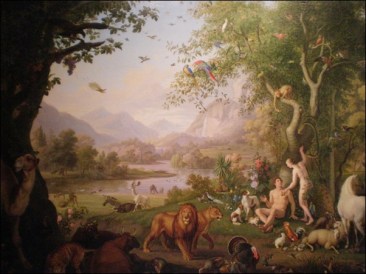
Adam and Eve – Paradise Ignored

Here is another take on Adam and Eve …

OLYMPUS DIGITAL CAMERA
Wenzel Peter’s Painting: Adam and Eve in the Garden of Eden
courtesy of the Vatican Museum

Paradise Ignored
(on viewing Wenzel Peter’s Painting ‘Adam and Eve in the Garden of Eden’)

greater love has no man than that he lay down his life for a friend
John 15 v13

Images of more than two hundred animals
perfected in paint in unreal detail
carefully positioned in a still of verdant harmony
show an intricate love of the animal world
and for the very marvel of creation
in all its great variety and abundance.

For one brief moment
we are invited into this paradise
but as we enter this unreal world

there is a certain foreboding
an animal premonition prevails …

a flock of birds stir into the air
scurry above the tree of knowledge
give the danger warning
the wise owl sits atop another tree
knowing of the unknown perhaps
that knowledge is truly a dangerous thing
the cockerel at the foot of Eve
exhibits a full throttle crow –
an ominous omen
and the monkey appears to taunt
all ready in mischievous mood
proffering the reason for the disquiet.

At Adam’s right hand
dogs sit true to the letters of their name.
Below the left foot of Eve
lambs are bleating their concern, for …

Eve has left the paradise party
locked herself out to a deadly world
her skin is turning a shade pale
now separated from eternal life
alone, cold, knowing she must die
makes her desperate plea for company.

But Eve is Adam’s very own flesh and blood
his one and only friend and in a state of total need
can he not ignore! – he has no choice –
surely love and surely God
would equally agree.

Richard Scutter
from the selected poems publication ‘My Word In Your Ear’

Imperial Adam – A. D. Hope : Comments

Imperial Adam

Imperial Adam, naked in the dew,
Felt his brown flanks and found the rib was gone.
Puzzled he turned and saw where, two and two,
The mighty spoor of Yahweh marked the lawn.

Then he remembered through mysterious sleep
The surgeon fingers probing at the bone,
The voice so far away, so rich and deep:
“It is not good for him to live alone.”

Turning once more he found Man’s counterpart
In tender parody breathing at his side.
He knew her at first sight, he knew by heart
Her allegory of sense unsatisfied.

The pawpaw drooped its golden breasts above
Less generous than the honey of her flesh;
The innocent sunlight showed the place of love;
The dew on its dark hairs winked crisp and fresh.

This plump gourd severed from his virile root,
She promised on the turf of Paradise
Delicious pulp of the forbidden fruit;
Sly as the snake she loosed her sinuous thighs,

And waking, smiled up at him from the grass;
Her breasts rose softly and he heard her sigh —
From all the beasts whose pleasant task it was
In Eden to increase and multiply

Adam had learned the jolly deed of kind:
He took her in his arms and there and then,
Like the clean beasts, embracing from behind,
Began in joy to found the breed of men.

Then from the spurt of seed within her broke
Her terrible and triumphant female cry,
Split upward by the sexual lightning stroke.
It was the beasts now who stood watching by:

The gravid elephant, the calving hind,
The breeding bitch, the she-ape big with young
Were the first gentle midwives of mankind;
The teeming lioness rasped her with her tongue;

The proud vicuna nuzzled her as she slept
Lax on the grass; and Adam watching too
Saw how her dumb breasts at their ripening wept,
The great pod of her belly swelled and grew,

And saw its water break, and saw, in fear,
It quaking muscles in the act of birth,
Between her legs a pigmy face appear,
And the first murderer lay upon the earth.

A. D. Hope

This is a well-crafted eleven stanza poem with rhyming scheme (abab) and more importantly showing plenty of imagination, and what a wonderful build-up to an immense last line.

S1 and S2 – well here is Adam … hopefully he did not experience any pain during the night … remembering in his sleep hearing a voice … perhaps he had a dream of something beautiful … ‘the spoor of Yahweh’ – well he himself is a similar product. It is interesting that the word spoor is chosen as this associates the creator as animal. We will see later that the animal world is very evident in this poem.

S3 – what a shock … but he knew her at first-sight … woman part of man … woman and man inextricably connected … he noticed her in need (allegory of sense – poetic expression of this urge – allegory = a picture that can reveal a hidden meaning) … (he didn’t say ‘I have a bone to pick with you’!)

S4 – and what was this that winked at him … he was aware of the difference … Eve not tempting with an apple but with other fruit … a nice touch that a pawpaw is associated with Eve

S5 – again another fruit reference (nice to have different fruit from the Eve-apple association) – a gourd (hard celled fruit for decoration) … such an appropriate choice … and the typical female seductive stereotype written by a male in snake terms

S6 – all the animals that have been enjoying sex are there watching … nice contrast … and interesting when later we see these animals are of a friendly nature

S7 – so Adam in line with the animals … copying … has the first sexual act with a woman … it might have been a surprise to find the changes to his body in this encounter

S8 – Eve has achieved her purpose … her need satisfied … a triumphant cry while the animals watch and in S9 and S10 become loving midwifes as Eve’s body changes with pregnancy … great imagination … all the animals seem friendly and Adam is regarded as one of them

S11 – Adam watches the first human birth in fear … and then that confronting last line that stuns the thought of the reader.

And so began the fragmentation of the empire of Imperial Adam.

Here is a link to the Australian poet A. D. Hope on Wikipedia … https://en.wikipedia.org/wiki/A._D._Hope

Shelley’s Preface to Prometheus Unbound

Shelley’s preface to Prometheus Unbound is well worth reading in understanding the something of the nature Shelley …

It is interesting to see what he has to say about his hero Prometheus compared to Satan detailed in ‘Paradise Lost’ (Milton) …

‘… the only imaginary being resembling in any degree Prometheus, is Satan; and Prometheus is, in my judgement, a more poetical character than Satan because, in addition to courage and majesty and firm and patient opposition to omnipotent force, he is susceptible of being described as exempt from the traits of ambition, envy, revenge, and a desire for personal aggrandisement, which is the hero of ‘Paradise Lost’… … Prometheus is, as it were, the type of the highest perfection of moral and intellectual nature, impelled by the purest and truest motives to the best and noblest ends.’

The only thing I can say to that … Satan can’t be perfect can he …but seriously, again we see Shelley (= Prometheus) willing to stand-up … even against omnipotence

On the imagery – ‘ … drawn from the operations of the human mind, or from those external actions by which they are expressed’… Shelley says this is unusual in the poetry of his day … with the exception of Shakespeare and Dante (especially Dante) … he also applauds the Greek poets who had no antecedent

He pays homage to the way literature fuelled a better interpretation of the Christian Religion …

We owe the great writers of the golden age of our literature to that fervid awakening of the public mind which shook to dust the oldest and most oppressive form of the Christian Religion’

I agree that in one sense ‘poetry is a mimetic art’ … the influence of others is unavoidable … Shelley states the following generalisation …

‘A Poet, is the combined product of such internal powers as modify the nature of others, and of such external influences as excite and sustain these powers; he is not one but both. Every man’s mind is in this respect modified by all the objects in nature and art, by every word and every suggestion which he ever admitted to act upon his consciousness; it is the mirror upon which all forms are reflected, and in which they compose one form. … Poets, not otherwise than philosophers, painters, sculptors, musicians, are in one sense the creators and in another the creations of their age.’

… finding similarity between Homer with Hesiod, Aeschylus and Euripides, Virgil and Horace, Dante and Petrarch, Shakespeare and Fletcher and Dryden and Pope … and in the need to read the work of others …

‘He might as wisely and as easily determine that his mind should no longer be the mirror of all that is lovely in the visible universe, as exclude from his contemplation the beautiful which exists in the writings of a great contemporary’

Footnote …

from Wikipedia on Prometheus Unbound … Prometheus Unbound is a four-act lyrical drama by Percy Bysshe Shelley, first published in 1820.  It is concerned with the torments of the Greek mythological figure Prometheus, who defies the gods and gives fire to humanity, for which he is subjected to eternal punishment and suffering at the hands of Zeus.