The Raincoat – Ada Limón – Analysis

To become familiar with the work of Ada Limón as a starting point I chose a poem where there was some rapport. Ada Limón created this poem based on personal experience reflecting back later in life.

The Raincoat

When the doctor suggested surgery
and a brace for all my youngest years,
my parents scrambled to take me
to massage therapy, deep tissue work,
osteopathy, and soon my crooked spine
unspooled a bit, I could breathe again,
and move more in a body unclouded
by pain. My mom would tell me to sing
songs to her the whole forty-five-minute
drive to Middle Two Rock Road and forty-
five minutes back from physical therapy.
She’d say that even my voice sounded unfettered
by my spine afterward. So I sang and sang,
because I thought she liked it. I never
asked her what she gave up to drive me,
or how her day was before this chore. Today,
at her age, I was driving myself home from yet
another spine appointment, singing along
to some maudlin but solid song on the radio,
and I saw a mom take her raincoat off
and give it to her young daughter when
a storm took over the afternoon. My god,
I thought, my whole life I’ve been under her
raincoat thinking it was somehow a marvel
that I never got wet.

Ada Limón (1976 -

Copyright Credit: ALimón, "The Raincoat " from The Carrying. Copyright © 2018 by Ada Limon. Reprinted by permission of Milkweed Editions.
Source: The Carrying (Milkweed Editions, 2018)

The title, when a specific object is chosen like the raincoat; this must have significance in relation to the poem. In this poem it was in relation to the way the coat was being used as she watched a mother take care of a child. A moment observed in daily life has prompted thought to a personal connection. And this connection is elaborated in Ada Limón’s reflection on her own childhood with her mother to form the basis of the poem.

The text down to the full stop in line 8 gives details of the corrective course for a crooked spine. A condition known as scoliosis which involved continual travel over her childhood years which gradually eased the pain and assisted breathing.

The next lines to the full stop in line 12 detail the 45 minute travel journey with her mother to attend the medical sessions. Her mother asks her to sing while they travel and she responds. It is not necessary to know that the location is Middle Two Rock Road which happens to be in California but this gives actuality to her own personal life as a child.

In the next sentence her mother declares that her singing is unfettered; independent of her spine condition. AL thought she was doing this purely to satisfy her mother. She never thought of any inquiry to the sacrifice her mother was making all the time in facilitating the journeys. Her mother may very well have suggested the singing to detract from the scoliosis and show what she could achieve independent of her daughter’s chronic medical burden.

Then years later Ada Limón is doing the exact same thing at her Mother’s age; driving back from another medical appointment on her spine. At the same time doing as she did before as a child; singing away. The sight of a mother in the rain who uses her own raincoat to protect her daughter from a storm prompts thoughts on the sacrifice her mother made in taking her to medical sessions. And for the first time she thinks of the cost to her mother in giving her such support. She then extends this lack of recognition to her whole life – my whole life I’ve been under her raincoat giving; for all that her mother has done to support her through the years.

A poem created by giving personal thought on observing the the day-to-day life in the street. It shows how something quite simple can act as a trigger in creating a poem. And as a child we are often quite oblivious to the cost of the support given by parents. Later in life that support is often reciprocated as our parents age. Whether there is a balancing act is another matter.

Ada Limón is the current poet laureate in the United States. Ada Limón details on Wikipedia
A Message to my Granddaughters

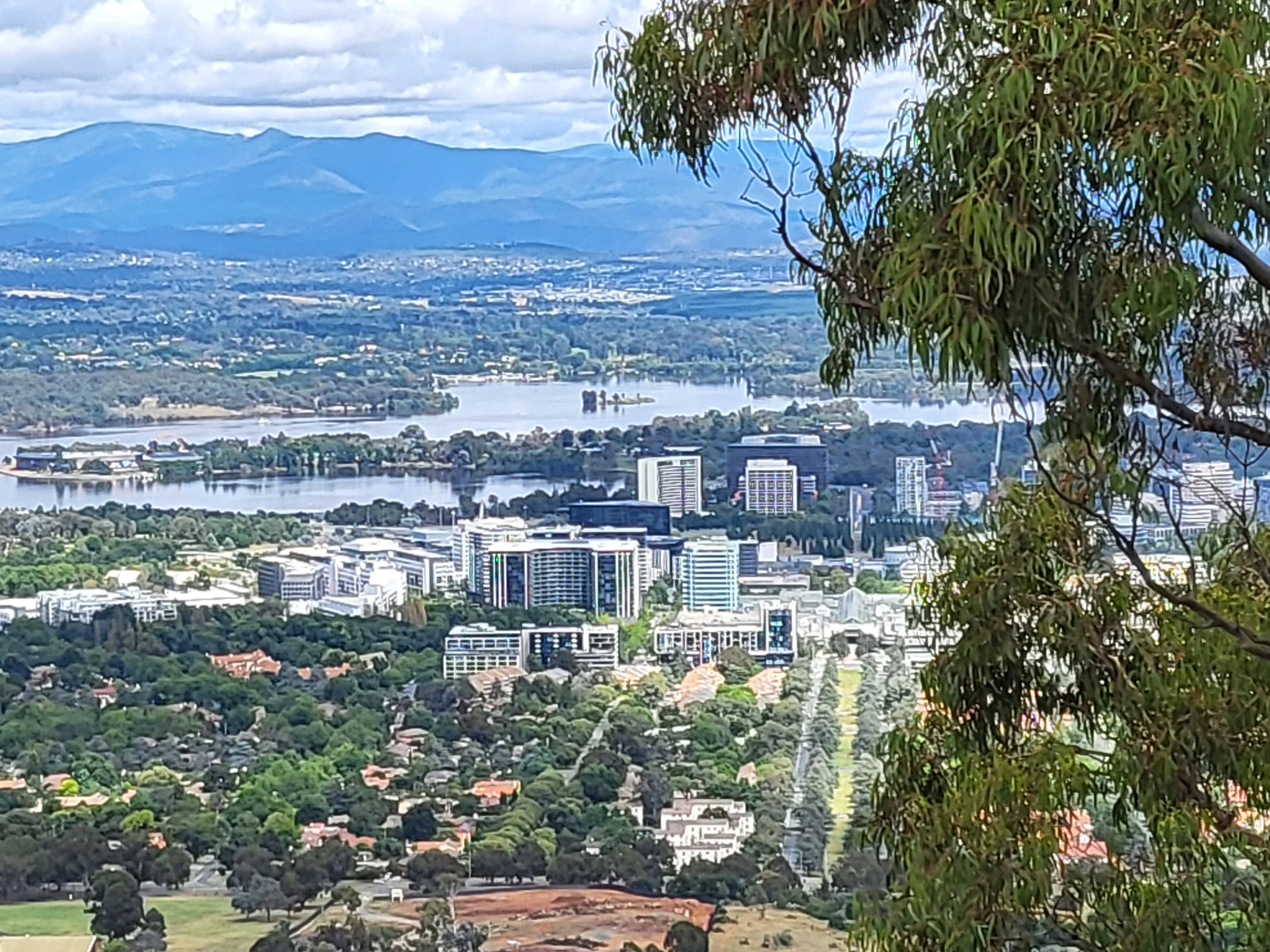
Mt Ainslie, Canberra – looking down on the city centre and Lake Burley Griffin
A Message to my Granddaughters 
in response to Michael Thwaites
Sometimes you slowly still, 
and within a certain satisfaction exudes
into a self-absorbed contentment.
And you say a quiet thank you,
as a peace envelops the soul.
Sometimes you slowly still.
I chose a marvellous city to call home,
the break of morning, the stars departing,
The mirror lake, the cutting Autumn air,
The sun unfolding on the Brindabellas –
I chose a marvellous city to call home.
And what a city, your native city.
The expansive view from Mt Ainslie
portrays Walter Burley Griffin’s plan in 
the continual change of trees, hills, water,
his forever friends in living beauty.
And in this vista, commanding features - 
St John’s Church, the War Memorial,
Civic Centre, The National Library,
the new and old Parliament buildings,
Regatta Point, Commonwealth Gardens,
Capital Hill … and so much more, caught
in the moment of an Autumn morning.
But will you appreciate in likewise fashion 
And will your days stretch to a contented life
and will you, when time falls back against the years,
will you … well, who knows! …
But on this morning, I will say again –
I chose a marvellous city to call home.

Richard Scutter March 2022, Canberra

March is the start of Autumn in Canberra. And this year it has not been a case of a sweltering summer and the autumn change will not be so dramatic; but always a time to appreciate the beauty of the changing colours of the trees.

And on this day, it is a time to value your home wherever you live. Hopefully, your home has not been violated by needless violence generated by future fear from another country.

All the best, Richard

i thank you God – e e cummings – analysis

i thank You God for most this amazing
day: for the leaping greenly spirits of trees
and a blue true dream of sky; and for everything
which is natural which is infinite which is yes
(i who have died am alive again today,
and this is the sun’s birthday; this is the birth
day of life and of love and wings: and of the gay
great happening illimitably earth)
how should tasting touching hearing seeing
breathing any–lifted from the no
of all nothing–human merely being
doubt unimaginable You?

(now the ears of my ears awake and
now the eyes of my eyes are opened)

e e cummings (1894 – 1962) (in ‘complete poems 1904 – 1962’)

This is a Sunday praise poem … the birth of another week … the birth of another day. And someone once said that each day is a new life. I can’t help thinking of ‘Mrs Dalloway’ and all that happened on a glorious English summer June day in her party arrangements and the entertaining of friends.

This is a thankyou in recognition of the boundless happening of all that is Earth (illimitably – having no bounds).

And a statement that God can be found in the natural world.

Life is to be tasted, touched, heard, seen and breathed in all its immeasurable wonder. And in the last two lines there is a spiritual awakening expressed in terms of hearing and seeing.

And e e c had this prayer his only be want was he be he

(‘may I be I is the only prayer—not may I be great or good or beautiful or wise or strong’)

An excellent discussion of this poem is on this Art and Theology site.

Born in Cambridge, Massachusetts, he was raised, a pastor’s son, in the Unitarian faith, which emphasizes the oneness of God. As an adult he wed this spiritual framework to Emersonian transcendentalism, a philosophical movement that celebrates humanity and nature. Elements from these two complementary traditions can be detected in his praise poem “i thank You God for most this amazing,” in which the natural world triggers an awakening to Truth. And for Cummings, Truth is a person, a “You” with a capital Y.

e e cummings on Wikipedia.

Little Jack Horner – Discussion

Little Jack Horner

Sat in the corner
Eating a Christmas pie.
He stuck in his thumb
And pulled out a plum
And said, “What a good boy am I!”

Anonymous

Discussion …

What is the meaning behind the well-known words of this nursey rhyme …

… my thoughts …… he sat in the corner … perhaps he didn’t want to be found out that he had taken the pie, he wanted to secretly have it to himself and not be disturbed … and what was he after – plums! … he ignored the pastry and put in his thumb searching for one … he seems impatient to get to the inside … though the pie is much more!… and he does seem to be a little self-centred and that anything slightly fortunate is due to him being good and deserving of such fortune … what if the plum had a stone which cracked a tooth … would that have indicated that he had done something bad.

… this nursery rhyme was given as the chapter-title-poem on Meaning and Idea in Laurence Perrine’s excellent book Literature – Structure, Sound, and Sense (isbn 0-15-55 1100-9) … the interpretation …the pie exists for the plum (at least for Jack) though the pie is much more! … poetry (pie) is more than just meaning (plum) … savour the whole poetry pie please … don’t just look for meaning … that’s right eat the pastry and enjoy with your custard! … take a holistic approach when reading poetry … don’t just search for your plums … savour the total poetic experience … even if the essence of the poem is alien to your point of view … and poems are not word puzzles to be interrogated by the mind of the reader seeking some justification for their existencu.

Well Christmas is coming and I guess presents will come your way in some form or other. So make sure you inspect the card carefully and unwrapp slowly and when you sight the the unwanted (don’t go plum crazy) be generous in your response no matter what … quite often the ‘unwanted’ can eventually be of use to you or someone else … and if you are a poet you should be well versed in the use of your imagination!

Footnotes …

… funny that even today some still think that if something “unfortunate” happens it is due to that person being bad … and globally the current world woes are, of course, due to the world being bad

The origins/history according to the Site below give a different perspective on this nursery rhyme … http://www.rhymes.org.uk/little_jack_horner.htm
… funny place to put valuables – in a pie … there again we used to have a coin in the family Christmas pudding … a three-penny piece from memory. And I must admit that as a child the main focus was on getting a coin.