Summer – Judith Wright : Analysis

Summer is here again and already we have had a few very hot days in Canberra. This poem by Judith Wright relates to Edge, her former home in Braidwood, and to the Australian summer and how nature must accommodate the disturbance by man and the effect of bush fire. It was written towards the end of her life.

Summer

This place’s quality is not its former nature
but a struggle to heal itself from many wounds.
Upheaved ironstone, mudstone, quartz and clay
drank dark blood once, heard cries and the running of feet.
Now that the miners’ huts are a tumble of chimney-stones
shafts near the river shelter a city of wombats.
Scabs of growth form slowly over the rocks.
Lichens, algae, wind-bent saplings grow.
I’ll never now it’s inhabitants. Evening torchlight
catches the moonstone eyes of big wolf-spiders.
All day the jenny-lizard dug hard ground
watching for shadows of hawk or kookaburra.
At evening, her pearl-eggs hidden, she raked back earth
over the tunnel, wearing a wide grey smile.
In a burned-out summer, I try to see without words
as they do. But I live through a web of language.

from Judith Wright Collected Poems – The Shadow of Fire (Ghazals)

JW shows strong identity to the land commenting on the effects of man  … a land which drank dark blood once … the killing of Aborigines … and a land once  subject to mining … her words describe the attempted recovery by nature  … the attempt to revert to previous conditions – which of course can never happen.

JW also shows strong empathy with the natural environment … with knowledge of local animals and insects seen at Edge. The environment adjusts to the disturbance by man … shafts near the river shelter a city of wombats … and the environment must adjust to the destruction of nature by bush fire … suggesting this is a greater problem …  trying to see without words … … creating words always detracts … many survivors of bush fires would identify with the intensity of thought conveyed by such words.

… it is fascinating to see how diversity manifests through continual evolution … species adapting to changes to environment and the resultant changes to other species … the total connectivity of life as it creates a future by the process of the survival of the fittest … or put another way survival by those best able to adapt to change.

… now this may be Ok when evolution is gradual, although of course some species become extinct, but what happens to this evolutionary process under sudden dramatic disturbances, humanity-made or not … and more important how can humanity act to ‘better the evolutionary process’ … humanity being the prime custodian of the world … having the key role in the very determination of the nature of existence. Global warming is of course one consideration for attention.

… there may of course be other influences at play in the evolutionary process such as spiritual connectivity … but a little foolish and quite a cop-out to think that God will protect the world from destruction … however this could become an indirect truth … if humanity allows God to work through humanity … by humanity listening and responding as appropriate.

… I really love the first two lines … This place’s quality is not its former nature / but a struggle to heal itself from many wounds … the quality of nature is in its resilience and ability to adapt to change and to heal … I am an an optimist of course.

Here is a link to the ‘Braidwood property Edge’ where Judith Wright lived.
and a link  to Judith Wright on Wikipedia

The Listeners – Walter de la Mare – Analysis

‘The Listeners’ by Walter de la Mare is one of the most popular poems of all-time … often in the top in any peoples’ poetry poll …

The Listeners

‘Is there anybody there?’ said the Traveller,
Knocking on the moonlit door;
And his horse in the silence champed the grasses
Of the forest’s ferny floor:
And a bird flew up out of the turret,
Above the Traveller’s head
And he smote upon the door again a second time;
‘Is there anybody there?’ he said.
But no one descended to the Traveller;
No head from the leaf-fringed sill
Leaned over and looked into his grey eyes,
Where he stood perplexed and still.
But only a host of phantom listeners
That dwelt in the lone house then
Stood listening in the quiet of the moonlight
To that voice from the world of men:
Stood thronging the faint moonbeams on the dark stair,
That goes down to the empty hall,
Hearkening in an air stirred and shaken
By the lonely Traveller’s call.
And he felt in his heart their strangeness,
Their stillness answering his cry,
While his horse moved, cropping the dark turf,
‘Neath the starred and leafy sky;
For he suddenly smote on the door, even
Louder, and lifted his head:-
‘Tell them I came, and no one answered,
That I kept my word,’ he said.
Never the least stir made the listeners,
Though every word he spake
Fell echoing through the shadowiness of the still house
From the one man left awake:
Ay, they heard his foot upon the stirrup,
And the sound of iron on stone,
And how the silence surged softly backward,
When the plunging hoofs were gone.

Walter de la Mare

… the atmosphere and imagery created by the words is very direct and it is easy to think of experiences where we have waited impatiently after knocking at a door … and such circumstances force our mind to look at the surrounds as we wait, taking more note of these than we usually do – concentrating on hearing and hopeful that someone will come.

… there is a certain mystery conjured up giving thought to such things as … why is it so important for the Traveller to be heard … what is the history harboured behind the walls of this somewhat isolated house in the country … there is very much a ghostly feel to the words such as ‘a host of phantom listeners’.

… it poses a question … does the environment have a voice, all be it in the stillness … does each object exude a message … the Traveller speaks to the house and surrounds as though he is talking to a person, as well as speaking to himself

… I do like the bird flying up out of the turret … the immediate response to the initial demands of the Traveller … a taking of flight from the disturbance – a certain omen

… does the ‘world of men’ rudely intrude on nature … and when man is an intricate part of nature what is the response in any ‘conversation’ … the Traveller actually talks to the innate objects in his state of annoyance and to the extent of asking the house to respond back to the person he wishes to see after he has left the scene

… the opening words straight away pose a question … is anybody there and at the end of the poem the answer is left for the reader to decide … clearly there is no human response, other than a non-response … someone may be inside who will not answer … but the house has ‘answered’ of course … it is up to the Traveller and the reader to make interpretation of this too

… you could also say this is a poem about poetry, about being heard … the poet trying to converse with the reader … in the end the poet has tried, leaving behind his or her words and that is all a poet can do … imploring the reader to respond and ‘shouting’ at his words it is up to you to deliver!

SilentHouse

What does this silent house say?

A link to Walter de la Mare on Wikipedia

Douglas Stewart – Scribbly Gum – Analysis

Here is a simple poem from Australian poet Douglas Stewart (1913 – 1985). He was born in New Zealand but lived most of his life in Australia. He was editor of the Bulletin for twenty years. This poem appeared in the centenary publication of the Bulletin.

Scribbly Gum

A child might think
The fairies have come
And scribbled in play
On the scribbly gum,

But we say, no;
Burrowing and biting,
It’s some small insect
Has done this writing;

And yet as though
Wild honey dripped
Down the white tree
To shape the script,

The creature makes
Such clear gold words
Of rock and bush
And leaves and birds

And it its own strange life
As it writes on bark
Like poetry dancing
Out of the dark,

Perhaps after all
The thick white wood
Does hide a fairy
Or just as good.

Douglas Stewart
 
The shorter the text the more thought needed … the more imagination needed perhaps and this is a poem about both imagination and nature and how we communicate with nature. Douglas Stewart wrote many poems on nature so that it is no surprise that such a poem was included in the special edition.

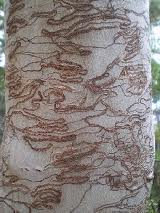
When I first read the poem I immediately thought of my grandchildren and their interpretation of nature and life when they do not relate to any adult understanding. Children, of course, readily make up fanciful stories. The Sribbly Gum along with other eucalypts shed bark leaving quite a beautiful white trunk and insects that create their random scribble then open up a book to be read. Similarly honey can also create interesting language on the trunk of the tree – notice that the ‘words’ are in gold indicating both importance and the link with honey.

This can be seen as nature communicating – and a child or a poet or anyone with imagination can interpret accordingly to their fancy.

And perhaps this is what poetry is all about – an imaginative interpretation of all life. And it must be said that we are part of the natural world too, for so often we seem to separate humanity as something special above environment and other life.

The question is how does nature communicate within its own … and of more importance what is our understanding … it may not be as clear as the scribble on a tree – but it is always there for us to understand, as well as admire the beauty and diversity. And of course when the environment turns sick the message is very clear … how we respond is another matter.

And for those that like to explain everything in life … it is well to recognise that there will always be ‘fairies’ – or just as good! – and we should take a lesson from our children. After all what would life be without the unknown and a little mystery.

Below is an image of the trunk of a Sribbly Gum.

Scribbly Gum 

A link to the background on Douglas Stewart.