... that everybody is trying to understand after unwrapping…
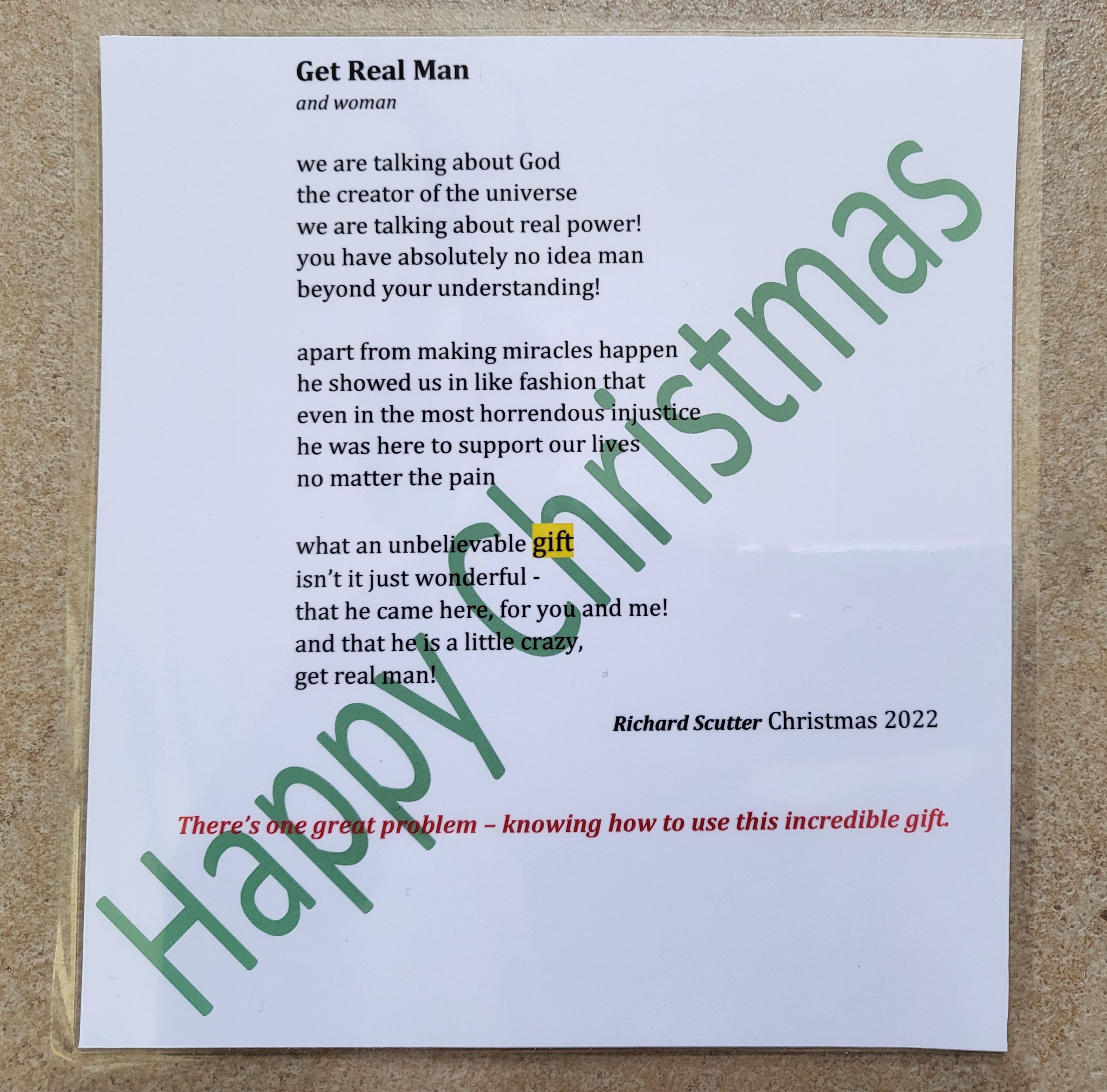
Christmas Greetings
Have a super time with family and friends.

... that everybody is trying to understand after unwrapping…
Christmas Greetings
Have a super time with family and friends.
December 23

A sip and a smoke on the back porch,
then its starts to snow;
it seems the night
has decided to number
its ghosts.

No snowflakes settle; beyond reproach,
all absolved — go, go, —
a cull of light;
as my birthday remembers
its lost.

Carol Ann Duffy (1955 -
December 23

pavlova and BBQ on the beach
the day full of light
and gives warmth
to all the cells
of my now

so many memories have rescinded
like missing snowflakes
that once came to my window
and momentarily settled
before melting away

Richard Scutter
Well interesting that I share a birthday with Carol Ann Duffy. And that she mentions the snow in relation to the passing years as people like ghosts are recalled before fading like disappearing flakes of snow.
It was snowing heavily when I was born. It was so cold, I got quite a shock. I am still recovering.
Along by merry Christmas time

Along by merry Christmas time they buy the aged goose,
And boil the dread plum pudding, because of ancient use.
But to sneer at old time customs would be nothing but a crime,|
For the memory of the Past is all bound up in Christmas time.

Then Jim comes home from shearing, and he puts a few away,
With Dad, perhaps, or Uncle, but they’re right on Christmas Day:
For be it on the Never, or ‘neath the church bells’ chime,
The family gets together, if they can, at Christmas time.

And, after tea at Christmas, they clear the things away
And play the dear old silly games our grand-folk used to play
And Dad gives a recitation that used to be the joy
Of all the Western countryside, when Father was a boy.

Along by merry Christmas time, and ere the week is o’er
We meet and fix up quarrels that each was sorry for.
Our hearts are filled with kindness and forgiveness sublime,
For no one knows where one may be next merry Christmas time.

Henry Lawson (1867 – 1922)
S1 – Christmas is all about remembering the past. The birth of Christ and friends and family that are, or have been, dear to us.
At Christmas we reflect on people that are not with us … always hard to come to terms with loss of the precious in our life. But can love deal with the loss of a recent family member. Here is a poignant poem by Louisa Lawson, the mother of Henry Lawson – A Mother’s Answer – Louisa Lawson | my word in your ear
Henry Lawson’s easy flowing rhymed poem was written in 1913, maybe the plum pudding was not what it is today. An aged goose doesn’t sound attractive either. How many people in Australia are planning to eat goose this year, not exactly a first choice! In fact a meat I have never eaten.
S2 – Christmas is all about bringing family and friends together. And regardless of where the family gather – the Never, Never – the outback, or whether the family congregates at Church together. Food and drink are always to the fore. The variety of food and drink on offer has expanded considerably since I was a boy. And many items that were a luxury for us at Christmas are now commonplace throughout the year.
S3 – Christmas is all about sharing family play. And being accepting of the previous generation in the games they used to play. There are always well-known familiar stories associated with relatives in conjunction with the play. And listening without comment maybe hard for the younger generation, however boring! And when I was growing up music renditions by those who could play, piano and violin from my mother and an uncle come to mind.
S4 – Christmas is all about forgetting squabbles and forgiving. And the last line tells us unequivocally to make the best of the time together; for who knows where family and friends will be next Christmas.
Henry Lawson is best known for being a master of the short story – ‘While the Billy Boils’ – rather than his poetry. Although an Australian theme the Christmas expression in this poem has wide universal association in the Western World.
So what can I say – make the most of this coming Christmas Day.
The Prisoner

I sit by the bars in my cell, in the damp
A lusty young eagle caged up in a cramp.
A suffering comrade down there waves his wing.
And flaps as he pecks at some blood-spattered thing.

He pecks it and drops it, and looks up at me
As if our ideas were in deep sympathy.
His beckoning call and his eyes seem to say
What he wants from me: ‘come on let’s fly away!

We brothers, free birds of the air, let us go!
Where mountains stand white, with the storm clouds below,
Where rolling blue oceans run off to the sky,
Where I can fly free with the wind - he and I!’

Alexander Pushkin (1799 – 1837)
translated by A. D. P. Briggs
Ostensibly a poem about a caged eagle. Representative of Russian oppression and the cruel treatment of Russians in the Stalin era. Seeking flight from such conditions and the beauty of nature outside the cage.
Pushkin is considered by many to be the greatest Russian poet and the founder of modern Russian literature.
Alexander Pushkin on Wikipedia – Alexander Pushkin – Wikipedia
 my word in your ear