International Poetry Studies Institute – Canberra University

An International Poetry Studies Institute has been created at Canberra University.

From Sally Pryor’s article in the Canberra Times (11/5/13) …

… the country’s first research institute dedicated to poetry is now right here in the capital. The International Poetry Studies Institute has just been launched at the University of Canberra, as part of the newly established Donald Horne Centre for Creative and Cultural Research in the Faculty of Arts and Design. For an institute with such a grand title, its ambitions are suitably lofty – to conduct research into poetry and poets, and publish its findings internationally, as a way of “furthering the appreciation and understanding of poetry, poetic language and the cultural and social significance of poetry”.

Paul Hetherington, an associate professor and a Canberra poet, is on the institute’s management team, along with Professor Jen Webb, another published poet.

Hetherington comments … “We think that in Australia in particular, there’s this burgeoning interest in research into creativity, and also there’s a kind of resurgence in poetry all round the world” … and …

“It’s interesting that although poetry may not be a meal ticket for most poets, there’s a great proliferation of people who are interested in writing it and who are writing it. And in Australia … the national and international standing of Australian poetry at the moment is very high. We’ve got a great number of very skilled and important poets in this country, and at the moment it’s an area that’s been under-researched.”

The institute also has an online journal, Axon: Creative Explorations, established in 2011 as the faculty was testing the poetic waters. It now produces two themed editions a year containing poetry, interviews and articles from around the world.

Hetherington states …

“So far, people we’ve talked to have been very enthusiastic about this nationally, but also internationally there’s recognition of the importance of research into creativity and the way poetry exemplifies the creative process

“Poetry presents such interesting and diverse ways of using language, it’s an interesting take and way to just look at language and how we express ourselves, how we understand ourselves.”

Read more: http://www.canberratimes.com.au/entertainment/an-ode-to-verse-20130509-2jabb.html#ixzz2T4HCXgNe

Rugby – A Mysterious Lass : Matt Laffan

Old men dream of her,
her soft touch, her goading eyes that challenged them to
deeds that the men’s wives and women despised.
They remember their youth,
youthful lives with youthful mates
that now are old not young
with old men’s bones and old men’s fates.
Yet she is young, even now,
touching younger men, arousing souls
to burn, a raging fire –
old men’s still glow, with embers and coal.

They see glories gone,
eyelids closed, cobwebs clearing
of crowds and team mates
slapping backs, winks and smiles, and cheering.

They hear comments,
they’re proud to love her
and they see her fondness –
deep in the soul emotion stirs.
Old eyes grow misty,
throats are dry, hearts do ache
they look at hands, once skilled
and then sadly the old men’s heads shake.
Comradeship and pride,
is what she’d taught so well,
and that she still does
as more she enthrals with her spell.

Young men, new men
to be trained and told
how to be a good man, a better man
and learn as did the old.
Some she breaks,
their hearts, their lives and they cry
for she can be brutal, harsh –
for the better she loves the more they’ll try.

Some are her champs,
their names chanted in stadiums, loud
while others are just followers
and held silently proud.
Smell of sweat,
Feelings of ache and strain
on bodies brutally thumped
and jumpers soaked with blood and stains.
Hands passing,
flesh on leather, fluent moves
moving forward for the goal
with boots pounding the sound of thundering hooves.
They play her game,
they win, they lose for many years
and time passes on
as men do laugh and shed some tears.

Rivals meet,
they play hard against each other
to be the best in her eyes
and always try to beat their brother.
But in the end,
the men are all as one,
they are all lovers of the woman,
like thousands under the sun.
Many she’s caressed
in her endless global walk
and young men grow old
and of her and their love they talk.

Lovely woman,
A mystical ghost touching deep
within, her men –
to her side they’ll keep.

Matt Laffan 24 September 1985

My comments follow …

S1 … Do men love sport more than woman? … what a silly question – however, sport does take men away from women or attending other activities. But this poem is clearly about rugby being a woman … and of course an eternally young lass that will continue to arouse men. Rugby is remembered as an old man remembering a young woman. An interesting last line – old men’s still glow, with embers and coal – not old men still glow … I quess because the old men are still now.

S2 … old men have to close their eyes to see things … well things from the past – the glory days when they were involved.

S3 … the deep emotional attachment to the game … and the lament that they can no longer play the game looking at hands that no longer can perfom. But they are proud that they once loved the game (the young woman) and what the game gave in  comradeship and what the game continues to give as woman will continue to entrall men with their spell.

S4 … and now a reflection on what the game gives to young men taking up rugby … rugby teaches man to be better … likewise woman of course … the last line has a nice pun play on the last word … rugby is all about trying.

S5 … looking at the game from the game’s point of view … or the view of the game as personified by the young lass … some are her champs and some are just followers … and there is a lot of blood sweat and tears in the foundation of the relationship … and here we have the very physical aspects … to play her game it must be boots and all … and of course there are laughs and tears, winners and losers.

S6 … well, of course there are rivals and competition … but it is all clean fun … they are all lovers of the game and respectful of the game … thousands world wide lovers of this woman

S7 … I rather like the closing stanza … men only part of the game … they’ll keep … woman (and rugby of course) must always put men in proper perspective.

A wonderful poem about rugby the irony of the situation in that he could never play the game. He had a serious disability and was confined to a wheelchair for most of his life and died aged 38. He had a brilliant interlect … a link to some personal details.

ANZAC Day in Australia

Today is ANZAC Day in Australia

 OLYMPUS DIGITAL CAMERA

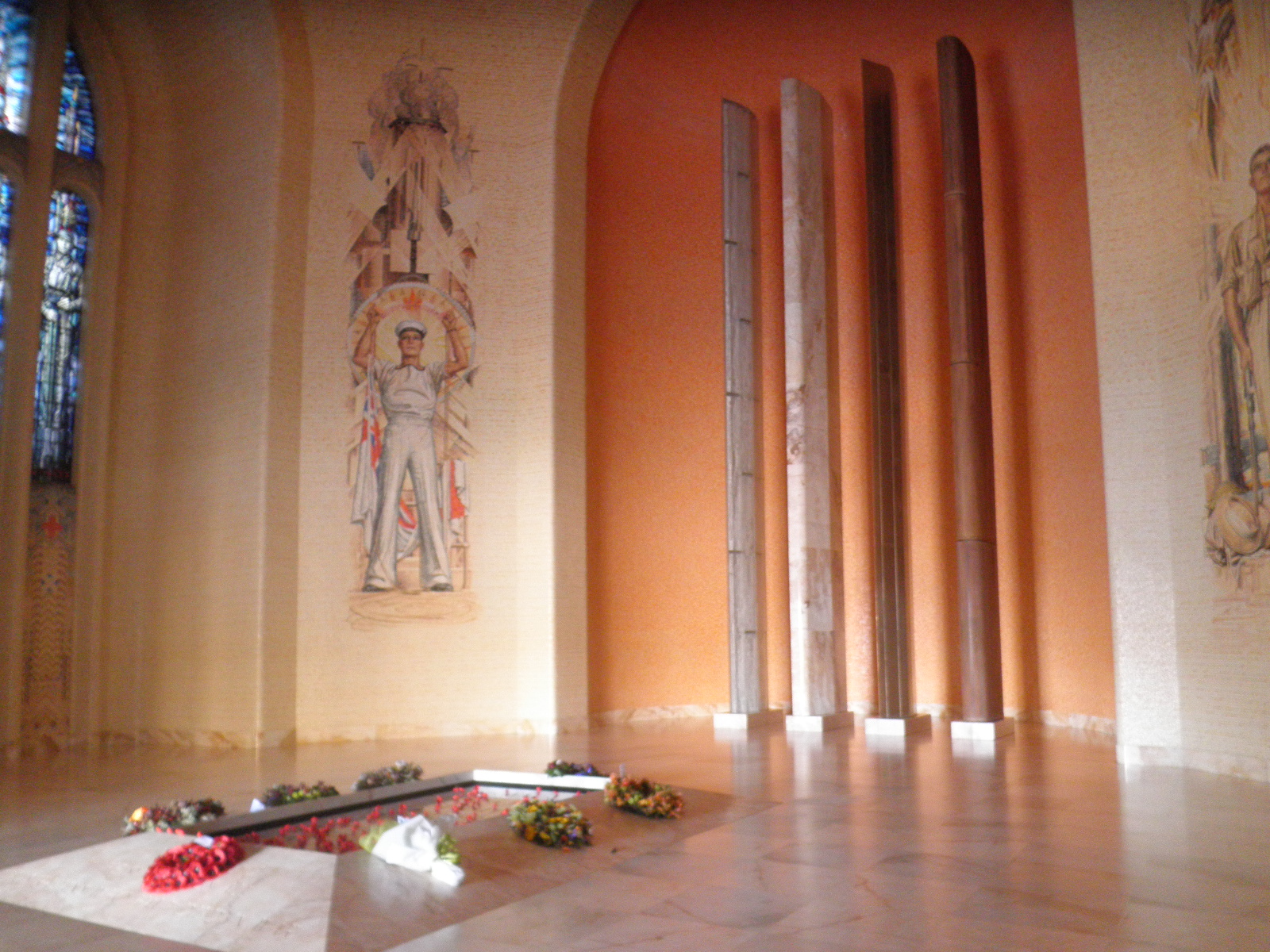
The Australian War Memorial
Hall of Memories
Tomb of the Unknown Soldier
The four basic elements as pillars1

Plaque outside the Australian War Memorial

 OLYMPUS DIGITAL CAMERA

Commemorating the spot of the planting of the first
tree of the remembrance driveway to Sydney
by Queen Elizabeth II in February 1954.

Footnote1

The Earth pillar is made of marble and has associations with permanence and endurance, physical structure and the coldness of death.

The metal pillar symbolizes Fire; it is associated with energy and passion, patriotism and bravery.

The wooden pillar symbolizes Air; its polished surface is associated with disembodied spirit and the souls of the dead.

The Water pillar is made of glass, ice-like and colorless. It is linked with the flow of change and transfiguration and the souls of the living.

Words like tree

words like tree
give a recognition
grown by love
from the breath of God
that stirred still waters
came the first seed
into soft earth
to be fired by the sun

we remember an unknown life
how life came
the four great pillars of truth
of a life that is no more
of a life that lives again
of life that lives forever

Richard Scutter 25 April 2013

Link to Australian War Memorial Website

The Wattle Tree – Judith Wright

-Oh that I knew that word!
I should cry loud, louder than any bird.
Oh let me live forever, I would cry.
For that word makes immortal what would wordless die;
and perfectly, and passionately,
welds love and time into the seed,
till tree renews itself and is forever tree –

Then upward from the earth
and from the water,
Then inward from the air
and the cascading light
poured gold, till the tree trembled with its flood.

Now from the world’s four elements I make
my immortality; it shapes within the bud.
Yes, now I bud, and at last I break
into the truth I had no voice to speak:
into a million images of the Sun, my God.

From The Two Fires 1955
The Collected Poems

© Judith Wright

The four prime elements (earth, water, air and fire) … are needed by the tree … (and define the world). But what is this process (love and time) that creates ‘a voice’ from a seed … oh that it could be known … the key to immortality.

In the beginning was the word … the start of the process … a never ending process as the tree continues to renew itself … regeneration … immortality … for the wattle the transformation is to a ‘flood of gold’.

Like the tree … in likewise fashion to nature … JW defines her immortality … and like the wattle to the myriad images of the sun … her metaphorical God … the truth could not be expressed by her voice (but perhaps by her poetry … and perhaps by becoming her ‘natural self’).

The wattle tree that JW is talking about is the Cootamundra Wattle a ball of gold in spring. The poem was written in 1955 when Judith Wright was starting to become recognised.

Note … the four prime elements are shown as columns of different materials at the back of the Hall of Memories at the Australian War Memorial in Canberra … behind the tomb of the unknown soldier.

Varadero en Alba – Richard Blanco – Commentary

Here is another poem from Richard Blanco – ‘Varadero at Dawn’ taken from his Website. This is a very different poem from the inauguration poem which may have been constrained by the guidelines for producing that work. This poem is very personal and is based on his visit to Varadero beach in Cuba where his father came from.

First RB’s own comments about this poem …

According to my parents, Miami Beach was a filthy, ugly beach. There was no beach in the world that could even compare to their beautiful Varadero in Cuba. I never believed their nostalgic chatter, until I saw Varadero for the first time during my first visit to Cuba. This poem is about my encounter with that landscape at sunrise and memories of my father. The stanzas in Spanish were written first, then the English stanzas, which are a kind of response echoing similar images, but are not direct translations. They are reflections of each other, responses of how my two “halves”–the Spanish and English-experienced Varadero.

 Here are the Spanish lines that head each of three distinct numbered stanzas. The English translation in italics is via a friend …

Varadero en Alba
Varadero at Dawn

i ven
tus olas roncas murmuran entre ellas
las luciérnagas se han cansado
las gaviotas esperan como ansiosas reinas

you come
your roaring waves whisper among themselves
the fireflies are exhausted
the seagulls wait like anxious queens

ii ven
tus palmas viudas quieren su danzón
y las nubes se mueven inquietas como gitanas,
adivina la magia encerrada del caracol

you come
your empty palms want their dance
and the clouds move like restless gypsies
figure out the magic locked inside the seashell

iii ven
las estrellas pestañosas tienen sueño
en la arena, he grabado tu nombre,
en la orilla, he clavado mi remo

you come
the blinking stars are sleepy
on the sand, I have printed your name
on the shore, I have wedged my oar

My comments on the Spanish –

S1 RB has made a special visit to go to the beach of his father … waves whispering is appropriate (father talking)  …  the fireflies never ending activity and the seagulls dominate the scene … they are anxious queens … perhaps because in the next stanza we find the clouds are ready to shake the palms … seagulls are only queens the weather is king

S2 … clouds = gypsies (wanderers that carry all with them) … figuring magic hidden in shells – perhaps thinking of his family history and Cuban culture

S3 …morning is coming and stars are dying … strong personal identity and link with his father … wedging an oar – equating to personal direction – oar controls journey and linking RB symbolically to his father.

Below is the full poem with the English reflections and at the end my comments on the English text.

Varadero en Alba

1 … ven
tus olas roncas murmuran entre ellas
las luciérnagas se han cansado
las gaviotas esperan como ansiosas reinas

We gypsy through the island’s north ridge
ripe with villages cradled in cane and palms,
the raw harmony of fireflies circling about
amber faces like dewed fruit in the dawn;
the sun belongs here, it returns like a soldier
loyal to the land, the leaves turn to its victory,
a palomino rustles its mane in blooming light.
I have no other vision of this tapestry.

2 … ven
tus palmas viudas quieren su danzón
y las nubes se mueven inquietas como gitanas,
adivina la magia encerrada del caracol

The morning pallor blurs these lines:
horizon with shore, mountain with road;
the shells conceal their chalky magic,
the dunes’ shadows lengthen and grow;
I too belong here, sun, and my father
who always spoke paradise of the same sand
I now impress barefoot on a shore I’ve known
only as a voice held like water in my hands.

3 … ven
las estrellas pestañosas tienen sueño
en la arena, he grabado tu nombre,
en la orilla, he clavado mi remo

There are names chiselled in the ivory sand,
striped fish that slip through my fingers
like wet and cool ghosts among the coral,
a warm rising light, a vertigo that lingers;
I wade in the salt and timed waves,
facing the losses I must understand,
staked oars crucifixed on the shore.
Why are we nothing without this land?

My comments on the English –

S1 RB is a gypsy in the way he is travelling the Island  villages like ripe fruit folded in the tropical scene … the fireflies are in harmony with the dawn light = dew on fresh fruit … the sun belongs and is returning and RB the son is returning to this sacred place – loyal like a soldier.

S2 … the blurred lines of morning equate to the blurred lines of knowing this family place for the first time … but here RB emphatically states that he belongs here by making an imprint on the sand (and of course he is involved with words and print) … before the voice was like holding water in the hand – he has never known this place – till this day

S3 …perhaps reflecting on family that have identity with the beach … chiselled = and perhaps their occupation was associated with the beach (fishing?) … he feels dizzy with these thoughts in the brightening morning … he immerses in the sea … the timed waves and with full focus on his ancestry trying to understand lose of those he has known and understand his own being … and then a concocted word ‘crucifixed’ implies crucified and fixed … the situation cannot be changed … and then reflecting – why is this land is so important to our history.

Here is the link to Richard Blanco’s site which includes a reading of this poem –
http://www.richard-blanco.com/city-of-a-hundred-fires/varadero-en-alba.php

One Today – Richard Blanco – Commentary

Below is Richard Blanco’s poem written for the second inauguration of Obama with my comments in italics after each of the nine stanzas. 

One Today

One sun rose on us today, kindled over our shores,
peeking over the Smokies, greeting the faces
of the Great Lakes, spreading a simple truth
across the Great Plains, then charging across the Rockies.
One light, waking up rooftops, under each one, a story
told by our silent gestures moving across windows.

S1 – The start of the day from the outside determined by the sun and ‘kindled’ is an appropriate word for the sun is fire and you could consider dawn as the breaking of fire on the world … links nicely in the second line with  the Smokies (I take it these are mountains with this name). The sun is simple and true – at least from most peoples perspective (unless you are a studier of sunspots) … truth and plain link nicely … and light can suddenly charge across landscape even such rugged mountains as the Rockies … and it does of course wakeup the world – the roof top world that is open to light … and then the reflection coming down to what cannot be clearly seen – to the people within that silently move … seen only as blurred shapes from the outside – gestures (a movement of part of the body to express meaning) … but each person has a story – a hidden story akin to being hidden from the light of the sun. Herein lies the theme that of oneness and of being inclusive.

My face, your face, millions of faces in morning’s mirrors,
each one yawning to life, crescendoing into our day:
pencil-yellow school buses, the rhythm of traffic lights,
fruit stands: apples, limes, and oranges arrayed like rainbows
begging our praise. Silver trucks heavy with oil or paper —
bricks or milk, teeming over highways alongside us,
on our way to clean tables, read ledgers, or save lives —
to teach geometry, or ring up groceries as my mother did
for twenty years, so I could write this poem for all of us today.

S2 … movement to specific detail to personal lives as though the sun can now pierce into this world … the common routines … the increase in momentum – crescendo … and now we see such detailed specific colours as the rainbow of different fruits … people are not merely gestures they are now in action – with a personal reflection on the occupation of RB’s mother for many years and the goal for her son.

All of us as vital as the one light we move through,
the same light on blackboards with lessons for the day:
equations to solve, history to question, or atoms imagined,
the “I have a dream” we all keep dreaming,
or the impossible vocabulary of sorrow that won’t explain
the empty desks of twenty children marked absent
today, and forever. Many prayers, but one light
breathing color into stained glass windows,
life into the faces of bronze statues, warmth
onto the steps of our museums and park benches
as mothers watch children slide into the day.

S3 … We are all integrated through the light of our existence. That light is vital as vital as we are to each other. And now consider children learning through that light and as children we all have a dream, a future – ambitions – but then there is that reference to the slaughter of twenty children where there are no words for those caught in grief … and perhaps the dream is on hold … but the one light (akin to the one God) is an answer to prayer breathes life (colour) and warmth into the inanimate – and perhaps recovery to those in grief (likened to bronze statues)– or generally for those in need of a response to their prayer – note stained glass has church and religious connotations. And at the detailed level a mother watches a child slide into the day – slide into life … a reference to play and playground and early years.

One ground. Our ground, rooting us to every stalk
of corn, every head of wheat sown by sweat
and hands, hands gleaning coal or planting windmills
in deserts and hilltops that keep us warm, hands
digging trenches, routing pipes and cables, hands
as worn as my father’s cutting sugarcane
so my brother and I could have books and shoes.

S4 … We are integrated by one ground as well as one light and that ground has a direct personal relationship through occupation and through using resources for personal benefit of food and warmth … and the ground carries our life through infrastructure which we mould into the ground … and at the detailed level a reference to the poet’s father who cut sugarcane to benefit the poet (the dream of the father – education for his children).

The dust of farms and deserts, cities and plains
mingled by one wind — our breath. Breathe. Hear it
through the day’s gorgeous din of honking cabs,
buses launching down avenues, the symphony
of footsteps, guitars, and screeching subways,
the unexpected song bird on your clothes line.

S5 … One light, one ground and now one wind. At the personal level we all breathe the one substance exhale and inhale … one human wind – we hear it through the sounds of busy city life (gorgeous din – din that can also be seen as gorgeous) and then in the unexpected – an example, the song of a bird on a clothes line.

Hear: squeaky playground swings, trains whistling,
or whispers across cafe tables, Hear: the doors we open
each day for each other, saying: hello, shalom,
buon giorno, howdy, namaste, or buenos días
in the language my mother taught me — in every language
spoken into one wind carrying our lives
without prejudice, as these words break from my lips.

S6 … One wind carries the sounds of life … communicates without prejudice … it does not matter what language … and again we have a personal reference to the words of RB’s mother.

One sky: since the Appalachians and Sierras claimed
their majesty, and the Mississippi and Colorado worked
their way to the sea. Thank the work of our hands:
weaving steel into bridges, finishing one more report
for the boss on time, stitching another wound
or uniform, the first brush stroke on a portrait,
or the last floor on the Freedom Tower
jutting into the sky that yields to our resilience.

S7 … One sky in which both the natural world and the created world exist … a thank you to this twofold creativity … from the smallest work to the Freedom Tower and the importance of what this building represents to Americans.

One sky, toward which we sometimes lift our eyes
tired from work: some days guessing at the weather
of our lives, some days giving thanks for a love
that loves you back, sometimes praising a mother
who knew how to give, or forgiving a father
who couldn’t give what you wanted.

S8 … One sky again, which we look too away from work … in contemplation  … guessing the weather … but reflecting on this in relation to how we have been weathered in life … a thank you to love … a thank you to our parents despite any shortcomings.

We head home: through the gloss of rain or weight
of snow, or the plum blush of dusk, but always, always — home,
always under one sky, our sky. And always one moon
like a silent drum tapping on every rooftop
and every window, of one country — all of us —
facing the stars
hope — a new constellation
waiting for us to map it,
waiting for us to name it — together.

S9 … we head home at the end of the day … all heading home … in different weathers (note the flow on of the weather metaphor from the previous stanza) … but we all head home … one silent moon just tapping on the rooftop … no one hearing – compare with the sun’s early rays in the first stanza … first light on rooftops and the windows hiding movement … gestures in the awaking day … but now it is the end of the day … all of the nation facing the stars – the brights in the dark … and it is up to us to map together, a new future.

A link to Richard Blanco’s Website … on this site you can hear Richard Blanco’s reading of this poem at the Inauguration.

Be inspired by Christ

On this Easter day.

in celebration

of this ever-living day

we again give thanks

Be inspired by Christ

be inspired by Christ
live by his ever-living example
that in your own life
you too may become Christ-like

and maybe somewhere someone in need
will be inspired by the Christ in you
that you will come alive
in the Christ of another

Richard Scutter 5 Jan 2013

The Breaking of the Drought

there is a certain feeling to the day
that something will happen

the air massing with no colour to the sky
sifting itself inside out in turmoil
but the cloud disperses
dissipating expectation

the sun is quick to return
stretches headstrong to the horizon
hard pressing its flat horror
the stunted scrub squeeze-dried

bent over double in submission
the ghost wrap of the winter crop
rattles its dead prayers to the wind
his harvester idle for the season

the long wait begins again
that endless wait for change
day after day of disciplined ritual
waiting for a break in the heavens

and in the tomorrow that never came
at dawn in the patched shadow
with the sky groping to contain itself
he walked to the back shed

a sudden, sharp crack-echo
the air shocked still,
and it is over –

too soon the family will find
and then the endless cry

Richard Scutter 11 November 2007

This poem was published in ‘Voices from the Valley’ the 2012 anthology of stories and verse by the Yass Valley Writers – 2012. It was written at the peak of the drought.