Lovesick – Carol Ann Duffy – Analysis

Lovesick

I found an apple
A red and shining apple
I took its photograph

I hid the apple in the attic
I opened the skylight
and the sun said Ah!

At night I checked that it was safe,
under the giggling stars,
and the sly moon. My cool apple.

Whatever you are calling about,
I am not interested.
Go away. You with the big teeth.

Carol Ann Duffy

Well, I am sure you have been in love and perhaps you can remember that first time. Can you remember that new found feeling – a red shining apple and how it affected your demeanour. Maybe it was something so personal you wanted to keep forever (by taking a ‘photograph’ if you could photograph a feeling). And being a little shy you probably wanted to keep this lovesickness hidden. You had to open up to your surroundings with this joy. The sun of course new and said Ah. And at night time you could bathe in this sickness with delight – such a delight to be in love! – so cool under the giggling stars. A female perspective of the situation is evident. But let’s face it friends and family might just happen to see any change exhibited from your new found happiness state!

But this love sickness, this little euphoria, is very vulnerable. The actual presence and development of a new relationship will destroy or should I say cure any mental heaven – especially if your lover has big teeth.

No other fruit but an apple!

If we consider Estella and Pip from Charles Dickens’ Great Expectations then Pip had a very red apple. And even on continual meetings when Estella snubbed his advances he was not perturbed and was quick to convert a greening apple back to red as soon as he was away from her presence. Love can be so mental, so individual.

This is a totally brilliant poem from Dame Carol Ann Duffy who was appointed Britain’s Poet Laureate in May 2009. Here is a Wikipedia link … https://en.wikipedia.org/wiki/Carol_Ann_Duffy
 

The Fly – William Blake – Analysis

The Fly

Little Fly,
Thy summer’s play
My thoughtless hand
Has brushed away.

Am not I
A fly like thee?
Or art not thou
A man like me?

For I dance
And drink, and sing,
Till some blind hand
Shall brush my wing.

If thought is life
And strength and breath
And the want
Of thought is death;

Then am I
A happy fly,
If I live,
Or if I die.

William Blake (1757 – 1827)

A five-stanza poem with a dancing careless rhythm that fits well with the ending in the last lines, the first four stanzas are ‘abcb’ and the final stanza ‘aabb’. The short lines reflect the nature of passing life and the poem itself perhaps produced from a passing thought when disturbed by an annoying fly.

The subject is life, nature, existence and death with a comparison between the fly and man. Blake controls the life of a fly that came to close just as fate, God or luck could equally determine the fate of Blake.

The poem concerns thought and action. Thoughtless action can cause death. Will some blind hand deal with Blake in the same way that Blake deals with the fly?

Thought always motivates action no matter how fleeting a thoughtless response. Thought dominates life. If life is totally in the mind then it is a happy life free from worry when the mind is so developed.

William Blake on Wikipedia

The Red Cockatoo – Po Chu-I – Comments

The Red Cockatoo

Sent as a present from Annam –
A red cockatoo,
Coloured like the peach-tree blossom,
Speaking with the speech of men.
And they did with it what is always done
To the learned and the eloquent:
They took a cage with stout bars
And shut it up inside.

Po Chu-I (772 -846)
Translated by Arthur Waley

Annam – the southernmost province of China

This eight line Chinese poem is divided into two distinct components each of four lines. I would prefer to see a blank line between the change to give sufficient pause. A distinct image is taken and presented to the reader. A present from a foreign land, a spectacular bird visually and red being so appropriate to the theme of the poem. And a bird that relates to mankind – speaking with the speech of men –this line is the link to second part.

The outcome of the gift is stated – what happens to the bird, what happens to the words of the learned and the eloquent. Mankind suppresses and the gift is caged and is not appreciated and freedom lost. This simple poem makes a powerful statement so often defining the unfortunate plight of mankind but hopefully not what is always done. I am reminded on what happened to Nelson Mandela.

Some information on Po Chu-I – apparently he tested the accessibility of his work by ensuring it was understood when presented to an old country woman … see the following … http://www.hyperhistory.com/online_n2/people_n2/persons4_n2/po.html

and another Blog Site on this poem …
http://margaret-cooter.blogspot.com.au/2014/10/poetry-thursday-red-cockatoo-by-po-chu-i.html

The Express – Stephen Spender – Commentary

The Express

After the first powerful, plain manifesto
The black statement of pistons, without more fuss
But gliding like a queen, she leaves the station.
Without bowing and with restrained unconcern
She passes the houses which humbly crowd outside,
The gasworks, and at last the heavy page
Of death, printed by gravestones in the cemetery.
Beyond the town, there lies the open country
Where, gathering speed, she acquires mystery,
The luminous self-possession of ships on ocean.

It is now she begins to sing — at first quite low
Then loud, and at last with a jazzy madness —
The song of her whistle screaming at curves,
Of deafening tunnels, brakes, innumerable bolts.
And always light, aerial, underneath,

Retreats the elate metre of her wheels.
Streaming through metal landscapes on her lines,
She plunges new eras of white happiness,
Where speed throws up strange shapes, broad curves
And parallels clean like trajectories from guns.

At last, further than Edinburgh or Rome,
Beyond the crest of the world, she reaches night
Where only a low stream-line brightness
Of phosphorus on the tossing hills is light.
Ah, like a comet through flame, she moves entranced,

Wrapt in her music no bird song, no, nor bough
Breaking with honey buds, shall ever equal.

Stephen Spender (1909 – 1995)

S1 … manifesto – a declaration, a platform – fitting for this poem
She is a queen gliding slowly as movement starts without fuss or ceremony she leaves the station … as passengers we all know that sensation as the train starts to move … passing the gasworks reminds me of taking the train from Waterloo to the country, there was always that prominent feature … the heavy page of death printed by gravestones … another memory of the journey and death seen as a heavy page is so appropriate as a metaphor considering the gravestone inscriptions … and beyond the town there is the mystery of the beyond, especially relevant for those taking the journey for the first time … she is now a ship on the ocean of discovery as she gathers speed and she starts to know herself (self-possession … a growing in confidence)

Do you think the change of metaphor adds or detracts?

S2 … fewer lines, S1 was the slow start needing more lines … she is now a jazzy singer as she speeds along carefree with all the noises of her motion as she negotiates curves and tunnels and applies her whistle … (tis but the freedom of unrestrained youth)

S3 … she knows her way … where she is going is pre-determined (but perhaps not so for all of us who journey without such direction) … and she is happy as she plunges new areas of white happiness … and she moves like being fired from a gun … (well I guess we are all happy when fully focused and speeding along towards our goals)

S4 … this Express train is going some distance! … and as night comes you can see her disappearing in the fading light like a comet through the hills and emotionally entranced (an interesting state of mind for the ending of her journey … she knows where she is going in the dark … beyond the crest of the world)

S5 … and again ending in song … a song that is totally hers – beyond nature her creation and she appears to be in some state of ecstasy … (well what a way to end in such happiness as her journey perhaps continues to unknown places)

The glorification of the peronified train as it makes its journey … a symbol of modern travel and industrial achievement and perhaps that of life too from a slow beginning to a happy end … if you stay on the tracks of course!

Here is a link to Stephen Spender on Wikipedia … https://en.wikipedia.org/wiki/Stephen_Spender


Portrait of a Machine : Louis Untermeyer

Portrait of a Machine

What nudity as beautiful as this
Obedient monster purring at its toil;
These naked iron muscles dripping oil
And the sure-fingered rods that never miss.
This long and shining flank of metal is
Magic that greasy labour cannot spoil;
While this vast engine that could rend the soil
Conceals its fury with a gentle hiss.
It does not vent its loathing, it does not turn
Upon its makers with destroying hate.
It bears a deeper malice; lives to earn
It’s masters bread and laughs to see this great
Lord of the earth, who rules but cannot learn,
Become the slave of what his slaves create.

Louis Untermeyer

A sonnet … abba / abba /ababab … the machine is personified … two important attributes compared – beauty and power

The first eight lines show the machine as an untiring body with the beauty of its created components compared to muscles, fingers, and flank. The purring voice never faltering. The power of the machine far out weighing the physical capability of the mere creator.

The last six lines then reflect the non-emotional characteristic of the inanimate object but there is a subtle twist for the machine may have the last laugh – the question on the effect it has on its creator … does the creator become a slave to his or her creation?

I remember years ago visiting the Rowntrees Chocolate factory in York and watching girls taking deformed smartees from the production line. I guess that nowadays this would be an automated process.

From Wikipedia … Louis Untermeyer (October 1, 1885 – December 18, 1977) was an American poet, anthologist, critic,[and editor. He was appointed the fourteenth Consultant in Poetry to the Library of Congress in 1961.

https://en.wikipedia.org/wiki/Louis_Untermeyer

… and perhaps an appropriate time for a New Year’s resolution … for the Internet may well laugh at us if we spend all our time absorbed in this activity … well, time for a cup of tea …


Digging – Seamous Heaney – Analysis

Digging

Between my finger and my thumb
The squat pen rests; snug as a gun,

Under my window, a clean rasping sound
When the spade sinks into gravelly ground:
My father, digging. I look down

Till his straining rump among the flowerbeds
Bends low, comes up twenty years away
Stooping in rhythm through potato drills
Where he was digging.

The coarse boot nestled on the lug, the shaft
Against the inside knee was levered firmly.
He rooted out tall tops, buried the bright edge deep
To scatter new potatoes that we picked,
Loving their cool hardness in our hands.

By God, the old man could handle a spade.
Just like his old man.

My grandfather cut more turf in a day
Than any other man on Toner’s bog.
Once I carried him milk in a bottle
Corked sloppily with paper. He straightened up
To drink it, then fell to right away

Nicking and slicing neatly, heaving sods
Over his shoulder, going down and down
For the good turf. Digging.

The cold smell of potato mould, the squelch and slap
Of soggy peat, the curt cuts of an edge
Through living roots awaken in my head.
But I’ve no spade to follow men like them.

Between my finger and my thumb
The squat pen rests.

Seamous Heaney

S1 and S2 …His father was skilled at the use of the spade in the garden. SH compares his poetic skill in contrast … and he fires away in the opening lines – snug as a gun. At the same time he can watch the work of his Father from the window. He incorporates this distraction into words … it is as though Father and Son are working together each dedicated and focused.

S3 and S4 … However, when his straining rump comes up twenty years away there is indication that this is a reflection … so the words may not be coming directly from his seated position looking out the window as his Dad works but from memory. And the picking of the potatoes – to scatter new potatoes that we picked … perhaps he is recalling when as a child he helped in the garden. (The lug is the shoulder of a spade)

What is clear is the digging skill of his Father and Grand-father. And emphasied by the two lines and exclamation in stanza five.

S6 and S7… And in comparison with others his Dad was quite a champion at digging and when interrupted and given a drink he is quick to take up work again … a momentary break – as indicated by the break between stanzas six and seven. Repetion gives emphasis to his focus on digging.

S8 … The next stanza gives sensual feeling to this family digging work, both smell and sound. Digging goes deep into family history connecting the two with his words – the curt cuts of an edge through living roots. But this type of work is not for SH.

S9 … A repeat of words from S1 – the squat pen rests. Squat gives weight to his implement to contrast with the spade where the foot is replaced by the finger.  Seamous Heaney was as dedicated to poetry as his past family were to digging. Poetry was a new branch to the family tree. And of course he truly becme a well-respected champion at his art.

In this poem SH states his calling and gives emphasis that he is taking a different path from previous generations, and perhaps the expectation of family. He solidly makes known his calling with this wonderful example of his poetic skill.

It is great if a person knows what they should be doing in life and follows it even though it might be very different and against tradition and against family opposition.

Nasturtiums – Margaret Scott – Analysis

Nasturtiums

The nasturtiums are sprouting in hundreds
across the garden. Each seed puts down
a succulent white root, thrusts up a stalk
with two small neat round leaves, winsome
and vividly-green as those comic-book plants
dotted among a child’s party of frogs.
I feel like a cruel old witch when I yank them out,
but left to themselves they swell to monstrous mounds –
turtles with heaving shells of soft green platelets
simmering mobs of pale-eyed parasols
shaken by a raucous babble of lurid shrieking
more dreadful in lying low in venomous silence.
Sniggering flowers peak out – orange and mustard
some yolk-yellow with throats as brown as hyenas
or bad teeth, some paler as bulbous foreheads
and dwarfish scowls. They have blood on their chins
and spiky hair on their lips. What a crop!
What a nest of serpents. What can have rotted down
in this mild garden to feed these hysterical leaves
and malevolent blossoms?

Margaret Scott (1934 – 2005)

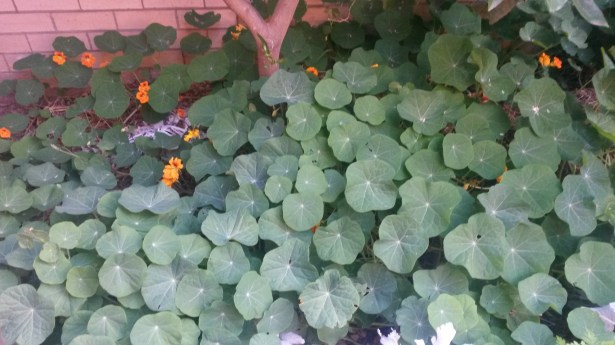
I can identify with this poem strongly as my garden is often overrun with these creatures and they do seem to have a liking for the compost area. But I must say they do provide a cover for a lot of sins. Below is a photograph taken from my garden which clearly demonstrates their dominance if left unchecked …

Nasturtiums

It also illustrates how well the words of the poem fit the reality of the plant and they are certainly a veritable mound of turtles with heaving shells of soft green platelets. And the flowers have blood on their chins and spiky hairs on their lips. All flowers have a face and are pretty and some are prettier than others. This poem with the strong personification gives clear evidence that the poet is a gardener who has done conflict with this plant on numerous occasions. They do grow so quickly and no matter how much you yank them out they will be sure to turn up again.

Margaret Scott does not mention the distinctive scent which I always find a touch antiseptic and not quite pleasant – nor the fact they have decorative and edible properties.

MS was an Australian author, poet, comedian, educator and public intellectual.

Margaret Scott on Wikipedia … https://en.wikipedia.org/wiki/Margaret_Scott_(author)

Remembering Sylvia … ‘Poppies in October’ …

Remembering Sylvia Plath who would have been 85 today …

Poppy

Poppies in October

Even the sun-clouds this morning cannot manage such skirts.
Nor the woman in the ambulance
Whose red heart blooms through her coat so astoundingly –

A gift, a love gift
Utterly unasked for
By a sky

Palely and flamily
Igniting its carbon monoxides, by eyes
Dulled to a halt under bowlers.

Oh my God, what am I
That these late mouths should cry open
In a forest of frosts, in a dawn of cornflowers.

Sylvia Plath (1932 – 1963)

Analysis …

Nothing in sun and sky can match the poppy skirts (petals) in their colour … nor the woman (reference to herself) in the ambulance whose red heart is amazingly kept alive … the woman close to death … others not so lucky … she has been rescued and will survive.

This late showing is out of context with the season … and is a gift unasked for …and in this regard, SP could be talking about her astoundingly good luck in surviving her earlier suicide attempt … her red heart did bloom … how come she was saved? … how come she was given a second chance? … SP did not ask for this … to be re-born … at least she acknowledges this gift as a ‘love-gift’ … even if she is not thankful.

… the action of the heart – ‘igniting its carbon monoxides’ (carbon monoxide has a stronger bind to haemoglobin than oxygen) … igniting – coming alive again … the medicos that saved her did not know her … see her red passion, her emotional state … how could they … they wear bowler hats … head-centric on their work

… and then the lament of not knowing who she is … the poppy in October … out of context … but still alive … she cries aloud for some understanding … why should she be alive in a ‘forest of frosts’ (in a deep tangle where growth is unlikely – how she saw her life) and in a ‘dawn of cornflowers’ (emerging against the bland mass of the common … a little arrogance perhaps)

… this poem was written on SP’s last birthday (27 Oct 1962) … her 30th birthday … at a time when she was living by herself (with the two children) in London – separated from Ted Hughes … she also wrote another poem ‘Ariel’ on the same day … so she had time to herself on this day to devote to poetry … and to question her existence … to question why she has survived out of season (like the poppy) … and to ask why she is still alive … and inferred – why is live so hard … it is a cry for an explanation from the deep intensity of her being for a meaning in her troubled world … questioned in a state of mental unrest..

… and whether any physical poppies were around on this her birthday is open to question … they could be mind-poppies … (refer also to a previous poem ‘Poppies in July’ written in Devon in the summer … when times were different.)

Here is a link to a recommended Site with 10 years of discussion material on the work of Sylvia Plath …
http://www.sylviaplathforum.com/

Here is the text of the interview with Sylvia Plath by Peter Orr (of the British Council) – recorded on 30 October 1962 (just after her 30th birthday) … Interview Sylvia Plath 30 Oct 1962 …
http://www.english.illinois.edu/maps/poets/m_r/plath/orrinterview.htm

Footnote

… during the Autumn of 1962 SP was at a poetic high producing some of her best work … the irony of the situation that although given a second life after her first suicide attempt and although adjusting to her new life without TH it would not be that long before she would succumb to sever depression and a fatal suicide. There would be no second ‘Lazarus‘.

… the poppy image was from the Australian spring taken at an open garden.