In the Bleak Mid-Winter – Christina Rossetti

A Christmas Carol

In the bleak mid-winter
Frosty wind made moan,
Earth stood hard as iron,
Water like a stone;
Snow had fallen, snow on snow,
Snow on snow,
In the bleak mid-winter
Long ago.

Our God, Heaven cannot hold Him
Nor earth sustain;
Heaven and earth shall flee away
When He comes to reign:
In the bleak mid-winter
A stable-place sufficed
The Lord God Almighty,
Jesus Christ.

Enough for Him, whom cherubim
Worship night and day,
A breastful of milk,
And a mangerful of hay;
Enough for Him, whom angels
Fall down before,
The ox and ass and camel
Which adore.

Angels and archangels
May have gathered there,
Cherubim and seraphim
Thronged the air –
But only His mother
In her maiden bliss
Worshipped the Beloved
With a kiss.

What can I give Him,
Poor as I am?
If I were a shepherd
I would bring a lamb;
If I were a wise man
I would do my part;
Yet what I can, I give Him –
Give my heart.

Christina Georgina Rossetti (5 December 1830 – 29 December 1894)

Christina Rossetti was asked to write a Christmas poem for a magazine and so she had to consider the audience and clearly she has stayed true to the traditional Christmas story. And quite clearly she has but poetic thought in creating five eight line stanzas with rhyme and rhythm. So much so that her words have been used to create one of the most popular Christmas carols and the first line ‘in the bleak mid-winter’ has become well known.

S1 – she lived in London so snow and a winter Christmas was synonymous. Winter is always an appropriate setting for the coming of Christ … for the birth of redemption in a cold hard bleak world. And looking back on 2015 it doesn’t take much to see that a little bleakness is in evidence.

S2 – in this stanza there is an interpretation of biblical passages so Christina must have been familiar with her bible – the first four lines of the stanza are questioned in the analysis in Wikipedia (see the footnote below) … the lines ‘Heaven and earth shall flee away / When He comes to reign’ suggest a second coming – but who has any idea how this will manifest itself! Perhaps a daughter will be sent next time, that would show a nice balance between the sexes.

S3 – I have always liked the humble beginnings and the makeshift environment for the arrival of the most powerful entity imaginable.

S4 – of all the people and paraphernalia around the stable it is the mother Mary who truly worships the new born with a kiss. Whether or not He cried when He was born we do not know – perhaps it would be quite poetic and very appropriate if he had.

cherubim = angel, chubby-faced child
seraphim = an angel of the highest order of nine rankings

S5 – this shows a personal identity with Jesus … and if we have any understanding of the Christ gift in its unimaginable enormity then there is only one gift in return – it costs of course.

May you appreciate your gifts this Christmas and enjoy with family and friends.

Here is a You Tube recording of the carol sung by Susan Boyle

Footnote …

From Wikipedia … Wikipedia Analysis

‘Hymnologist and theologian Ian Bradley has questioned the poem’s theology: “Is it right to say that heaven cannot hold God, nor the earth sustain, and what about heaven and earth fleeing away when he comes to reign?”[3] However I Kings 8.27, in Solomon’s prayer of dedication of the Temple, says: “But will God really dwell on earth? The heavens, even the highest heaven, cannot contain you.” Regarding “heaven and earth fleeing away”, many New Testament apocalyptic passages use such language, principally Revelation 20. 11 “And I saw a great white throne, and Him that sat on it, from whose face the earth and heaven fled away; and there was found no place for them” (KJV). Similar language is used in II Peter 3. 10-11: “The heavens will disappear with a roar, the elements will be destroyed by fire… That day will bring about the destruction of the heavens by fire, and the elements will melt in the heat. But in keeping with his promise we are looking forward to a new heaven and a new earth, where righteousness dwells” (NIV).’
Let us drink and be merry – Thomas Jordan

Let us drink and be merry

Let us drink and be merry, dance, joke, and rejoice,
With claret and sherry, theorbo and voice!
The changeable world to our joy is unjust,
All treasure’s uncertain,
Then down with your dust!
In frolics dispose your pounds, shillings, and pence,
For we shall be nothing a hundred years hence.

We’ll sport and be free with Moll, Betty, and Dolly,
Have oysters and lobsters to cure melancholy:
Fish-dinners will make a man spring like a flea,
Dame Venus, love’s lady,
Was born of the sea:
With her and with Bacchus we’ll tickle the sense,
For we shall be past it a hundred years hence.

Your most beautiful bride who with garlands is crown’d
And kills with each glance as she treads on the ground.
Whose lightness and brightness doth shine in such splendour
That one but the stars
Are thought fit to attend her,
Though now she be pleasant and sweet to the sense,
Will be damnable mouldy a hundred years hence.

Then why should we turmoil in cares and in fears,
Turn all our tranquill’ty to sighs and to tears?
Let’s eat, drink, and play till the worms do corrupt us,
’Tis certain, Post mortem
Nulla voluptas.
For health, wealth and beauty, wit, learning and sense,
Must all come to nothing a hundred years hence.

Thomas Jordan (1612-1685)

The poem is well crafted – iambic with rhyming couplets – it has been labelled a song and it does have a nice rhythmic beat.

Theorbo – plucked string instrument of the lute family
Venus – Goddess of love and beauty
Bacchus – God of wine
Post mortem nulla voluptas – after death no pleasure remains

Interesting that oysters were known as an aphrodisiac over four hundred years ago.

Well it is the season to be merry. Thomas Jordan is not thinking of Christmas – quite clearly he is thinking of death of where he, or others, will be in a hundred years’ time.

To me the words have a sense of ‘must’ and a sense of urgency while accepting that we only have this moment – the now to be enjoyed in all its’ fullness. But in my book when you try to force merriment the party often falls flat.

Having said that I insist you have a ‘merry’ Christmas.

Anyway isn’t Christmas the celebration of the birth of life eternal so who knows what pleasures will be unwrapped in the future! Well one day we all may know.

A link to Thomas Jordan on Wikipedia.

The Second Coming – W. B. Yeats – Analysis

The Second Coming

Turning and turning in the widening gyre
The falcon cannot hear the falconer;
Things fall apart; the centre cannot hold;
Mere anarchy is loosed upon the world,
The blood-dimmed tide is loosed, and everywhere
The ceremony of innocence is drowned;
The best lack all conviction, while the worst
Are full of passionate intensity.

Surely some revelation is at hand;
Surely the Second Coming is at hand.
The Second Coming! Hardly are those words out
When a vast image out of Spiritus Mundi
Troubles my sight: somewhere in sands of the desert
A shape with lion body and the head of a man,
A gaze blank and pitiless as the sun,
Is moving its slow thighs, while all about it
Reel shadows of the indignant desert birds.
The darkness drops again; but now I know
That twenty centuries of stony sleep
Were vexed to nightmare by a rocking cradle,
And what rough beast, its hour come round at last,
Slouches towards Bethlehem to be born?

The Collected Poems of W. B. Yeats (1989)

Comments …

It is Advent now and the lead up to the celebration of the birth of Christ. In this poem Yeats considers the lead up to a second coming – the inference is the coming of another being to the world whether or not a second coming of Christ.

The first eight lines of the poem define the nature of a world scene as the prerequisite to such an event. This is not a pleasant view for ‘the best lack all conviction’ the worst ‘full of passionate intensity’. It is as though the world has lost contact with its creator – the falcon not hearing the falconer. And that memorable line ‘Things fall apart; the centre cannot hold’.

Yeats also suggest the world will know intuitively when it is time for a second coming. For Yeats it is the ancient image of the Great Sphinx that comes to mind – a sculpture that was created about 2,500 years before the birth of Christ. And Yeats identifies a second coming with the underlying ‘Spirit of the World’ made manifest through this ancient sculpture. But what has invoked the pending birth of this somewhat terrifying mystical monster?

The darkness drops again; but now I know
That twenty centuries of stony sleep
Were vexed to nightmare by a rocking cradle

Well, I think the answer is in the above lines – ‘twenty centuries of stony sleep’. When Christ came into the world everything was turned on its head and life suddenly became a little uncomfortable. This is made so very clear on a practical level in the T. S. Eliot’s poem ‘The Journey of the Magi’.

The question is has the world responded to any measurable extent to the message of Christ. In Yeats’ scenario it looks like the answer is an emphatic ‘no’. He was writing after the end of the First World War, but what of today – I will leave it for the reader to contemplate on how our world is changing.

Looking at this poem perhaps the ‘response’ to a ‘non-responsive world’ is the coming of something quite frightening exemplified by a slouching sphinx crawling towards Bethlehem to be born.

Alternatively, the slouching sphinx may be the world that we are currently creating. We are perhaps in the process of slouching towards the birth of quite a monster.

Footnotes …

Gyre … a circular course of action, in the context of this poem perhaps a historical cycle of about 2000 years.

Spiritus Mundi  -a Latin term that literally means, ‘world spirit’.

According to William Butler Yeats this is a universal memory and a ‘muse’ of sorts that provides inspiration to artists.

The Great Sphinx of Giza from Wikipedia

The Terrifying One; literally: Father of Dread, commonly referred to as the Sphinx, is a limestone statue of a reclining or couchant sphinx (a mythical creature with a lion’s body and a human head) that stands on the Giza Plateau on the west bank of the Nile in Giza, Egypt. The face of the Sphinx is generally believed to represent the face of the Pharaoh Khafra.

It is the largest monolith statue in the world, standing 73.5 metres (241 ft) long, 19.3 metres (63 ft) wide, and 20.22 m (66.34 ft) high. It is the oldest known monumental sculpture, and is commonly believed to have been built by ancient Egyptians of the Old Kingdom during the reign of the Pharaoh Khafra (c. 2558–2532 BC).

see T. S. Eliot’s poem ‘The Journey of the Magi’  

And Am to Pambula Come – Michael Farrell – Analysis

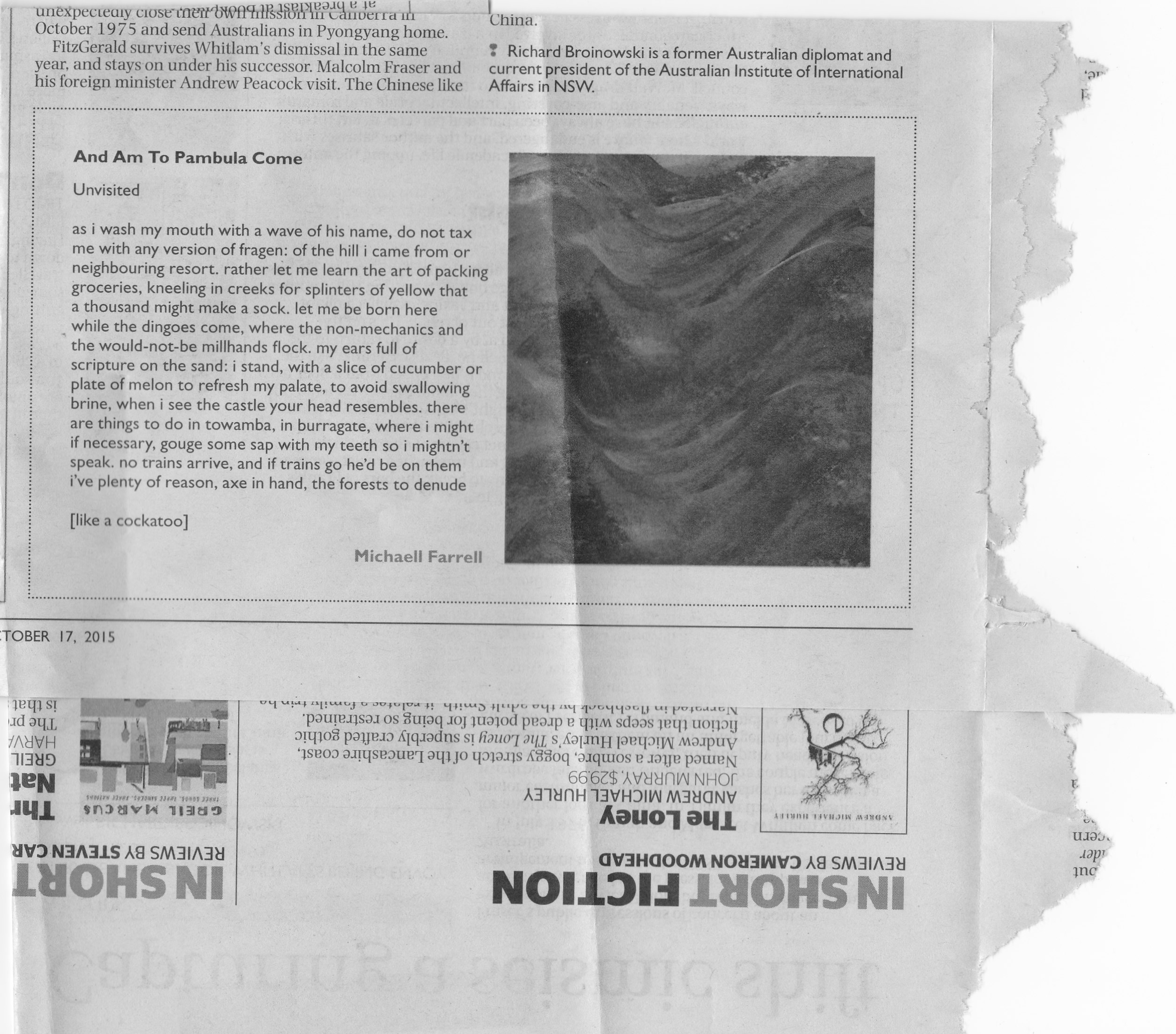
AndAmtoPambulaCome (2)

This poem appeared in the Canberra Times on 17 October (see the above image). It is by the ‘modern experimental poet’ Michael Farrell and as you can see it is a little different from a normal sonnet though it meets the fourteen line requirement. You will notice there are no capital letters and that includes place names and personal pronouns.

In trying to give some understanding I broke the text into six components defined by the punctuation. My initial comments are in italics after each of these sections. Alongside the poem is an image of what appears to be sea waves so I bore this in mind when I looked at the text.

Note that they were my thoughts without any knowledge of the experimental nature of the poet so please read the comments that follow after the poem …

And Am to Pambula Come

Pambula is a seaside town on the south New South Wales coast. So perhaps this is about someone making a visit to that town.

Unvisited

Pambula is declared as unvisited. Why we don’t know until we understand the poem.

as i wash my mouth with a wave of his name, do not tax
me with any version of fragen: of the hill i came from or
neighbouring resort.

After reading the whole poem this is my interpretation. I think the person speaking is an Aborigine and ‘he’ is the personification of progress – which is distasteful. Don’t ask me who I am and where I came from whether from the country or a holiday resort. ‘Fragen’ is German for ‘ask’. Asking this is foreign to me in any language.

rather let me learn the art of packing
groceries, kneeling in creeks for splinters of yellow that
a thousand might make a sock.

Let me just keep on doing the menial tasks assigned to me packing groceries or searching for gold – to support your meaningless industries – a cynical statement .

let me be born here,
while the dingoes come, where the non-mechanics and
the would-not-be millhands flock.

Let this be my home, my birth where there are dingoes and where the people flock that are not mechanics or millhands. People I can identify with – my flock.

my ears full of
scriptures on the sand: i stand with a slice of cucumber or
plate of melon to refresh my palate, to avoid swallowing
brine, when i see the castle your head resembles.

My scriptures are of the sand and the sound of the sea. Not the scriptures brought by foreigners from overseas. Perhaps ‘head’ is a reference to the person asking or represents the personification of progress. Progress started from the sea and from the land of castles so the sea could represent the inflow of progress many years ago – however there is a certain irony here as cucumber and melon may have come from overseas.

there
are things to do in towamba and burragate, where i might
if necessary, gouge some sap with my teeth so i mightn’t
speak.

Burragate and Towamba are two places away from the coast and up the Bega valley. Presumably untouched by progress and where the trees are still available – where there is no need to complain about deforestation.

No trains arrive, and if trains go he’d be on them
i’ve plenty of reason, axe in hand, the forest to denude.

No trains arrive progress hasn’t reached these places and if trains came progress and the deforesters would sure be on them. And if they came there would be plenty of reason to do my own deforestation by removing the foresters with my axe.

If you treated these last two lines as the ‘rhyming couplet’ there is no way one could understand this sentence without reading the full poem – except of course picking up a great degree of anger.

Referring back to ‘Unvisited’ – the land is in the blood of the Aborigine so when he goes to Pambula he is never a visitor.

Michael Farrell

The above was based on my interpretation without knowledge of the experimental nature of  the poet. As a follow-up I obtained the following feedback on the Canberra Times literary selection … and as you can see I fell into an over-analysis trap. I have retained my text in this Post as an example of what can happen!

… ‘the speaker in the poem is a gay man missing his lover. However trying to “translate” a Michael Farrell poem into any kind of sequential logical train of thought is missing the point. He is deliberately trying to jump all over the place. At the base of this poem is a moving sense of longing and loss, and a deep engagement with landscape, but the path the poem takes is meant to be confusing, surreal, playful and unsettling’

The links below may be helpful in understanding the poet and the nature of this very different experimental work.

This link gives a review of his all work …
http://www.sydneyreviewofbooks.com/who-fries-a-crumpet/

Details on the poet Michael Farrell via the Australian Book Review Site – https://www.australianbookreview.com.au/component/k2/152-march-2015-no-369/2402-michael-farrell-is-poet-of-the-month

In summary, it is a difficult poem to come to terms with and I know some people are immediately put off by this type of poetry and readily dismiss it. An understanding of the poet may increase value.

Journey to the Interior – Margaret Atwood – Analysis

Journey to the Interior

There are similarities
I notice: that the hills
which the eyes make flat as a wall, welded
together, open as I move
to let me through; become
endless as prairies; that the trees
grow spindly, have their roots
often in swamps; that this is a poor country;
that a cliff is not known
as rough except by hand, and is
therefore inaccessible. Mostly
that travel is not the easy going

from point to point, a dotted
line on a map, location
plotted on a square surface
but that I move surrounded by a tangle
of branches, a net of air and alternate
light and dark, at all times;
that there are no destinations
apart from this.

There are differences
of course: the lack of reliable charts;
more important, the distraction of small details:
your shoe among the brambles under the chair
where it shouldn’t be; lucent
white mushrooms and a paring knife
on the kitchen table; a sentence
crossing my path, sodden as a fallen log
I’m sure I passed yesterday

(have l been
walking in circles again?)

but mostly the danger:
many have been here, but only
some have returned safely.

A compass is useless; also
trying to take directions
from the movements of the sun,
which are erratic;
and words here are as pointless
as calling in a vacant wilderness.

Whatever I do I must
keep my head. I know
it is easier for me to lose my way
forever here, than in other landscapes

Margaret Atwood

Margaret Atwood is better known as a Canadian author of books rather than a poet. She is a prolific writer and very creative so it is interesting to look at this poem. 

S1 … This is obviously an internal journey within contrasted with travelling in the external environment. The first line states that there are ‘similarities’. The eyes define the scene as a wall to be broken … perhaps a ‘flat wall’ as the scene only comes ‘known’ when entered at a personal level. But what is found in S1 is that the environment is endless as ‘prairies’ and that it is ‘poor country’ and not easy going.

Well, to get to know yourself – who you really are – is perhaps a difficult and endless task. But this is the start of the journey so, hopefully, the country will improve with travel. It is interesting that the cliffs cannot be seen for what they are except at a very base level.

S2 … Destination is unknown except to be vague as a dotted line between points on a map. The endless light and dark could relate to both day and night as well as emotional highs and lows. I guess when we start any internal search we have little idea of what might be revealed … and again it is a difficult journey to untangle.

S3 … It is the small details in life that have internal effect. Small details can absorb much of our thinking if they have sufficient deep association. ‘A shoe among the brambles under a chair/ where it shouldn’t be’ – this implies an unfortunate meeting with another person – the ‘shoe’ indicating crossing another’s journey. White mushrooms are immature mushrooms and a paring knife is used to peel fruit to make it edible. What significance these hold for the poet is not known. You could of course liken the personal journey to that of fruit being made acceptable.

A ‘sentence crossing’ my path has double meaning – life as a sentence, and the written sentence of the poet that is now ‘sodden as a fallen log’ whereas yesterday it was more acceptable – ‘I’m sure I passed yesterday’.

S4 and S5 – this search for self is circulating into deep depression to the extent of self-danger. The poet knows within of this danger – ironic self knowledge given the circumstances.

S6 – There is no solution not from any words, not from the poet’s writing or from the Sun (whether or not indicating religious connotation). There is a cry for help.

S7 – The solution is internal – to stay focused and rational – ‘keep my head’  … a double meaning in a very real sense.

Here is a Wikipedia link  to Margaret Atwood.

Light Breaks Where No Sun Shines – Dylan Thomas – Analysis

This poem by Dylan Thomas is not easy to master and is open to personal interpretation … my thoughts are in italics after each stanza …

Light Breaks Where No Sun Shines

Light breaks where no sun shines;
Where no sea runs, the waters of the heart
Push in their tides;
And, broken ghosts with glowworms in their heads,
The things of light
File through the flesh where no flesh decks the bones.

… light only comes from darkness … light can only be recognised in terms of darkness … and the ‘heart pushes’ into new territory not like the sea which comes and goes to the same boundaries … the ‘waters of the heart’ can be equated to spiritual light … they are like ‘broken ghosts with glow-worms’ because such light is latent within the body as an abstraction … and so file through the flesh quite separate from the flesh that decks the bones …

A candle in the thighs
Warms youth and seed and burns the seeds of age;
Where no seed stirs,

A candle in the thighs has sexual connotations as well as representing time … with time the seed of youth is burnt away as a candle burns and no seed is produced

The fruit of man unwrinkles in the stars,
Bright as a fig;
Where no wax is, the candle shows its hairs.

… and with time wrinkled man unwrinkles in the stars … the ‘fruit of man’ – with light as bright as the stars … the fig an appropriate choice of fruit (it was under the fig tree that Buddha received enlightenment) .… and you could say that with time when the candle burns to the end instead of a wick we have the silver hairs of age

Dawn breaks behind the eyes;
From poles of skull and toe the windy blood
Slides like a sea;
Nor fenced, nor staked, the gushers of the sky
Spout to the rod
Divining in a smile the oil of tears.

… light and awareness in general comes from within … and dawn may break unseen (‘behind the eyes’) … ‘blood’, the waters of the heart seeks enlightenment like a spreading sea … but from the sky comes light …the divining rod searching for water spouts… and then ‘a smile’ and oil – coming as a healing to the tears of the search …the rod and oil having religious connotations

Night in the sockets rounds,
Like some pitch moon, the limit of the globes;
Day lights the bone;
Where no cold is, the skinning gales unpin
The winter’s robes;
The film of spring is hanging from the lids.

… night takes its toll … and any warmth is taken by ‘skinning gales’ … when daylight comes it meets the bone … spring will happen hopefully but it is now ‘hanging from the lids’ … this speaks to me of morning light encountering a dark depression in the body

Light breaks on secret lots,
On tips of thought where thoughts smell in the rain;
When logics die,
The secret of the soil grows through the eye,
And blood jumps in the sun;
Above the waste allotments the dawn halts.

… but light has a mystery to its work … subtle and beyond logic … ‘on tips of thought where thoughts smell in the rain’… what a marvellous line … and light comes only when attempt at logic is abandoned … the secret of light comes through the hidden soil of the eye … as a plant would grow from that that’s hidden below the ground … and when spring is here ‘blood jumps in the sun’… an awakening … but what does dawn find ‘above the waste allotments’ no recognition, no response and in such areas dawn is ineffective … perhaps a plea for a response to light

Dylan Thomas

…  I’m sure further light will come when I re-read

Marginalia – Billy Collins – Analysis

Marginalia

Sometimes the notes are ferocious,
skirmishes against the author
raging along the borders of every page
in tiny black script.
If I could just get my hands on you,
Kierkegaard, or Conor Cruise O’Brien,
they seem to say,
I would bolt the door and beat some logic into your head.

Other comments are more offhand, dismissive –
“Nonsense.” “Please!” “HA!!” –
that kind of thing.
I remember once looking up from my reading,
my thumb as a bookmark,
trying to imagine what the person must look like
why wrote “Don’t be a ninny”
alongside a paragraph in The Life of Emily Dickinson.

Students are more modest
needing to leave only their splayed footprints
along the shore of the page.
One scrawls “Metaphor” next to a stanza of Eliot’s.
Another notes the presence of “Irony”
fifty times outside the paragraphs of A Modest Proposal.

Or they are fans who cheer from the empty bleachers,
Hands cupped around their mouths.
“Absolutely,” they shout
to Duns Scotus and James Baldwin.
“Yes.” “Bull’s-eye.” My man!”
Check marks, asterisks, and exclamation points
rain down along the sidelines.

And if you have manage to graduate from college
without ever having written “Man vs. Nature”
in a margin, perhaps now
is the time to take one step forward.

We have all seized the white perimeter as our own
and reached for a pen if only to show
we did not just laze in an armchair turning pages;
we pressed a thought into the wayside,
planted an impression along the verge.

Even Irish monks in their cold scriptoria
jotted along the borders of the Gospels
brief asides about the pains of copying,
a bird signing near their window,
or the sunlight that illuminated their page-
anonymous men catching a ride into the future
on a vessel more lasting than themselves.

And you have not read Joshua Reynolds,
they say, until you have read him
enwreathed with Blake’s furious scribbling.

Yet the one I think of most often,
the one that dangles from me like a locket,
was written in the copy of Catcher in the Rye
I borrowed from the local library
one slow, hot summer.
I was just beginning high school then,
reading books on a davenport in my parents’ living room,
and I cannot tell you
how vastly my loneliness was deepened,
how poignant and amplified the world before me seemed,
when I found on one page

A few greasy looking smears
and next to them, written in soft pencil-
by a beautiful girl, I could tell,
whom I would never meet-
“Pardon the egg salad stains, but I’m in love.”

Billy Collins

I do appreciate the annotations of others … especially in poetry where interpretation is so varied. Comments can be incisive, amusing as well as informative and appreciative.

Looking at this text …

S1 … we don’t like what is being said … we hate it … we want others to know it is a load of – … so anger may generate such a response

S2 … the text is studid, silly, child like … and you have to let the author know how silly and stupid he or she is … and a dismissive derisive word only takes a second to write

S3 … well students studying text need to expand and reinfore their new found learning … so this is quite justified of course

S4 … in agreement … the empty bleachers … they want you to know they are with you all the way  … but they are quite empty of their own thinking and probably they have only given a superfical read of your precious words

S5 and S6 … BC wants you to know that you should have annotated some book at some time in your life … and if not why not? … You can’t be that lazy!

S7 … it has happened all through history … and I love the lines … anonymous men catching a ride into the future /on a vessel more lasting than themselves. … so another reason – immortality

S8 … the great merit of annotations by the famous

S9 … this annotation takes the cake and the icing even though eggs are at issue … saying something entirely outside the text and about that one subject that is so important – love! – and at the same time giving an excuse for eating and reading with messy hands! – the line that’s remembered, the line that makes the poem perfect or should I say without stain!

So keep those comments flowing … it is so easy to do in today’s internet world. Those on Facebook and other social media are doing it everyday.

So why do we write in books? – well this is what I’ve just got to tell you – it’s all about self-expression and being heard … when you were in your young wet-concrete years I’m sure you were duly tempted … well, you don’t need to find a stick …  just use those fingers! … go on, my ear is waiting!  LoL

The Moor – R. S. Thomas Analysis

The Moor

It was like a church to me.
I entered it on soft foot,
Breath held like a cap in the hand.
It was quiet.
What God there was made himself felt,
Not listened to, in clean colours
That brought a moistening of the eye,
In a movement of the wind over grass.
There were no prayers said. But stillness
Of the heart’s passions — that was praise
Enough; and the mind’s cession
Of its kingdom. I walked on,
Simple and poor, while the air crumbled
And broke on me generously as bread.

R. S. Thomas: The Moor, from Pietà, 1966

R. S. Thomas was an Anglican minister so he knew exactly what ‘traditional church’ was like but in this poem he discovers a different church while walking on his local Welsh moorland.

One enters a church with reverence taking the hat off and you expect a certain quiet – that is if there is no service in progress – so this description is an apt translation as he sets foot on the moor. And by holding his breath giving greater attention to the surrounding as he first sets foot on the moor.

But in this ‘church’ there is no listening to God via the pulpit. Here God is known as a feeling. The clean colours implying perhaps that the moor is clean and sinless – so we may assume there is no litter to corrupt the eye. If it was a windy cold day then that may have provoked a watering of the eye. On the other hand the feeling of the presence of God due to the beauty of the moor may have been so overwhelming that this caused such moisturising.

In church communication with God is by prayer – but on the moor there is direct communication between God and man via the environment.  The stillness of the heart’s passions is communication if considered as a religious response from walking on the moor in the form of a settling peace within the poet. This could then be regarded as an automatic prayer of both praise and thanks – especially by R. S. Thomas being tuned to religious thought.

The mind’s cession of its kingdom gives an emphasis to the exhilaration in this moment such that the mind is expanded in wonderment in trying to give comprehension. But then the move as he walks on – the breaking away from this intense communion – clearly likened to a church communion where there is the breaking of bread.

I think in today’s twenty four by seven world we all need to find time to escape into a place of solitude – to find our own moor and perhaps in the still and beauty of a such a sacred place experience the presence of God and a settling within. If my bible memory is correct JC had to do likewise when he was overwhelmed by the masses that pressed in on him.

R. S. Thomas on Wikipedia.

Here are some wonderful images of the Welsh Moor on Tom Clark’s Blog.