Douglas Stewart – Scribbly Gum – Analysis

Here is a simple poem from Australian poet Douglas Stewart (1913 – 1985). He was born in New Zealand but lived most of his life in Australia. He was editor of the Bulletin for twenty years. This poem appeared in the centenary publication of the Bulletin.

Scribbly Gum

A child might think
The fairies have come
And scribbled in play
On the scribbly gum,

But we say, no;
Burrowing and biting,
It’s some small insect
Has done this writing;

And yet as though
Wild honey dripped
Down the white tree
To shape the script,

The creature makes
Such clear gold words
Of rock and bush
And leaves and birds

And it its own strange life
As it writes on bark
Like poetry dancing
Out of the dark,

Perhaps after all
The thick white wood
Does hide a fairy
Or just as good.

Douglas Stewart
 
The shorter the text the more thought needed … the more imagination needed perhaps and this is a poem about both imagination and nature and how we communicate with nature. Douglas Stewart wrote many poems on nature so that it is no surprise that such a poem was included in the special edition.

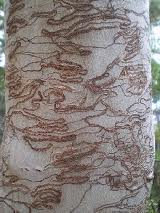
When I first read the poem I immediately thought of my grandchildren and their interpretation of nature and life when they do not relate to any adult understanding. Children, of course, readily make up fanciful stories. The Sribbly Gum along with other eucalypts shed bark leaving quite a beautiful white trunk and insects that create their random scribble then open up a book to be read. Similarly honey can also create interesting language on the trunk of the tree – notice that the ‘words’ are in gold indicating both importance and the link with honey.

This can be seen as nature communicating – and a child or a poet or anyone with imagination can interpret accordingly to their fancy.

And perhaps this is what poetry is all about – an imaginative interpretation of all life. And it must be said that we are part of the natural world too, for so often we seem to separate humanity as something special above environment and other life.

The question is how does nature communicate within its own … and of more importance what is our understanding … it may not be as clear as the scribble on a tree – but it is always there for us to understand, as well as admire the beauty and diversity. And of course when the environment turns sick the message is very clear … how we respond is another matter.

And for those that like to explain everything in life … it is well to recognise that there will always be ‘fairies’ – or just as good! – and we should take a lesson from our children. After all what would life be without the unknown and a little mystery.

Below is an image of the trunk of a Sribbly Gum.

Scribbly Gum 

A link to the background on Douglas Stewart.

Shelley and the Moon

The moon is a feature in some of Shelley’s work … including his masterpiece ‘Prometheus Unbound’ … whether or not you know anything about Shelley and his poetry have a look at the imagery conjured by this beautiful little poem (these are two fragments that were put together after his death) …

THE MOON

I.

And, like a dying lady lean and pale,
Who totters forth, wrapp’d in a gauzy veil,
Out of her chamber, led by the insane
And feeble wanderings of her fading brain,
The moon arose up in the murky east
A white and shapeless mass.

II.

Art thou pale for weariness
Of climbing heaven and gazing on the earth,
Wandering companionless
Among the stars that have a different birth,
And ever changing, like a joyless eye
That finds no object worth its constancy?

Percy Bysshe Shelley (1792-1822)

… and here are some ‘transformation lines’ from Prometheus Unbound (1 see below) showing a thankful Moon in discussion with Earth …

THE EARTH

“How art thou sunk, withdrawn, cover’d drunk up
By thirsty nothing, as the brackish cup
Drained by a Desart-troop – a little drop for all;
And from beneath, around, within, above,
Filling thy void annihilation, Love
Bursts in like light on caves cloven by the thunderball”

THE MOON

The snow upon my lifeless mountains
Is loosened into living fountains,
My solid Oceans flow and sing and shine
A spirit from my heart bursts forth,
It clothes with unexpected birth
My cold bare bosom: Oh! it must be thine
On mine, on mine!

Gazing on thee, I feel, I know,
Green stalks burst forth, and bright flowers grow
And living shapes upon my bosom move:
Music is in the sea and air,
Winged clouds soar here and there,
Dark with the rain new buds are dreaming of:
“Tis Love, all Love!

Prometheus Unbound Act 4 (lines 350-369)

Percy Bysshe Shelley (1792-1822)

Footnote …

1 Prometheus Unbound is based on the work of Aeschylus which dramatizes the sufferings of Prometheus, unrepentant champion of humanity, who, because he had stolen fire from Heaven, was condemned by Zeus to be chained to Mount Caucasus and to be tortured by a vulture feeding on his liver. Shelley continued the story but transformed it into a symbolic drama about the origin of evil and of overcoming it.

(Aeschylus (525-455BC) was an ancient Greek playwright … the father of tragedy … earliest of the three Greek playwrights Sophocles, Euripides.)

For those interested in Shelley’s background this is a link to an excellent bio

… and some relevant text from the above site …

During this 1818-1819 period Shelley wrote what many consider to be his masterpiece, Prometheus Unbound (1820), subtitled A Lyrical Drama, perhaps to suggest a hybrid genre in the way Wordsworth and Coleridge had signalled their pioneering efforts by titling their first volume of poetry Lyrical Ballads (1798). Shelley had been developing the symbolism, imagery, and ideas for the poem for several years. For example, he states in the preface that “the imagery which I have employed will be found … to have been drawn from the operations of the human mind,” a technique he had already used in Mont Blanc. Shelley had had a longstanding interest in and familiarity with Aeschylus’s Prometheus Bound, even translating it for Byron, but he could not accept the idea that Aeschylus had bound the champion of mankind for eternity, or even worse, that Prometheus would have been reconciled with Jupiter in Aeschylus’s lost drama, the sequel to Prometheus Bound. As Shelley avers in the preface, “I was averse from a catastrophe so feeble as that of reconciling the Champion with the Oppressor of mankind.” The choice of Prometheus as his hero is not surprising, given this mythological character’s association with rebellion and isolation from his act of giving fire to man against the gods’ wishes and his reputation as a “fore-thinker” or prophet. For Shelley he came to symbolize the mind or soul of man in its highest potential.

Shelley was willing to challenge ‘the establishment’, the conventions of his day, and of more importance ‘The Gods’ (God) to establish his own internal truth.

P. B. Shelley – Philosophy from his Poetry

P. B. Shelley’s philosophy (following my previous Post on Love’s Philosophy) …

He went from an external to an internal philosophy based on humanity having the power to combat the sources of suffering based on a personal responsibility within the social framework (a micro view).

Here is his philosophy as reflected in some of his poetry … based on ‘The Norton Anthology’ –

1 … In Queen Mab

… Shelley believed that injustice and suffering can be eliminated by an external revolution that will wipe out or radically reform the sources of evil

2 … In Prometheus Unbound

… the origin of evil and the possibility of reform are the responsibility of men and women themselves. Social chaos and wars are a gigantic projection of human moral disorder and inner division and conflict, tyrants are the outer representatives of the tyranny of our baser over our better elements; hatred for others is a product of self-contempt; and successful political reform is impossible unless we have reformed our own nature at its roots, by substituting selfless love for divisive hate. Shelley incorporates into his secular myth … (i.e.  universal regeneration by an apocalypse of the moral imagination of the human race) … the ethical teaching of Christ on the Mount, as well as the highest classical morality represented in Prometheus.

Note … Prometheus Unbound (from Shelley’s preface) … is a large and intricate imaginative construction that involves premises about human nature and the springs of morality and creativity (Shelley abhorred didactic poetry).

The non-Christian poet W. B. Yeats called PU one of ‘the sacred books of the world’.

The Christian critic C. S. Lewis found in PU poetic powers matched only by Dante.

Love’s Philosophy – P. B. Shelley

Love’s Philosophy

The fountains mingle with the river,
And the rivers with the ocean;
The winds of heaven mix forever
With a sweet emotion;
Nothing in the world is single;
All things by a law divine
In another’s being mingle–
Why not I with thine?

See, the mountains kiss high heaven,
And the waves clasp one another;
No sister flower could be forgiven
If it disdained its brother;
And the sunlight clasps the earth,
And the moonbeams kiss the sea;–
What are all these kissings worth,
If thou kiss not me?

Percy Bysshe Shelley (1792 – 1822)

Here is a love sonnet from a romantic Shelley seeking a kiss … or using his words seeking to mingle in another’s being … very suggestive. Whether it was reciprocated is another matter. But it is more than just a love poem for his  love philosophy underlines some certain basic philosophic tenants in relation to how Shelley viewed the world.

The world is a unity and everything is connected. There is no such thing as a singularity. This is clearly stated in the first eight lines. But more over the connecting force in the way the world has been created is love. All things have come from a divine source and mingle in a natural love with ‘sweet emotion’. I went to a poetry meeting last night and one comment from a reader was ‘every thing in life reduces to emotion’ … and Shelley would have it as sweet emotion … a very positive view of the world and the way it was created and the essence of that creation. It is very much an inclusive view of life – one world. And a beautiful world.

In the last two lines of this section we see a personal plea for Shelley to mingle with some particular person … suggesting that these words were given, or read, to someone special. Another interpretation of ‘I with thine’ is a seeking of a link between Shelley and his environment … we perhaps assume that Shelley feels connected with nature … my view is that he certainly does for he expresses the beauty of the world in his poetry … but he may be seeking a deeper link.

The last six lines explore the close relationships between elements in the universe. This close connectivity is likened to ‘kissing’, moreover he now considers nature in terms of the family relationships of sister-brother … this is how the elements are joined … you may think that this is a little bit poetic in the extreme.

The last two lines say it all … please kiss me … this is what it is all about, for all this natural connectivity has no value unless he is connected likewise.

Perhaps those that have had an intense spiritual experience can equate the experience with a feeling of great love for nature … a greater awareness of the beauty in nature … and on the same basis as that expressed by Shelley.

(I have this vague memory of Prince Charles talking to his plants at one stage in his life … perhaps he had been reading too much Shelley.)

Here is a link to Percy Bysshe Shelley on Wikipedia.

When I am in doubt – Glenn Colquhoun

When I am in doubt
(a poem for surgeons)

When I am in doubt
I talk to surgeons.
I know they will know what to do.

They seem so sure.

Once I talked to a surgeon.
He said that when he is in doubt
he talks to priests.
Priests will know what to do.

They seem so sure.

Once I talked to a priest.
He said that when he is in doubt
he talks to God.
God will know what to do.

God seems so sure.

Once I talked to God.
He said that when he is in doubt
he thinks of me.
He says I will know what to do.

I seem so sure.

Dr Glenn Colquhoun
Hammersmith Press UK 2007
First published Robert Steele NZ 2002

Glenn Colquhoun is a contemporary New Zealand poet and medical doctor. Here is a link to some of his poems … http://www.beyond-the-pale.co.uk/backwards.htm

I had the pleasure of attending a workshop under his leadership a couple of years ago.

This could be regarded as a ‘pass-the-buck for advice poem’ the sequence of authority being – Surgeon-Priest-God … and of course we are going up the ladder.

The last stanza is where it all happens so to speak … after the build-up … and apart from a cynical response here is another interpretation and an interesting twist …

… and generalizing in the following to anyone with difficult decisions in life …

… a nice personification of God that when He is in doubt that humanity will do the ‘right thing’ He has faith at a very personal level that ‘We’ will know what to do. You could say God has great faith in his  creation … great faith in you and me. Usually we see faith flowing the other way so the reverse is an interesting change of thought … an emphasis on a two-way connectivity of the flowing of faith.

… and of course to what extent does any ‘God-connectivity’ aid us in our own decision making can only be answered by each of us at a very personal level … regardless whether or not we have to make difficult decisions akin to the work of a doctor

… and do we go up the hierarchy in that quest for working out what to do – and is God on the agenda … well that’s another question

… another thought if you are in the creation process do you likewise have faith in your own creations … and faith in your own children if you have any … well we always live in hope.

A Fixed Idea – Amy Lowell

Here is an early poem by Amy Lowell

A Fixed Idea

What torture lurks within a single thought
When grown too constant; and however kind,
However welcome still, the weary mind
Aches with its presence. Dull remembrance taught
Remembers on unceasingly; unsought
The old delight is with us but to find
That all recurring joy is pain refined,
Become a habit, and we struggle, caught.
You lie upon my heart as on a nest,
Folded in peace, for you can never know
How crushed I am with having you at rest
Heavy on my life. I love you so
You bind my freedom from its rightful quest.
In mercy lift your drooping wings and go.

Amy Lowell

This poem is a Petrarchan sonnet with rhyming scheme ‘ABBAABBACDCDCD’.

The first eight lines give emphasis to the mind reflecting – thinking of a time when there was joy/delight. Thinking about it being a poor substitute to the actual experience … however the experience is such that you cannot get it out of the mind … it was that important and that emotionally charged that it dominates your life … in summary trapped in the dull pain of remembrance … the recurring joy is now ‘pain refined’. Interesting words defining the type of pain being experienced … to me it seems like a grieving … a loss has taken place and can never return. So it leads to questions such as – what to do to escape the relapse to the past? … how to incorporate a highly emotional experience in on-going living in a positive way?

The last six lines are the turn in the sonnet. Now we clearly know that this is a love experience and the lover (=you) is clearly identified. And you lie on the heart as a nest … you have made your home upon my heart and settled down at peace … but you don’t know how terrible this is to me now that you have gone … (we don’t know the circumstances – nor do we know whether the person concerned is alive or if alive whether he or she has any comprehension of how important the relationship was to the other person.)

This love can’t be ignored … a plea to find a way for it to be dissolved … for it to take flight as a bird leaving a nest. Drooping wings a very appropriate word … freedom is needed … for the wings to be activated.

Well how do you ‘deal with life’ after a relationship ends … after a death … after any other major event which dominates the mind.

And can you ever stop love?


Eli, Eli – Judith Wright

Eli, Eli

To see them go by drowning in the river –
soldiers and elders drowning in the river,
the pitiful women drowning in the river,
the children’s faces staring from the river –
that was his cross, and not the cross they gave him.

To hold the invisible wand, and not to save them –
to know them turned to death, and not to save them;
only to cry to them and not to save them
knowing that no one but themselves could save them –
this was the wound, more than the wound they dealt him.

To hold out love and know they would not take it,
to hold out faith and know they dared not take it –
the invisible wand, and none would see or take it –
all he could give, and there was none to take it –
thus they betrayed him not with the tongue’s betrayal.

He watched, and they were drowning in the river;
faces like sodden flowers in the river
faces of children moving in the river;
and all the while he knew there was no river.

Judith Wright (from the ‘Woman to Man’ sequence 1949)

The title Eli, Eli (Eloi, Eloi) … suggests those words spoken on the cross by Christ – ‘… why have you forsaken me’

Looking at the poem stanza by stanza …

S1 … it seems that everyone is drowning in the river … interesting that the children aren’t drowning, they are caught up in the river though, but they are not drowning, they are staring – watching what is going on in a fixed state

… the last line defines the ‘cross’ given to Christ in terms of this scene … to watch the world drowning (or staring) in the river … and this is not the cross given to him (the crucifixion cross) … but it is not until later that this is clarified

S2 … Christ had (has) the ‘invisible wand’ the ability to intervene … note that it is an invisible power … but JC can only cry … he does not save them – a contrast with the view of Christ=Saviour … the key is in the fourth line – it is up to the each person to save themselves the pain is that JC must watch when he knows they have the ability to be saved … and the last line suggests that this pain is greater than the physical pain

S3 … the details of the ‘invisible wand’ are stated in terms of the gifts of love and faith … but these have been ignored … the message of Christ has not been heard … all that he had to give … the people not hearing – not taking up the power of the wand … in doing this they have betrayed him far more than a lip-betrayal.

S4 … so JC is watching the drowning in the river … interesting that the children are not drowning but moving in the river … then we have that powerful last line … there is no river … the river is a creation of humanity = all those things that stop us truly living

…and the children moving in the environment of the negative adult world – ( … unless you become like little children comes to mind … age corrupts perhaps).

This poem gives a new dimension on that final crucifixion scene. Christ looking out on the crowd. Christ in pain because his message is not headed. Christ recognizing children … and we like sodden flowers.

In summary – a very spiritual poem with great understanding on how Christ works. One of JW’s excellent early poems.

Footnote …

Matthew 27:45
“Eli, Eli lema sabatchthani?” – “My God, My God, why did you abandon me?”

Haiku and Tanka – Text to mull and dwell

Looking at the traditional Japanese structures of Haiku and Tanka … Haiku is simply three lines with the first and last line five syllables and the middle line seven … Tanka is an extension of Haiku by adding two extra seven syllable lines …

Here is an example by Doris Heitmeyer … a contemporary poet who I think is (or has been) the secretary of the American Haiku Society.

On the morning bus

I look past the handsome face

to the red maple.

When did it happen – the change

in the leaves, the change in me? 

Doris Heitmeyer, New York

The first sentence is a Haiku statement of a person (the poet) travelling on a bus … the morning bus implies that she is a regular bus traveler, perhaps on the way to work or shopping … she looks past another traveler … past a handsome face … it is up to the reader to fill in any personal details like age, sex … and where positioned on the bus … but she looks past this person to an outside view via the window … the important detail is the face … maybe she has been studying this face … and she sees the red maple … so we know it is autumn. The red maple is quite a stunning autumn tree so the maple and the face have common prominence in the eye of the traveler. If the poem ended here with just these lines it would be no more than a simple factual statement on a moment of travel on a bus.

But this moment of everyday travel has stimulated a personal reflection defined by the extension of the last two lines to form the Tanka. The important word is ‘change’ a personal change … the metaphor change in the leaves … relating to the direct reference by last three words … ‘change in me’. So there is a question to be contemplated … it is up to the reader to contemplate on the thoughts suggested … for example …

Has there been an age change … a physical change in the face of the person … or is the change an internal change within … is the change for better or for worse … how dramatic is the change … is it inevitable as with a changing season … or is this change in relation to many years …

… and of course the reader will start to think of how she or he has changed in any dramatic way.

The reader’s understanding/interpretation is dictated by personal experience and the unique personal association prompted by the words presented by the poet …

I think there is quite a contrast with such short Haiku and Tanka text compared with other forms of poetic expression … for few words are read – but much thought and contemplation is needed to appreciate the text … for those that like to dwell and mull.