Poppies in October – Sylvia Plath and AI

Poppies in October
Even the sun-clouds this morning cannot manage such skirts.
Nor the woman in the ambulance
Whose red heart blooms through her coat so astoundingly –

A gift, a love gift
Utterly unasked for
By a sky

Palely and flamily
Igniting its carbon monoxides, by eyes
Dulled to a halt under bowlers.
Oh my God, what am I
That these late mouths should cry open
In a forest of frosts, in a dawn of cornflowers.
Sylvia Plath (27 October 1962)

Analysis …

Nothing in sun and sky can match the poppy skirts (petals) in their colour … nor the woman (reference to herself) in the ambulance whose red heart is amazingly kept alive … the woman (SP) close to death … others not so lucky … she has been rescued and will survive.

This late showing is out of context with the season … and is a gift unasked for …and in this regard, SP could be talking about her astoundingly good luck in surviving her earlier suicide attempt … her red heart did bloom … how come she was saved? … how come she was given a second chance? … SP did not ask for this … to be re-born … at least she acknowledges this gift as a ‘love-gift’ … even if she is not thankful.

… the medicos that saved her did not know her … see her red passion, her emotional state … how could they … they wear bowler hats … head-centric on their work

… and then the lament of not knowing who she is … the poppy in October … out of context … but still alive … she cries aloud for some understanding … why should she be alive in a ‘forest of frosts’ (in a deep tangle where growth is unlikely – how she saw her life) and in a ‘dawn of cornflowers’ (emerging against the bland mass of the common … a little arogance perhaps)

Note … this poem was written on SP’s last birthday (27 Oct 1962) … her 30th birthday … at a time when she was living by herself (with the two children) in London – separated from Ted Hughes  … she also wrote another poem ‘Ariel’ on the same day … so she had time to herself on this day to devote to poetry … and to question her existence … to question why she has survived out of season (like the poppy) … and to ask why she is still alive … and inferred – why is live so hard … it is a cry for an explanation from the deep intensity of her being for a meaning in her troubled world … questioned in a state of mental unrest.

… and whether any physical poppies were around on this her birthday is open to question … they could be mind-poppies … (refer also to a previous poem ‘Poppies in July’ written in Devon in the summer … when times were different.)

And this is what AI (CHATgpt) had to say about this poem illustrating the dangers of using AI without careful attention to the response …

“Poppies in October” is one of Sylvia Plath’s poignant poems, reflecting her complex relationship with nature, life, and death. In this poem, she explores themes of beauty, transience, and the inevitable decay that accompanies life.

The imagery of poppies, often associated with remembrance and sleep, takes on multiple layers of meaning in Plath’s hands. They are portrayed as fragile and ephemeral, yet their vibrant red hue contrasts sharply with the barrenness of autumn, suggesting a defiance against mortality.

Plath’s use of language is characteristic of her poetic style—rich in symbolism and laden with emotion. The juxtaposition of “scarecrow” and “blood-burned barns” evokes a sense of desolation and decay, while the “golden mummies” suggest a haunting beauty amidst the inevitable march of time.

The poem’s closing lines, “Now she is flying / More terrible than she ever was, red / Scar in the sky, red / Comet / Over the engine that killed her— / The mausoleum, the wax house,” hint at the speaker’s acceptance of death as a transformative force. The image of the poppy as a “red / Scar in the sky” suggests a lingering presence even in death, a reminder of the fragility and resilience of life.

Overall, “Poppies in October” is a powerful meditation on mortality, capturing both the beauty and sorrow inherent in the cycle of life and death. Plath’s adept use of imagery and language imbues the poem with a haunting quality that lingers in the mind of the reader long after the final lines have been read.

Quite clearly the text that I have highlighted in red above refers to the different SP poem Stings.

Here is the last stanza of Stings ...

Now she is flying
More terrible than she ever was, red
Scar in the sky, red comet
Over the engine that killed her ----
The mausoleum, the wax house.

It is interesting that AI picked up these lines. The red scar in the sky could have association with a poppy. And after her suicide attempt in the cellar she had a scar on her face enhancing personification. Stings was written in early October 1962. That month SP was really flying in terms of her poetic creativity.

… and here is a poppy from the Australian spring a poppy very much in season.


Sonnet V – Edna St. Vincent Millay – Comments

Sonnet V

If I should learn, in some quite casual way,
That you were gone, not to return again–
Read from the back-page of a paper, say,
Held by a neighbour in a subway train,
And such a street (so are the papers filled)
A hurrying man–who happened to be you–
At noon to-day had happened to be killed,
I should not cry aloud–I could not cry
Aloud, or wring my hands in such a place–
I should but watch the station lights rush by
With a more careful interest on my face,
Or raise my eyes and read with greater care
Where to store furs and how to treat the hair.

Edna St. Vincent Millay (1892 – 1950)

A sonnet with rhyming scheme ‘abab cdcd efef gg’ with a clear volta breaking the text into the notice of a death and the corresponding effect on the person hearing the news.

There is an ‘if’ about this poem – If I should learn. But it strikes me as being close to the experience of many who have suddenly been made aware of an unexpected death. Recently I was informed of the death of a friend who had limited life but it was quite unexpected that death would arrive quickly and I was immediately stunned by the news. It took me quite awhile to refocus and become emotionally stable enough in order to share with others who knew her.

The poem relates to such a notification but in a public place and by the chance reading of the back page of a paper being read by a fellow traveller on the seat opposite. It is up to the reader to infer the extent of personal connection with the death. We do not know whether it is a close family member or a work college not seen for several years. I have that feeling it might have been someone from the past such as a previous lover. I think there was quite a depth in the relationship with the ‘you’ in the text.

But this is irrelevant for the poem describes the catering of the emotional shock by a somewhat artificial concentration on the station lights and other text on the back of the paper. Self-control is evident in not wishing to draw attention from others on the train. But perhaps this represents an immediate internalisation of the death in coming to terms with the sudden shock unexpected news. It does not, of course, preclude a private emotive release a little later and under different circumstances.

Edna St. Vincent Millay was an American poet and playwright.  She received the Pulitzer Prize for poetry in 1923,  and she was known for her feminist activism.  A link to her on Wikipedia.

Prayer – Carol Ann Duffy – Analysis

Prayer

Some days, although we cannot pray, a prayer
utters itself. So, a woman will lift
her head from the sieve of her hands and stare
at the minims sung by a tree, a sudden gift.

Some nights, although we are faithless, the truth
enters our hearts, that small familiar pain;
then a man will stand stock-still, hearing his youth
in the distant Latin chanting of a train.

Pray for us now. Grade 1 piano scales
console the lodger looking out across
a Midlands town. Then dusk, and someone calls
a child’s name as though they named their loss.

Darkness outside. Inside, the radio’s prayer –
Rockall. Malin. Dogger. Finisterre.

Carol Ann Duffy

Minim = a musical note with the time value of half a semibreve or two crotchets. It is written as an open note head with a stem.
Train = long moving line of people

Looking at this sonnet …

The first quatrain … when in the middle of a task something to the peripheral arrests attention … in this instant a voice from the trees … as though someone else is speaking and there is communion with the environment … the woman stops what she is doing and for one brief moment there is an appreciation of life … the joy of just being.… there is a gift of thanks … or putting it another way this can be thought of as a prayer of thanks whether or not just a thank you for life or whether a thank you to another ‘God’.

The second quatrain … prayers happen regardless of any formal faith … night is the time when the mind is vulnerable … and often in those sleep hours thoughts occur seemingly out of nowhere… and if the truth of the matter unravels there is usually some pain and discomfort from this communion in any resolution.

Maybe hearing a piece of music gives association to something way back from his youth … perhaps to a time when the man was more motivated and a time when he was following his young heart with strong purpose … and again this may be painful and the man may seek consolation if reflecting on unfilled dreams.

The third quatrain … pray for us now – this looks like an ask … an ask for help and we all need help and support in order to give help and support … prayer is defined as a solemn request or a giving of thanks to an object of worship (usually God) … so this is an ask for us to ask our ‘God’ for help for those in need … to invoke an external force … if the lodger needed consolation then the Grade 1 piano scales could be seen as a response to prayer. The last sentence seems to show a person in grief … as though they named their loss … in grief for a child and in need of consolation … in need of prayer

The rhyming couplet … mentioning the shipping forecast invokes a prayer for those at sea … a prayer that sailors may be able to heed the information and not risk life … darkness outside gives the feeling that prayer is a mystery and hidden … whereas inside the radio’s prayer gives the other side of the coin that prayer always emanates from the internal reaching out from the person

Re: shipping forecasts … the unique and distinctive sound of these broadcasts has led to their attracting an audience much wider than that directly interested in maritime weather conditions. Many listeners find the repetition of the names of the sea areas almost hypnotic, particularly during the night-time broadcast at 0048 UK time. (from Wikipedia)

I do like this sonnet as it widens the concept of traditional prayer and brings prayer down to the basics of everyday communication in the living of life.

And to end, –  a prayer that our daily transactions are appropriate as we negotiate life!

The Trains – Judith Wright – Analysis – ANZAC Day

ANZAC Day 2015

TrainOfroses

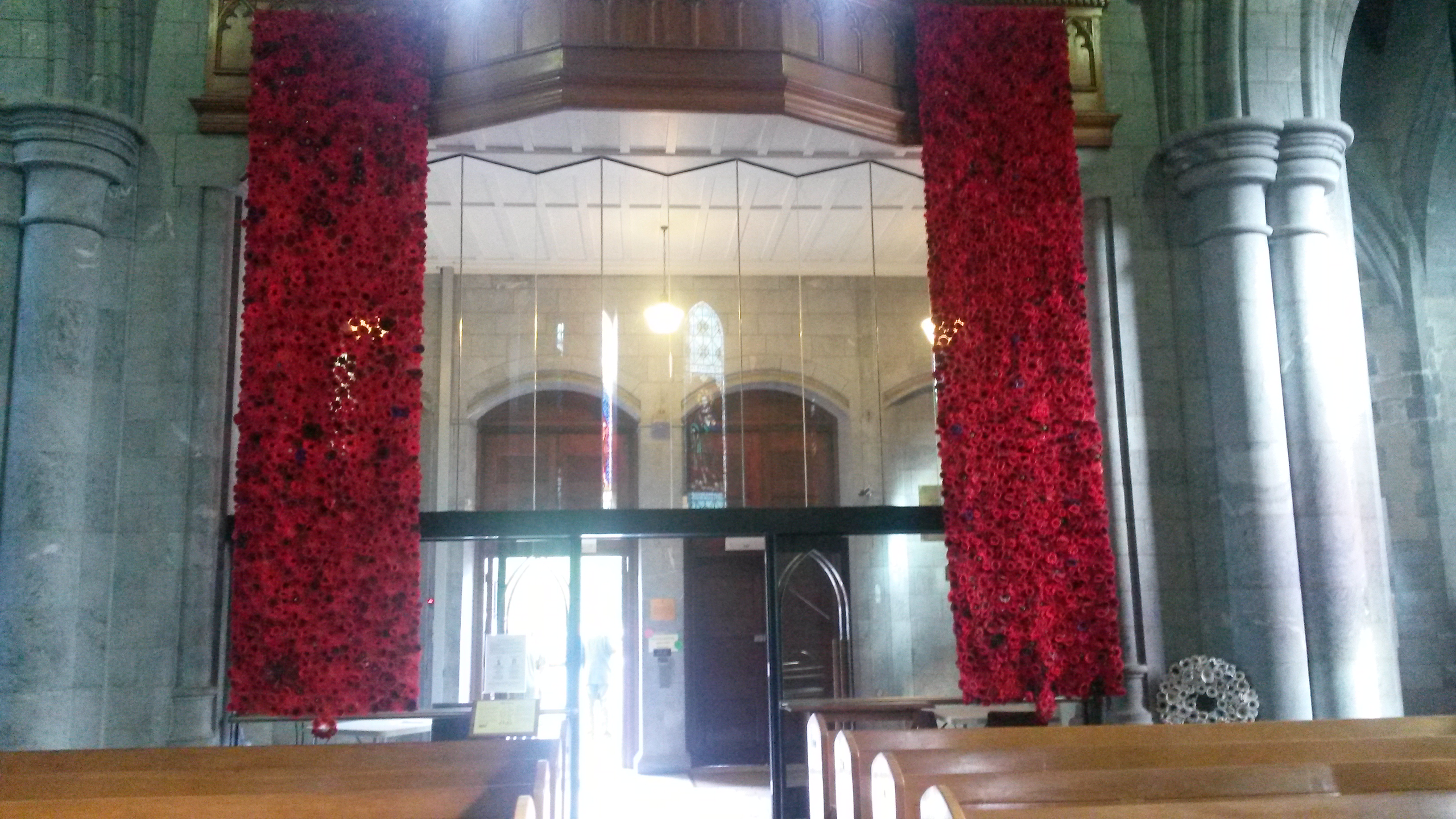
Two trains of roses have been placed down the inside the back wall at the entry of Nelson Cathedral, New Zealand.

The following is my choice of a war poem and it is ANZAC (Australian and New Zealand Army Corps) day today when the ‘World War 1 Gallipoli’ campaign is on the minds of Australians and New Zealanders. This year also marks hundred years since the birth of Judith Wright in 1915. This is a generic poem about pending dark days as war approaches.

The Trains

Tunnelling through the night, the trains pass
in a splendour of power, with a sound like thunder
shaking the orchards, waking
the young from a dream, scattering like glass
the old mens’ sleep, laying
a black trail over the still bloom of the orchards;
the trains go north with guns.

Strange primitive piece of flesh, the heart laid quiet
hearing their cry pierce through its thin-walled cave
recalls the forgotten tiger,
and leaps awake in its old panic riot;
and how shall mind be sober,
since blood’s red thread still binds us fast in history?
Tiger, you walk through all our past and future,
troubling the children’s sleep’; laying
a reeking trail across our dreams of orchards.

Racing on iron errands, the trains go by,
and over the white acres of our orchards
hurl their wild summoning cry, their animal cry….
the trains go north with guns.

Judith Wright

The first stanza reminds me of the time I was staying in a rondavel in a valley in South Africa when on the way to Durban. The trains disturbed my sleep as high up they trundled through tunnels in the hills making an eerie sound at the same time. Trains are very powerful images and coming suddenly at night representative of the foreboding onset of war. And more importantly these lines show how both old and young would be affected. The young might dream of adventure unknowing of the nature of war and being easily misled by any recruitment drive, whereas the old know only too well what is at hand and their hope for the the next generation is shattered like broken glass. The peace of the orchard is now clouded by the events which were unfolding represented by the trail of black smoke over white spring blossom. The trains are going north with guns and this was appropriate to the Australia situation as Darwin was first in line in the Second World War.

The second stanza likens the war-trait in the human condition to a tiger within the blood of all generations. It seems this tiger will always be present to trouble each generation and as in the first stanza reeking a trail across our dreams for peace (orchards). And how can mind be sober when it has to confront the terror of this tiger. It seems that the mind of man has to continually deal with war in whatever form. The last lines highligh the manic-force with which the war-cry manifests, represented by the trains travelling on iron errands, rather than iron rails. It is an animal cry reflecting the ever present unstoppable base elements of the human condition.

As the world gets smaller and smaller war and conflict is quicky brought to our attention by the media – wherever it is occuring, so you could say that ‘train-noise’ is a more frequent visitor to the background of the mind. Whether this awareness makes the world better equiped to deal with such situations is another matter – but we live in hope.

yesterday the earth shook
today there are poppies every where

We give thanks that we are lucky enough to live where peace prevails!

I have also commented on this poem on my previous Site.

   … and the following are links to previous ANZAC Day Posts …

Previous ANZAC Day words 2014

Previous ANZAC Day words 2013

Report Card – 2013

Report Card 2013

could do better, could do much better

there once came a God from the sky
who looked on the Earth with a sigh
Oh what a disgrace!
that Human Race
so he returned back up to the sky

Will humanity progress this year?
Has God gone to sleep in his arm chair?

… and what was your report like? …

A very happy New Year to Everyone.

Richard Scutter  31 January