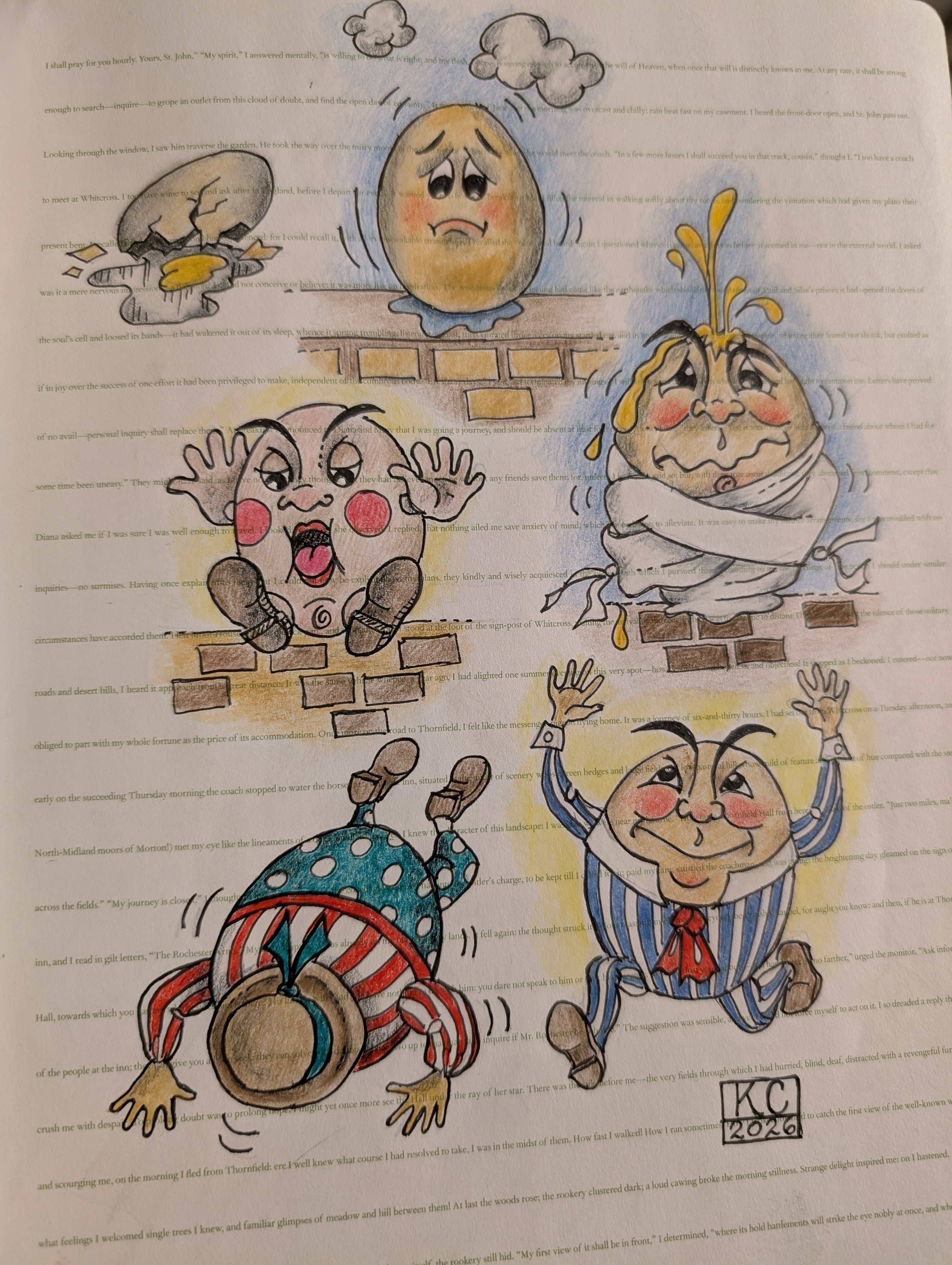
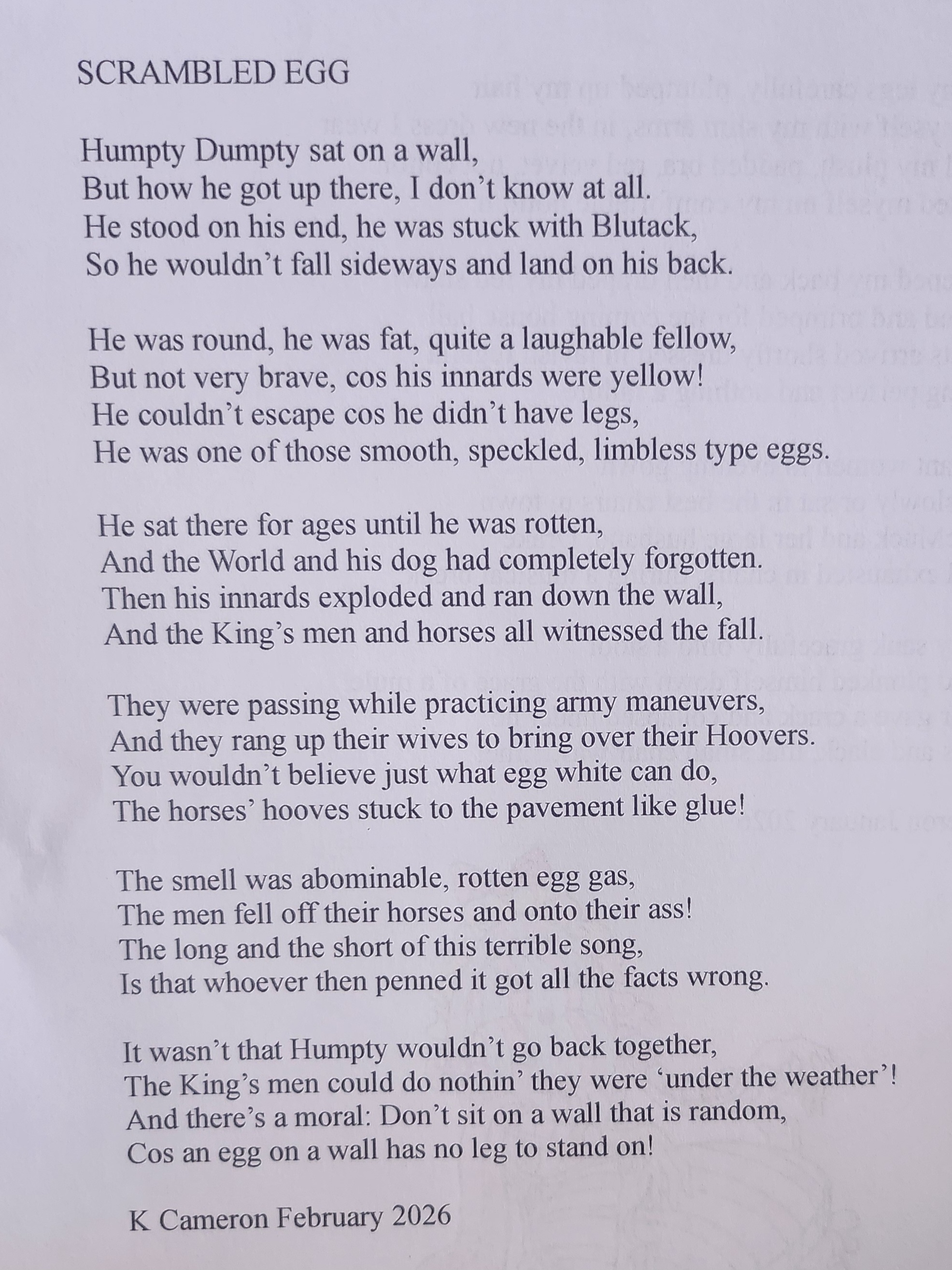
Scrambled Egg – Kate Cameron – Yass Valley Writers

Time for a touch of humour …


Kate Cameron is a member of The Yass Valley Writers. She is a very talented lady that exudes humour in her contributions to the group. Her creative drawings are always an entertaining addition to many of her poems. I attend the meetings and Kate has given me permission to share her work.

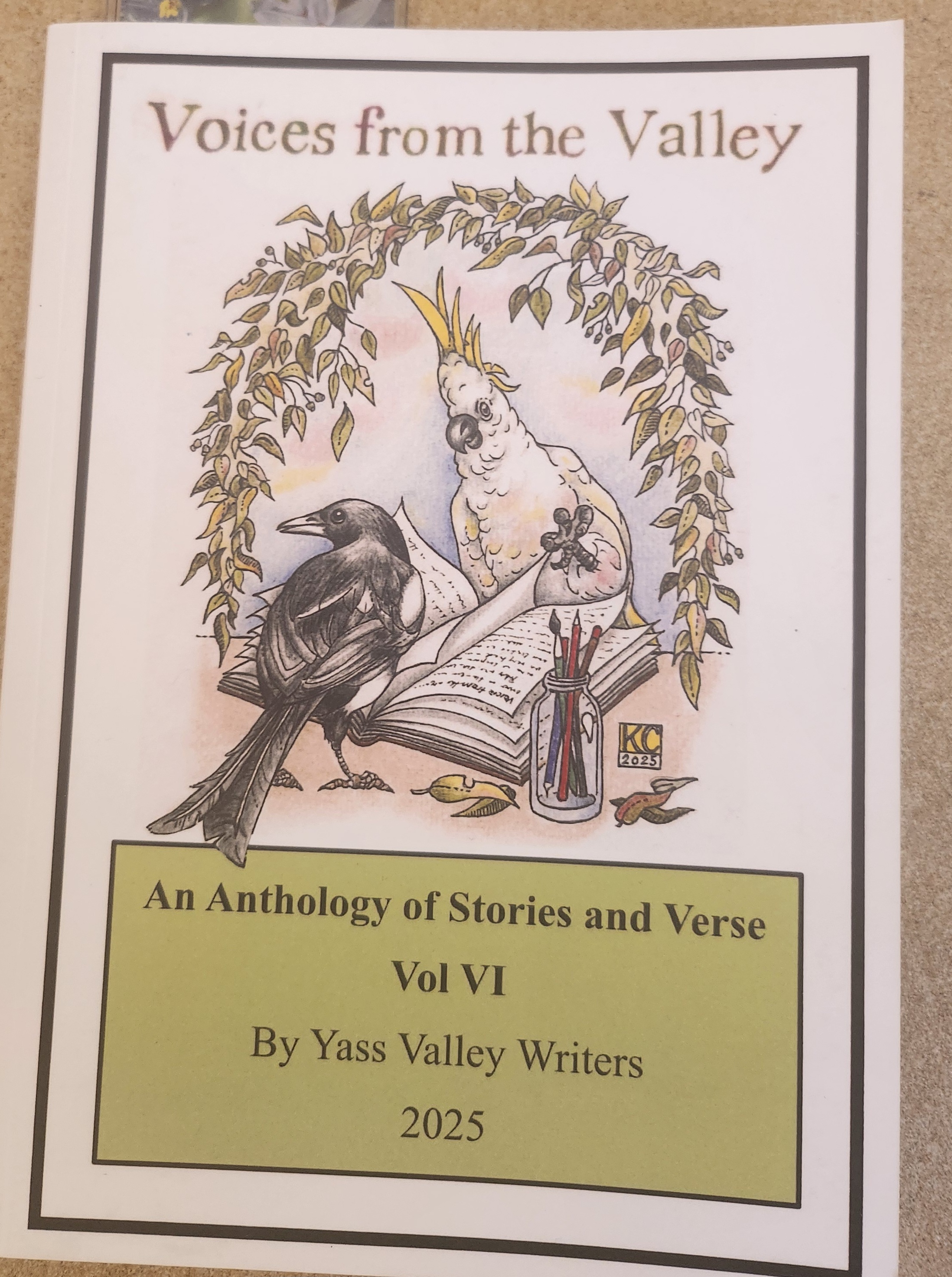
The Yass Valley Writers Group have recently produced their sixth anthology (Voices from the Valley) which is available via Amazon – see below. A diverse range of writing from seventeen of the members.

You – a poetic elaboration

I have been considering the one-word poem YOU. It is up to the reader or listener to meditate/associate/respond according to the receptive nature of that individual person at the time of reading or hearing. That is, if that person has time to contemplate such a poem in the busy 24 by 7 world of today.

Here are some positives in relation to such a poem to stimulate thought –

Subject and Object: The beloved is both the reason for the poem and its entire content. They are not just being addressed — they are the poem.

Economy of Expression: It says, “Nothing else matters. Only you.”

Devotion: It’s a surrender — the lover reduces the infinite complexity of love to a single, defining presence: you. If it is a lover that is being addressed by this word.

Mirror: It can also be a reflection — the beloved might see themselves in the poem, but also see the lover’s entire being poured into that word.

Timelessness: Unlike longer poems, it doesn’t age or tire; it remains whole and immediate

I have expanded the one-word poem into the following to give more poetic expression. But again, the subject and object of the poem depends on the reader/listener for interpretation.

                                           
YOU

I wrote a hundred lines.
Burned them.
Too many metaphors.
Too many ways to almost say it.
Then I wrote your name.
Once.
Paused.

The page stared back —
full.
Complete.
Crowded, even.
Everything empty
nothing
except

and you read it
                  as if I’d hidden more,
                         but there is no more to say


What can I say … enjoy being you … whoever and wherever you are. And thanks for reading this Post. You are important; essential in keeping poetry alive.

.

A one-word poem – Boring

I was on duty trying to entertain my eleven-year-old granddaughter when she came back from school.

She knows I am interested in words and poetry. When I started to broach that subject the response was one word -Boring.

I said to her that words are important. The words that you use say something about you. And of course choosing the best word and placing it in the appropriate location is always the aim of the poet.

Well, the one-word response was Boring. And then as though she wanted to emphasis her response she repeated Boring several times. You could say she created a one-word poem.

I guess this eleven-year-old finds grandfather totally boring. Wendy Cape was in that boring state with nothing creative on her mind. So she used that emotive feeling to create a boring poem.

Being Boring
'May you live in interesting times.' Chinese curse
If you ask me 'What's new?', I have nothing to say
Except that the garden is growing.
I had a slight cold but it's better today.
I'm content with the way things are going.
Yes, he is the same as he usually is,
Still eating and sleeping and snoring.
I get on with my work. He gets on with his.
I know this is all very boring.
There was drama enough in my turbulent past:
Tears and passion - I've used up a tankful.
No news is good news, and long may it last.
If nothing much happens, I'm thankful.
A happier cabbage you never did see,
My vegetable spirits are soaring.
If you're after excitement, steer well clear of me.
I want to go on being boring.
I don't go to parties. Well, what are they for,
If you don't need to find a new lover?
You drink and you listen and drink a bit more
And you take the next day to recover.
Someone to stay home with was all my desire
And, now that I've found a safe mooring,
I've just one ambition in life: I aspire
To go on and on being boring.
Wendy Cope (1945 -

Wendy Cape is renowned for her humorous poems. She is happy to be a cabbage. An appropriate metaphor. A cabbage just responds to soil and temperature. It can be a little annoying when the same friend always starts the conversation – “What have you been doing”.

What can I say, I hope you are coping (forgive the pun) with all that is happening in the world.

Wendy Cope on Wikipedia

The King and I – meeting notable people


Richard, Richard … where have you been
      I’ve been to the War Memorial to visit the King, and the Queen
Richard, Richard … what did you there
                 I told the King to respect his fair hair
                                         … for I think a hat should surely be seen

Context …

Sometimes there is a chance of coming in contact with notable people whether royalty, politicians, popstars or actors. Maybe for a fleeting moment of course. I did get the chance to see King Charles III and Queen Camilla when they made a one-day visit to Canberra last week. I took the above photograph when the royal couple came out of the Australian War Memorial and took time out to greet some of the well-wishers who had gathered for the occasion. He spoke to the fellow next to me before moving on.

King Charles seemed in a good mood he undoubtedly has a sense of humour. I think he is a bit philosophical at being in the role of King. Making the most of it I guess, not an enviable job.

The Pussycat was very kind to the Queen in trying to chase-off a mouse that had frequented the Palace. I was only trying to give the King some helpful advice to protect himself. The spring sunshine on the day was quite intense, a little different from England I might add.

Playing with words – A Wislawa Szymborska poem

The Three Oddest Words

When I pronounce the word Future,
the first syllable already belongs to the past.

When I pronounce the word Silence,
I destroy it.

When I pronounce the word Nothing,
I make something no non-being can hold. 

Wisława Szymborska (1923 - 2012)
Translated by S. Baranczak & C. Cavanagh

Poets do like playing with words. And the choice of words is always a consideration. And so too the way they will present themselves when pronounced. An example is HIS, a wonderful word to be used when talking about a snake in a poem. So, if you are considering creating a poem about a snake make it masculine.

Looking at the three words in the above. Future is a two-syllable word. It is really a past/present word when split into syllables and pronounced. And so does that make all one-syllable words present, well until you release pronunciation of the syllable and then it fades into the past. Well, of course it is continually fading as the sound of the syllable dissipates. In the example of HIS, perhaps you should hold that sound when reading to make that snake a vicious one about to bite the listener.

Silence is not a word to have in a poem for it destroys the intent of what the poet is trying to create. Is it better to have a pause instead when reading the work? And how do you create a pause and hold a break when reading a poem?

Nothing is of course something for NOTHING is beyond comprehension.

So here is a sonnet which contains the word SILENCE … but I am asking the reader not to say the word SILENCE but to make a twenty second break. So that when it is read it is no longer a sonnet – so to speak (sorry about that!).

Wind and Sun

Wind and sun give us a choice,
shouting with their voice.
SILENCE
Drenching rain, din, din, din
soaked again to the skin.

And to add overwhelming proof
some are climbing on the roof. 

Some think of building a new arc
but cut down trees to make a start.

Our children know better though,
they're being taught the way to go.
Wind and sun give us a choice,
shouting with their voice.
SILENCE

Well, we are experiencing unprecedented flooding in Eastern Australian!

See my previous Post on The Joy of Writing by Wisława Szymborska.

Skinnydipping – Murray Hartlin – Humour

The problem with humour in short poems is that poetic structure is often ignored, but not so in the following poem which has nice rhyme and flowing rhythm. And, of course, many short poems are dependent on the last line for a twist to generate a smile. And often, like a joke, once you have heard it you seldom want to read it again as all impact dissipates. Well, you might want to share with a few friends until it recedes from the mind. And many say ‘I can’t remember jokes’ and many jokes are not worth remembering.

But I do like the repartee developed in the last two lines of this poem, so here it is …

Skinnydipping
The temperature was soaring, the sun was beating down,
Matt walked by the river the other side of town.
He had a look around and there was no-one there but him,
So he ripped off all his clothes and jumped in for a swim.
The water cooled his sweaty hide, he swam and splashed all about,
He felt a whole lot better and he started to get out.
He headed for his clothes and was reaching for his jocks,
When two young girls came walking from behind a pile of rocks.
Matty quickly grabbed his hat and covered up his front
The girls just stood and giggled, so Matt became quite blunt.
‘If you two girls were ladies, you’d turn around’ said Matt.
'And if you, sir, were a gentleman, ‘you’d bow and raise your hat!’
Murray Hartlin (

Taken from ‘An Australian Heritage of Verse’ by Jim Haynes. Murray Hartlin is an Australian bush poet, author and entertainer. He likes a good yarn! Here is a link to his website.

Emily Dickinson on Facebook – Pamela Milne

A U3A friend, Ian, introduced me to a very amusing poem by Pamela Milne that imagined Emily Dickinson on Facebook. He obtained it from this link.

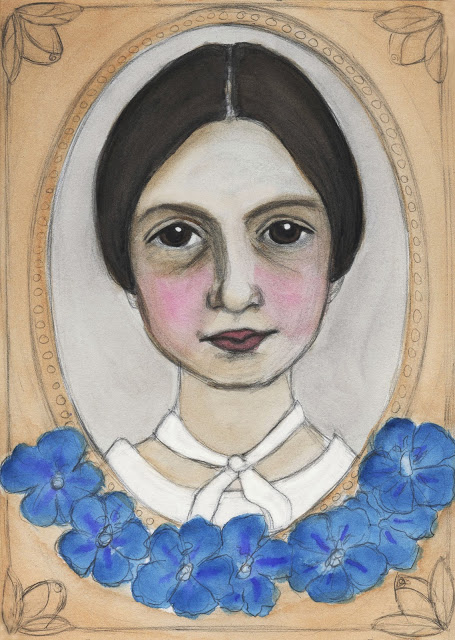
In the poem Milne mentions Emily using a tinted/photo-shopped version of the one famous daguerreotype (early photographic process). Here’s just the thing By Debra Styer to go with the poem.

EmilyDickinson

Emily Dickinson on Facebook

She posts many times a day.
Often during the night and early morning.
Photos of spiders and flies on windowsills,
her garden seen through her bedroom window,
her new tulle dress, flowers in a simple vase.
No poems.
Anyone who requests to be her friend, she accepts,
but she never clicks the Like button.
She never comments.
She never responds to messages.
She joins no groups.
Every weekend she changes her cover photo:
leaves of trees and bushes, surfaces of water,
things seen so close up as to be abstract.
But her profile photo is always the same one.
Sometimes she does something to it in Photoshop –
a tint, a filter, sepia – but still, the same.
Emily.

Pamela Milne

Here are Ian’s comments from a recent U3A Poetry meeting –

The idea of the quintessential recluse Emily Dickinson choosing to be on Facebook sounds oxymoronic at first like … but of course social media, artfully used, is a godsend for the true recluse. Pamela Milne’s sense of how Emily would/wouldn’t use Facebook, how she’d make so much of small things in her necessarily small world, is exquisite. Perfect, even. I went “Gosh!” with admiration when I read it. I can’t find a biographical word anywhere about Milne…so if anyone knows anything about her…

I too could find nothing on the Internet so if I find out more about her this Post will be amended.

Well, seclusion is highly topical with the virus restricting many people to limited space. Emily Dickinson would have no problems adhering to the restrictions! Perhaps those poetically minded or those involved in writing that are in forced confinement can use the time to produce some work. Another thought is the maintenance of a diary. For all those reading this Post and in forced seclusion I wish you well.

Smile – A one Word Poem

Arthur Stace was an alcoholic but when he attended a Christianity meeting he was totally besotted by the word ‘Eternity’ and what this word represented. From then on he spread this word by writing it in copperplate with chalk on footpaths in and around Sydney. He did this for 35 years from 1932 to 1967 and became known as ‘Mr Eternity’.

A Wikipedia link

Awhile ago I was in a hurry to write a poem so I decided to choose just one word –

SMILE

But in order to spread this SMILE to the masses I have thought it wise not to embark on a similar promotion spree. As an alternative I thought some words might suffice for all to read – hence the following ….

My One Word Poem
(Dedicated to Arthur Stace who took ETERNITY to be understood)

The first and last line
starts and ends
at the next word.

SMILE.

Go back to the first line.

Short though it be, and like Arthur’s
this poem is an endless journey!
that’s right – you’ve got it
Smile!

But why are you down here,
Ok, you don’t like to read in circles
I guess I will have to repeat things
so – just for you
Smile!

Now, have you finally ingested it?
I mean – is it fully understood
analysed and sunk in
more than skin deep!
Smile!

Now that’s better!
if there’s one thing I hate
not to be fully understood
and have no response –
it is only the one word!

SMILE.

Richard Scutter

… and of course there is another way to disseminate my message when walking down the street!

… and interestingly what word would you choose (I guess love is already taken)