Little Jack Horner – Discussion

Little Jack Horner

Sat in the corner
Eating a Christmas pie.
He stuck in his thumb
And pulled out a plum
And said, “What a good boy am I!”

Anonymous

Discussion …

What is the meaning behind the well-known words of this nursey rhyme …

… my thoughts …… he sat in the corner … perhaps he didn’t want to be found out that he had taken the pie, he wanted to secretly have it to himself and not be disturbed … and what was he after – plums! … he ignored the pastry and put in his thumb searching for one … he seems impatient to get to the inside … though the pie is much more!… and he does seem to be a little self-centred and that anything slightly fortunate is due to him being good and deserving of such fortune … what if the plum had a stone which cracked a tooth … would that have indicated that he had done something bad.

… this nursery rhyme was given as the chapter-title-poem on Meaning and Idea in Laurence Perrine’s excellent book Literature – Structure, Sound, and Sense (isbn 0-15-55 1100-9) … the interpretation …the pie exists for the plum (at least for Jack) though the pie is much more! … poetry (pie) is more than just meaning (plum) … savour the whole poetry pie please … don’t just look for meaning … that’s right eat the pastry and enjoy with your custard! … take a holistic approach when reading poetry … don’t just search for your plums … savour the total poetic experience … even if the essence of the poem is alien to your point of view … and poems are not word puzzles to be interrogated by the mind of the reader seeking some justification for their existencu.

Well Christmas is coming and I guess presents will come your way in some form or other. So make sure you inspect the card carefully and unwrapp slowly and when you sight the the unwanted (don’t go plum crazy) be generous in your response no matter what … quite often the ‘unwanted’ can eventually be of use to you or someone else … and if you are a poet you should be well versed in the use of your imagination!

Footnotes …

… funny that even today some still think that if something “unfortunate” happens it is due to that person being bad … and globally the current world woes are, of course, due to the world being bad

The origins/history according to the Site below give a different perspective on this nursery rhyme … http://www.rhymes.org.uk/little_jack_horner.htm
… funny place to put valuables – in a pie … there again we used to have a coin in the family Christmas pudding … a three-penny piece from memory. And I must admit that as a child the main focus was on getting a coin.
Framed in a first-storey winder … Anonymous

Framed in a first-storey winder …

Framed in a first-storey winder of a burnin’ buildin’
Appeared: A Yuman Ead!
Jump into this net, wot we are ‘oldin’
And yule be quite orl right!
But ‘ee wouldn’t jump …
And the flames grew Igher and Igher and Igher
(phew!)

Framed in a second-storey winder of a burnin’ buildin’
Appeared: A Yuman Ead!
Jump into this net, wot we are ‘oldin’
And yule be quite orl right!
But ‘ee wouldn’t jump …
And the flames grew Igher and Igher and Igher
(strewth!)

Framed in a third-storey winder of a burnin’ buildin’
Appeared: A Yuman Ed!
Jump into this net, wot we are ‘oldin’
And yule be quite orl right!
Honest!
And ‘ee jumped …
And ‘ee broke ‘is blooming neck!

anonymous

A poem that leads you higher and higher to a climax in the so important last line.

You have to know who to trust. The reason this poem is anonymous ‘cos the guy who ‘rote it was the guy in the street telling the person what to do like!

Nasturtiums – Margaret Scott – Analysis

Nasturtiums

The nasturtiums are sprouting in hundreds
across the garden. Each seed puts down
a succulent white root, thrusts up a stalk
with two small neat round leaves, winsome
and vividly-green as those comic-book plants
dotted among a child’s party of frogs.
I feel like a cruel old witch when I yank them out,
but left to themselves they swell to monstrous mounds –
turtles with heaving shells of soft green platelets
simmering mobs of pale-eyed parasols
shaken by a raucous babble of lurid shrieking
more dreadful in lying low in venomous silence.
Sniggering flowers peak out – orange and mustard
some yolk-yellow with throats as brown as hyenas
or bad teeth, some paler as bulbous foreheads
and dwarfish scowls. They have blood on their chins
and spiky hair on their lips. What a crop!
What a nest of serpents. What can have rotted down
in this mild garden to feed these hysterical leaves
and malevolent blossoms?

Margaret Scott (1934 – 2005)

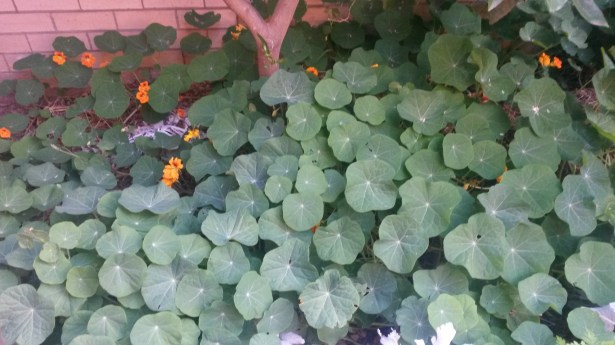
I can identify with this poem strongly as my garden is often overrun with these creatures and they do seem to have a liking for the compost area. But I must say they do provide a cover for a lot of sins. Below is a photograph taken from my garden which clearly demonstrates their dominance if left unchecked …

Nasturtiums

It also illustrates how well the words of the poem fit the reality of the plant and they are certainly a veritable mound of turtles with heaving shells of soft green platelets. And the flowers have blood on their chins and spiky hairs on their lips. All flowers have a face and are pretty and some are prettier than others. This poem with the strong personification gives clear evidence that the poet is a gardener who has done conflict with this plant on numerous occasions. They do grow so quickly and no matter how much you yank them out they will be sure to turn up again.

Margaret Scott does not mention the distinctive scent which I always find a touch antiseptic and not quite pleasant – nor the fact they have decorative and edible properties.

MS was an Australian author, poet, comedian, educator and public intellectual.

Margaret Scott on Wikipedia … https://en.wikipedia.org/wiki/Margaret_Scott_(author)

Remembering Sylvia … ‘Poppies in October’ …

Remembering Sylvia Plath who would have been 85 today …

Poppy

Poppies in October

Even the sun-clouds this morning cannot manage such skirts.
Nor the woman in the ambulance
Whose red heart blooms through her coat so astoundingly –

A gift, a love gift
Utterly unasked for
By a sky

Palely and flamily
Igniting its carbon monoxides, by eyes
Dulled to a halt under bowlers.

Oh my God, what am I
That these late mouths should cry open
In a forest of frosts, in a dawn of cornflowers.

Sylvia Plath (1932 – 1963)

Analysis …

Nothing in sun and sky can match the poppy skirts (petals) in their colour … nor the woman (reference to herself) in the ambulance whose red heart is amazingly kept alive … the woman close to death … others not so lucky … she has been rescued and will survive.

This late showing is out of context with the season … and is a gift unasked for …and in this regard, SP could be talking about her astoundingly good luck in surviving her earlier suicide attempt … her red heart did bloom … how come she was saved? … how come she was given a second chance? … SP did not ask for this … to be re-born … at least she acknowledges this gift as a ‘love-gift’ … even if she is not thankful.

… the action of the heart – ‘igniting its carbon monoxides’ (carbon monoxide has a stronger bind to haemoglobin than oxygen) … igniting – coming alive again … the medicos that saved her did not know her … see her red passion, her emotional state … how could they … they wear bowler hats … head-centric on their work

… and then the lament of not knowing who she is … the poppy in October … out of context … but still alive … she cries aloud for some understanding … why should she be alive in a ‘forest of frosts’ (in a deep tangle where growth is unlikely – how she saw her life) and in a ‘dawn of cornflowers’ (emerging against the bland mass of the common … a little arrogance perhaps)

… this poem was written on SP’s last birthday (27 Oct 1962) … her 30th birthday … at a time when she was living by herself (with the two children) in London – separated from Ted Hughes … she also wrote another poem ‘Ariel’ on the same day … so she had time to herself on this day to devote to poetry … and to question her existence … to question why she has survived out of season (like the poppy) … and to ask why she is still alive … and inferred – why is live so hard … it is a cry for an explanation from the deep intensity of her being for a meaning in her troubled world … questioned in a state of mental unrest..

… and whether any physical poppies were around on this her birthday is open to question … they could be mind-poppies … (refer also to a previous poem ‘Poppies in July’ written in Devon in the summer … when times were different.)

Here is a link to a recommended Site with 10 years of discussion material on the work of Sylvia Plath …
http://www.sylviaplathforum.com/

Here is the text of the interview with Sylvia Plath by Peter Orr (of the British Council) – recorded on 30 October 1962 (just after her 30th birthday) … Interview Sylvia Plath 30 Oct 1962 …
http://www.english.illinois.edu/maps/poets/m_r/plath/orrinterview.htm

Footnote

… during the Autumn of 1962 SP was at a poetic high producing some of her best work … the irony of the situation that although given a second life after her first suicide attempt and although adjusting to her new life without TH it would not be that long before she would succumb to sever depression and a fatal suicide. There would be no second ‘Lazarus‘.

… the poppy image was from the Australian spring taken at an open garden.

The Conclusion of Joseph Turrill – Andrew Motion – Analysis

The Conclusion of Joseph Turrill
Garsington, Oxfordshire, 1867

I suppose I was cut out for a quiet life;
whether I have managed any such thing
is another matter,
what with larks to shoot,
and harvesting, gooseberries, and whatnot.

Then there was all that with Netty:
would she or wouldn’t she;
did I or didn’t I?
It is my belief
I spent more hours kicking my heels at her gate
than happy the other side.

Be that as it may,
Anno Domini drives out stern matters of fact,
and faults that appear to us
when we compare the lives we have
with those we imagine…
There’s nothing a gentle stroll
in the woods by moonlight can’t put right.

I tried that just now.
I saw swallows on the branches like clothes pegs,
which put me in such good humour
I brought home one of their nests and also four chicks.

Andrew Motion (1952 –

Andrew Motion was the UK Poet Laureate prior to Carol Ann Duffy.

Anno Domini – Medieval Latin and means “in the year of the Lord”, but is often translated as “in the year of our Lord”.

The problem with this poem is that many readers may not know anything about Joseph Turrill. Google is always there to help. JT lived in the period 1841-1925 and he was an Oxfordshire market gardener and diarist.

Perhaps if you read his diaries knowledge of a conclusion might be evident. But without such knowledge this poem independently tells us something about his nature.

S1 … JT thought he was in for a quiet life being a market gardener and close to nature and all the associated work … but here is a lamentation … it is a very busy life with all that his job entails … perhaps overwhelmed with all the work in a busy time of the year … of note is the shooting of larks something that may have occurred in his day, not sure of the reason – perhaps a food delicacy? … but the main thrust is the lamentation that time is being taken away from him … a loss of the life he wanted … not a quiet life

S2 … a different lamentation a loss of time in all his wasted efforts in courting Netty … would she or wouldn’t she … facilitation in the development of a relationship … again the loss of the life he wanted … perhaps wanting the permanent relationship of marriage

S3  … this is the way it is so he must face reality against his mind imaginings of what he would like to happen … how he would like life to be … so to get over these feelings of annoyance with his life … the solution a walk into the woods under moonlight … the escape to be himself alone with nature (I think I can remember JC doing something like this in the bible – escaping into nature when frustrated with the crowds)

S4 … well it worked, and moreover he saw ‘swallows like clothes pegs on the branches’ an added bonus, he could take a nest of young birds back home … something which would abhor readers of today!

So the conclusion (or my thoughts) – have time to yourself alone with nature when stressed … but to what extend this helps recovery and the continuance of everyday life is another matter! … time to enjoy a little exercise outside!

This is a link to details on Andrew Motion courtesy of Wikipedia.

Love after Love – Derek Walcott – Analysis

Love After Love

The time will come
when, with elation
you will greet yourself arriving
at your own door, in your own mirror
and each will smile at the other’s welcome,

and say, sit here. Eat.
You will love again the stranger who was your self.
Give wine. Give bread. Give back your heart
to itself, to the stranger who has loved you

all your life, whom you ignored
for another, who knows you by heart.
Take down the love letters from the bookshelf,

the photographs, the desperate notes,
peel your own image from the mirror.
Sit. Feast on your life.

Derek Walcott (1930 -2017)

S1 … a time of joy (hopefully) when you confront yourself … this is not a daily mirror glance … we see as we read the poem that this is an end of life reflection on who you really are … the face in the mirror who has known you all through your life now speaks back with a smile as you and your personified reflection welcomes each other … it is the door that opens to eternity … that time will come for all of us … but of course there is nothing stopping us reflecting at any stage on our journey … as we get older we have more to reflect on and we become more reflective as we slowdown in life.

S2 … it is only through life and living that you really come to know yourself … this person is a stranger at the start … at the end of life it is a time to love this person with wine and bread like a holy sacrament … the person that has loved you from the start … love being an inherent attribute in your creation – from a religious perspective

S3/4 … whom you ignored for another suggests a coming to a terms with yourself … in becoming you … who you really are … and independent of traditional trappings that define life such as letters and photographs … peel back the image that is you – your own image … then sit back and feast on you – forget those mistakes and all those parts not to your liking and celebrate your existence as you would sitting down at a table for a meal with a friend – that wonderful friend that is you.

Sir Derek Walcott was a West Indian poet and dramatist who died this year on 17 March. He was awarded the Nobel Prize for literature in 1992.

More background on this eminent poet via Wikipedia


The Human Seasons – John Keats – Comments

The Human Seasons

Four Seasons fill the measure of the year;
There are four seasons in the mind of man:
He has his lusty Spring, when fancy clear
Takes in all beauty with an easy span:
He has his Summer, when luxuriously
Spring’s honied cud of youthful thought he loves
To ruminate, and by such dreaming high
Is nearest unto heaven: quiet coves
His soul has in its Autumn, when his wings
He furleth close; contented so to look
On mists in idleness—to let fair things
Pass by unheeded as a threshold brook.
He has his Winter too of pale misfeature,
Or else he would forego his mortal nature.

John Keats

Spring = lusty
Summer = dream-time
Autumn = age
Winter = death

Are these the four seasons of human life?

The seasons have always been a subject for poetic expression and I’m sure there are many words that can be linked to each! It is an interesting exercise to associate one word with each of the seasons. Looking at this poem winter = misfeature – what does that conjure up in the mind of the reader and I guess winter = mortality is a common association.

In similar fashion one day can be associated with a lifetime – remember a certain Shakespeare sonnet.

More commentary on this poem 

A link to John Keats on Wikipedia


The Snow Village – Glyn Maxwell – Analysis

The Snow Village

In the age of pen and paper,
when the page was a snow village,
when days the light was leafing through
descended without message,

the nib that struck from heaven
was the sight of a cottage window
lit by the only certain
sign of a life, a candle,

glimpsed by a stranger walking
at a loss through the snow village.
All that can flow can follow
that sighting, though no image,

no face appear – not even
the hand that draws across it –
though the curtains close the vision,
though the stranger end his visit,

though the snow erase all traces
of his passing through the village,
though his step become unknowable
and the whiteness knowledge.

Glyn Maxwell (1962 – ) used by permission of the author
from The Nerve (Picador, 2002)

S1 … we are talking of times when things could be written down … when communication could take this form – the age of pen and paper … the page likened to a snow village – waiting for some ‘prints’ … just as plants wait for a break through based on light … the poet waits for a breakthrough all he or her has is the white sheet of paper

S2 … it appears communication was initiated from ‘heaven’ – the nib struck from heaven … the mind connected with some spiritual force … to a window in a cottage in the village where life is the simple flame of a candle … indicating somewhat tenuous beginnings … but there is a certainty of this life, this flame, this fire which shows some importance … the window indicating an ‘opening’ … and the poet is able to make a start – there is inspiration and footprints in the snow can be seen as the stranger (poet) starts to make his mark on his journey

S3 / S4 … the stranger (poet) is at a loss lacking understanding on where to go … and only glimpses what has happened in the window, not seeing how the message was born but everything flows from that brief encounter, that sighting of the candle. The inspiration is only momentary and the curtains close on the window and the sighting lost but of importance there is impact on the stranger … akin to making a start by a poet in the creation process … enough for something to follow – All that can flow can follow that sighting – not being privy to the initiator or the process, not seeing the motivator or understanding the fire of inspiration that brought the message-flame to life – but the stranger takes something away with him or her – from this insight there is some direction on where to go and he or she takes up the journey and leaves footprints (writing) in the snow.

S5 … after passing through the village the snow (white pages) cover up again … the poet leaves snow or white pages behind as time erases … but although the snow covers up the snow has that latent knowledge within from the printing that has taken place by the stranger. The snow is more than just snow. Time has a continuous history.

Perhaps we all live in a local snow village of some sort and as we pass through pick up the lost prints of those that have gone before who left some message and created knowledge, in particular thinking of the poet who leaves a poem for posterity.

Glyn Maxwell (born in 1962) is a well regarded British poet, playwright, librettist, and lecturer.

A reading of this poem by Glyn Maxwell can be heard from this link.