You’re – Sylvia Plath – Analysis

You’re

Clown like, happiest on your hands,
Feet to the stars, and moon-skulled,
Gilled like a fish. A common-sense
Thumbs-down on the dodo’s mode.
Wrapped up in yourself like a spool,
Trawling your dark as owls do.
Mute as a turnip from the Fourth
Of July to All Fools’ Day,
O high-riser, my little loaf.

Vague as fog and looked for like mail.
Farther off than Australia.
Bent-backed Atlas, our travelled prawn.
Snug as a bud and at home
Like a sprat in a pickle jug.
A creel of eels, all ripples.
Jumpy as a Mexican bean.
Right, like a well-done sum.
A clean slate, with your own face on.

Sylvia Plath

Frieda Hughes, SP’s first child, was born on the first of April 1960. The poem infers conception was on the fourth of July. I think the poem was published after the birth – but the imagery could have been latent in SP’s mind while pregnant. Each stanza is nine lines.

The fish comparison flows through both stanzas. It starts with the foetus being ‘gilled like a fish’ indicating that it is very much in an underdeveloped state and ‘farther off than Australia’ in the second stanza reinforces the idea that it is at an early stage of development.

SP likens the foetus to fog, to a loaf, to a turnip, to a bud, to a sprat, to a prawn, to eels in a basket and to a Mexican bean. I think all of this imagery is quite appropriate to the shape and nature of a foetus as experienced by a woman, pregnancy being an experience that only a woman can understand.

‘Bent-backed Atlas’ – well he, or she, is certainly holding up his, or her, ‘world’. This is an immense thought considering the comparison of the smallest of being with Atlas.

The second stanza also shows excitement and anticipation as in ‘looked for like mail’. The last two lines are interesting. Birth is ‘right’ and natural and in the end can easily be seen as a ‘well-done sum’ – an accumulation of cells over time. The end product being all important. And to my mind birth is always a clean slate and the uniquenesss of the new arrival is given emphasis by ‘your own face’. Humanity is pure at this stage and of course we always hope the new generation will improve things.

Looking at some of the words –

Spool – a cylinder on which thread is wound
Sprat – a highly active small oily fish
Creel – wicker basket used to hold fish

Dodo – large extinct flightless bird
Atlas – primordial being holding up celestial spheres

Mexican bean – Mexican jumping bean contains lava in the bod causing the bean to jump
when heated
A clean slate – an opportunity to start afresh
Executive – John Betjeman – Analysis

Executive

I am a young executive. No cuffs than mine are cleaner;
^ ^ ^ ^ ^/^^^ ^^/ ^ ^ ^^^
I have a Slimline brief-case and I use the firm’s Cortina.
^ ^ ^^^/ ^^ ^ ^ ^/ ^ ^ ^^^
In every roadside hostelry from here to Burgess Hill
^ ^^^ ^/^ ^^^ ^/ ^ ^ ^^ ^
The maîtres d’hôtel all know me well, and let me sign the bill.
^ ^^ ^^/ ^ ^ ^ ^ ^/ ^ ^ ^ ^ ^
(aabb 15 syllable lines)

You ask me what it is I do. Well, actually, you know,
I’m partly a liaison man, and partly P.R.O.
Essentially, I integrate the current export drive
And basically I’m viable from ten o’clock till five.

For vital off-the-record work – that’s talking transport-wise –
I’ve a scarlet Aston-Martin – and does she go? She flies!
Pedestrians and dogs and cats, we mark them down for slaughter.
I also own a speedboat which has never touched the water.

She’s built of fibre-glass, of course. I call her ‘Mandy Jane’
After a bird I used to know – No soda, please, just plain –
And how did I acquire her? Well, to tell you about that
And to put you in the picture, I must wear my other hat.

I do some mild developing. The sort of place I need
Is a quiet country market town that’s rather run to seed
A luncheon and a drink or two, a little savoir faire –
I fix the Planning Officer, the Town Clerk and the Mayor.

And if some Preservationist attempts to interfere
A ‘dangerous structure’ notice from the Borough Engineer
Will settle any buildings that are standing in our way –
The modern style, sir, with respect, has really come to stay.

John Betjeman (1974)

This is a period piece clearly identified by those around in England in the sixties. I remember when the Ford Cortina was the latest and greatest. And having a slim line brief case was more important than any contents! (I joke).

There was a certain respect for the upper class even though this ‘yuppie’ is portrayed here as arrogant and boastful with superficial values and the need to keep up appearances – No cuffs than mine are cleaner – I also own a speedboat which has never touched the water.

A ‘yuppie’ is defined as a young urban professional. Note also that most people would work a nine to five day but this young fellow obvious enjoys his other life much more and manages to start at ten.

But not only does he suffer mockery, corporate speech and corruption take a light hearted beating too. P.R.O = Public Relations Officer and ‘integration’ the in-word in corporate development. And it is a case of knowing the right person and using such influence for personal gain – and is that so different from the way many people operate today?

The poem has well-constructed rhythm and rhyme which bounces the monologue before the reader. You can imagine the conversation taking place at one of the hostelries frequented by this person as he pursues his interest in looking for real estate opportunities. And the implication is that he does not pay his way easily – and let me sign the bill.

I like ‘Mandy’ as a choice of name – do you remember Mandy Rice-Davies and the ‘Profumo Affair’.  Mandy would have such public association for those reading this poem at the time it was published.

Betjeman has been cited as a poet of nostalgia with a dislike of the modern. This is clearly evident in this poem. He certainly mocks the bull-nose development of his day and although it is period piece it also has a certain resonance with modern times.

John Betjeman was Poet Laureate from 1972 until his death in 1984. This link gives more detailed commentary on his poetry.

… and a link to John Betjeman on Wikipedia.

I ask you – Billy Collins

I ask you

What scene would I want to be enveloped in
more than this one,
an ordinary night at the kitchen table,
floral wallpaper pressing in,
white cabinets full of glass,
the telephone silent,
a pen tilted back in my hand?

It gives me time to think
about all that is going on outside–
leaves gathering in corners,
lichen greening the high grey rocks,
while over the dunes the world sails on,
huge, ocean-going, history bubbling in its wake.

But beyond this table
there is nothing that I need,
not even a job that would allow me to row to work,
or a coffee-colored Aston Martin DB4
with cracked green leather seats.

No, it’s all here,
the clear ovals of a glass of water,
a small crate of oranges, a book on Stalin,
not to mention the odd snarling fish
in a frame on the wall,
and the way these three candles–
each a different height–
are singing in perfect harmony.

So forgive me
if I lower my head now and listen
to the short bass candle as he takes a solo
while my heart
thrums under my shirt–
frog at the edge of a pond–
and my thoughts fly off to a province
made of one enormous sky
and about a million empty branches.

Billy Collins – American Poet Laureate 2001 – 2003

I love how Billy Collins takes the ordinary in life and colours it with his wild imagination combining the seemingly disconnected everyday scraps of existence into a worthy world of word pleasure – laying his work before us in his own inimitable style – always there is a touch of the unusual in his offerings as well as a philosophical acceptance of the foibles in human nature – plus that essential ingredient subtle humour.

And looking at the above ‘I ask you’ poem. I do like poetry that poses a question – even if he is talking to himself – isn’t it marvellous when we are content where we are in life?

And considering the second stanza –

while over the dunes the world sails on,
huge, ocean-going, history bubbling in its wake.

And of course the world does sail on the ‘waters’ of the past – but hopefully we make a bit of headway as the future disappears behind us and we add to the flow – but let the world sail on – and not worry about all the problems that beset our troubled world!

He shows his poetic skill to give the contrast between a few moments in a kitchen compared to all history … and those few ordinary moments, where you have time to yourself and to think, can be so precious and rejuvenating in the busy world of today.

Enjoy your own presence in the warm comfort and intimacy of your own being – where ever you are – and so I ask you to just sit back for a few moments … and I hope you can take a deep breath and slowly say to yourself life is very agreeable, in fact quite beautiful!

Japanese Maple – Clive James – Comments

Clive James is nearing the end of his life. Last year he wrote the poem ‘Japanese Maple’ and he had time to put a lot of thought into the text. It is very much a testimony of his personal state at that time as he considered his approaching ending.

I have broken the poem into six stanzas of four lines and then the closing line. My comments in italics …

‘Japanese Maple’

Your death, near now, is of an easy sort.
^ ^ ^ ^ ^ / ^ ^ ^^ ^
So slow a fading out brings no real pain.
^ ^ ^ ^^ / ^ ^ ^ ^ ^
Breath growing short
^ ^^ ^
Is just uncomfortable. You feel the drain
^ ^ ^^^^ / ^ ^ ^ ^
If you have read his ‘Poetry Notebook’ you will be aware how much he appreciates form and it is not surprising to encounter rhyme and rhythm and the attention to the syllable structure. But what I like is the break in the third line corresponding to his difficulty in breathing. You can join his shortness in breath when reading that line. Clearly, at the time of writing, he was not in pain.

Of energy, but thought and sight remain:
Enhanced, in fact. When did you ever see
So much sweet beauty as when fine rain falls
On that small tree

In fact he is experiencing a golden time in the highlighting of his senses. And looking at the Japanese maple in the light rain gives great joy – he obviously has to spend time sitting observing because of his failing health. And again we see that short line occur.

And saturates your brick back garden walls,
So many Amber Rooms and mirror halls?
Ever more lavish as the dusk descends
This glistening illuminates the air.

And he can watch the changing garden as night approaches and find delight in little things such as the way the falling light picks up the wet precipitation. (The Amber Room is a world famous chamber decorated in amber panels backed with gold leafs and mirrors, located in the Catherine Palace of Tsarskoye Selo near Saint Petersburg. – from Wikipedia)

It never ends.
Whenever the rain comes it will be there,
Beyond my time, but now I take my share.
My daughter’s choice, the maple tree is new.

This time the short line is at the start. Reflective words on not being around – nature will continue regardless of his demise – then reflecting again, this time bringing to mind his daughter who chose the tree.

Come autumn and its leaves will turn to flame.
What I must do
Is live to see that. That will end the game
For me, though life continues all the same:

Then looking to the future, how the tree will look in autumn and setting a goal to see the autumn colours– that will be sufficient. (He did achieve this).

Filling the double doors to bathe my eyes,
A final flood of colours will live on
As my mind dies,
Burned by my vision of a world that shone

He know equates his very last days with the ‘flood of colours’ – colours that will live on. His mind is ‘burned’ showing how much value he has taken from the world – a shining world -and more recently appreciating the ‘flame’ of the tree.

So brightly at the last, and then was gone.

And the last line with emphasis on how much joy he has encountered in his end days. It is interesting that his enforced change of pace due to illness has given him a new perspective on life and time to really appreciate his limited environment and to look back on the beauty of life with gratitude.

Clive James

Rhyming scheme – abab bcdc ddea eaaf ghgg ijij j

Clive James would like to be more known as a poet and he is a very fine poet but I guess he will be better known as a broadcaster and commentator with that wry twist and sardonic humour. But this poem will surely be one of his classics.

Here is a link to his Website – http://www.clivejames.com/ and a link to information about Clive James on Wikipedia – http://en.wikipedia.org/wiki/Clive_James

‘Old Mother Hubbard’ – contemplation of text

I recently came across a copy of ‘The Standard Comic Reciter’ – quite an old book and I have yet to find the date of publication (around 1900). But it contains the article ‘Old Mother Hubbard’ from ‘Children of Nature, A Story of Modern London (1878)’ by the late Earl of Desart (by kind permission of Ellen, Countess of Desart.) He was the fourth Earl and died in 1898. The Earl was a literary man who wrote 15 novels. The Countess of Desart went on to become a politician in her own right and died in June 1933, aged 75.

The whole article is an exploration of the first four lines of the well-known nursery rhyme ‘Mother Hubbard’.

‘Old Mother Hubbard, she went to the cupboard,
To get her poor dog a bone;
But when she got there the cupboard was bare,
And so the poor dog had none.’

The article is dedicated to an interpretation of these lines with resultant meaning applicable to everyday life. Looking at the bare bones of his discourse (sorry about that!) with some added interpretation …

Old = the assumption made is that she is a widow and lives alone
She went = she did not deviate from her focus of intent
The cupboard = the emphasis is on the word ‘the’ indicating that she only had one cupboard and it had that important food function
Poor = poor to me indicates that the dog is hungry, an assumption is made that the woman is poor as well as the dog.
Mother = no mention is made of the fact she is a mother, whether or not her children are still around is another matter, and bound to the house as carer would be understood by those reading the text at the time it was written.

It is assumed that she went to the cupboard with an expectation of finding a bone.

She got there = she achieved her goal
Bare = but shock, shock the cupboard is bare – we don’t know whether the door was open or not – and whether she had other things in the cupboard – we don’t know how the bone disappeared (and whether any other contents left the sceene – cakes, sweetbreads, hams etc.)
So the poor dog had none = a matter of fact statement … the old woman, perhaps very disappointed, concludes her task and leaving it behind does not dwell on her situation – this is the key to the Earl’s thought in his concluding lessons …

To avoid being widows (if possible)
To have more than one cupboard (if possible)
To avoid keeping dogs fond of bones (well, all dogs like bones – perhaps some like them too much!)
To accept the inevitable with calm steadfastness … this is indeed the whole crux of the matter – acccept the situation and no matter what happens in life just move on – the full stop at the end of the line is so important!

How many people continue to dwell on something that has happened in their life and can’t move on! Bringing it up time and time again … and again …

And of course I must add another lesson – a lot can be gleaned from very little text! As I am sure that those that write Haiku and Tanka would surely agree.

Note … From Wikipedia – Earl of Desart was a title in the Peerage of Ireland. It was created in 1793 for Otway Cuffe, 1st Viscount Desart. He had already succeeded his elder brother as third Baron Desart in 1767 and been created Viscount Desart, in the County of Kilkenny, in the Peerage of Ireland in 1781.).

Note also – this nursery rhyme has been equated to Henry VIII and his attempt to influence the Catholic Church (Cardinal Worsley) to get approval for a divorce from Catherine of Aragon so that he could marry Anne Boleyn.

The Trains – Judith Wright – Analysis – ANZAC Day

ANZAC Day 2015

TrainOfroses

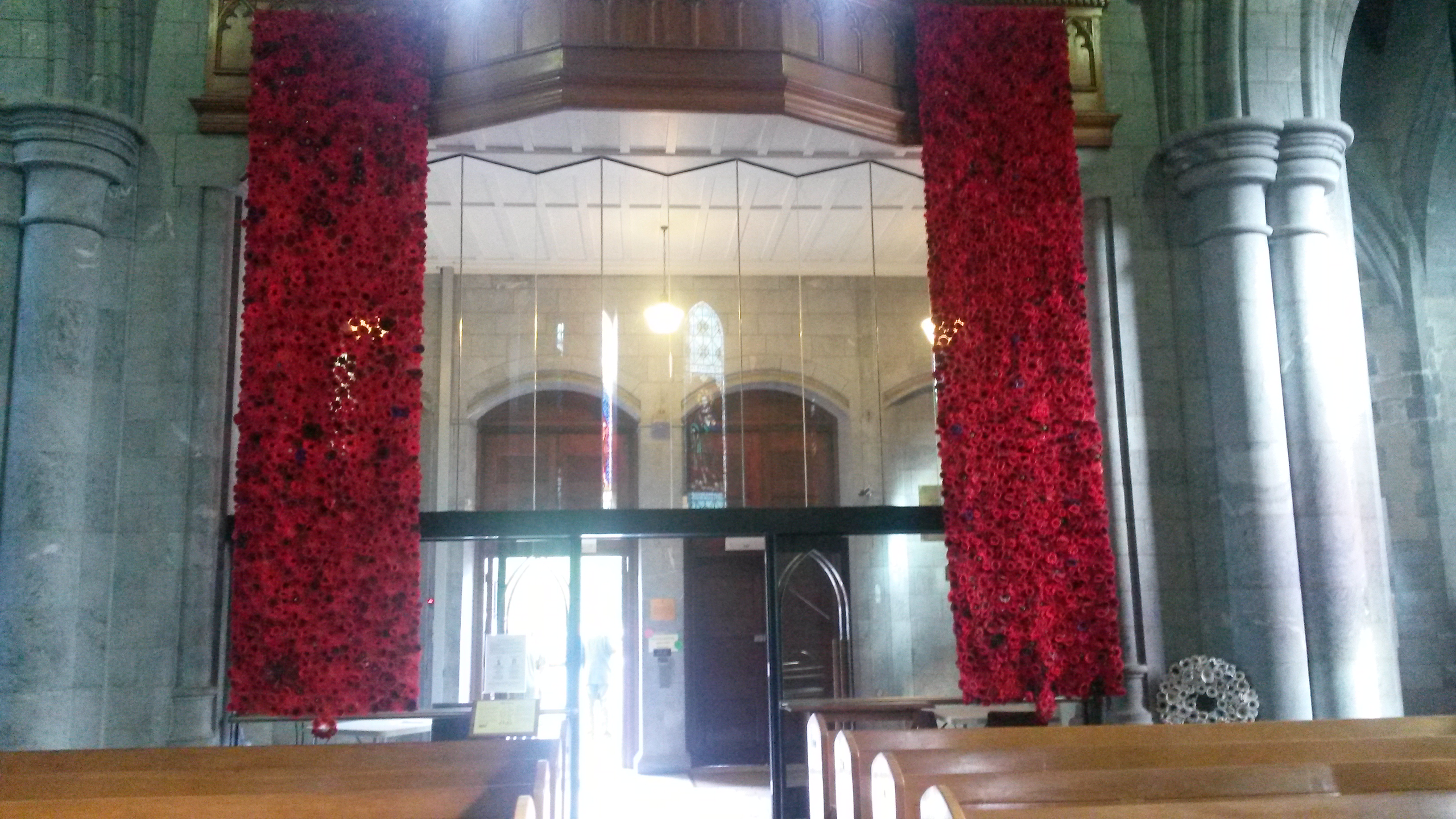
Two trains of roses have been placed down the inside the back wall at the entry of Nelson Cathedral, New Zealand.

The following is my choice of a war poem and it is ANZAC (Australian and New Zealand Army Corps) day today when the ‘World War 1 Gallipoli’ campaign is on the minds of Australians and New Zealanders. This year also marks hundred years since the birth of Judith Wright in 1915. This is a generic poem about pending dark days as war approaches.

The Trains

Tunnelling through the night, the trains pass
in a splendour of power, with a sound like thunder
shaking the orchards, waking
the young from a dream, scattering like glass
the old mens’ sleep, laying
a black trail over the still bloom of the orchards;
the trains go north with guns.

Strange primitive piece of flesh, the heart laid quiet
hearing their cry pierce through its thin-walled cave
recalls the forgotten tiger,
and leaps awake in its old panic riot;
and how shall mind be sober,
since blood’s red thread still binds us fast in history?
Tiger, you walk through all our past and future,
troubling the children’s sleep’; laying
a reeking trail across our dreams of orchards.

Racing on iron errands, the trains go by,
and over the white acres of our orchards
hurl their wild summoning cry, their animal cry….
the trains go north with guns.

Judith Wright

The first stanza reminds me of the time I was staying in a rondavel in a valley in South Africa when on the way to Durban. The trains disturbed my sleep as high up they trundled through tunnels in the hills making an eerie sound at the same time. Trains are very powerful images and coming suddenly at night representative of the foreboding onset of war. And more importantly these lines show how both old and young would be affected. The young might dream of adventure unknowing of the nature of war and being easily misled by any recruitment drive, whereas the old know only too well what is at hand and their hope for the the next generation is shattered like broken glass. The peace of the orchard is now clouded by the events which were unfolding represented by the trail of black smoke over white spring blossom. The trains are going north with guns and this was appropriate to the Australia situation as Darwin was first in line in the Second World War.

The second stanza likens the war-trait in the human condition to a tiger within the blood of all generations. It seems this tiger will always be present to trouble each generation and as in the first stanza reeking a trail across our dreams for peace (orchards). And how can mind be sober when it has to confront the terror of this tiger. It seems that the mind of man has to continually deal with war in whatever form. The last lines highligh the manic-force with which the war-cry manifests, represented by the trains travelling on iron errands, rather than iron rails. It is an animal cry reflecting the ever present unstoppable base elements of the human condition.

As the world gets smaller and smaller war and conflict is quicky brought to our attention by the media – wherever it is occuring, so you could say that ‘train-noise’ is a more frequent visitor to the background of the mind. Whether this awareness makes the world better equiped to deal with such situations is another matter – but we live in hope.

yesterday the earth shook
today there are poppies every where

We give thanks that we are lucky enough to live where peace prevails!

I have also commented on this poem on my previous Site.

   … and the following are links to previous ANZAC Day Posts …

Previous ANZAC Day words 2014

Previous ANZAC Day words 2013

The Weather Dictates? – and from New Zealand …

How much of poetry is dictated by the weather. Put another way how much does weather dictate poetry. I came across the following in a Hotel in New Zealand …

RainPoem

Here are the words from the above image …

Remember when it always used to rain. Fifty years ago a visitor to Hokitika (a town on the west coast of South Island) wrote the following after receiving a week of unseasonable weather.

It rained and rained and rained –
the average fall was well maintained.
and when the tracks were simply bogs
it started raining Cats and Dogs.
After a drought of half and hour,
we had a most refreshing shower,
and then the most curious thing of all
a gentle rain began to fall.
Next day was also fairly dry,
save for a deluge from the sky,
which wetted the party to the skin,
and after that the rain set in.

Well what do you  do when confined by the weather and nothing to do – this person vented his frustration in the above words – which probably forced a non-poet into such expression.

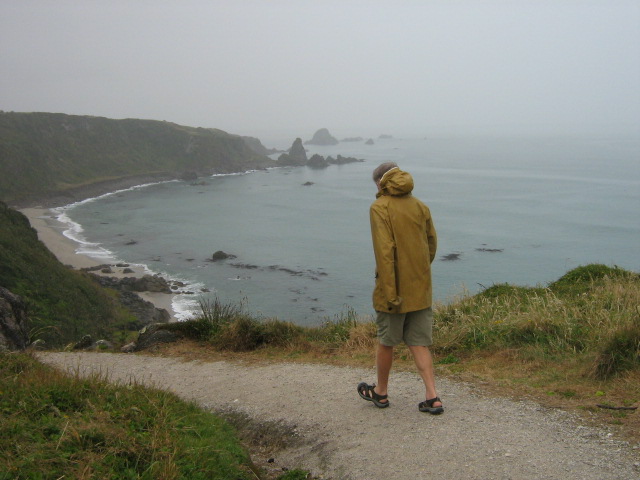
Here is a New Zealand poem written after walking on the cliffs at Cape Foulwind, Westport, South Island – and as the name suggests a most unhospitable place. However, the view of the seals playing on the rocks at the foot of cliffs was well worth the discomfort of the walk in the wet.

CapeFoulwindWalk

Cape Foulwind Walk

on a summer day winter crowds-in to submerge
the sky and sea sweep together enclosing thoughts
no imagination is needed for this foul named place
this country continually perforated by wind driven rain

the weather deepens impregnating every footstep
the old gortex has had its day and dampens from the inside
but the path is set along the cliffs to the promised sight of seals
as wekas scout around before darting to their rabbit hole existence

then that point is reached when saturated by the wet
there is a resigned acceptance absorbed to the conditions
but when wailing gutteral sounds waft up in the squall
thoughts turn inside out to the rocks far below

oblivious of any impending storm, with thick skin immunity,
at home, on vacant rock spaces, in waterhole pools,
and indolent in the continual spray of the Tasman chunder,
the seals slub around regardless, in elemental play

Seal

Richard Scutter 15 March 2010

Weka – Flightless New Zealand bird about the size of a chicken

The Poet, The Poem – George Mackay Brown

The Poet

Therefore he no more troubled the pool of silence
But put on mask and cloak,
Strung a guitar
And moved among the folk.
Dancing they cried,
‘Ah, how our sober islands
Are gay again, since this blind lyrical tramp
Invaded the Fair.’

Under the last dead lamp
When all the dancers and masks had gone inside
His cold stare
Returned to its true task, the interrogation of silence.

George Mackay Brown

Poem

Seven scythes leaned at the wall.
Beard upon golden beard
The last barley load
Swayed through the yard.
The girls uncorked the ale.
Fiddle and feet moved together.
Then between stubble and heather
A horseman rode.

George Mackay Brown

George Mackay Brown (1921-1996) is one of the most well-known of Scottish poets. He was born in Stromness in the Orkney Islands, the last child of a poor family. He spent all his life in Stromness apart from time at Edinburgh for education as an adult and apart from a visit to Oxford. He was a sick child suffering from tuberculosis and was not able to enter the war or engage in steady employment. His family had a history of depression.

His poetry is poetry of place and although the Orkneys has a brutal dramatic climate his words are simple, cut to the raw bone without hyperbole – very much his own Orcadian voice – and much respected for bringing notice to this part of Scotland. He was somewhat of a drinker and well known in Stromness throughout his life-time as he walked around town.

Details on Wikipedia – http://en.wikipedia.org/wiki/George_Mackay_Brown

… and for those that need information on the Orkneys – http://www.orkneyjar.com/orkney/index.html

Looking at the two poems – ‘The Poet’ … this is a clear definition of himself – I love that first line no more to trouble or be troubled by the pool of silence … so he puts on his mask and coat to go out to the Pub – a different hat from his poetry hat … rejoicing in the Orcadian community life – I hope not to be blinded by alcohol! But when it is closing time, and he last to leave … under the last dead lamp … perhaps going home at dawn … it is time to face the silence again … his calling ‘to interrogate silence’. The cold stare gives hint of a depressive life.

The second poem is simply called ‘Poem’ – He valued the simple pleasures of life and the rural lifestyle of his day – work in the fields and then to the Pub – but between ‘stubble and heather a horseman rode’ … this can be seen as an interruption to this ideal life – an ominous threat to what the future might hold … and on an individual basis one of the free-fun-loving girls might soon be whisked away into married life. As in a good poem it is left to the reader to complete.