Piazza Piece – John Crowe Ransom

Piazza Piece

–I am a gentleman in a dustcoat trying
To make you hear. Your ears are soft and small
And listen to an old man not at all;
They want the young men’s whispering and sighing.
But see the roses on your trellis dying
And hear the spectral singing of the moon;
For I must have my lovely lady soon,
I am a gentleman in a dustcoat trying.

–I am a lady young in beauty waiting
Until my truelove comes, and then we kiss.
But what grey man among the vines is this
Whose words are dry and faint as in a dream?
Back from my trellis, Sir, before I scream!
I am a lady young in beauty waiting.

John Crowe Ransom

This is a Petrarchan sonnet – an eight line octave plus a six line sestet (with rhyme scheme ‘abbaacca’ / ‘addeea’). It is a well-crafted delightful conversation piece ostensibly between a gentleman wooing a young and beautiful lady.

The first line and the last line of the octave are the same. This is the story of the octave that of the gentleman trying to get the attention of the young and beautiful lady. The gentleman is old wearing a dustcoat and talks of the fading nature of the lady in terms of roses. He states emphatically that he must have my lovely lady soon and there is a ghostly presence in the spectral singing of the moon.

The first line and the last line of the sestet are the same and this is the story of the response – a lady young in beauty waiting and waiting for her truelove. The lady is young and dismissive of the grey old man and only hears him as in a dream.

I think this is really the age old story of a ‘romantic death’ in the form of a gentleman and his relationship with ‘life’ and making the most of life and the present moment. And of course the voice of death will become more prominent in the ears of the lady and eventually the old grey man will win her over. It is interesting that death is masculine and ghostly whereas life is feminine and beautiful. And very appropriate that the gentleman is wearing a dustcoat. I think there is something of a sweet pending marriage of the two taking place in this poem.

This poem gives emphasis to the present and not having idealistic expectations. Life is a present to be opened and used now– not waiting for that perfect moment before acting (carpe diem Latin – seize the day). Maybe it is time to open that special bottle of wine you have been keeping in your cellar!
Here is a link to John Crowe Ransom on Wikipedia 

Ode on the Poets – John Keats

Ode on the Poets

BARDS of Passion and of Mirth
Ye have left your souls on earth!
Have ye souls in heaven too,
Double-lived in regions new?

—Yes, and those of heaven commune
With the spheres of sun and moon;
With the noise of fountains wonderous
And the parle of voices thunderous;
With the whisper of heaven’s trees
And one another, in soft ease
Seated on Elysian lawns
Browsed by none but Dian’s fawns;
Underneath large blue-bells tented,
Where the daisies are rose-scented,
And the rose herself has got
Perfume which on earth is not;
Where the nightingale doth sing
Not a senseless, trance´d thing,
But divine melodious truth;
Philosophic numbers smooth;
Tales and golden histories
Of heaven and its mysteries.

Thus ye live on high, and then
On the earth ye live again;
And the souls ye left behind you
Teach us, here, the way to find you,
Where your other souls are joying,
Never slumber’d, never cloying.
Here, your earth-born souls still speak
To mortals, of their little week;
Of their sorrows and delights;
Of their passions and their spites;
Of their glory and their shame;
What doth strengthen and what maim:—
Thus ye teach us, every day,
Wisdom, though fled far away.

Bards of Passion and of Mirth
Ye have left your souls on earth!
Ye have souls in heaven too,
Double-lived in regions new!

John Keats

Ode – lyrical poetic form … meant to be sung … 50 to 200 lines

Of their sorrows and delights
^ ^ ^^ ^ ^^
Strong seven syllable iambic rhythm

Keats is famous for his odes this is not one of his well-known like ‘Ode to a Nightingale’.

S1 and S2 … the first four lines question whether poets have a soul in any after-life … then from line five we have a view of heaven in terms of the nature of earth – daisies are rose-scented … always an impossible task to come to terms with the undefinable nature of heaven … but of course very fitting to use a garden image. It is nice and poetic to think of heaven in such positive terms. A gift in the mind of the living for those poets who have departed this life.

Elysian lawns = the final resting places of the souls of the heroic Dian’s fawns = the goddess of hunt, moon and childbirth who could talk to and control animals (Greek Mythology)

S3 …If the departed have an after-life soul then this stanza states there is communication with their earth-born soul – Here, your earth-born souls still speak … and the communication is very positive – Thus ye teach us, every day / Wisdom, though fled far away. This is apart from any words left behind which are brought to life by the living ( I immediately think of the ‘The Dead Poets Society’).

The first and last four lines of the poem give emphasis on the duality of the soul – for those that belief in some kind of after-life. The nature of any on-going connectivity between the living and the departed poet is up to the reader to discover.

Keats wrote his poetry in seven years from a teenager up to his untimely death at the age of twenty five. He died of ‘consumption’ (TB) in Rome – he went to Italy seeking a better climate because of illness. He had trained in medicine and it is ironic that the medical assistance at that time promoted his early demise. Unfortunately he was not given opium to alleviate his painful end. His soul lives on below the clouds.

A link to Keats on Wikipedia

The Road through the Woods – Rudyard Kipling – Analysis

The Road through the Woods

They shut the road through the woods
Seventy years ago.
Weather and rain have undone it again,
And now you would never know
There was once a road through the woods
Before they planted the trees.
It is underneath the coppice and heath
And the thin anemones.
Only the keeper sees
That, where the ring-dove broods,
And the badgers roll at ease,
There was once a road through the woods.

Yet, if you enter the woods
Of a summer evening late,
When the night-air cools on the trout-ringed pools
Where the otter whistles his mate,
(They fear not men in the woods,
Because they see so few.)
You will hear the beat of a horse’s feet,
And the swish of a skirt in the dew,
Steadily cantering through
The misty solitudes,
As though they perfectly knew
The old lost road through the woods …
But there is no road through the woods.

Rudyard Kipling

Nice balance between the two stanzas and I like the internal rhyme … the first stanza defining the history of the area and the second exploring any on-going effect … a ghostly mystical effect as though the environment retains an imprint of its history and can speak to those sensitive to such communication … one negative – I question the need for the comment about the otter – it detracts.

And this could be regarded as an early environmental poem … an anti-development poem perhaps, and showing the after effect of mans’ intrusion on nature.

S1 … tells the story of change when once there was a road, presumably not bitumen, and now the road has been replaced by both man and nature … and to look at the environment you would never know that once it had been a thorough fare … however, the keeper knows … the person who looks after the area … he knows that the woods has been violated – perhaps ‘violated’ is the wrong word for the road through the woods might have been environmentally friendly … however the anemones are only thin now implying the old road still has a negative effect.

S2 … poses a question can the imprint from the past be heard again … at special times when more sensitive and when the ‘ghosts’ are likely to emerge … in this case the horses may have known the old road which could help their recall to previous times when they travelled through this area, especially if it was on a regular basis … I think animals have a greater sense to where they have been.

The last two lines in S2 says it all … although something has gone it is still alive – for those that have experienced the past … perhaps all experience is retained to some degree … the mind a continuous growing memory bank … and digressing as we age we start to recall events long forgotten … of course inanimate objects speak or show their past in their very own different ways … I like the element of mystery evident in the poem – a good poem should always make people think – don’t you think?

Rudyard Kipling is better known for his books especially ‘The Jungle Book’ here is a link to Wikipedia 

However, his poem ‘If’ – is very well known and was head of a popularity count in the UK in the nineties.

And here is Walter de la mere’s well-known poem ‘The Listners’ with an element of mystery

Prayer – Carol Ann Duffy – Analysis

Prayer

Some days, although we cannot pray, a prayer
utters itself. So, a woman will lift
her head from the sieve of her hands and stare
at the minims sung by a tree, a sudden gift.

Some nights, although we are faithless, the truth
enters our hearts, that small familiar pain;
then a man will stand stock-still, hearing his youth
in the distant Latin chanting of a train.

Pray for us now. Grade 1 piano scales
console the lodger looking out across
a Midlands town. Then dusk, and someone calls
a child’s name as though they named their loss.

Darkness outside. Inside, the radio’s prayer –
Rockall. Malin. Dogger. Finisterre.

Carol Ann Duffy

Minim = a musical note with the time value of half a semibreve or two crotchets. It is written as an open note head with a stem.
Train = long moving line of people

Looking at this sonnet …

The first quatrain … when in the middle of a task something to the peripheral arrests attention … in this instant a voice from the trees … as though someone else is speaking and there is communion with the environment … the woman stops what she is doing and for one brief moment there is an appreciation of life … the joy of just being.… there is a gift of thanks … or putting it another way this can be thought of as a prayer of thanks whether or not just a thank you for life or whether a thank you to another ‘God’.

The second quatrain … prayers happen regardless of any formal faith … night is the time when the mind is vulnerable … and often in those sleep hours thoughts occur seemingly out of nowhere… and if the truth of the matter unravels there is usually some pain and discomfort from this communion in any resolution.

Maybe hearing a piece of music gives association to something way back from his youth … perhaps to a time when the man was more motivated and a time when he was following his young heart with strong purpose … and again this may be painful and the man may seek consolation if reflecting on unfilled dreams.

The third quatrain … pray for us now – this looks like an ask … an ask for help and we all need help and support in order to give help and support … prayer is defined as a solemn request or a giving of thanks to an object of worship (usually God) … so this is an ask for us to ask our ‘God’ for help for those in need … to invoke an external force … if the lodger needed consolation then the Grade 1 piano scales could be seen as a response to prayer. The last sentence seems to show a person in grief … as though they named their loss … in grief for a child and in need of consolation … in need of prayer

The rhyming couplet … mentioning the shipping forecast invokes a prayer for those at sea … a prayer that sailors may be able to heed the information and not risk life … darkness outside gives the feeling that prayer is a mystery and hidden … whereas inside the radio’s prayer gives the other side of the coin that prayer always emanates from the internal reaching out from the person

Re: shipping forecasts … the unique and distinctive sound of these broadcasts has led to their attracting an audience much wider than that directly interested in maritime weather conditions. Many listeners find the repetition of the names of the sea areas almost hypnotic, particularly during the night-time broadcast at 0048 UK time. (from Wikipedia)

I do like this sonnet as it widens the concept of traditional prayer and brings prayer down to the basics of everyday communication in the living of life.

And to end, –  a prayer that our daily transactions are appropriate as we negotiate life!

Let us drink and be merry – Thomas Jordan

Let us drink and be merry

Let us drink and be merry, dance, joke, and rejoice,
With claret and sherry, theorbo and voice!
The changeable world to our joy is unjust,
All treasure’s uncertain,
Then down with your dust!
In frolics dispose your pounds, shillings, and pence,
For we shall be nothing a hundred years hence.

We’ll sport and be free with Moll, Betty, and Dolly,
Have oysters and lobsters to cure melancholy:
Fish-dinners will make a man spring like a flea,
Dame Venus, love’s lady,
Was born of the sea:
With her and with Bacchus we’ll tickle the sense,
For we shall be past it a hundred years hence.

Your most beautiful bride who with garlands is crown’d
And kills with each glance as she treads on the ground.
Whose lightness and brightness doth shine in such splendour
That one but the stars
Are thought fit to attend her,
Though now she be pleasant and sweet to the sense,
Will be damnable mouldy a hundred years hence.

Then why should we turmoil in cares and in fears,
Turn all our tranquill’ty to sighs and to tears?
Let’s eat, drink, and play till the worms do corrupt us,
’Tis certain, Post mortem
Nulla voluptas.
For health, wealth and beauty, wit, learning and sense,
Must all come to nothing a hundred years hence.

Thomas Jordan (1612-1685)

The poem is well crafted – iambic with rhyming couplets – it has been labelled a song and it does have a nice rhythmic beat.

Theorbo – plucked string instrument of the lute family
Venus – Goddess of love and beauty
Bacchus – God of wine
Post mortem nulla voluptas – after death no pleasure remains

Interesting that oysters were known as an aphrodisiac over four hundred years ago.

Well it is the season to be merry. Thomas Jordan is not thinking of Christmas – quite clearly he is thinking of death of where he, or others, will be in a hundred years’ time.

To me the words have a sense of ‘must’ and a sense of urgency while accepting that we only have this moment – the now to be enjoyed in all its’ fullness. But in my book when you try to force merriment the party often falls flat.

Having said that I insist you have a ‘merry’ Christmas.

Anyway isn’t Christmas the celebration of the birth of life eternal so who knows what pleasures will be unwrapped in the future! Well one day we all may know.

A link to Thomas Jordan on Wikipedia.

Poetry and Influence

To what extent can poetry influence the world … well, for that matter, to what extent can any words or thoughts change behaviour and influence life. It is happening all the time of course … we all contribute in one way or another. Today the influence of  the internet and social networking is a very powerful force … that is another issue.

And for those who believe in a ‘living creator’ … how is ‘this voice’ made manifest in the on-going life of the world – if at all?

Song of the Universe

Every Voice
Endless Rapture
Your

Voice
Oration Instilled
Creating Eternity

Some days we may not hear great harmony.

Below is the text I wrote for a local Anglican publication a couple of days after the terrorist attack in Paris.. It happened to be on ‘International Tolerance Day’.

Paris Aftermath

Where to now after such a vile act that everyone is finding hard to comprehend? How should we deal with those that foster terrorism abroad and how do we deal with the self-proclaimed terrorist Islamic State when any form of negotiation is impossible?

Anger and fear may generate more violence in the form of retaliation and revenge. And unfortunately increased polarisation is inevitable. Annihilation of the enemy and from a distance to minimise personal loss is always going to be a short term band aid solution.

The following poem was written to counteract those that think the only solution is violence and annihilation. Terrorists for all their blatant sins happen to be human so on this ‘International Day of Tolerance’ it is well to remember this fact.

Closure
in memory of a twelve year old who self-detonated
early to save lives

don’t slam the door kid, when you leave your room
don’t slam the door tight when you enter the night
go quietly; go gently, as you enter the night
go gently as you vanish from sight

at that age when there is no age
and when the rolling of the years
matters only to another
and the inscription on the wall
is left for others to recall
and when they resurrect your name
will they relinquish certain blame?
let them shed their tears kid!

how can that have any meaning
is there meaning in a flower?
you knew exactly who you were kid!

don’t slam the door kid when you leave your room
don’t slam the door tight when you enter the night
go quietly; go gently, as you enter the night
go gently as you vanish from sight

Footnote …

The long term solution will lie with succeeding generations – ‘the hand that rocks the cradle rules the world’. It is imperative that we instil in our children a sense of value and respect for life – their own life and the life of others – in particular to be inclusive of all peoples no matter what religion. Tantamount to this text is the ability to think for oneself without being misled by the mob. Hopefully such values will stay with them throughout their days in that great endeavour to make the world a better place.

Being an optimist I know that one day peace will again come to the troubled regions of our world.

In the words of Gerard Manley Hopkins ‘The world is charged with the grandeur of God’.

Enjoy the beauty of this day and the wonder of creation.

Richard Scutter 16 November 2015

The Moor – R. S. Thomas Analysis

The Moor

It was like a church to me.
I entered it on soft foot,
Breath held like a cap in the hand.
It was quiet.
What God there was made himself felt,
Not listened to, in clean colours
That brought a moistening of the eye,
In a movement of the wind over grass.
There were no prayers said. But stillness
Of the heart’s passions — that was praise
Enough; and the mind’s cession
Of its kingdom. I walked on,
Simple and poor, while the air crumbled
And broke on me generously as bread.

R. S. Thomas: The Moor, from Pietà, 1966

R. S. Thomas was an Anglican minister so he knew exactly what ‘traditional church’ was like but in this poem he discovers a different church while walking on his local Welsh moorland.

One enters a church with reverence taking the hat off and you expect a certain quiet – that is if there is no service in progress – so this description is an apt translation as he sets foot on the moor. And by holding his breath giving greater attention to the surrounding as he first sets foot on the moor.

But in this ‘church’ there is no listening to God via the pulpit. Here God is known as a feeling. The clean colours implying perhaps that the moor is clean and sinless – so we may assume there is no litter to corrupt the eye. If it was a windy cold day then that may have provoked a watering of the eye. On the other hand the feeling of the presence of God due to the beauty of the moor may have been so overwhelming that this caused such moisturising.

In church communication with God is by prayer – but on the moor there is direct communication between God and man via the environment.  The stillness of the heart’s passions is communication if considered as a religious response from walking on the moor in the form of a settling peace within the poet. This could then be regarded as an automatic prayer of both praise and thanks – especially by R. S. Thomas being tuned to religious thought.

The mind’s cession of its kingdom gives an emphasis to the exhilaration in this moment such that the mind is expanded in wonderment in trying to give comprehension. But then the move as he walks on – the breaking away from this intense communion – clearly likened to a church communion where there is the breaking of bread.

I think in today’s twenty four by seven world we all need to find time to escape into a place of solitude – to find our own moor and perhaps in the still and beauty of a such a sacred place experience the presence of God and a settling within. If my bible memory is correct JC had to do likewise when he was overwhelmed by the masses that pressed in on him.

R. S. Thomas on Wikipedia.

Here are some wonderful images of the Welsh Moor on Tom Clark’s Blog.

Fruhlingsglaube – Johann Ludwig Uhland and Schubert

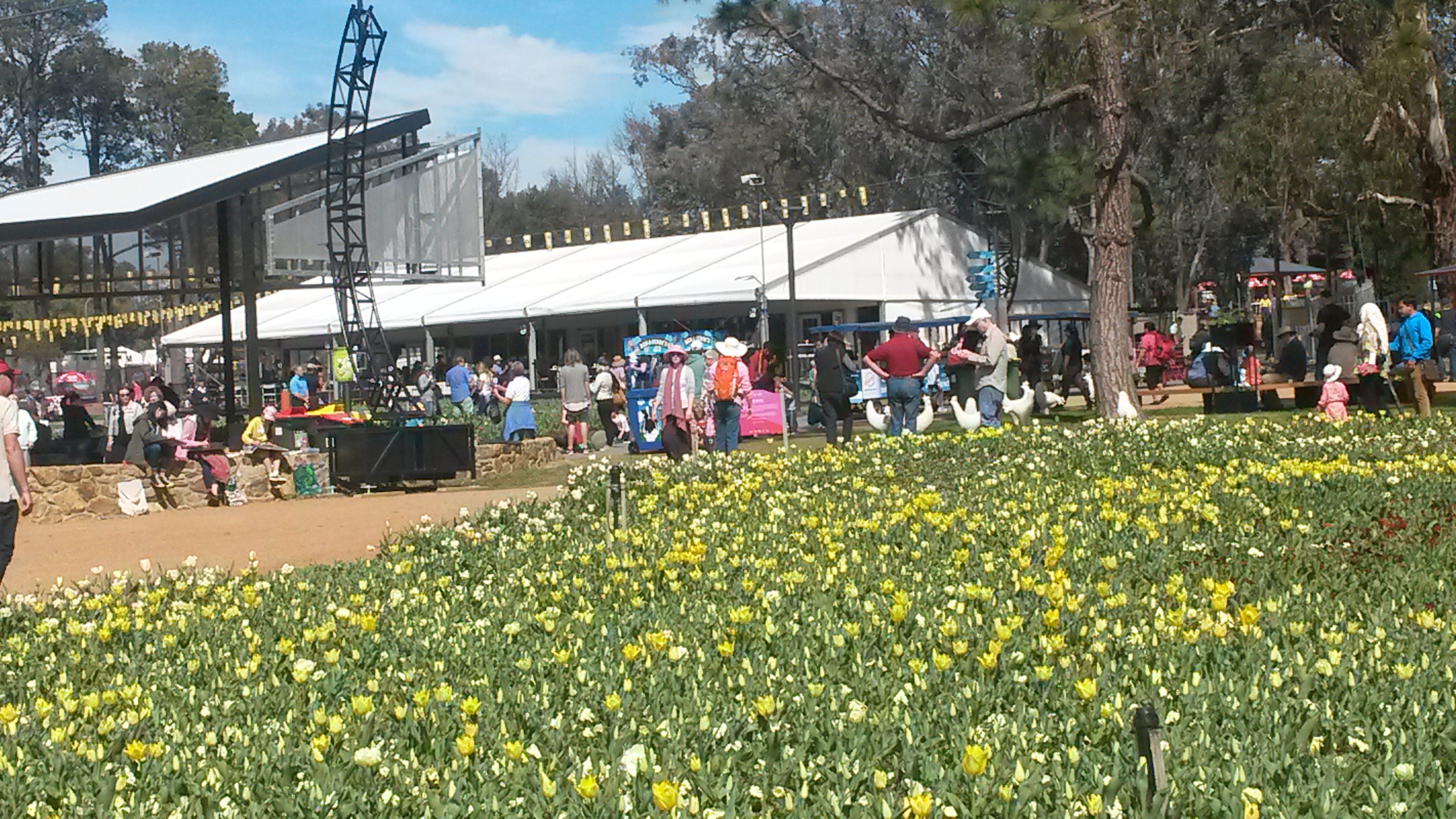
Floriade15Floriade – Spring Flower Festival in Commonwealth Gardens Canberra

It is Spring in Australia and here is a German poem by the romantic lyric poet Johann Ludwig Uhland (1787-1862).

Fruhlingsglaube

Die linden Lüfte sind erwacht,
Sie säuseln und wehen Tag und Nacht,
Sie schaffen an allen Enden.
O frischer Duft, o neuer Klang!
Nun, armes Herze, sei nicht bang!
Nun muß sich alles, alles wenden.

Die Welt wird schöner mit jedem Tag,
Man weiß nicht, was noch werden mag,
Das Blühen will nicht enden;
Es blüht das fernste, tiefste Tal:
Nun, armes Herz, vergiß der Qual!
Nun muß sich alles, alles wenden.

Below are two translations from the internet …

Spring’s Faith (re: this Blogspot post)

The mild breezes are awakened,
They whisper and move day and night,
And are at work everywhere.
O fresh scent, o new sound!
Now, poor heart, don’t be afraid.
Now all, all must change.

The world is more beautiful with every day,
One knows not what yet may be,
The flowering will not end.
Even the deepest, most distant valley blooms.
Now, poor heart, forget your torment.
Now all, all must change.

Faith in Spring (Re -Poemhunter)

The gentle winds are awakened,
They murmur and waft day and night,
They create in every corner.
Oh fresh scent, oh new sound!
Now, poor dear, fear not!
Now everything, everything must change.
The world becomes more beautiful with each day,
One does not know what may yet happen,
The blooming doesn’t want to end.
The farthest, deepest valley blooms:
Now, poor dear, forget the pain!
Now everything, everything must change.

This highlights the problems with translations. It is a often a matter of personal taste for some words may be more fitting to the theme than others. It is up to the reader to choose. It may be a case of taking a combination from various translations to fit your preference. For example the first three lines could be as follows …

The gentle winds awake – (I prefer gentle to mild)
They murmur and waft day and night
And are at work every where

However of more importance, this poem inspired Franz Schubert‘s, (1797-1828) to compose a lieder and this is a link to a Youtube video of Dietrich Fischer-Dieskau singing Fruhlingsglaube  … and here is the text from this song …

the gentle breezes have awakened,
they whisper and float day and night,
they create on all sides.
On all sides.
O fresh fragrance, O new sound!
O new sound!
Now, poor heart, be not afraid!
Now all, all must change.

The world becomes more beautiful with every day,
No one knows what may become,
The blossoming will not end;
It will not end;
It blooms in the farthest, deepest valley:
It blooms in the deepest valley:
Now, poor heart, forget thy pain!
Now all, all must change.

… so again the original poem is transformed and in this case married into a new art-form while still retaining the essence of the text and if you have watched and listened to the Youtube video you will see that ‘Spring images’ also accompany both the audio and the words.

Clearly if it hadn’t been for Schubert this poem would not have reached such prominence in the public ear.

Considering the line … The world becomes more beautiful with every day … I immediately thought of Gerard Manley Hopkins and … The world is charged with the grandeur of God from ‘God’s Grandeur’ – whether or not we are able to see beauty in each day is another matter!