The Trains – Judith Wright – Analysis – ANZAC Day

ANZAC Day 2015

TrainOfroses

Two trains of roses have been placed down the inside the back wall at the entry of Nelson Cathedral, New Zealand.

The following is my choice of a war poem and it is ANZAC (Australian and New Zealand Army Corps) day today when the ‘World War 1 Gallipoli’ campaign is on the minds of Australians and New Zealanders. This year also marks hundred years since the birth of Judith Wright in 1915. This is a generic poem about pending dark days as war approaches.

The Trains

Tunnelling through the night, the trains pass
in a splendour of power, with a sound like thunder
shaking the orchards, waking
the young from a dream, scattering like glass
the old mens’ sleep, laying
a black trail over the still bloom of the orchards;
the trains go north with guns.

Strange primitive piece of flesh, the heart laid quiet
hearing their cry pierce through its thin-walled cave
recalls the forgotten tiger,
and leaps awake in its old panic riot;
and how shall mind be sober,
since blood’s red thread still binds us fast in history?
Tiger, you walk through all our past and future,
troubling the children’s sleep’; laying
a reeking trail across our dreams of orchards.

Racing on iron errands, the trains go by,
and over the white acres of our orchards
hurl their wild summoning cry, their animal cry….
the trains go north with guns.

Judith Wright

The first stanza reminds me of the time I was staying in a rondavel in a valley in South Africa when on the way to Durban. The trains disturbed my sleep as high up they trundled through tunnels in the hills making an eerie sound at the same time. Trains are very powerful images and coming suddenly at night representative of the foreboding onset of war. And more importantly these lines show how both old and young would be affected. The young might dream of adventure unknowing of the nature of war and being easily misled by any recruitment drive, whereas the old know only too well what is at hand and their hope for the the next generation is shattered like broken glass. The peace of the orchard is now clouded by the events which were unfolding represented by the trail of black smoke over white spring blossom. The trains are going north with guns and this was appropriate to the Australia situation as Darwin was first in line in the Second World War.

The second stanza likens the war-trait in the human condition to a tiger within the blood of all generations. It seems this tiger will always be present to trouble each generation and as in the first stanza reeking a trail across our dreams for peace (orchards). And how can mind be sober when it has to confront the terror of this tiger. It seems that the mind of man has to continually deal with war in whatever form. The last lines highligh the manic-force with which the war-cry manifests, represented by the trains travelling on iron errands, rather than iron rails. It is an animal cry reflecting the ever present unstoppable base elements of the human condition.

As the world gets smaller and smaller war and conflict is quicky brought to our attention by the media – wherever it is occuring, so you could say that ‘train-noise’ is a more frequent visitor to the background of the mind. Whether this awareness makes the world better equiped to deal with such situations is another matter – but we live in hope.

yesterday the earth shook
today there are poppies every where

We give thanks that we are lucky enough to live where peace prevails!

I have also commented on this poem on my previous Site.

   … and the following are links to previous ANZAC Day Posts …
Previous ANZAC Day words 2014

Previous ANZAC Day words 2013

The Weather Dictates? – and from New Zealand …

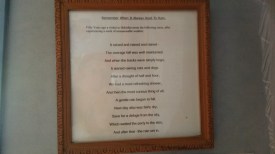
How much of poetry is dictated by the weather. Put another way how much does weather dictate poetry. I came across the following in a Hotel in New Zealand …

RainPoem

Here are the words from the above image …

Remember when it always used to rain. Fifty years ago a visitor to Hokitika (a town on the west coast of South Island) wrote the following after receiving a week of unseasonable weather.

It rained and rained and rained –
the average fall was well maintained.
and when the tracks were simply bogs
it started raining Cats and Dogs.
After a drought of half and hour,
we had a most refreshing shower,
and then the most curious thing of all
a gentle rain began to fall.
Next day was also fairly dry,
save for a deluge from the sky,
which wetted the party to the skin,
and after that the rain set in.

Well what do you  do when confined by the weather and nothing to do – this person vented his frustration in the above words – which probably forced a non-poet into such expression.

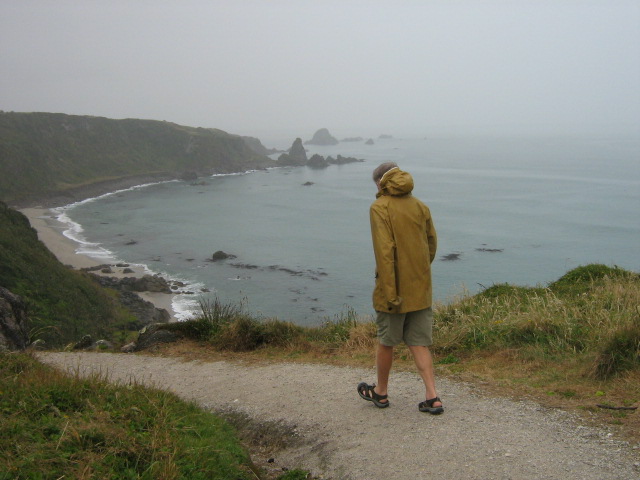
Here is a New Zealand poem written after walking on the cliffs at Cape Foulwind, Westport, South Island – and as the name suggests a most unhospitable place. However, the view of the seals playing on the rocks at the foot of cliffs was well worth the discomfort of the walk in the wet.

CapeFoulwindWalk

Cape Foulwind Walk

on a summer day winter crowds-in to submerge
the sky and sea sweep together enclosing thoughts
no imagination is needed for this foul named place
this country continually perforated by wind driven rain

the weather deepens impregnating every footstep
the old gortex has had its day and dampens from the inside
but the path is set along the cliffs to the promised sight of seals
as wekas scout around before darting to their rabbit hole existence

then that point is reached when saturated by the wet
there is a resigned acceptance absorbed to the conditions
but when wailing gutteral sounds waft up in the squall
thoughts turn inside out to the rocks far below

oblivious of any impending storm, with thick skin immunity,
at home, on vacant rock spaces, in waterhole pools,
and indolent in the continual spray of the Tasman chunder,
the seals slub around regardless, in elemental play

Seal

Richard Scutter 15 March 2010

Weka – Flightless New Zealand bird about the size of a chicken

Black Rook in Rainy Weather – Sylvia Plath – Analysis

Black Rook in Rainy Weather

On the stiff twig up there
Hunches a wet black rook
Arranging and rearranging its feathers in the rain-
I do not expect a miracle
Or an accident

To set the sight on fire
In my eye, nor seek
Any more in the desultory weather some design,
But let spotted leaves fall as they fall
Without ceremony, or portent.

Although, I admit, I desire,
Occasionally, some backtalk
From the mute sky, I can’t honestly complain:
A certain minor light may still
Lean incandescent

Out of kitchen table or chair
As if a celestial burning took
Possession of the most obtuse objects now and then —
Thus hallowing an interval
Otherwise inconsequent

By bestowing largesse, honour
One might say love. At any rate, I now walk
Wary (for it could happen
Even in this dull, ruinous landscape); sceptical
Yet politic, ignorant

Of whatever angel any choose to flare
Suddenly at my elbow. I only know that a rook
Ordering its black feathers can so shine
As to seize my senses, haul
My eyelids up, and grant

A brief respite from fear
Of total neutrality. With luck,
Trekking stubborn through this season
Of fatigue, I shall
Patch together a content

Of sorts. Miracles occur.
If you care to call those spasmodic
Tricks of radiance
Miracles. The wait’s begun again,
The long wait for the angel,

For that rare, random descent.

Sylvia Plath (1957)

This poem was written in 1956 and published in 1957 when Sylvia Plath would have been about 24 years old. She had married Ted Hughes in June 1956 (Bloomsbury Day) and she would have been living in England (Cambridge) and studying. It was the first SP poem that I read and prompted me to find out more about her – and that lead to discovering the relationship with Ted Hughes.

Here is a link to a You-Tube audio of SP reading this poem

Ostensibly this is a poem about boredom and living in a dull wintry environment with no respite from the depressing English weather … (even in this dull, ruinous landscape), remembering too that SP was used to ‘Boston’ weather. But at times miracles occur and simple objects radiate a heavenly aspect. However there are long waits for such happenings – (for that rare random descent).

For me her words underscore the nature of bipolar depression, albeit with a somewhat philosophic acceptance, – the many days of depression broken by an occasional intense high before the onset of many more depressive days. In this regard it is a poem which resonates and I placed a post on the ‘Sylvia Plath Forum’ several years ago which gives an explanation. Here is the link … (you will have to scroll to the archived Post for 27 October 2001).

And I do I like the choice of her words … well poetry was her vocation and she spent much thought in the use of words in expressing her poetic voice. And unlike many SP poems this poem is readily accessible as well as being an honest reflection on her state of mind.

Desultory – unfocused, aimless
Portent – sign, omen
Largesse – generosity, benevolence
Politic – tactful, diplomatic
Incandescent – luminous, radiant
Inconsequent – unimportant, insignificant
Celestial – heavenly, holy

OMG Just Imagine – Easter Sunday

RisenSun

A well and truly risen sun – Murramarang National Park, NSW South Coast

OMG Just Imagine
(Easter Sunday)

OMG Just imagine life without Easter.
We need Easter, holidays might disappear!
Not to mention those rabbit-eared children
running sweet-toothed through our classrooms.
OK it may be egg-centred commercialisation
but there’s no harm in a bit of gaiety!

Even if Easter is a little chocolate coated
Christ always seems to be hanging around,
whether in the background or foreground
depending of course on your point of view!
But without Easter life is a momentary firing
a captivating firework display none the less
but perhaps a series of confused sparks
dying in a sea of perpetual darkness?

Richard Scutter

… and some more Easter Words    … Enjoy your Easter! – Celebrate Life

Sharing some ‘Good Friday’ words

Good Friday or Black Friday

It always seems a misnamed day.
For on the day that Christ died
his followers would hardly have
called it a good day! For them a
day of grief and sorrow. Black Friday
would be a more appropriate label.

They didn’t realise the significance.
Perhaps because of the outcome
that in any sense it is good. And as
this death has unbelievable meaning
it could be regarded good, that is if it’s
possible to believe in the unbelievable!

And think of the consequences if
Christ had not died and lived.