A Message to my Granddaughters

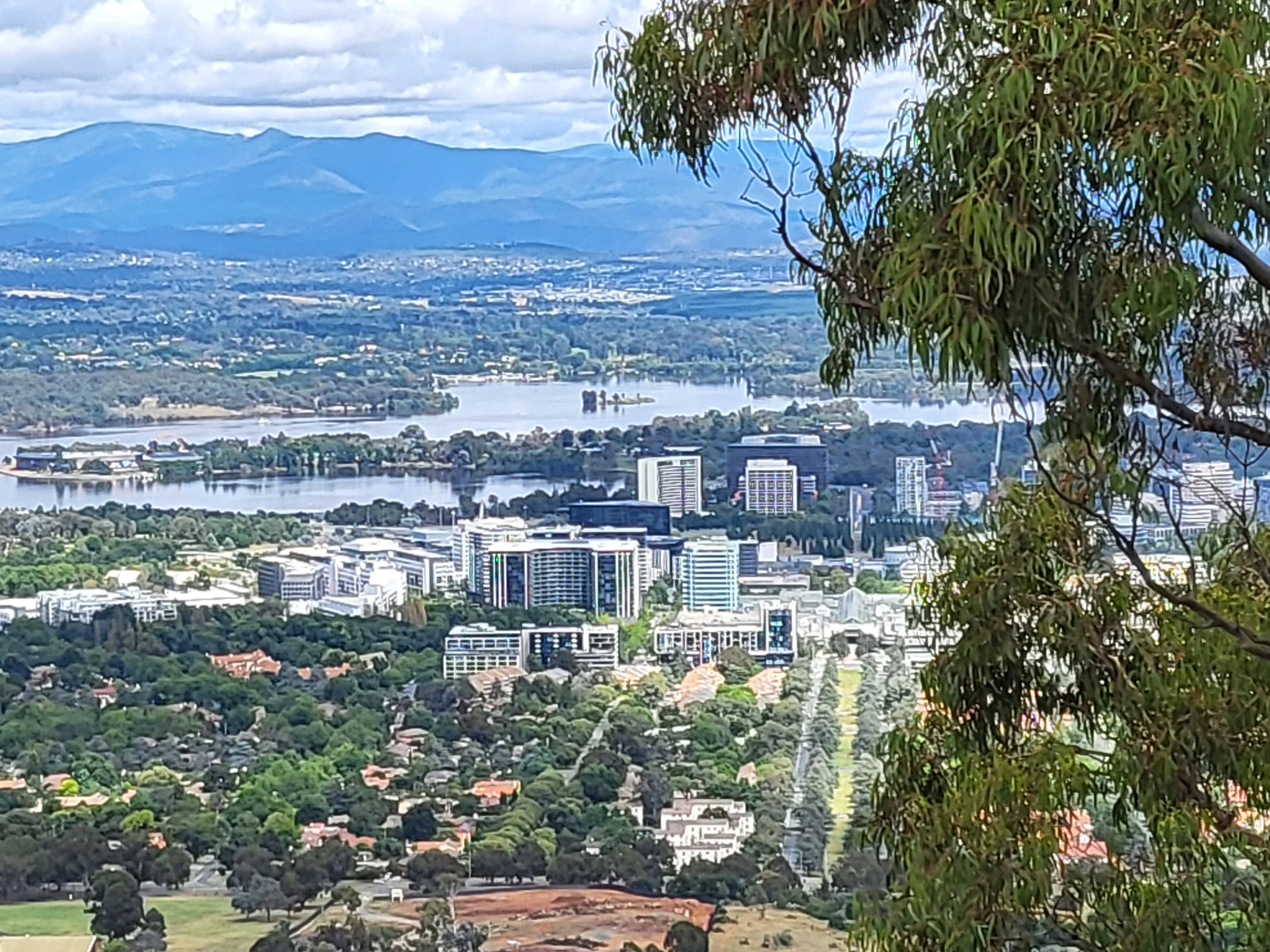
Mt Ainslie, Canberra – looking down on the city centre and Lake Burley Griffin
A Message to my Granddaughters 
in response to Michael Thwaites
Sometimes you slowly still, 
and within a certain satisfaction exudes
into a self-absorbed contentment.
And you say a quiet thank you,
as a peace envelops the soul.
Sometimes you slowly still.
I chose a marvellous city to call home,
the break of morning, the stars departing,
The mirror lake, the cutting Autumn air,
The sun unfolding on the Brindabellas –
I chose a marvellous city to call home.
And what a city, your native city.
The expansive view from Mt Ainslie
portrays Walter Burley Griffin’s plan in 
the continual change of trees, hills, water,
his forever friends in living beauty.
And in this vista, commanding features - 
St John’s Church, the War Memorial,
Civic Centre, The National Library,
the new and old Parliament buildings,
Regatta Point, Commonwealth Gardens,
Capital Hill … and so much more, caught
in the moment of an Autumn morning.
But will you appreciate in likewise fashion 
And will your days stretch to a contented life
and will you, when time falls back against the years,
will you … well, who knows! …
But on this morning, I will say again –
I chose a marvellous city to call home.

Richard Scutter March 2022, Canberra

March is the start of Autumn in Canberra. And this year it has not been a case of a sweltering summer and the autumn change will not be so dramatic; but always a time to appreciate the beauty of the changing colours of the trees.

And on this day, it is a time to value your home wherever you live. Hopefully, your home has not been violated by needless violence generated by future fear from another country.

All the best, Richard

A Message to my Grandson – Michael Thwaites – Comments

A Message to my Grandson
You chose a marvellous morning to be born,
The orange edge of dawn, the stars paling,
The glassy lake, the diamond Autumn air,
The sun breaking in surf on the Brindabellas –
You chose a marvellous morning to be born.
Welcome: And I extend an invitation
To tour your native city; for a start
The view from Ainslie (quite superlative)
Delineates Burley Griffin’s genius, working
After his death, enlisting trees, hills, water
As friends (he hoped) not subjects to his plan.
Then we could visit some outstanding features,
St John’s, the War Memorial, Civic Centre,
The National Library, Parliament House of course,
Regatta Point, the Gardens, Capital Hill…
But those who met you first at your arrival
Have judged my invitation premature.
You were, I hear, quite tired after your journey,
Found our light trying, though intriguing too,
Through flickering lids seemed eager to discover
Just what was going on, but had some trouble
In focusing the things you had in mind,
And close observers felt that you were opting
For further time to orientate yourself.
In point of fact, it seems you waved your hands
In general greeting to your father, mother,
Then, having twice refused some light refreshment,
You went to sleep.
No explanations needed, my dear fellow!
We’ll simply do our tour some other time
Convenient to yourself. The sun is climbing,
The city goes to work, and you are here.
You chose a marvellous morning to be born.
Michael Thwaites (1915 – 2005)

S1 … Autumn is approaching in Canberra, and it is a marvellous time after the heat of summer. The air is so clear and fresh as night temperatures start to drop. The low Brindabella Mountains form an enclosing forever scenic backdrop and surfing is a nice poetic way of expressing any rolling of early mist as it evaporates as the sun takes strength. Birth of a grandson and birth of a day happen to be married to give that special day double remembrance.

S2 … Here is the start of a list of iconic aspects known to Canberrans and those that have visited the city. A tribute to Walter Burley Griffin who was instrumental in the design of Canberra from its very inception, not forgetting his wife who played a dominant part. The beauty of the city is emphasised on this day of beginnings. Canberra does have three distinct Mountains that give splendid views of the city, one of which is Mt Ainslie. Canberra is a Capital city if you excuse the pun.

S3 … First light in the birth with a witty touch of thought by clever use in the personification of the mind of baby. An arrogant wave of hand from baby as he decides enough for now, a little sleep is needed. The suggestion of royalty is so apt.

S4 … Acceptance that much time is needed for baby to understand the city. The sun is climbing / the city goes to work, and you are here. And this is what makes a marvelous autumn morning so more meaningful.

Regarding the invitation for a future understanding, I do not know whether his grandson came to value the city in such a way.

Website – A Message to my Grandson | ThwaitesLink

Wikipedia – Michael Thwaites AO was an Australian academic, poet, and intelligence officer.

To Lucasta, Going to the Wars – Richard Lovelace – Comments

To Lucasta, Going to the Wars
Tell me not (Sweet) I am unkind, 
         That from the nunnery
Of thy chaste breast and quiet mind
         To war and arms I fly.
True, a new mistress now I chase, 
         The first foe in the field;
And with a stronger faith embrace
         A sword, a horse, a shield.
Yet this inconstancy is such 
         As you too shall adore;
I could not love thee (Dear) so much,
         Lov’d I not Honour more.
Richard Lovelace (1617 – 1657)

This is a well-known poem by Richard Lovelace who is known as a cavalier poet.  He strongly supported the royalty at the time of the Civil War. It was a very turbulent time in England. He did get injured in battle and eventually died of his wounds.

S1 … RL is trying to placate Lucinda. A religious person perhaps and peace loving

S2 … RL being a soldier gives focus to a new mistress. This implies that a different kind of love is involved.

S3 … RL states that he would not be loved or respected if such Honour were not obeyed. He would not be true to himself. Again, a placating voice.

What exactly is honour and does honour always have precedence? Honour – the quality of knowing and doing what is morally right. Well, we all must make tough decisions according to our conscience.

Richard Lovelace on Wikipedia

The World Peace Bell – Canberra

The Rotary World Peace Bell, Nara Park, Canberra

The inscription at the memorial, attributed to Laozi – Chinese Poet and Philosopher …

If there is to be peace in the world, there must be peace between nations. 
If there is to be between nations, there must be peace in the cities.
If there is to be peace in the cities, there must be peace within neighbours.
If there is to be peace within neighbours, there must be peace at home.
If there is to be peace at home, there must be peace in the heart.

Laozi – Lao Tzu, also rendered as Lao-Tze, was an ancient Chinese philosopher and writer. He is the reputed author of the Tao Te Ching, the founder of philosophical Taoism, and a deity in religious Taoism and traditional Chinese religions.

Laozi on Wikipedia – Laozi – Wikipedia

Details –
In partnership with the World Peace Bell Associationthe Rotary Club of Canberra Burley Griffin built the Canberra Rotary Peace Bell within the Canberra Nara Peace Park precinct on the shores of Lake Burley Griffin.

Officially launched on 23 February 2018 the bell provides a destination in Nara Park to remind us that we want a peaceful World.

Canberra has a sister city relationship with Nara, Japan

An appropriate time to ring out for world peace. Let us not underestimate the power of prayer and communal thought for peace.

Australia Day – A Personal Poem

The Galileo Galilei – Courtesy of the Western Australia Museum, Perth

Australia, Australia, Australia
It was the dignified ship horn blasts that heralded hello 
together with the salute from a myriad of smaller craft
that highlighted the welcome …
… giving their shake wave acknowledgement 
against the magnificence of our sizeable vessel - 
the ‘Galileo’. The ship moved at a stately slow pace.
As the bow cut gracefully in the still sea, it was 
as if, from the depths, a bubbling champagne effervescence
glittered glorious Spring sunshine into life.
That unforgettable early Sunday morning in September 1969. 
After four weeks, standing on top deck with ‘Rottnest Island' on the right, 
and ‘Fremantle’ discernible and increasing in definition.
That first impression, the hello to a new life, 
a new country, a new week, and that first day
of my beginning -
Australia, Australia, Australia
I try to hold on to that memory, 
of that initial day. Like catching a new fish, 
fresh out of the sea.
That amazing sight of something stunningly beautiful 
just caught and held against the light of day - 
those first few moments.

Australia, Australia, Australia

Richard Scutter 26 January 2022, Australia Day

Galileo Galilei – A Lloyd Triestino ship built in 1963 that plied migrants from Italy to Australia
Rottnest – an Island close to Freemantle, the port entrance to city of Perth, Western Australia

The Hawk in the Rain – Ted Hughes – Analysis

Looking in detail at one of Ted Hughes’ most famous poemsThe Hawk in the Rain – Ted Hughes (from The Hawk in the Rain 1957)

A line-by-line progressive commentary …

Hawk and Rain are the two operative words in the title.

I drown in the drumming ploughland, I drag up

I can imagine Ted Hughes walking along the edge of a ploughed field in Yorkshire on a rain filled day. The nature of the rain is clearly stated by the two alliterative words drown and drumming. It is heavy – enough to drown and persistent and dominating as the continual sound of a drum. There is no tin roof sound, but we don’t know what noise is being made against the clothing Ted might be wearing. There is a nice pause after I drag up, enjambment text, text which must flow on to the next line … to be continued … as the rain continues. It gives us time to absorb the on-going background to the poem.

Heel after heel from the swallowing of the earth's mouth,

We now have a picture of movement, of difficulty in walking and the earth becomes a mouth swallowing, what it is exactly swallowing besides water is not known at this stage.

From clay that clutches my each step to the ankle
With the habit of the dogged grave, but the hawk

It is now quite clear that the sodden ground is engulfing Ted. The alliterative clutching clay gives personification to the earth. If you say these two words it has a sticky feel and my each has an awkward construct.

Ted now extends his thoughts to the grave and the ground that will inevitably conquer him. The earth has this habit of taking or absorbing people. But the hawk … again we have enjambment text which must continue, this time to the text of the second stanza.

Effortlessly at height hangs his still eye.
His wings hold all creation in a weightless quiet,

Eye and height define the hawk. In great contrast to Ted who has been focusing on the ground. The hawk has the entire world below him and moreover it is effortless for him to hover in adverse conditions. His eye is still in contrast to the wind and rain.

Steady as a hallucination in the streaming air.
While banging wind kills these stubborn hedges,

We do not know what has drawn Ted to look at the sky but in doing so we sense a degree of envy for the Hawk while the wind destroys below. By choosing hallucination Ted wonders whether this is real and whether the hawk can resist nature in this way.

Thumbs my eyes, throws my breath, tackles my heart,
And rain hacks my head to the bone, the hawk hangs,

Emphasis is given to what is happening at Ted’s level, the wind and the rain taking on the dimension of a murderer, and then he returns his vision to the hawk. We must wait after hangs to go to the next line.

The diamond point of will that polestars
The sea drowner's endurance: And I,

The ability of the hawk to withstand the weather is emphasised by taking the diamond shape confronting the wind and that diamonds are used for cutting. Polestars is a wonderful choice of word it gives eye to the sky and the polestar is a guide and safety symbol. It is used as a verb giving action to the scene. The weather is such that anyone caught at sea is likely to have a most unpleasant time. Then returning to Ted’s predicament, the stanza ends with another pause. It is though the background rain continually interrupts.

Bloodily grabbed dazed last-moment-counting
Morsel in the earth's mouth, strain to the master- 
Fulcrum of violence where the hawk hangs still. 
That maybe in his own time meets the weather

The stanza splits in two again between the hawk and Ted. Ted is about to be devoured akin to the hawk devouring a morsel from the ground. The key word in this stanza is master fulcrum. Fulcrum – the support, or point of rest, on which a lever turns in moving a body.

In the last line consideration is given to the mortality of the hawk and a question is started with a pause at the end of the stanza.

Coming the wrong way, suffers the air, hurled upside-down, 
Fall from his eye, the ponderous shires crash on him, 
The horizon trap him; the round angelic eye 
Smashed, mix his heart's blood with the mire of the land.

In time the hawk will be caught by nature and meet the same fate and the earth will conquer. The ponderous shires crash on him. This bottom-up expression gives strength to the power of the earth to greet the fate of the hawk. Note how this links to the wrong way in the first line.

The angelic eye shows the beauty of the hawk and gives religious tones as of the falling of an angel – even the most perfect of creatures will meet the fate of all – a cry on the nature of nature from one who had so great an affinity with natural world.

Going back to the first line and the first words … I drown in the drumming. This could be translated to life and time. And time is mentioned later in the poem when the hawk meets his downfall – in his own time meets the weather. A negative thought that we are all drowning or dying but drumming does have that repetitive nature like the ticking of a clock. Indeed, we will all be caught by nature and from nature return. There seems to be an emphasis on violence in nature, so again a negativity in the poem. But of course, there is beauty in nature even if the vase is shattered one way or another.

So, ending on a positive, it is good to appreciate beauty and have an angelic view of life. And a case of going back to whence we came giving thanks for existence.

Today the weathering of life has taken on a new dimension as we come to terms with our treatment of the environment and how nature adjusts. Rains and storms have certainly been a feature in recent months across eastern Australia.

Requiem – Robert Louis Stevenson

Requiem
Under the wide and starry sky, 
Dig the grave and let me lie.
Glad did I live and gladly die,
And I laid me down with a will.
This be the verse you grave for me:
Here he lies where he longed to be;
Home is the sailor, home from sea,
And the hunter home from the hill.
Robert Louis Stevenson (1850 – 1894)

Requiem – an act or token of remembrance

Robert Louis Stevenson was born in Edinburgh, Scotland and was a sick child and lived with a debilitating bronchial illness for much of his life. In his last four years he lived in Samoa where he died at the early age of forty-four. And these are the lines he wanted on his grave – this be the verse you grave for me. Grave meaning to be indelibly written. So grave takes on a double meaning. And they are on his tomb at Mount Vaea, Samoa.

He was near death before when he was in California where he first thought out these lines. The last lines have become the most memorable.

He was glad to die at the same time equally pleased with his life – glad did I live and gladly die.

Looking at the last two poignant lines –

Home is the sailor, home from sea, 
And the hunter home from the hill.

Death is home and all that home represents a lasting place of convivial comfort. And like the sailor coming home to land after being at sea. Sea being equated to life. The sailor and the sea go together in the same way as being human and living. And it is a positive thought equating death to returning home. A sailor obviously comes home many times so return is appropriate. And RLS is returning.

And in the hunter home from the hill RLS equates life to hunting. There is a hill involved so there is difficulty to overcome in coming back with a catch. He is happy with his catch; what he has achieved in life and the difficulties he has overcome.

All the best in your hunting!

Robert Louis Stevenson on Wikipedia Robert Louis Stevenson – Wikipedia

And for a detailed analysis of this poem –

Analysis of Requiem by Robert Louis Stevenson – Poemotopia

Piano – D. H. Lawrence – Analysis

Piano
Softly, in the dusk, a woman is singing to me; 
Taking me back down the vista of years, till I see
A child sitting under the piano, in the boom of the tingling strings
And pressing the small, poised feet of a mother who smiles as she sings.
In spite of myself, the insidious mastery of song 
Betrays me back, till the heart of me weeps to belong
To the old Sunday evenings at home, with winter outside
And hymns in the cosy parlour, the tinkling piano our guide.
So now it is vain for the singer to burst into clamour 
With the great black piano appassionato. The glamour
Of childish days is upon me, my manhood is cast
Down in the flood of remembrance, I weep like a child for the past.
D. H. Lawrence (1885 – 1930)

The poem consists of rhyming across each double line. And much thought has gone into the choice of words … some key words …

appassionato is an Italian term used in music … telling the musician to perform with a great amount of emotion. A love duet in an opera is an example of music that is sung appassionato.

insidious – proceeding in a gradual, subtle way, but with very harmful effects.

vain – too proud of your own appearance, abilities, achievements

vista – sweeping view

cast – to form a particular shape by pouring ‘it’ = life, into a mold

Occasionally something happens in daily life to take us back in time to our childhood. Something that triggers a memory. In this poem it is a woman singing and her singing is the start of a trigger that leads to the piano. This is the object of childhood reflection and hence the title of the poem.

S1 … The memory comes at dusk in the fading of light. And here DHL is focusing on a different time, bringing light from the mind. The vista of the years is recalled. We do not know where the singing emanates but this is immaterial. We might assume that DHL is alone with his thoughts. And then we have that personal image of a small child at the foot of his mother while she plays the piano. The mother is happy and unperturbed by the pressing at her feet.

S2 … It is insidious how the singing and the music penetrates DHL. He cannot avoid owning up to his past. He would like to avoid this, but he is betrayed by the continuance of song and piano, so he succumbs to recollections of his childhood. The warmth of a convivial home life in winter is emphasised against the cold outside. And the strong personal link with his mother is evident, both physical and spiritual. And he weeps as his mind and heart relive the past. Tinkling and tingling are onomatopoeia.

S3 … DHL is overcome and weeps again and is so swamped by emotion that he has no regard for the singer and the presentation; vain for her to try. The great black piano appassionato is translated into a great black emotional recollection. Black because there can be no return. And the poem ends in this emotional state; DHL crying like a child – a pointless cry.

The present happenings in life can betray who we are and where we come from based on our own background. The past completes us as we drop away each day creating new dimensions and aiding and abetting the reshaping of the mold. DHL poses the question of how to deal with the past in on-going life. There may be times when we should allow the past to return with all the related emotion?

D. H. Lawrence on Wikipedia – D. H. Lawrence – Wikipedia