Many have died from the virus. However far more have recovered, all be it a painful process. And as we reach the end of a very demanding year I have a feeling the world is now coming out of the virus.
Wallflower and Bee
Recovery Steps
                        the courtyard warms in the winter sun
                        two disheveled cushions rest on the seat
                        the garden is at peace with itself
                        waiting,
                        confined to her room
                        she has been waiting patiently
                        for the day after yesterday
                        to be out of bed for the first time
                        there is an immensity in each measured movement
                        she shuffles slowly forward
                        steadies at the sliding door, grasps the handle
                        painfully the door starts to give
                        she has a clear determined focus
                        and is glad her nurse is not around
                        and there is no one else about
                        there is enough space now
                        and her dressing-gowned frail frame
                        takes the few steps needed
                        struggling she reaches the closest armrest
                        to slowly make her comfort known,
                        she recovers from her exertion
                        a sigh spreads relaxation through her body,
                        it is all fresh blue sky
                        her eyes still on the beauty of a bee
                        absorbing the late morning sunshine
                        all her being radiates her thanks
                        a deep internal thank you
                        her contentment slowly dissolves to a doze,
                        but before drifting into sleep
                        she is gently disturbed
                        the sliding doors click-shut
                        patient and nurse disappear,
                        the courtyard reclaims the empty seat
Richard Scutter
Context Sylvia was in isolation for several weeks. She is a keen gardener and appreciated regaining mobility and access to the outside. I am happy to say she has fully recovered from the virus.
I had written him a letter which I had, for want of better
Knowledge, sent to where I met him down the Lachlan, years ago,
He was shearing when I knew him, so I sent the letter to him,
Just "on spec", addressed as follows, "Clancy, of The Overflow".
And an answer came directed in a writing unexpected,
(And I think the same was written with a thumb-nail dipped in tar)
Twas his shearing mate who wrote it, and verbatim I will quote it:
"Clancy's gone to Queensland droving, and we don't know where he are."
In my wild erratic fancy visions come to me of Clancy
Gone a-droving "down the Cooper" where the Western drovers go;
As the stock are slowly stringing, Clancy rides behind them singing,
For the drover's life has pleasures that the townsfolk never know.
And the bush hath friends to meet him, and their kindly voices greet him
In the murmur of the breezes and the river on its bars,
And he sees the vision splendid of the sunlit plains extended,
And at night the wond'rous glory of the everlasting stars.
I am sitting in my dingy little office, where a stingy
Ray of sunlight struggles feebly down between the houses tall,
And the foetid air and gritty of the dusty, dirty city
Through the open window floating, spreads its foulness over all
And in place of lowing cattle, I can hear the fiendish rattle
Of the tramways and the buses making hurry down the street,
And the language uninviting of the gutter children fighting,
Comes fitfully and faintly through the ceaseless tramp of feet.
And the hurrying people daunt me, and their pallid faces haunt me
As they shoulder one another in their rush and nervous haste,
With their eager eyes and greedy, and their stunted forms and weedy,
For townsfolk have no time to grow, they have no time to waste.
And I somehow rather fancy that I'd like to change with Clancy,
Like to take a turn at droving where the seasons come and go,
While he faced the round eternal of the cash-book and the journal —
But I doubt he'd suit the office, Clancy, of "The Overflow".
Andrew Barton (Banjo) Paterson (1864 - 1941)
Lachlan – a river in New South Wales Overflow – the name of a sheep and cattle station in central New South Wales droving – to move sheep or cattle long distances by walking them Cooper – refers to the Cooper Basin a geological region in south-western Queensland and north-eastern South Australia. stringing – the spreading out of animals in single-file as they walked. Bush – Australians refer to any part of the country outside the major cities and towns as ‘the bush’. And there are truly vast areas of bush in Australia.
Banjo Paterson is monumental in early Australian bush poetry. This was his first poem to be published in the Bulletin Magazine in 1889 and was an immediate success. Many bush ballads abound depicting early Australian settlement and the hardship of establishing life in the severe environment. This poem does romanticize the life of the drover; a person on horseback moving cattle.
And today life in the City is compared with life in the Country by those wishing to move away from City life in such popular TV Programs as ‘Escape to the Country’.
Apparently, the poem was based on a chance experience when he sent a letter to a man named ‘Clancy‘ at a sheep station (ranch) named ‘Overflow’. The short simple reply ‘Clancy’s gone to Queensland droving, and we don’t know where he are’ inspired Paterson to create ‘Clancy of the Overflow’. This poem has become well known throughout Australian and is often included in school literature.
Here is some historical detail from the Internet where there is plenty of material …
Andrew Barton Paterson was born on the 17th February 1864 on the property called Narambla, New South Wales. His Father, Andrew a Scottish farmer from Lanarkshire. Young Andrew spent his formative years living at a station called “Buckenbah’ in the western districts of New South Wales. The land was unfenced; Dingo infested and was leased by his Father and Uncle from the Crown for a few pennies an acre.
His career as a journalist is well documented. His despatches from the Boer War and later the Boxer Rebellion in China were to provide invaluable details of the hardships of the men he travelled with. He travelled to London at the invitation of Rudyard Kipling and returned to Sydney in 1902. Later that year he travelled to Tenterfield NSW where he was to meet Alice Walker whom he was later to marry.
His home base was Binalong a rural community near Yass, NSW. And from the Banjo Paterson Statue in a Park of the same name in Yass you will see that ‘Banjo’ was the name of a favourite horse which he used as a pseudonym for his writing. And he is very well known for another famous poem ‘The Man from Snowy River’ .
Impossibly black Amid the impudence of summer thighs Long arms and painted toenails And the voices Impossibly obscure She hunches sweltering Twists in sweating hands A scrap of paper – address, destination, Clue to the labyrinth Where voices not understood Echo Confusing directions.
(There was a time They sent them out of Greece In black-sailed ships To feed the minotaur. Whose is the blind beast now Laired in Collingwood, Abbotsford, Richmond, Eating up men?)
Street-names in the glare Leap ungraspably from sight Formless collisions of letters Impossibly dark She is forlorn in foreign words and voices, Remembering a village Where poverty was white as bone And the great silences of sea and sky Parted at dusk for voices coming home Calling names Impossibly departed.
Jennifer Strauss (
The first stanza gives such startling contrast between a black migrant covered up in dress and the summer Oz girls who are a little undressed with their bare arms and painted toenails. And their chattering voices are totally meaningless as she tries to decipher the foreign words written for her on a scrap of paper.
The use of the word ‘impossibly’ throughout the poem … unbelievably or perhaps dreadfully … against black, obscure, dark, departed … stresses the alienation of the migrant woman as she tries to negotiate an alien environment in search of an address. If it is the sixties in Melbourne then a black migrant lady would be an unusual traveller on the tram.
There is an excellent analysis of this poem and other poems by Jennifer Strauss at the end of this text. Here is the explanation of the second stanza from that Site …
Lost in such a labyrinth, Strauss connects the migrant woman’s life with the myths of the Cretan Minotaur in several ways. First there is the monstrous shame of their dark foreignness . Next there is the labyrinthine displacement that they feel. Finally there is the image of sacrifice. To appease Crete, the ancient Athenians sent youths and maidens, “In black-sailed ships” to be fed to the monster housed beneath the Cretan capital Cnossus. In this poem “the blind beast now” is the industrialised new-world city devouring the newly arrived migrants, which is yet again a metaphor for the relentless cannibalistic appetite of capitalism, “Eating up men”.
Another contrast is evident, the economic reason for migrating and the devouring nature of capitalism. Of course the reason for migration may be entirely family related.
The last stanza highlights the difficult of the language and the words displayed as she travels on the tram. And ‘ungraspably’ defines the impossibly of understanding. She becomes forlorn and travels back to her homeland. And having hard poverty defined as white as bone is a nice contrast with the white Australian girls in the first stanza who are perhaps in party mood.
And then she hears the voices of her own language calling her home – hopefully giving some comfort as she struggles on.
The problem with humour in short poems is that poetic structure is often ignored, but not so in the following poem which has nice rhyme and flowing rhythm. And, of course, many short poems are dependent on the last line for a twist to generate a smile. And often, like a joke, once you have heard it you seldom want to read it again as all impact dissipates. Well, you might want to share with a few friends until it recedes from the mind. And many say ‘I can’t remember jokes’ and many jokes are not worth remembering.
But I do like the repartee developed in the last two lines of this poem, so here it is …
Skinnydipping
The temperature was soaring, the sun was beating down,
Matt walked by the river the other side of town.
He had a look around and there was no-one there but him,
So he ripped off all his clothes and jumped in for a swim.
The water cooled his sweaty hide, he swam and splashed all about,
He felt a whole lot better and he started to get out.
He headed for his clothes and was reaching for his jocks,
When two young girls came walking from behind a pile of rocks.
Matty quickly grabbed his hat and covered up his front
The girls just stood and giggled, so Matt became quite blunt.
‘If you two girls were ladies, you’d turn around’ said Matt.
'And if you, sir, were a gentleman, ‘you’d bow and raise your hat!’
Murray Hartlin (
Taken from ‘An Australian Heritage of Verse’ by Jim Haynes. Murray Hartlin is an Australian bush poet, author and entertainer. He likes a good yarn! Here is a link to his website.
As you set out for Ithaca
hope that your journey is a long one,
full of adventure, full of discovery.
Laestrygonians and Cyclops,
angry Poseidon- don’t be afraid of them:
you’ll never find things like that on your way
as long as you keep your thoughts raised high,
as long as a rare sensation
touches your spirit and your body.
Laestrygonians and Cyclops,
wild Poseidon- you won’t encounter them
unless you bring them along inside your soul,
unless your soul sets them up in front of you.
Hope that your journey is a long one.
May there be many summer mornings when,
with what pleasure, what joy,
you come into harbors you’re seeing for the first time;
may you stop at Phoenician trading stations
to buy fine things,
mother of pearl and coral, amber and ebony,
sensual perfume of every kind-
as many sensual perfumes as you can;
and may you visit many Egyptian cities
to learn and learn again from those who know.
Keep Ithaca always in your mind.
Arriving there is what you’re destined for.
But don’t hurry the journey at all.
Better if it lasts for years,
so that you’re old by the time you reach the island,
wealthy with all you’ve gained on the way,
not expecting Ithaca to make you rich.
Ithaca gave you the marvelous journey.
Without her you would have not set out.
She has nothing left to give you now.
And if you find her poor, Ithaca won’t have fooled you.
Wise as you will have become, so full of experience,
you’ll have understood by then what these Ithacas mean.
C. P. Cavafy (translated by Edmund Keeley?)
Cavafy was an Egyptiot Greek poet. His consciously individual style earned him a place among the most important in Greek and Western poetry. And there are plenty of references to Greek mythology in this poem.
Ithaca – a Greek Island – as well as being a metaphoric life goal in this poem.
Laestrygonians – were a tribe of man-eating giants from ancient Greek mythology. They were said to have sprung from Laestrygon, son of Poseidon.
Cyclops – a one-eyed giant first appearing in the mythology of ancient Greece.
Poseidon – was god of the sea, earthquakes, storms, and horses and is considered one of the most bad-tempered, moody and greedy Olympian gods.
Phoenicians – the Phoenicians occupied a narrow tract of land along the coast of modern Syria, Lebanon and northern Israel. They are famed for their commercial and maritime prowess
S1 … don’t be afraid of imaginations … don’t carry fear with you as you live! … put your soul into life to get more out of experience
S2 … a plea of hope that you will find many diverse wonderful sensations as you experience life … and may you travel and learn much … but always keep Ithaca in mind.
S3 … the journey is all important, always hold on to what you want to achieve as you progress in life … keep them in background as you stay focused on what you are doing
S4 … looking back on your ‘Ithacas’ you will understand life and meaning, and some may be poor but that is the nature of ‘Ithacas’ … but you will understand because you have become wise,
Staggering over the running combers
The long-ship heaves her dripping flanks,
Singing together, the sea-roamers
Drive the oars grunting in the banks.
A long pull,
And a long long pull to Mydath.
"Where are ye bound, ye swart sea-farers,
Vexing the grey wind-angered brine,
Bearers of home-spun cloth, and bearers
Of goat-skins filled with country wine?"
"We are bound sunset-wards, not knowing,
Over the whale's way miles and miles,
going to Vine-Land, haply going
To the Bright Beach of the Blessed Isles.
"In the wind's teeth and the spray's stinging
Westward and outward forth we go,
Knowing not whither nor why, but singing
An old old oar-song as we row.
A long pull,
And a long long pull to Mydath."

John Masefield (1878 – 1967)
John Masefield is known for the opening line … I must down to the seas again, to the lonely sea and the sky … from his poem ‘Sea Fever’. He was Poet Laureate from 1930 – 1967.
This is another sea poem based on long boats powered by galley rowers. In times gone by galley-slaves were convicted criminals, prisoners of war or actual slaves. And the poem reflects songs sung by the rowers. A long pull, and a long long pull mirror the physicality of rowing. I equate Mydath to death as many died but it could be metaphoric too.
The second stanza asks the question of their destination. They are swart sea-farers in other words swarthy and presumably muscular especially those that survived years of rowing. And the reply is to Vine-Land and to the Bright Beach of the Blessed Isles which equates to an escape to paradise. And as they are rowers finding a bright beach and an island is appropriate all be it in the mind.
The last stanza stresses the togetherness in song independent of the why and where of the journey. And the rhythmic flowing words accompany the movement of the oars. A great example of using words, poetry and song are in harmony with repetitive physical activity.
So how much does words, poetry, song and indeed music help us in the struggle in life?
Well spring is here in Australia and the initial thrust is now behind us but there were certain days that exploded in delight and Billy Collins uses this theme in a rather exaggerated way in the following poem –
Today

If ever there were a spring day so perfect,
so uplifted by a warm intermittent breeze
that it made you want to throw
open all the windows in the house
and unlatch the door to the canary's cage,
indeed, rip the little door from its jamb,
a day when the cool brick paths
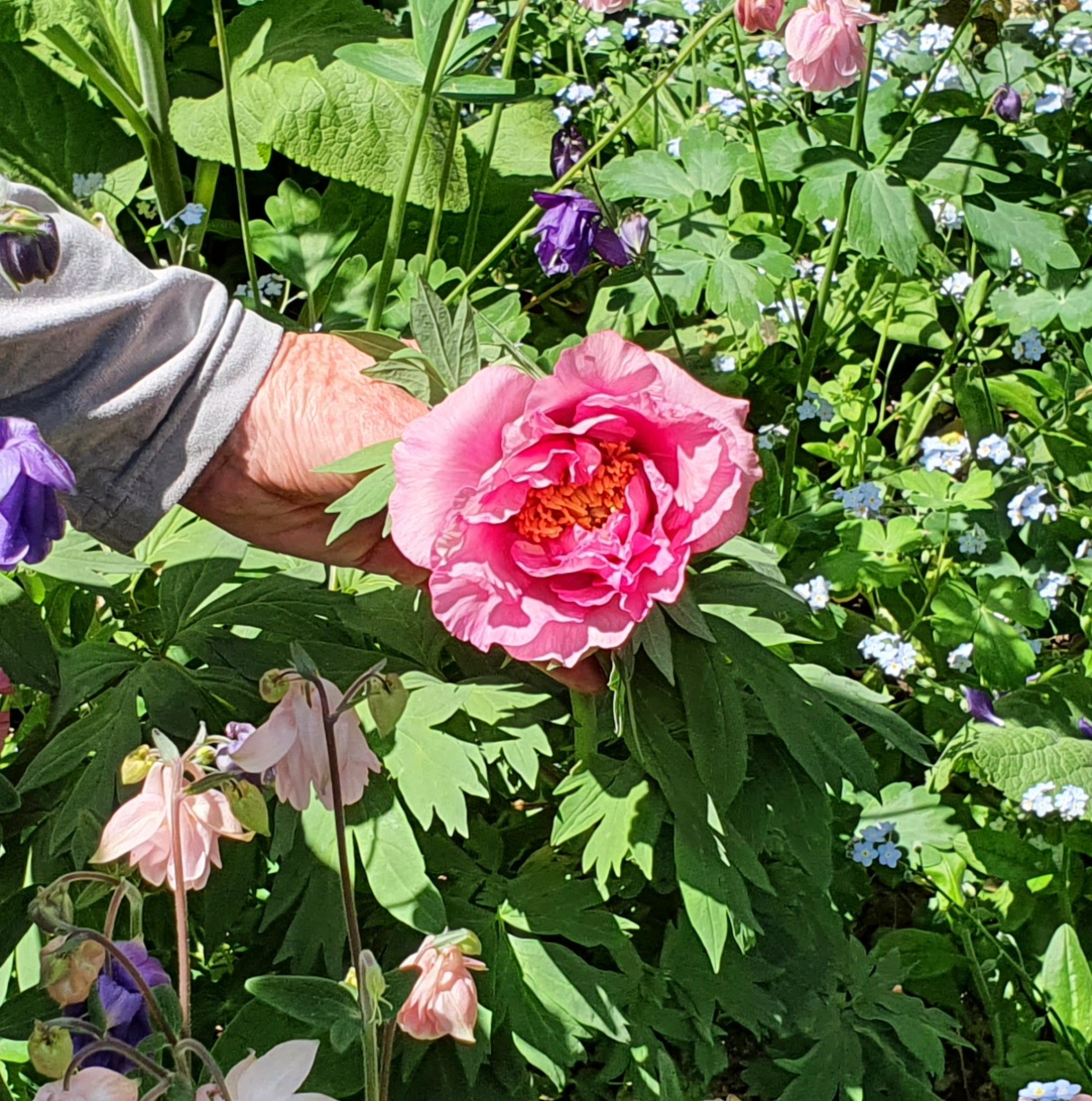
and the garden bursting with peonies
seemed so etched in sunlight
that you felt like taking
a hammer to the glass paperweight
on the living room end table,
releasing the inhabitants
from their snow-covered cottage
so they could walk out,
holding hands and squinting
into this larger dome of blue and white,
well, today is just that kind of day.

Billy Collins ( 1941 -
It is based on a Northern Hemisphere spring when snow is often around as spring makes itself known. Snow covered cottages are not really the scene in Australia.
Spring is certainly the time for getting outdoors and appreciating the environment and the changes in colour and the burst of growth. And if you have been locked up by winter and the virus just getting out in the sunshine is a real treat.
And there may be a day that you feel so elated and alive that, as Billy Collins suggests, you feel like releasing the inhabitants from their inside bondage. Breaking loose with poetical damage to the home. A very effective way of emphasising a state of high emotion. Setting the canary free so to speak.
Of course, not everybody may share your enthusiasm for getting out and about. But I must add it is now a delight to be out in the Canberra spring and in a virus free city.
A week or so ago the poet Louise Glück became the first American woman to win the Nobel prize for literature in 27 years, cited for “her unmistakable poetic voice that with austere beauty makes individual existence universal”.
Glück is the 16th woman to win the Nobel, and the first American woman since Toni Morrison took the prize in 1993. The American singer-songwriter Bob Dylan was a surprise winner in 2016.
One of America’s leading poets, the 77-year-old writer has also won the Pulitzer prize and the National Book Award, tackling themes including childhood and family life, often reworking Greek and Roman myths.
The Wild Iris’ by Louise Glück is the title poem of her 1992 collection. This volume follows a specific sequence, poem to poem, describing the poet’s garden. In this piece, she considers the human soul, immortality associated with rebirth, and the commonalities between all life no matter how that life is manifested.
Looking at the text …
The Wild Iris
At the end of my suffering
there was a door.

Hear me out: that which you call death
I remember.

Overhead, noises, branches of the pine shifting.
Then nothing. The weak sun
flickered over the dry surface.

It is terrible to survive
as consciousness
buried in the dark earth.

Then it was over: that which you fear, being
a soul and unable
to speak, ending abruptly, the stiff earth
bending a little. And what I took to be
birds darting in low shrubs.

You who do not remember
passage from the other world
I tell you I could speak again: whatever
returns from oblivion returns
to find a voice:

from the center of my life came
a great fountain, deep blue
shadows on azure seawater.
Louise Gluck (1943 –
The iris is wild as though it has a natural uncultivated presence.
The door is death and going through the door ends suffering and someone has gone through the door. It is not unreasonable to assume a person has died. But in the second stanza we see that the person wants to talk about ‘death’ – what you call death – after ‘death’ has actually taken place.
The next two stanzas change thoughts from personal death to the death of an iris. The dead iris is buried in the earth. However, the dead iris is not dead but has become a consciousness. This consciousness is ‘terrible’. The question is left for the reader to ponder meaning. Maybe it is terrible because it wants to become. Equally the reader can entertain the thought that all death might become latent consciousness.
Then it is over. That horrible time of the consciousness not being able to speak – not able to become living and have a voice and meaning. And we see the stiff earth bending a little, as though the iris has started to break through the earth.
Then the voice beyond ‘death’ speaks again to tell us that all re-birth seeks a voice.
In the last stanza the voice of the blue iris coming to life is described in dramatic terms. The voice of the iris in all its splendor is a great fountain. The whole purpose of the iris is to flower in glory.
While the speaker is talking about a flower, there are obvious implications for humanity, and the human soul. What are we meant to become? And is life a continual cycle of re-birth? And are we naturally beautiful?



 my word in your ear