The humour of Ogden Nash

Looking at the humour of this well know player of the word …

– from Wikipedia …

Frederic Ogden Nash … was an American poet well known for his light verse. At the time of his death in 1971, The New York Times said his “droll verse with its unconventional rhymes made him the country’s best-known producer of humorous poetry”.

Born: August 19, 1902, Rye, New York, United States
Died: May 19, 1971, Baltimore, Maryland, United States

Some of his quotes …
A door is what a dog is perpetually on the wrong side of.
Middle age is when you’ve met so many people that every new person you meet reminds you of someone else.
There is only one way to achieve happiness on this terrestrial ball, and that is to have either a clear conscience or none at all.
Progress might have been all right once, but it has gone on too long.
People who work sitting down get paid more than people who work standing up.

His poetic style … Nash was best known for surprising, pun-like rhymes, sometimes with words deliberately misspelled for comic effect, as in his retort to Dorothy Parker’s humorous dictum, Men seldom make passes/At girls who wear glasses:

A girl who is bespectacled
She may not get her nectacled

He often wrote in an exaggerated verse form with pairs of lines that rhyme, but are of dissimilar length and irregular meter:

Once there was a man named Mr. Palliser and he asked his wife, May I be a gourmet?
And she said, You sure may,

Nash’s poetry was often a playful twist of an old saying or poem. For one example, he expressed this playfulness in what is perhaps his most famous rhyme, a twist on Joyce Kilmer’s poem “Trees” (1913):

I think that I shall never see
a poem lovely as a tree

which becomes …

I think that I shall never see
A billboard lovely as a tree

And then he adds …

Indeed, unless the billboards fall
I’ll never see a tree at all.

He is such a witty, clever, fun-word fellow … or putting it in the Ogden smash-Nash vernacular –

Ogden Nash is a humour-US poet I admire
his rhymes are often quite exemplar
for, if a word he cannot take
a new one he soon doth make
yes, Ogden Nash is a poet quite unique-lar!

Ogden Nash on Wikipedia

Mrs Reece Laughs – Martin Armstrong – Commentary

Here is a very different poem from another soldier who fought in the Great War. Martin Armstrong was lucky to survive and was demobbed in 1919. As you can see from his poem below he exhibits great poetic skill in his characterisation.

I have broken the poem up into segments for my commentary. It is usually presented as one continuous stream of text.

Mrs Reece Laughs

Laughter, with us, is no great undertaking,
A sudden wave that breaks and dies in breaking.

Laughter with Mrs. Reece is much less simple:
It germinates, it spreads, dimple by dimple,
From small beginnings, things of easy girth,
To formidable redundancies of mirth.

Clusters of subterranean chuckles rise
And presently the circles of her eyes
Close into slits and all the woman heaves
As a great elm with all its mounds of leaves
Wallows before the storm.

From hidden sources
A mustering of blind volcanic forces
Takes her and shakes her till she sobs and gapes.

Then all that load of bottled mirth escapes
In one wild crow, a lifting of huge hands,
And creaking stays, a visage that expands
In scarlet ridge and furrow. Thence collapse,
A hanging head, a feeble hand that flaps
An apron-end to stir an air and waft
A steaming face. And Mrs. Reece has laughed.

Martin Armstrong (1882 -1974)

The title is Mrs Reece – Mrs Jones or Mrs Smith would just not do for Mrs Reece opens the face to a smile; so this was carefully chosen as the name of the lady.

Lines 1-2 … great rhythmic undulation in the rise and fall of the words … laughter an everyday occurrence as in the rise and fall of the sea … this sets the scene to give contrast on how Mrs Reece expresses mirth … no simple rise and fall!
Lines 3-6 … the slow germination as in a seed that grows in time … from ‘things of easy girth’ to ‘formidable redundancies’ … a nice way of describing the gradual uptake of movement of her constitution … or to put it another way the gradual rolling rumble, tumble of the tummy
Lines 7-11 … one imagines this lady to be of some size … the drama unfolds as laughter takes increasing possession of her body  … a great visual transformation before the eyes of any onlooker … likened to a huge elm tree under the authority of a great storm … I think we can all readily identify with a lady of such proportions and can easily picture a lady of such unfortunate circumstance
Lines 12 – 14 … but now there is great physical disturbance as in a volcanic eruption … the peak of her merriment as she explodes in shakes, sobs and gapes … quite a sight!
Lines 15 – 21 … the climax has been reached … all the bottled mirth has escaped … and the aftermath of such exertion now causes body collapse, and flapping of hands and Mrs Reece uses her apron string as a fan. I imagine her to be a homely domestic lady experiencing laugher in her kitchen because of the steaming face. And the final statement – Mrs Reece has laughed – something to witness in all its glory!

A wonderful poem as a performance piece that will surely generate a smile in the audience!

Martin Armstrong on Wikipedia 

Futility – Wilfred Owen – Remembrance Day 2018

Today marks 100 years since the end of WW1 in 1918.

PoppiesWarMemorial

The hand-woven poppy display at the Australian War Memorial, Canberra

Futility

Move him into the sun—
Gently its touch awoke him once,
At home, whispering of fields unsown.
Always it woke him, even in France,
Until this morning and this snow.
If anything might rouse him now
The kind old sun will know.

Think how it wakes the seeds—
Woke, once, the clays of a cold star.
Are limbs so dear-achieved, are sides
Full-nerved,—still warm,—too hard to stir?
Was it for this the clay grew tall?
—O what made fatuous sunbeams toil
To break earth’s sleep at all?

Wilfred Owen (1893 – 1918)

Sonnet structure of two 7 line stanzas with slant rhyming scheme …

Wilfred Owen technique is to use slant rhyme; this poem is no exception. It has an AABABBB rhyming pattern in the first stanza, then alternating slant-rhyming lines in the last stanza. Slant rhymes (such as “sun” and “once”) are a subtle way of giving a poem unity, where the words may echo each other, without being an obvious rhyme. The reader gains a sense of coherence without, initially at least, being conscious of how it is done. However, in certain contexts, such as this poem, the near rhymes may signify discord, a rhyme that is not ‘quite right’. Refer – https://genius.com/Wilfred-owen-futility-annotated

S1 – Farm labourers had no comprehension of what they were in for when they enlisted in WWI. This poor fellow is mortally injured as his mates move him into the sun. It is cold as there is snow on the ground and the sun will provide warmth. The sun is personified as a healer capable of giving recovery. In England the sun has always been a friend to him waking him and giving life to his fields. Even in France it has been with him in the mornings. Perhaps ‘the kind old sun will know’ how to revive him.

S2 – The sun brings life to seeds and from the text it appears that it brought life to the universe – ‘woke, once, the clays of a cold star’ … and much has been achieved in the evolution of life and the advancement of humanity … ‘limbs, so dear achieved’ … so is it too much to ask the sun for help akin to asking a mate for help.

This is a poem about grief following what has happened to a rural worker enlisted in WW1, with anger vented at the creator and maintainer of life represented by the sun.

Is the sun an uncaring mate (sun=creator, son, God) ?

And the poem poses the question if life has been created by an uncaring unintelligent ‘sun’ then what is the purpose of life!

A link to Wilfred Owen on Wikipedia – https://en.wikipedia.org/wiki/Wilfred_Owen

Note – 

The Canberra Rotary Peace Bell is available today for residents and visitors to sound … see https://canberrapeacebell.org/ This is done in conjunction with reading the following words by the Chinese Philosopher Laozi … (the bell is sounded after each statement is read).

“If there is to be peace in the world,
There must be peace in the nations.

If there is to be peace in the nations,
There must be peace in the cities.

If there is to be peace in the cities,
There must be peace between neighbours.

If there is to be peace between neighbours,
There must be peace in the home.

If there is to be peace in the home,
There must be peace in the heart.”

Bell


Snow – Louis MacNeice – Analysis

Snow

The room was suddenly rich and the great bay-window was
Spawning snow and pink roses against it
Soundlessly collateral and incompatible:
World is suddener than we fancy it.

World is crazier and more of it than we think,
Incorrigibly plural. I peel and portion
A tangerine and spit the pips and feel
The drunkenness of things being various.

And the fire flames with a bubbling sound for world
Is more spiteful and gay than one supposes–
On the tongue on the eyes on the ears in the palms of your hands–
There is more than glass between the snow and the huge roses.

Louis MacNeice (1907 – 1963) 1935

S1 … The bay window spawning snow – spawn = mass of eggs of a fish … white eggs of course, and it gives that image of a flurry of snow suddenly thrown against the window causing someone inside LN to move his attention to the bay-window. The pink roses inside are attacked for snow and roses are quite incompatible entities, you could say snow is a killer.

I do like that word ‘suddener’ … we are continually getting sudden impacts from the world … more than we fancy … also if we are fully focused on something a sudden sound will draw our attention elsewhere … and today the natural world is making a lot of noises due to climate change!

S2 … The word is crazy. The Greeks realised this years ago when they defined the primal state as one of chaos. However there is always plentyincorrigibly plural, and taste and touch add to that understanding of the plenty as shown by the example of peeling and eating a tangerine and spitting the pips. And things are so various in the ways they present to our senses. And we often see things differently when we see them the next time independent of alcohol! A drunk sees and emotionally responds to things in many ways!

S3 … I think spit and spiteful go together so nicely connecting the last two stanzas. There is more than glass separating the roses and the snow. They affect our senses in so many different ways. Our connection with the material world is something for contemplation. And this is a poem that celebrates how the plural abundance in the world communicates with humanity.

Louis MacNeice on Wikipedia

Wintering -Sylvia Plath

Wintering

This is the easy time, there is nothing doing.
I have whirled the midwife’s extractor,
I have my honey,
Six jars of it,
Six cat’s eyes in the wine cellar,

Wintering in a dark without window
At the heart of the house
Next to the last tenant’s rancid jam
and the bottles of empty glitters —-
Sir So-and-so’s gin.

This is the room I have never been in
This is the room I could never breathe in.
The black bunched in there like a bat,
No light
But the torch and its faint

Chinese yellow on appalling objects —-
Black asininity. Decay.
Possession.
It is they who own me.
Neither cruel nor indifferent,

Only ignorant.
This is the time of hanging on for the bees–the bees
So slow I hardly know them,
Filing like soldiers
To the syrup tin

To make up for the honey I’ve taken.
Tate and Lyle keeps them going,
The refined snow.
It is Tate and Lyle they live on, instead of flowers.
They take it. The cold sets in.

Now they ball in a mass,
Black
Mind against all that white.
The smile of the snow is white.
It spreads itself out, a mile-long body of Meissen,

Into which, on warm days,
They can only carry their dead.
The bees are all women,
Maids and the long royal lady.
They have got rid of the men,

The blunt, clumsy stumblers, the boors.
Winter is for women —-
The woman, still at her knitting,
At the cradle of Spanis walnut,
Her body a bulb in the cold and too dumb to think.

Will the hive survive, will the gladiolas
Succeed in banking their fires
To enter another year?
What will they taste of, the Christmas roses?
The bees are flying. They taste the spring.

Sylvia Path (1932 -1963) 9 October 1962

This is the last poem in the SP ‘Ariel’ sequence of poems. It was written in October 1962 a most productive time of writing for SP and while she was living in a flat in London after the breakup of her marriage with Ted Hughes and moving from Devon. SP had been involved in bee keeping in Devon. The following comments look behind the literal to the symbolism and in relation to the personal life of SP.

S1 … well now that SP has finished the ‘Ariel’ poems maybe it is a season of ease and just as the bees are hibernating so perhaps SP has alloted poetry-space before new writing. The bees have produced honey just as she has produced poems. She has referred to her poems as her babies so the midwife extraction could be seen in this light. But we do know she had been involved in bees at the cottage in Devon and so she is actually referring to the six jars in the cellar the liquid gold radiating like ‘cat’s eyes’. but more than that she has been married for six years, so this can be seen as the product – the precious store, from her marriage life which of course included poems.

S2 … The details of the cellar are described in relation to what has happened to other people’s projects. SP may be contemplating what will happen to her work. Of course her work has not been lost over the years and is very much alive today!

S3, S4 … The cellar is a very emotive object in the life of SP for it is the place associated with her attempted suicide when she spent three days in a cellar before being discovered. But in this instant I think she is using the cellar to represent herself – she has never been there – never quite found who she is and felt a stranger to life. The Chinese yellow implying that her insight to herself is from a foreign light. The cellar is dark damp and foreboding akin to her depressive nature. It is as though these appalling cellar objects have taken possession of her – as though she has no control – no control over her depressive state.

S5, S6 … It is the season of hibernation and the bees are given sugar so that they survive … she does not recognise them … they are not in worker mode … just as she is not in worker mode, in transition. She is not really living … not creating poems … so she has to exist on other means of keeping alive just as the bees have to live on the sugar from ‘Tate and Lyle’.

S7, S8 …The bees congregate in mass in order to survive the cold conditions. They are the survivors seen in the sugar like Meissen – porcelain, precious. SP identifies with survival like the bees. Only the women survive the men hopeless, identifying with the liberating force of femininity much needed in her days. Her father died at the age of eight and she showed her angst against him for such an act in her poem ‘Daddy’. Ted Hughes has left her so it is all up to her now a survivor and a woman.

S9 … Winter is associated with women because it is the death time. Women live in the male dominant culture of 1963, and perhaps she is slating those around her who are just content to knit rather than being proactive for change. Such women are seen as being more interested in their appearance than dealing with the ‘cold’ of their every-day life. The body is shown as a bulb showing the warmth the body generates and the link to the joy of birth that only a woman can know – so at least women can get joy this way.

S10 … Will the bees survive? Will SP survive? Will there be something at Christmas to give help? Will there be an inbuilt feeling for the future, for the spring? The last line gives that great positive statement of hope – ‘The bees are flying. They taste the spring’.

Unfortunately SP did not taste the spring – she commited suicide on 11 February 1963. Today (27/9/2018) is the day of her birthday and she would have been 86 years old.

SP on Wikipedia

Leda’s Story – Diane Fahey

Leda’s Story

‘I thought you were one of my kind,’ he said,
then, crestfallen, ‘I thought you’d be thrilled.’
To be fair, it was late, and I was a strange one
for squatting out among rushes waiting
to hear and feel the new tide slapping in
with cool subtle shadings of wind.
It was such a hot night … My white skin
must have flashed under the moon;
he must have seen the wings that, against
all opinion to the contrary, I know lie just
beneath my shoulder blades and, at moments
approaching happiness, edge and widen into air —
I had no need of those wings thrashing above me.
Now a voice from the swan enjoins me to turn
into a myth this sordid disturbance of a dream.
‘Total belief is all I ask,’ he says,
‘or, failing that, the skill to act its presence.’
Gods always ask for your everything, twice.
If I nestle deep down inside the mud, a new self
may hatch and arise, as if from fire …
Or will it be some old self, unreconciled
to these nights of yearning, disquiet:
waiting for an answer that will not raise up
the ghost of some more painful question?

Diane Fahey (1945 –

The above is a poem in response to Greek mythology and the story of ‘Leda and the swan’ where Leda is raped by Zeus who takes the form of a swan.

Unusual to contemplate a non-perfect God … if this is the case some amendment may be necessary in our thinking! … and her words pose a few thoughts …

… did the ‘rapist’ really think that Leda would be thrilled … was there no understanding

… how were the demands for acceptance (or pretence at acceptance) met by Leda …

… will Leda be changed forever (a new self … something hatched … born from fire) …

… and what was the ‘gain’ from the rape … the raising of the ghost … the ambivalence

… did she still have something of herself untouched … a sort of resilience despite the rape

Diane Fahey is an Australian poet. Her main creative concerns are nature writing, Greek myths, visual art, fairy tales and literary mystery novels.

A link to her Website

Wuthering Heights – Sylvia Plath – Analysis

Wuthering Heights

The horizons ring me like faggots,
Tilted and disparate, and always unstable.
Touched by a match, they might warm me,
And their fine lines singe
The air to orange
Before the distances they pin evaporate,
Weighting the pale sky with a soldier color.
But they only dissolve and dissolve
Like a series of promises, as I step forward.

There is no life higher than the grasstops
Or the hearts of sheep, and the wind
Pours by like destiny, bending
Everything in one direction.
I can feel it trying
To funnel my heat away.
If I pay the roots of the heather
Too close attention, they will invite me
To whiten my bones among them.

The sheep know where they are,
Browsing in their dirty wool-clouds,
Gray as the weather.
The black slots of their pupils take me in.
It is like being mailed into space,
A thin, silly message.
They stand about in grandmotherly disguise,
All wig curls and yellow teeth
And hard, marbly baas.

I come to wheel ruts, and water
Limpid as the solitudes
That flee through my fingers.
Hollow doorsteps go from grass to grass;
Lintel and sill have unhinged themselves.
Of people and the air only
Remembers a few odd syllables.
It rehearses them moaningly:
Black stone, black stone.

The sky leans on me, me, the one upright
Among all horizontals.
The grass is beating its head distractedly.
It is too delicate
For a life in such company;
Darkness terrifies it.
Now, in valleys narrow
And black as purses, the house lights
Gleam like small change.

Sylvia Plath (1930 – 1963)

This is a poem of place and SP lived in Yorkshire with Ted Hughes for a time and must have gone walking on the moors. I lived in Ilkley Yorkshire while studying so I can identify with these words as they convey the nature of the windswept moors.

Mention the word ‘wuthering’ and you immediately think of blustery winds, Yorkshire moors and Emily Bronte. And the title takes the mind to that most well-known of books ‘Wuthering Heights’. See this review.

S1 – Faggots and peat are a feature of moorland and were used as fuel, a faggot being defined as a bundle of sticks. The imagery is about sunset likened to the glow and death of singeing faggots. The sun catching the edges of cloud as it lowers in the sky. The moors are vast open expanses and the horizon features in all directions. Distances evaporate with the changing light like promises. SP touches an air of disappointment.

S2 – There is no life higher than the bending grasses and the odd sheep. The wind hurries with unending force bending nature in the prevailing direction. It hurries like destiny. SP stands out like a lone tree and must confront the onslaught as it continually chills. She wouldn’t want to stumble and join the white sheep-bones seen along the way in the heather. From my own experience there are vast tracks of land with little opportunity of shelter.

S3 – A very apt description of the moorland sheep. They do match the bleakness of the moors with their dirty wool-clouds – an appropriate combination of nouns. And of course they are used to the terrain. Grandmotherly disguise belies their more timid nature. And when alone on the moors you are in another world with only the sheep for company.

S4 – The track, ruts and grass clumps are likened to fallen architecture imagined as homes with hollow doorsteps the lintels and stills unhinged of people. The only conversation is from the wind which makes a few odd moaning syllables. The loneliness or solitude is reinforced. The repetition of black adds to the mood as well as implying it is now dark.

S5 – SP has sympathy for the grass terrified by the wind and the dark how can it survive. But SP is approaching the homeward descent and the lights of homes in the distance give anticipation of warmth and company in contrast to the moorland. The lights are likened to loose change. Indicating something personal that will give comfort when she returns. Something perhaps she has had with her all the time in her pocket which she now values very much.

Not that long later Sylvia plath had her final resting place in West Yorkshire for her grave is at St Thomas’ churhyard in the village of Heptonstall.

Sylvia Plath on Wikipedia. 


Loveliest of trees … A. E. Housman (carpe diem)

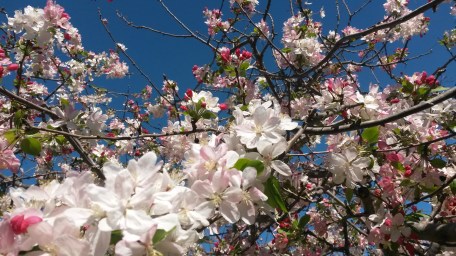
SpringBlossomCrab Apple

Spring is in the air (in Australia that is)… turning to A. E. Housman …

from The Shropshire Lad (II)

Loveliest of trees, the cherry now
Is hung with bloom along the bough,
And stands about the woodland ride
Wearing white for Eastertide.

Now, of my threescore years and ten,
Twenty will not come again,
And take from seventy springs a score,
It only leaves me fifty more.

And since to look at things in bloom
Fifty springs are litmitle room,
About the woodlands I will go
To see the cherry hung with snow.

A. E. Housman (1859 – 1936)

As ‘twenty will not come again’ AEH is considering the brevity of life at an early age … so he decides to make the most of the moment … appreciation of where he is … the beauty of spring blossom in Shropshire, England … good philosophy, and independent of age to make the most of the moment …

A different second stanza …

I’ve used my three score years and ten
only a few will come again
so in every possible way
I make the most of every day!

Another ‘carpe diem’ (seize the day) poem springs to mind …

To the Virgins, to Make Much of Time

Gather ye rosebuds while ye may,
Old Time is still a-flying;
And this same flower that smiles today
Tomorrow will be dying.

The glorious lamp of heaven, the sun,
The higher he’s a-getting,
The sooner will his race be run,
And nearer he’s to setting.

That age is best which is the first,
When youth and blood are warmer;
But being spent, the worse, and worst
Times still succeed the former.

Then be not coy, but use your time,
And while ye may, go marry;
For having lost but once your prime,
You may forever tarry.

Robert Herrick (1591 – 1674)

The Latin phrase carpe diem actually originated in the ‘odes’… poems composed by the Roman poet Horace … see https://www.poets.org/poetsorg/text/carpe-diem-poems-making-most-time