Lovesick – Carol Ann Duffy – Analysis

Lovesick

I found an apple
A red and shining apple
I took its photograph

I hid the apple in the attic
I opened the skylight
and the sun said Ah!

At night I checked that it was safe,
under the giggling stars,
and the sly moon. My cool apple.

Whatever you are calling about,
I am not interested.
Go away. You with the big teeth.

Carol Ann Duffy

Well, I am sure you have been in love and perhaps you can remember that first time. Can you remember that new found feeling – a red shining apple and how it affected your demeanour. Maybe it was something so personal you wanted to keep forever (by taking a ‘photograph’ if you could photograph a feeling). And being a little shy you probably wanted to keep this lovesickness hidden. You had to open up to your surroundings with this joy. The sun of course new and said Ah. And at night time you could bathe in this sickness with delight – such a delight to be in love! – so cool under the giggling stars. A female perspective of the situation is evident. But let’s face it friends and family might just happen to see any change exhibited from your new found happiness state!

But this love sickness, this little euphoria, is very vulnerable. The actual presence and development of a new relationship will destroy or should I say cure any mental heaven – especially if your lover has big teeth.

No other fruit but an apple!

If we consider Estella and Pip from Charles Dickens’ Great Expectations then Pip had a very red apple. And even on continual meetings when Estella snubbed his advances he was not perturbed and was quick to convert a greening apple back to red as soon as he was away from her presence. Love can be so mental, so individual.

This is a totally brilliant poem from Dame Carol Ann Duffy who was appointed Britain’s Poet Laureate in May 2009. Here is a Wikipedia link … https://en.wikipedia.org/wiki/Carol_Ann_Duffy
 

The Fly – William Blake – Analysis

The Fly

Little Fly,
Thy summer’s play
My thoughtless hand
Has brushed away.

Am not I
A fly like thee?
Or art not thou
A man like me?

For I dance
And drink, and sing,
Till some blind hand
Shall brush my wing.

If thought is life
And strength and breath
And the want
Of thought is death;

Then am I
A happy fly,
If I live,
Or if I die.

William Blake (1757 – 1827)

A five-stanza poem with a dancing careless rhythm that fits well with the ending in the last lines, the first four stanzas are ‘abcb’ and the final stanza ‘aabb’. The short lines reflect the nature of passing life and the poem itself perhaps produced from a passing thought when disturbed by an annoying fly.

The subject is life, nature, existence and death with a comparison between the fly and man. Blake controls the life of a fly that came to close just as fate, God or luck could equally determine the fate of Blake.

The poem concerns thought and action. Thoughtless action can cause death. Will some blind hand deal with Blake in the same way that Blake deals with the fly?

Thought always motivates action no matter how fleeting a thoughtless response. Thought dominates life. If life is totally in the mind then it is a happy life free from worry when the mind is so developed.

William Blake on Wikipedia

The Red Cockatoo – Po Chu-I – Comments

The Red Cockatoo

Sent as a present from Annam –
A red cockatoo,
Coloured like the peach-tree blossom,
Speaking with the speech of men.
And they did with it what is always done
To the learned and the eloquent:
They took a cage with stout bars
And shut it up inside.

Po Chu-I (772 -846)
Translated by Arthur Waley

Annam – the southernmost province of China

This eight line Chinese poem is divided into two distinct components each of four lines. I would prefer to see a blank line between the change to give sufficient pause. A distinct image is taken and presented to the reader. A present from a foreign land, a spectacular bird visually and red being so appropriate to the theme of the poem. And a bird that relates to mankind – speaking with the speech of men –this line is the link to second part.

The outcome of the gift is stated – what happens to the bird, what happens to the words of the learned and the eloquent. Mankind suppresses and the gift is caged and is not appreciated and freedom lost. This simple poem makes a powerful statement so often defining the unfortunate plight of mankind but hopefully not what is always done. I am reminded on what happened to Nelson Mandela.

Some information on Po Chu-I – apparently he tested the accessibility of his work by ensuring it was understood when presented to an old country woman … see the following … http://www.hyperhistory.com/online_n2/people_n2/persons4_n2/po.html

and another Blog Site on this poem …
http://margaret-cooter.blogspot.com.au/2014/10/poetry-thursday-red-cockatoo-by-po-chu-i.html

The Express – Stephen Spender – Commentary

The Express

After the first powerful, plain manifesto
The black statement of pistons, without more fuss
But gliding like a queen, she leaves the station.
Without bowing and with restrained unconcern
She passes the houses which humbly crowd outside,
The gasworks, and at last the heavy page
Of death, printed by gravestones in the cemetery.
Beyond the town, there lies the open country
Where, gathering speed, she acquires mystery,
The luminous self-possession of ships on ocean.

It is now she begins to sing — at first quite low
Then loud, and at last with a jazzy madness —
The song of her whistle screaming at curves,
Of deafening tunnels, brakes, innumerable bolts.
And always light, aerial, underneath,

Retreats the elate metre of her wheels.
Streaming through metal landscapes on her lines,
She plunges new eras of white happiness,
Where speed throws up strange shapes, broad curves
And parallels clean like trajectories from guns.

At last, further than Edinburgh or Rome,
Beyond the crest of the world, she reaches night
Where only a low stream-line brightness
Of phosphorus on the tossing hills is light.
Ah, like a comet through flame, she moves entranced,

Wrapt in her music no bird song, no, nor bough
Breaking with honey buds, shall ever equal.

Stephen Spender (1909 – 1995)

S1 … manifesto – a declaration, a platform – fitting for this poem
She is a queen gliding slowly as movement starts without fuss or ceremony she leaves the station … as passengers we all know that sensation as the train starts to move … passing the gasworks reminds me of taking the train from Waterloo to the country, there was always that prominent feature … the heavy page of death printed by gravestones … another memory of the journey and death seen as a heavy page is so appropriate as a metaphor considering the gravestone inscriptions … and beyond the town there is the mystery of the beyond, especially relevant for those taking the journey for the first time … she is now a ship on the ocean of discovery as she gathers speed and she starts to know herself (self-possession … a growing in confidence)

Do you think the change of metaphor adds or detracts?

S2 … fewer lines, S1 was the slow start needing more lines … she is now a jazzy singer as she speeds along carefree with all the noises of her motion as she negotiates curves and tunnels and applies her whistle … (tis but the freedom of unrestrained youth)

S3 … she knows her way … where she is going is pre-determined (but perhaps not so for all of us who journey without such direction) … and she is happy as she plunges new areas of white happiness … and she moves like being fired from a gun … (well I guess we are all happy when fully focused and speeding along towards our goals)

S4 … this Express train is going some distance! … and as night comes you can see her disappearing in the fading light like a comet through the hills and emotionally entranced (an interesting state of mind for the ending of her journey … she knows where she is going in the dark … beyond the crest of the world)

S5 … and again ending in song … a song that is totally hers – beyond nature her creation and she appears to be in some state of ecstasy … (well what a way to end in such happiness as her journey perhaps continues to unknown places)

The glorification of the peronified train as it makes its journey … a symbol of modern travel and industrial achievement and perhaps that of life too from a slow beginning to a happy end … if you stay on the tracks of course!

Here is a link to Stephen Spender on Wikipedia … https://en.wikipedia.org/wiki/Stephen_Spender


Portrait of a Machine : Louis Untermeyer

Portrait of a Machine

What nudity as beautiful as this
Obedient monster purring at its toil;
These naked iron muscles dripping oil
And the sure-fingered rods that never miss.
This long and shining flank of metal is
Magic that greasy labour cannot spoil;
While this vast engine that could rend the soil
Conceals its fury with a gentle hiss.
It does not vent its loathing, it does not turn
Upon its makers with destroying hate.
It bears a deeper malice; lives to earn
It’s masters bread and laughs to see this great
Lord of the earth, who rules but cannot learn,
Become the slave of what his slaves create.

Louis Untermeyer

A sonnet … abba / abba /ababab … the machine is personified … two important attributes compared – beauty and power

The first eight lines show the machine as an untiring body with the beauty of its created components compared to muscles, fingers, and flank. The purring voice never faltering. The power of the machine far out weighing the physical capability of the mere creator.

The last six lines then reflect the non-emotional characteristic of the inanimate object but there is a subtle twist for the machine may have the last laugh – the question on the effect it has on its creator … does the creator become a slave to his or her creation?

I remember years ago visiting the Rowntrees Chocolate factory in York and watching girls taking deformed smartees from the production line. I guess that nowadays this would be an automated process.

From Wikipedia … Louis Untermeyer (October 1, 1885 – December 18, 1977) was an American poet, anthologist, critic,[and editor. He was appointed the fourteenth Consultant in Poetry to the Library of Congress in 1961.

https://en.wikipedia.org/wiki/Louis_Untermeyer

… and perhaps an appropriate time for a New Year’s resolution … for the Internet may well laugh at us if we spend all our time absorbed in this activity … well, time for a cup of tea …


Christmas Day – A Fibonacci Poem

Christmas Day

this
day
is a
special day
for celebration
it is that one day in the year
when Christians stop to honour the birth of Jesus Christ
and Christ love becomes married with all humanity in the destiny of the world

Richard Scutter

The Fibonacci numbers are the numbers in the following integer sequence, called the Fibonacci sequence, and characterized by the fact that every number after the first two is the sum of the two preceding ones: 1 , 1 , 2 , 3 , 5 , 8 , 13 , 21 , 34 , 55 , 89 , 144 , …

A Fibonacci poem … each line has the number of syllables that follow this sequence.

Footnote …

Considering someone who was very Christ-Centric in his spiritual thought …

No work of the great believer Teilhard de Chardin can be understood except in relation to his ‘fundamental vision’ – as Christ as all-in-everything, of the universe moved and com-penetrated by God in the totality of its evolution.

– comment by the French Editor of Le Milieu Divin by Teilhard de Chardin

(com – penetrated  – converting and penetrating)

When ‘we’ create something part of us is always reflected in that creation and when we are not quite happy with it we continue to improve it to the way we eventually would like it to be … unless, of course, it is a continuing improving phenomenon without end.

All the best to everyone in this wonderful wide world.

Enjoy this time with family and friends.

Christmas Time – time to enjoy …

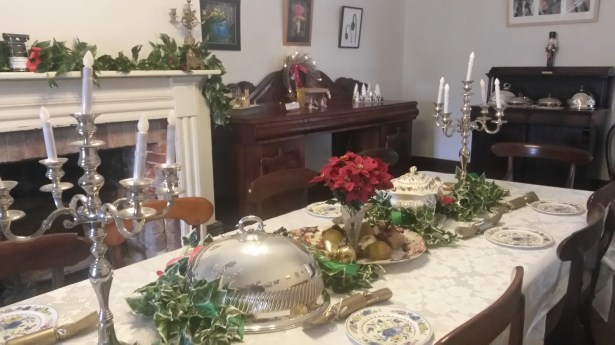
ChristmasTable

‘Riversdale’ – National Trust Property, Goulburn NSW on their Open Day 5 November

Christmas Time

Christmas time and holy bells chime
family time
and even if family are away
enjoy the day!

in the bright sun of Christmas morn
Christ was born!

it’s not the time to be forlorn
so please join in and play your part
tolerate the family fart!

family time, enjoy the day! Christ was born!

Richard Scutter

A Christmas Ovillejo, a Spanish poetic form …

10 lines
3 rhyming couplets, lines of eight syllables
second lines (lines 2,4,6) are short and only 3 or 4 syllables and are a reflection or comment on the first line of the couplet
then a quatrain ‘abba’
last line combines line 2, 4, and 6 as one line

Enjoyment may not be easy for those that find Christmas a very difficult time of the year for whatever reason.

Little Jack Horner – Discussion

Little Jack Horner

Sat in the corner
Eating a Christmas pie.
He stuck in his thumb
And pulled out a plum
And said, “What a good boy am I!”

Anonymous

Discussion …

What is the meaning behind the well-known words of this nursey rhyme …

… my thoughts …… he sat in the corner … perhaps he didn’t want to be found out that he had taken the pie, he wanted to secretly have it to himself and not be disturbed … and what was he after – plums! … he ignored the pastry and put in his thumb searching for one … he seems impatient to get to the inside … though the pie is much more!… and he does seem to be a little self-centred and that anything slightly fortunate is due to him being good and deserving of such fortune … what if the plum had a stone which cracked a tooth … would that have indicated that he had done something bad.

… this nursery rhyme was given as the chapter-title-poem on Meaning and Idea in Laurence Perrine’s excellent book Literature – Structure, Sound, and Sense (isbn 0-15-55 1100-9) … the interpretation …the pie exists for the plum (at least for Jack) though the pie is much more! … poetry (pie) is more than just meaning (plum) … savour the whole poetry pie please … don’t just look for meaning … that’s right eat the pastry and enjoy with your custard! … take a holistic approach when reading poetry … don’t just search for your plums … savour the total poetic experience … even if the essence of the poem is alien to your point of view … and poems are not word puzzles to be interrogated by the mind of the reader seeking some justification for their existencu.

Well Christmas is coming and I guess presents will come your way in some form or other. So make sure you inspect the card carefully and unwrapp slowly and when you sight the the unwanted (don’t go plum crazy) be generous in your response no matter what … quite often the ‘unwanted’ can eventually be of use to you or someone else … and if you are a poet you should be well versed in the use of your imagination!

Footnotes …

… funny that even today some still think that if something “unfortunate” happens it is due to that person being bad … and globally the current world woes are, of course, due to the world being bad

The origins/history according to the Site below give a different perspective on this nursery rhyme … http://www.rhymes.org.uk/little_jack_horner.htm
… funny place to put valuables – in a pie … there again we used to have a coin in the family Christmas pudding … a three-penny piece from memory. And I must admit that as a child the main focus was on getting a coin.