A Small Story – Peter Everwine – Analysis

A Small Story

When Mrs. McCausland comes to mind
she slips through a small gap in oblivion
and walks down her front steps, in her hand
a small red velvet pillow she tucks
under the head of Old Jim Schreiber,
who is lying dead-drunk against the curb
of busy Market Street. Then she turns,
labors up the steps and is gone . . .
A small story. Or rather, the memory
of a story I heard as a boy. The witnesses
are not to be found, the steps lead nowhere,
the pillow has collapsed into a thread of dust . .
.
Do the dead come back only to remind us
they, too, were once among the living,
and that the story we make of our lives
is a mystery of luminous, but uncertain moments,
a shuffle of images we carry toward sleep—
Mrs. McCausland with her velvet pillow,
Old Jim at peace—a story, like a small
clearing in the woods at night, seen
from the windows of a passing train.

Peter Everwine

This is a poem all to do with memory and age. Reflecting on an incident when a child and perhaps reflecting on something that has been recalled many times throughout a lifetime. The two characters that stand out are Mrs McCausland and Jim Schrieber. And the interaction of the red velvet pillow which makes the first stanza standout. Who would put a red velvet pillow under the head of a drunk in a busy street? What does it symbolise and what does it say about Mrs McClausland?

We do not know Mrs McClausland’s first name perhaps indicating she is a person of note. But I should imagine everybody knows Old Jim Schreiber especially if he goes around in a drunken stupor sleeping in the town gutter. Apart from being an expensive pillow it is red. I would like to think that Mrs McClausland is giving attention to the town-folk about Jim, giving value to his life and at the same time perhaps suggesting that something should be done to help him.

But getting back to memory, the child is not a witness to the event. He only remembers it from a story told by others probably family. The fact that it has been talked about to make a story indicates that it is a somewhat unusual event. The child is probably well aware of the two characters. No other characters come to mind ‘the witnesses are not to be found’ and the ‘steps lead nowhere’ for it is only a small insignificant story and gone to dust. But the memory is still there. Perhaps written from the perspective of an aged person turning to dust himself in the near future?

The first stanza is an event, the second a contemplation from that event to promote the reader to thought. Well of course the dead do come back to life when they live in the mind of the living. The living re-image the dead in their own unique personal way. And such memories do have on-going influence on the living. In my recent Post we see exactly that in the repeat of the father’s words ‘good fences make good neighbours’ in the Robert Frost poem ‘Mending Wall’. And family words of those we’ve known are apt to walk the mind quite frequently. My mother always used to end our conversations with two words and when I hear these two words in whatever context my mother is there too.

The story we make of our lives is a small story and no more than a collection of fleeting images from ‘the windows of a passing train’. ‘A shuffle of images we carry toward sleep’.But perhaps our lives will seed some memory in those that have known us and hopefully in a positive bright light when seen from that train window!

God Bless
A link to the poet Peter Everwine

Dance Me to the End of Love – Leonard Cohen – Analysis

Dance Me to the End of Love

Dance me to your beauty with a burning violin
Dance me through the panic till I’m gathered safely in
Lift me like an olive branch and be my homeward dove
Dance me to the end of love
Oh, let me see your beauty when the witnesses are gone
Let me feel you moving like they do in Babylon
Show me slowly what I only know the limits of
Dance me to the end of love
Dance me to the wedding now, dance me on and on
Dance me very tenderly and dance me very long
We’re both of us beneath our love, we’re both of us above
Dance me to the end of love
Dance me to the children who are asking to be born
Dance me through the curtains that our kisses have outworn
Raise a tent of shelter now, though every thread is torn
Dance me to the end of love
Dance me to your beauty with a burning violin
Dance me through the panic till I’m gathered safely in
Touch me with your naked hand or touch me with your glove
Dance me to the end of love

Leonard Cohen (1934 – 2016)

This is a marvellous poem about love over time … lifelong partnership … and seeing love as endless and beauty undiminished.

Looking at the repeated lines (14)…
Dance me to the end of love (a=10 repeats, also the title) … to the end of love … to the end of life … be with me always is implied
Dance me to your beauty with a burning violin (b=2) … beauty (seeing your beauty always) … the burning violin is the music of love … ‘burning alludes’ to time as well as the dramatic playing of the instrument
Dance me through the panic till I’m gathered safely in(c=2)
… there is a bit of a ‘panic’ at the end of life … see me through that time – to be ‘gathered safely in’

11 unique lines (u)
Looking at three of these …
Dance me to the children who are asking to be born
Dance me through the curtains that our kisses have outworn
Raise a tent of shelter now, though every thread is torn

… we have come through the wedding time … now the time for children … and then the kisses have lasted while the curtains have not … shelter is needed now … perhaps alluding to a different shelter needed with old age

Looking at the structure … twenty five lines – bc u aa uuu aa uuu aa uuu a bc u aaa (where a,b, and c are the repeat lines and u the unique) … and looking at how the lines rhyme … aa bbb cc d aa cc bbb eee b aa bbbb

To hear Leonard Cohen sing these words adds another dimension altogether – here is a YouTube link. https://www.youtube.com/watch?v=NGorjBVag0I

After hearing LC the words themselves become insufficient and you will probably always want to see and hear him.

Leonard Cohen on Wikipedia

Mending Wall – Robert Frost – Analysis

Mending Wall

Something there is that doesn’t love a wall,
That sends the frozen-ground-swell under it,
And spills the upper boulders in the sun;
And makes gaps even two can pass abreast.
The work of hunters is another thing:
I have come after them and made repair
Where they have left not one stone on a stone,
But they would have the rabbit out of hiding,
To please the yelping dogs. The gaps I mean,
No one has seen them made or heard them made,
But at spring mending-time we find them there.
I let my neighbour know beyond the hill;
And on a day we meet to walk the line
And set the wall between us once again.
We keep the wall between us as we go.
To each the boulders that have fallen to each.
And some are loaves and some so nearly balls
We have to use a spell to make them balance:
“Stay where you are until our backs are turned!”
We wear our fingers rough with handling them.
Oh, just another kind of out-door game,
One on a side. It comes to little more:
There where it is we do not need the wall:
He is all pine and I am apple orchard.
My apple trees will never get across
And eat the cones under his pines, I tell him.
He only says, “Good fences make good neighbours.”
Spring is the mischief in me, and I wonder
If I could put a notion in his head:
“Why do they make good neighbours? Isn’t it
Where there are cows? But here there are no cows.
Before I built a wall I’d ask to know
What I was walling in or walling out,
And to whom I was like to give offence.
Something there is that doesn’t love a wall,
That wants it down.” I could say “Elves” to him,
But it’s not elves exactly, and I’d rather
He said it for himself. I see him there
Bringing a stone grasped firmly by the top
In each hand, like an old-stone savage armed.
He moves in darkness as it seems to me,
Not of woods only and the shade of trees.
He will not go behind his father’s saying,
And he likes having thought of it so well
He says again, “Good fences make good neighbours.”

Robert Frost
 
This poem looks like a response to something that happened to RF when farming his land.

You could say this poem is all about challenging entrenched thought in order to explore possible change, in this case a farmer honours his father’s saying without employing his own mind to the situation. An ‘old stone savage armed’ and moving in ‘darkness’ gives strong negative emphasis to this way of non-thinking.

On the other hand in defence of the attitude taken the farmer could have given plenty of thought into his father’s saying and made similar choice after much consideration. After all it is nice to have your own defined space and control. And there may be good reasons unknown to RF that he does not want to talk about – future use of land, RF having an annoying dog that wanders …

However, the farmer does not want discussion – his mind is made up so even if he has his own well thought-through reasoning he is not willing to share this with RF. Perhaps all that RF is trying to do is to look for better communication with a neighbour who he finds difficulty to relate to –

And set the wall between us once again.
We keep the wall between us as we go.

… so perhaps all RF might be doing is trying to bridge that gap, at the same time doing a bit of stirring.

An interesting aspect from this poem is the proposition that nature is against walls – typified by the opening line – ‘Something there is that doesn’t love a wall’. So perhaps the world is naturally working towards becoming more and more ‘wall free’.

Of course there are ‘good walls’ and ‘bad walls’ depending on which side of the fence you are standing and fear always makes bad mortar. It is nice to see that some of the ‘bad walls’ eventually fall for the benefit of a more inclusive world (The Berlin Wall, Apartheid in South Africa, the ‘White Australia Policy’ … and when will the North Korean barrier crumble).

But how much do we live by sayings, how much do they influence our lives, how much do the words of others hold catch to our free thinking?

And how much do we challenge those around us to explore better communication (without saying Elves)? It is only through open communication that we can attempt to explore a better world for all and to start to break down barriers – beginning with our neighbours. Perhaps time to invite one in for a cup of tea!

Footnote …

Apparently ‘Mending Wall’ is indeed autobiographical: a French-Canadian named Napoleon Guay had been Frost’s neighbor in New Hampshire, and the two had often walked along their property line and repaired the wall that separated their land. Ironically, the most famous line of the poem (“Good fences make good neighbors”) was not invented by Frost himself, but was rather a phrase that Guay frequently declared to Frost during their walks. This particular adage was a popular colonial proverb in the middle of the 17th century, but variations of it also appeared in Norway (“There must be a fence between good neighbors”), Germany (“Between neighbor’s gardens a fence is good”), Japan (“Build a fence even between intimate friends”), and even India (“Love your neighbor, but do not throw down the dividing wall”).

Above italics taken from this Website … http://www.gradesaver.com/the-poetry-of-robert-frost/study-guide/summary-mending-wall-1914

When I was one and twenty – A. E. Housman

When I was one-and-twenty

When I was one-and-twenty
I heard a wise man say,
`Give crowns and pounds and guineas
But not your heart away;
Give pearls away and rubies
But keep your fancy free.’
But I was one-and-twenty
No use to talk to me.

When I was one-and-twenty
I heard him say again,
`The heart out of the bosom
Was never given in vain;
‘Tis paid with sighs a plenty
And sold for endless rue.’
And I am two-and-twenty
And oh, ’tis true, ’tis true.

A. E. Housman (1859 – 1936)

Here is another love poem in similar vein to my previous Coleridge Post made up of two eight line stanzas with rhyming scheme abcbcaaa / abcbadad and an easy flowing rhythm.

The advice from a wise man goes unheeded and youth must fall in love – falling is unavoidable … part of life … hopefully there is a getting up again without too many scars and the endless rue will eventually fade away. But ‘tis better to have loved’ than never loved at all’ which reminds me of a Tennyson poem.

The personal life for A. E. Housman, who had a dedicated and unrequited same sex love, was used to good effect in another poem. This time in a delightful poem by Wendy Cope who plays on this fact in relation to her, hopefully fictitious, choices of partners –

Another Unfortunate Choice

I think I am in love with A E Housman.
Which puts me in a worse than usual fix.
No woman ever stood a chance with Houseman
And he’s been dead since 1936.

Wendy Cope (1945 –

‘worse than usual fix’ – implying that previous choices for a partner have led to a degree of disappointment for one reason or another.

A link to A. E. Housman on Wikipedia 

Tho’ hid in spiral myrtle Wreath – Coleridge

Tho’ hid in spiral myrtle Wreath

Tho’hid in spiral myrtle Wreath,
Love is a sword that cuts its Sheath:
And thro’ the Slits, itself has made,
We spy the Glitter of the Blade.

But thro’ the Slits, itself had made,
We spy no less too, that the Blade
Is eat away or snap atwain,
And nought but Hilt and Stump remain.

Samuel Coleridge (1772 – 1834)

This poem on love from Coleridge equates love as a sword and love hiding in a wreath … showing the duality of love … the glitter of the blade only to be followed by a self-destructive nature … a sword that cuts its sheath … and all that is left is the hilt and the stump … the remnants … hopefully to be viewed in a positive light. Just an aspect of humanity … pain and joy … that’s the story of life … but special pain and special joy!

Another understanding of this poem may come from the first line. The ‘Tho’ could be an actual person who is to blame for the broken relationship – a person hiding ‘in spiral myrtle wreath’ … which doesn’t sound very nice and a little sinister. Perhaps Coleridge is being nice by saying the ubiquitous ‘love’ is to blame rather than the nature of any individual lover.

I do not know the context and the date of writing which could provide more insight.

Myrtle – evergreen bush with blue-black fruit
Wreath – a memorial on a grave
Sheath – a case for the blade of a knife
Hilt – the handle of a sword

Coleridge on Wikipedia … https://en.wikipedia.org/wiki/Samuel_Taylor_Coleridge

since feeling is first – e e cummings – analysis

Since feeling is first

since feeling is first
who pays any attention
to the syntax of things
will never wholly kiss you;
wholly to be a fool
while Spring is in the world

my blood approves
and kisses are a better fate
than wisdom
lady i swear by all flowers. Don’t cry
—the best gesture of my brain is less than
your eyelids’ flutter which says

we are for each other: then
laugh, leaning back in my arms
for life’s not a paragraph

and death i think is no parenthesis

e e cummings (1894 – 1962)

S1 – eec did not pay any attention to traditional syntax (he developed his own unique syntactical way of expression) … he is talking about love and feelings and how love is expressed, and if you think of syntax in relation to love – which to me relates to discipline and order – then it becomes an inhibiter of full expression, and in relation to a kiss it will not be a full kiss in all its enormity – scary, because if you are totally uninhibited in your love life you may become the stereotyped fool – love and fool both being four letter words that combine to form a bit of an oxymoron.

S2 – Perhaps everyone becomes a bit of a moron when spring is in the air, not me of course for I have English heritage. eec swears by all the flowers that his best brain gesture stands no match for the flutter of an eyelid which dissolves all reason. Love and flattery always have connection, so too love and laughter.

S3-4 Interestingly, you can’t put death in brackets and life is not a paragraph … eec indicates he is putting his writing to one side for the sake of love … (it is a whole story of many chapters … the question is whether there is a full stop to the last sentence … well of course there is a no full stop as you can see in the above!)

Details of e e cummings on Wikipedia … https://en.wikipedia.org/wiki/E._E._Cummings

NB Syntax – the ordering of and relationship between the words and other structural elements in phrases and sentences. The syntax may be of a whole language, a single phrase or sentence, or of an individual speaker.

May all those love-fools enjoy this day with a laugh!

‘Not waving but drowning’ – Stevie Smith -Analysis

Not waving but drowning

Nobody heard him, the dead man,
But still he lay moaning:
I was much further out than you thought
And not waving but drowning.

Poor chap, he always loved larking
And now he’s dead
It must have been too cold for him his heart gave way,
They said.

Oh, no no no, it was too cold always
(Still the dead one lay moaning)
I was much too far out all my life
And not waving but drowning.

Stevie Smith (1902 – 1971)
(Florence Margaret “Stevie” Smith)

Stevie Smith did suffer a bit from depression and at one stage she tried to commit suicide. To what extent she endured life and put on a good face for others is not known. But I think this poem does reflect something of her nature. This poem is all about pretence, and isn’t it a more common human trait for people to try to give positive response even if it is only skin deep. I like the explanatory words of the dead man talking, explaining to everyone but only after he has died.The dead always speak louder than the living because they have more time on their hands.

The ‘comfort zone’ is never a permanent state and we are often encouraged by others in life to move to the ‘uncomfortable’ in order to develop. Well, it is all about balance of course. The poor dead man tells us it was ‘cold’ always. Clearly he should have been more honest and let someone know he was living in hell or should I say kicking frantically in order to stay afloat. Apparently  this fellow also enjoyed larking about so beware of those that play games because they may be hiding a sinking underside.

This poem was number four in popularity by respondents in the BBC Poetry rankings of 1996 so clearly readers could identify with the words. And for those reading this and are out of their depth at the moment make sure you can easily swim to safety whenever you need to!

Death was a key theme in the poetry of Stevie Smith. She regarded death as a welcome friend someone who would be with her to the end, and of course at the end. I know we are all drowning poetically but I do hope we are all enjoying being in the water too! And I guess those that have learnt to swim enjoy it more!

For those interested in the life of Stevie Smith there is a marvellous autobiographical movie made in 1978 called ‘Stevie’. She lived most of her life with an aunt. Stevie is played by Glenda Jackson and her aunt by Mona Washbourne. I found the interplay between these two outstanding actors quite captivating. And the movie includes the reading of many of her poems.

She was awarded the Queen’s Gold Medal for Poetry in 1969. Here is a link to Stevie Smith on Wikipedia.

Retirement Arrival – A warning to drivers!

In my last Post in the poem ‘Warning’ Jenny Joseph alluded to a characteristic of ladies of a certain age – the propensity to choose purple as a favourite dress colour. This prompted thought on what would be an equivalent characteristic in the male population and how that could be used in creating a poetic response. Dress is so important to ladies whereas gentlemen have more attachment to their motor vehicles. I have noticed quite a common driving trait of those advancing in age. I have also combined dress in the following …

carhat

Retirement arrival

now is the day of much content
made so glorious by the thought
of this new road ahead

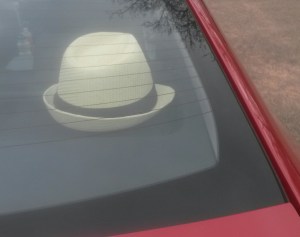
he places his hat carefully
on the sill against the back glass
declaring his status for all to see

he has arrived and when
he drives off taking the right turn
with the left indicator flashing

it is not totally unexpected
for he has arrived and this
unfortunately, must be accepted

Richard Scutter

All I can say is just be cautious while driving when you see a hat on the back sill of a car – especially if there are a couple and one is purple!