Black Rook in Rainy Weather – Sylvia Plath – Analysis

Black Rook in Rainy Weather

On the stiff twig up there
Hunches a wet black rook
Arranging and rearranging its feathers in the rain-
I do not expect a miracle
Or an accident

To set the sight on fire
In my eye, nor seek
Any more in the desultory weather some design,
But let spotted leaves fall as they fall
Without ceremony, or portent.

Although, I admit, I desire,
Occasionally, some backtalk
From the mute sky, I can’t honestly complain:
A certain minor light may still
Lean incandescent

Out of kitchen table or chair
As if a celestial burning took
Possession of the most obtuse objects now and then —
Thus hallowing an interval
Otherwise inconsequent

By bestowing largesse, honour
One might say love. At any rate, I now walk
Wary (for it could happen
Even in this dull, ruinous landscape); sceptical
Yet politic, ignorant

Of whatever angel any choose to flare
Suddenly at my elbow. I only know that a rook
Ordering its black feathers can so shine
As to seize my senses, haul
My eyelids up, and grant

A brief respite from fear
Of total neutrality. With luck,
Trekking stubborn through this season
Of fatigue, I shall
Patch together a content

Of sorts. Miracles occur.
If you care to call those spasmodic
Tricks of radiance
Miracles. The wait’s begun again,
The long wait for the angel,

For that rare, random descent.

Sylvia Plath (1957)

This poem was written in 1956 and published in 1957 when Sylvia Plath would have been about 24 years old. She had married Ted Hughes in June 1956 (Bloomsbury Day) and she would have been living in England (Cambridge) and studying. It was the first SP poem that I read and prompted me to find out more about her – and that lead to discovering the relationship with Ted Hughes.

Here is a link to a You-Tube audio of SP reading this poem

Ostensibly this is a poem about boredom and living in a dull wintry environment with no respite from the depressing English weather … (even in this dull, ruinous landscape), remembering too that SP was used to ‘Boston’ weather. But at times miracles occur and simple objects radiate a heavenly aspect. However there are long waits for such happenings – (for that rare random descent).

For me her words underscore the nature of bipolar depression, albeit with a somewhat philosophic acceptance, – the many days of depression broken by an occasional intense high before the onset of many more depressive days. In this regard it is a poem which resonates and I placed a post on the ‘Sylvia Plath Forum’ several years ago which gives an explanation. Here is the link … (you will have to scroll to the archived Post for 27 October 2001).

And I do I like the choice of her words … well poetry was her vocation and she spent much thought in the use of words in expressing her poetic voice. And unlike many SP poems this poem is readily accessible as well as being an honest reflection on her state of mind.

Desultory – unfocused, aimless
Portent – sign, omen
Largesse – generosity, benevolence
Politic – tactful, diplomatic
Incandescent – luminous, radiant
Inconsequent – unimportant, insignificant
Celestial – heavenly, holy
OMG Just Imagine – Easter Sunday

RisenSun

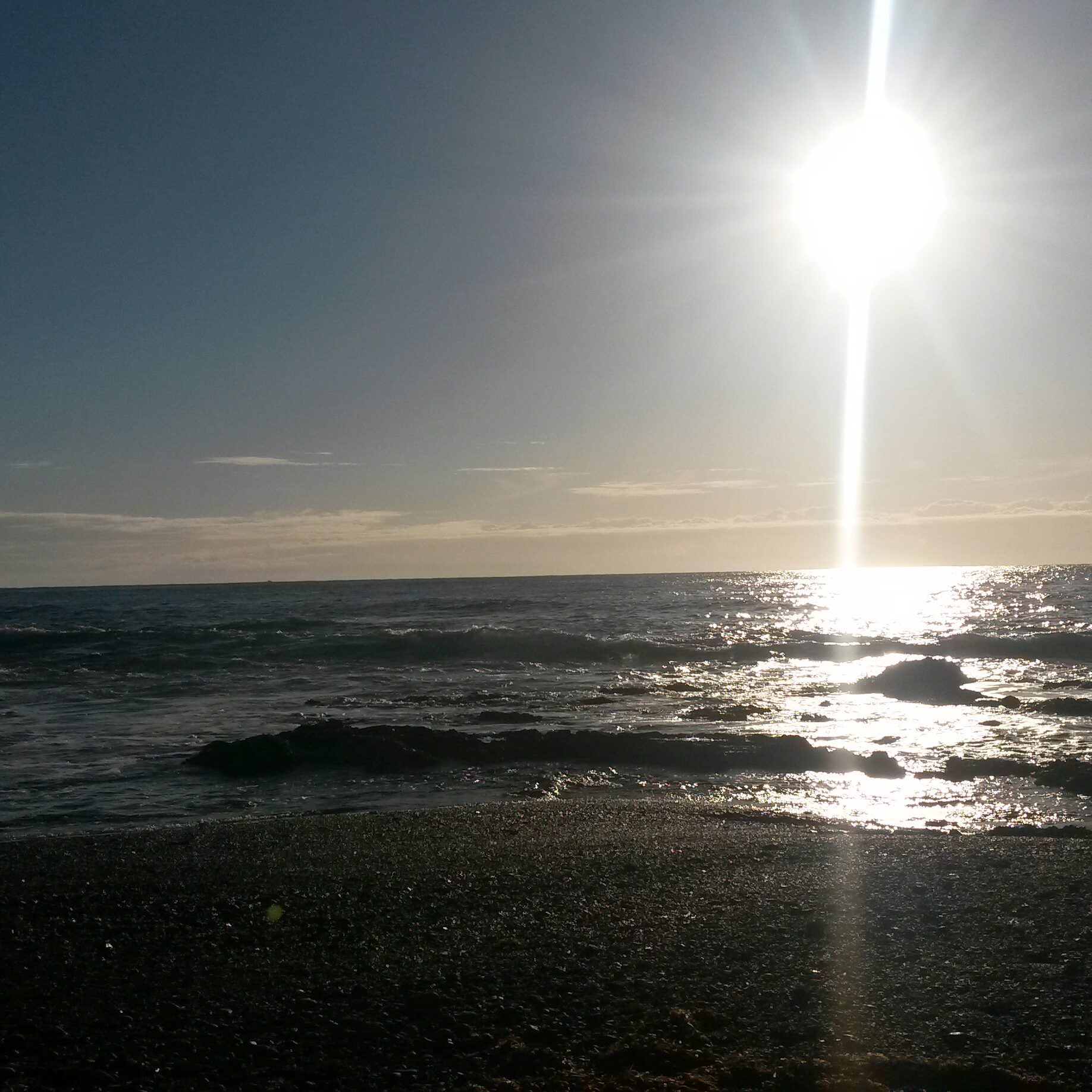
A well and truly risen sun – Murramarang National Park, NSW South Coast

OMG Just Imagine
(Easter Sunday)

OMG Just imagine life without Easter.
We need Easter, holidays might disappear!
Not to mention those rabbit-eared children
running sweet-toothed through our classrooms.
OK it may be egg-centred commercialisation
but there’s no harm in a bit of gaiety!

Even if Easter is a little chocolate coated
Christ always seems to be hanging around,
whether in the background or foreground
depending of course on your point of view!
But without Easter life is a momentary firing
a captivating firework display none the less
but perhaps a series of confused sparks
dying in a sea of perpetual darkness?

Richard Scutter

… and some more Easter Words    … Enjoy your Easter! – Celebrate Life

Sharing some ‘Good Friday’ words

Good Friday or Black Friday

It always seems a misnamed day.
For on the day that Christ died
his followers would hardly have
called it a good day! For them a
day of grief and sorrow. Black Friday
would be a more appropriate label.

They didn’t realise the significance.
Perhaps because of the outcome
that in any sense it is good. And as
this death has unbelievable meaning
it could be regarded good, that is if it’s
possible to believe in the unbelievable!

And think of the consequences if
Christ had not died and lived.

The Poet, The Poem – George Mackay Brown

The Poet

Therefore he no more troubled the pool of silence
But put on mask and cloak,
Strung a guitar
And moved among the folk.
Dancing they cried,
‘Ah, how our sober islands
Are gay again, since this blind lyrical tramp
Invaded the Fair.’

Under the last dead lamp
When all the dancers and masks had gone inside
His cold stare
Returned to its true task, the interrogation of silence.

George Mackay Brown

Poem

Seven scythes leaned at the wall.
Beard upon golden beard
The last barley load
Swayed through the yard.
The girls uncorked the ale.
Fiddle and feet moved together.
Then between stubble and heather
A horseman rode.

George Mackay Brown

George Mackay Brown (1921-1996) is one of the most well-known of Scottish poets. He was born in Stromness in the Orkney Islands, the last child of a poor family. He spent all his life in Stromness apart from time at Edinburgh for education as an adult and apart from a visit to Oxford. He was a sick child suffering from tuberculosis and was not able to enter the war or engage in steady employment. His family had a history of depression.

His poetry is poetry of place and although the Orkneys has a brutal dramatic climate his words are simple, cut to the raw bone without hyperbole – very much his own Orcadian voice – and much respected for bringing notice to this part of Scotland. He was somewhat of a drinker and well known in Stromness throughout his life-time as he walked around town.

Details on Wikipedia – http://en.wikipedia.org/wiki/George_Mackay_Brown

… and for those that need information on the Orkneys – http://www.orkneyjar.com/orkney/index.html

Looking at the two poems – ‘The Poet’ … this is a clear definition of himself – I love that first line no more to trouble or be troubled by the pool of silence … so he puts on his mask and coat to go out to the Pub – a different hat from his poetry hat … rejoicing in the Orcadian community life – I hope not to be blinded by alcohol! But when it is closing time, and he last to leave … under the last dead lamp … perhaps going home at dawn … it is time to face the silence again … his calling ‘to interrogate silence’. The cold stare gives hint of a depressive life.

The second poem is simply called ‘Poem’ – He valued the simple pleasures of life and the rural lifestyle of his day – work in the fields and then to the Pub – but between ‘stubble and heather a horseman rode’ … this can be seen as an interruption to this ideal life – an ominous threat to what the future might hold … and on an individual basis one of the free-fun-loving girls might soon be whisked away into married life. As in a good poem it is left to the reader to complete.

Autumn is always afternoon

Autumn is always afternoon

Autumn is always afternoon
that time after lunch in the garden
the plates scattered to one side
but still some wine in the glass

the children at play in the background
the old swing objecting strongly
while discussion leads to friends they’ve known

far-off the low moan from the motorway
and the sun still gives some comfort
as shadows stretch into the lawn
soon it will be time to call the children to task
but now they talk and laugh oblivious

a gust of wind detracts and for a moment
she looks down to the end of the garden
where the children are at play
her fingers feel her woollen jacket on the chair

And if you could hold time in a photograph
it would be caught in this moment forever
in a picture of complete happiness

Richard Scutter

May – John Shaw Neilson – Analysis

May

SHYLY the silver-hatted mushrooms make
Soft entrance through,
And undelivered lovers, half awake,
Hear noises in the dew.

Yellow in all the earth and in the skies,
The world would seem
Faint as a widow mourning with soft eyes
And falling into dream.

Up the long hill I see the slow plough leave
Furrows of brown;
Dim is the day and beautiful: I grieve
To see the sun go down.

But there are suns a many for mine eyes
Day after day:
Delightsome in grave greenery they rise,
Red oranges in May.

John Shaw Neilson (1872 – 1942)

John Shaw Neilson was born to a Scottish family who came to Australia in the late nineteenth century and took up farming in very difficult country. The family was very poor and their attempts at farming in dry tough Australian land was never very successful. He never had a formal education but his father wrote poetry and had an interested in literature.

It is now autumn in Australia so I thought I would look at this poem. And looking at the lines … the soft entrance of silver-hatted mushrooms – typifies the movement in the damp autumn ground … undelivered lovers – perhaps these are the early morning gatherers of mushrooms – the best time to pick them – but a note that you must be careful to pick mushrooms and not poisonous fungi!

Yellow features in quite a few of his poems – I equate it to sunshine … and in autumn you could regard the sunshine to be in the earth as well as in the skies – and the whole world takes on a golden softness  – and in autumn there is a feeling of loss – that summer is over, so the image of a widow faint and mourning is quite appropriate … and so too  falling into dream – autumn being an approach to the sleep of winter

Well,  he would have had plenty of experience of rural life … and in the preparation of the land, there is a ‘slowness’ to life … he grieves the shortening days and dim light in line with the mourning widow, but for him there is also great beauty – (in other poems such as ‘The Poor, Poor Country’ he finds a joy in the harsh landscape that his family is trying to farm).

He reiterates the beauty of the autumn sun … and the Australian sun delights each day … rising in the grave greenery– some trees would appear to be just head stones – and trees would be in their grave so to speak, but a green grave of course.  The final line combines the  two colours of red and orange … this indicates to me a loss of intensity – and a visual change from the summer sun … at the same time the May sun is seen as the round fruit of the orange – autumn being a time for fruit.

His most famous poem is ‘The Orange Tree’ – see this link.

Also, the collected poems of John Shaw Neilson have been digitised by Sydney University and they can be found on the following Internet Site –

Click to access v00042.pdf

The Last Word – Matthew Arnold – Analysis

The Last Word

Creep into thy narrow bed,
Creep, and let no more be said!
Vain thy onset! all stands fast.
Thou thyself must break at last.

Let the long contention cease!
Geese are swans, and swans are geese.
Let them have it how they will!
Thou art tired; best be still.

They out-talk’d thee, hiss’d thee, tore thee?
Better men fared thus before thee;
Fired their ringing shot and pass’d,
Hotly charged – and sank at last.

Charge once more, then, and be dumb!
Let the victors, when they come,
When the faults of folly fall,
Find thy body by the wall!

Matthew Arnold (1822-1888)

I don’t know whether this was the last poem that Matthew Arnold wrote but it is the last poem in the set of poems recorded against his name in my ‘The Harvard Classics’ edition.

S1 – well we all have to break sometime … leave the world that is … creep (go slowly) into your narrow bed (perhaps a link to that wooden box which awaits) … and it’s a bit silly if we ever thought we were going to change the world, all stands fast … we have no choice but to break.

S2 – Geese are swans, and swans are geese … well, you would have to be a goose not to know the difference, however there are some people who never learn – no matter how hard you try to educate – so unfortunately you must accept that others may always be a bit of a goose and not understand reality, not know the truth, not know the beauty of the swan – so there is a plea not to continue to try to make others understand, suggesting you are tired and maybe you need that rest … and indeed you will have no choice but to be very still!

S3 – they hiss’d thee – well if they are a bit of a goose this is an apt statement … and if it is any comfort others better than you have tried and failed – they sank like a drowning, appropriate considering swans are always seen with water

S4 – OK have one more attempt, one more charge at trying to make them see that swans are swans – but they the ‘victors’ with their faults of folly and will find your body by the wall – the wall that they have created in not letting your message get through

Of course you may not agree with all the sentiments expressed by this poem and I am sure that you will leave the world a better place! – but realistically there will always be some who you’ve tried to influence that have never heeded the message you wanted to convey.

Love and Complacency – Geoffrey Dutton – Analysis

Love and Complacency

At Christmas, sometimes, even for disbelievers,
Angels come slanting down across the firebreak
Over flecks of summer grass on the sheep-tracked hill.
Dragonflies mirrored in the dam, weavers
Of transparencies gyrate
Cerulean and ruby images of free-will.

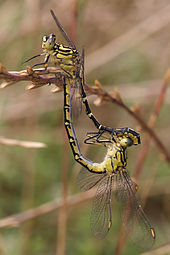
Dipping and drifting, they couple in mid-air
Like helicopters refuelling, carrying on
Mutual flirtations with the bronze face
Of the deep dam, their fuselages clear
As noon sky in the desert, or the red clarion
Venus sometimes flashes through the black space.

They float through the branches of the mirrored trees.
A trout rises. They cross the concentric rings,
Wings transparent as angels’, though the treasure
Of sex ballasts their jewelled bodies.
They brush the waters’ gum-blossoms with their wings.
The trout leaps. At least they died for pleasure.

Geoffrey Dutton  (1922 – 1998)

Complacency = gratification

S1 – Christmas in Australia – summer time and hot, and even if you don’t believe in Christmas it might come while sitting down by a dam watching nature on a sheep property. The sheep form tracks across the hill. Dragonflies become angels – their transparent wings perpendicular to their clear bodies – movement aptly defined by ‘weavers of transparencies gyrate’ … Cerulean – sapphire

S2 – The movement must have been captivating – especially to Geoff Dutton who was in the Air Force in the war – not that you have to know how helicopters refuel! The dam reflection gives a display of the flirtation. The water is certainly bronze (brown) and not blue and would be still on a hot mid-day … and a contrast with the clarity of the fuselages!

S3 – A trout enters the scene … only three words (a trout rises) … then back to the main theatre of operations … the sex play of dragonflies above the dam … I really like the words – the treasure of sex ballasts their jewelled bodies … and they are caught in pleasure in the still of a moment just above the water. Then another three words on the trout (the trout leaps) … and it is the end of the performance. Isn’t it wonderful that the trout only gets six words in the whole poem – and these words dedicated to action.

Apparently dragonflies are among the fastest flying insects in the world. Dragonflies can fly backwards, change direction in mid-air and hover for up to a minute so helicopters is qute an appropriate comparison.

… and below is a photograph courtesy of Wikipedia of two yellow striped hunter dragonflies fully focused …

Yellow_striped_hunter_mating


Geoff Dutton was one of the co-founders of the AustraliankBook Review (ABR) and for more details see