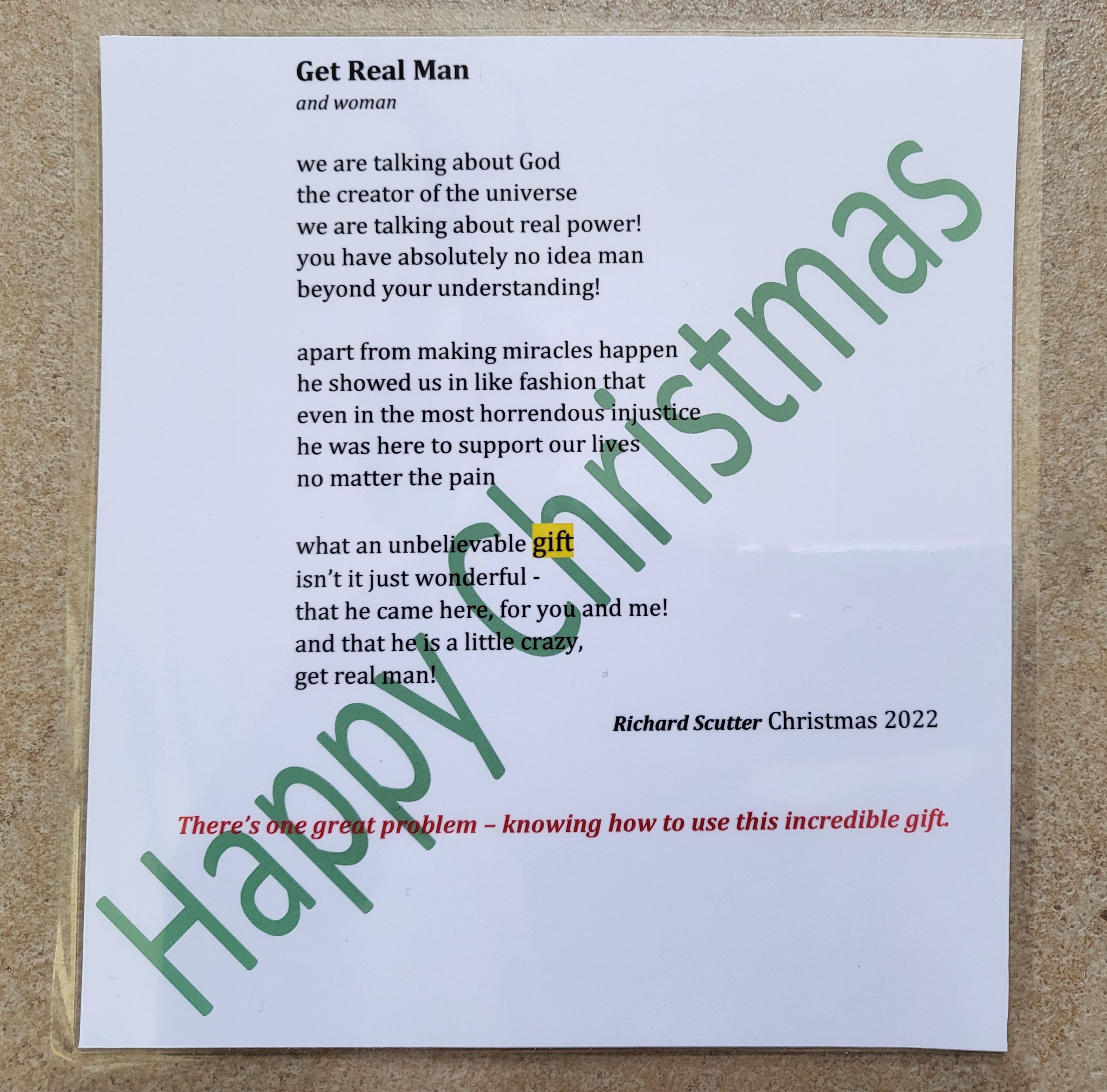
... that everybody is trying to understand after unwrapping…

Christmas Greetings
Have a super time with family and friends.
December 23
A sip and a smoke on the back porch,
then its starts to snow;
it seems the night
has decided to number
its ghosts.
No snowflakes settle; beyond reproach,
all absolved — go, go, —
a cull of light;
as my birthday remembers
its lost.
Carol Ann Duffy (1955 -
December 23
pavlova and BBQ on the beach
the day full of light
and gives warmth
to all the cells
of my now
so many memories have rescinded
like missing snowflakes
that once came to my window
and momentarily settled
before melting away
Richard Scutter
Well interesting that I share a birthday with Carol Ann Duffy. And that she mentions the snow in relation to the passing years as people like ghosts are recalled before fading like disappearing flakes of snow.
It was snowing heavily when I was born. It was so cold, I got quite a shock. I am still recovering.
Along by merry Christmas time Along by merry Christmas time they buy the aged goose, And boil the dread plum pudding, because of ancient use. But to sneer at old time customs would be nothing but a crime,| For the memory of the Past is all bound up in Christmas time. Then Jim comes home from shearing, and he puts a few away, With Dad, perhaps, or Uncle, but they’re right on Christmas Day: For be it on the Never, or ‘neath the church bells’ chime, The family gets together, if they can, at Christmas time. And, after tea at Christmas, they clear the things away And play the dear old silly games our grand-folk used to play And Dad gives a recitation that used to be the joy Of all the Western countryside, when Father was a boy. Along by merry Christmas time, and ere the week is o’er We meet and fix up quarrels that each was sorry for. Our hearts are filled with kindness and forgiveness sublime, For no one knows where one may be next merry Christmas time. Henry Lawson (1867 – 1922)
S1 – Christmas is all about remembering the past. The birth of Christ and friends and family that are, or have been, dear to us.
At Christmas we reflect on people that are not with us … always hard to come to terms with loss of the precious in our life. But can love deal with the loss of a recent family member. Here is a poignant poem by Louisa Lawson, the mother of Henry Lawson – A Mother’s Answer – Louisa Lawson | my word in your ear
Henry Lawson’s easy flowing rhymed poem was written in 1913, maybe the plum pudding was not what it is today. An aged goose doesn’t sound attractive either. How many people in Australia are planning to eat goose this year, not exactly a first choice! In fact a meat I have never eaten.
S2 – Christmas is all about bringing family and friends together. And regardless of where the family gather – the Never, Never – the outback, or whether the family congregates at Church together. Food and drink are always to the fore. The variety of food and drink on offer has expanded considerably since I was a boy. And many items that were a luxury for us at Christmas are now commonplace throughout the year.
S3 – Christmas is all about sharing family play. And being accepting of the previous generation in the games they used to play. There are always well-known familiar stories associated with relatives in conjunction with the play. And listening without comment maybe hard for the younger generation, however boring! And when I was growing up music renditions by those who could play, piano and violin from my mother and an uncle come to mind.
S4 – Christmas is all about forgetting squabbles and forgiving. And the last line tells us unequivocally to make the best of the time together; for who knows where family and friends will be next Christmas.
Henry Lawson is best known for being a master of the short story – ‘While the Billy Boils’ – rather than his poetry. Although an Australian theme the Christmas expression in this poem has wide universal association in the Western World.
So what can I say – make the most of this coming Christmas Day.
The Prisoner I sit by the bars in my cell, in the damp A lusty young eagle caged up in a cramp. A suffering comrade down there waves his wing. And flaps as he pecks at some blood-spattered thing. He pecks it and drops it, and looks up at me As if our ideas were in deep sympathy. His beckoning call and his eyes seem to say What he wants from me: ‘come on let’s fly away! We brothers, free birds of the air, let us go! Where mountains stand white, with the storm clouds below, Where rolling blue oceans run off to the sky, Where I can fly free with the wind - he and I!’ Alexander Pushkin (1799 – 1837) translated by A. D. P. Briggs
Ostensibly a poem about a caged eagle. Representative of Russian oppression and the cruel treatment of Russians in the Stalin era. Seeking flight from such conditions and the beauty of nature outside the cage.
Pushkin is considered by many to be the greatest Russian poet and the founder of modern Russian literature.
Alexander Pushkin on Wikipedia – Alexander Pushkin – Wikipedia
My Papa’s Waltz The whiskey on your breath Could make a small boy dizzy; But I hung on like death: Such waltzing was not easy. We romped until the pans Slid from the kitchen shelf; My mother’s countenance Could not unfrown itself. The hand that held my wrist Was battered on one knuckle; At every step you missed My right ear scraped a buckle. You beat time on my head With a palm caked hard by dirt, Then waltzed me off to bed Still clinging to your shirt. Theodore Roethke (1908 – 1963)
An episode between father and son when Theodore was a child. And you can always value the words from a poet when involving family in their work. Clearly his father was an alcoholic and his mother not improving on his resultant behavior and the impact on her kitchen domain. But the above words give only a limited insight into his character. And interesting Theodore Roethke said this about his father – ‘a great story could be written about my father, for in many ways he was truly a great man. I have never found anyone remotely like him in life or literature’.
I remember the words my father used to say – if you can’t be good be careful. I used to like these words because it gave acceptance to my non good behavior. There is another interpretation in that careful is care full and of course I try to be full of care as I react with people and life. Independent of the fact I don’t want to be had up for speeding. I am actually very good when driving especially if I have my partner at my side.
The father-son relationship is the foundation in the growth of any boy. The effect on the future life of the son is another matter. The new generation is always in conflict in some way with the old. I remember a Cat Stevenssong in relation to the differences in thought for those that can remember Cat Stevens.
There are plenty of poems in similar vein where the father-son relationship is articulated. Seamus Heaney has poems in relation to both his father and mother.
From a poetry point of perspective a lot of thought has gone into this simple story poem. The end rhyme words in the second and final lines of each stanza are well chosen. And there is a subtle stumbling effect in the sound of dizzy and easy as the small boy is twirled around in the first stanza.
Here is a link to a very personal poem from Seamus Heaney in relation to his mother.
In the Park She sits in the park. Her clothes are out of date. Two children whine and bicker, tug her skirt. A third draws aimless patterns in the dirt. Someone she loved once passes by –– too late to feign indifference to the casual nod. “How nice,” et cetera. “Time holds great surprises.” From his neat head unquestionably rises a small balloon … ”but for the grace of God.…” They stand awhile in flickering light, rehearsing the children’s names and birthdays. “It’s so sweet to hear the chatter, watch them grow and thrive,” she says to his departing smile. Then nursing the youngest child, sits staring at her feet. To the wind she says, “They are eating me alive.” Gwen Harwood (1920 – 1995) From Poems 1963
Gwen Harwood was an Australian poet and librettist, creating text for musical score. Harwood is regarded as one of Australia’s finest poets. And the above is a poem she is often identified with concerning motherhood.
The title In the Park brings immediate association to any park experience in the mind of the reader with the suggestion that something is going to happen.
S1 … The first three lines define the situation. A bedraggled poorly dressed mother coping with three young children two of which are pulling at her dated skirt. And I guess many seeking peace and quiet from the park would hurry their step as they walked by. But the next line is the key to the occurrence in the park. Someone she once knew under completely different circumstances confronts her painful situation. And this someone is a special person from the past, a lover. And I think many would assume a man but equally it could have been a girlfriend. But she is caught by surprise and can’t feign indifference to the previous relationship. And the break is appropriate as we flow into the section stanza.
S2 … And this lover from the past shows politeness and he says it all ‘Time holds great surprises’. And there is immense relief that he had avoided being associated with such a life – ‘but for the grace of God‘. He recovers from such emotional thought himself to spend time in conversation pleasantries that flow into the third stanza.
S3 … He takes an interest in the children, their names, and birthdays. The mother then completely denies her situation and contradicts her dire adjustment to motherhood saying a little sarcastically ‘It’s so sweet to hear the chatter, watch them grow and thrive’ as the fellow departs. Contradicting the glory of motherhood and the expectation once held by her and the expectation of society at that time in the role of the mother in family life.
What is interesting is that later in life she penned a different text to give a balance.
A later text … She sits in the park, wishing she’d ever written about that dowdy housewife and her brood. Better, The Memoirs of a Mad Sex Kitten, or a high-minded Ode to Motherhood in common metre with a grand doxology. “They have eaten me alive.” Did she write that? The sonnet nestles in a new anthology safe in its basket as a favoured cat. She sits a while in flickering light rehearsing the family’s birthdays. “Stop, you bloody fool!” A young house-father with a pram is cursing a child whose pushed another in the pool. She helps him calm them. “Eating you alive? Look at me. I’ve lived through it. You’ll survive.” Written in 1992 from The Present Tense (1995)
Two wonderful Petrarchan Sonnets. I think the first eight lines in the above, before the twist have a subtle swipe at the establishment of the day at the time she wrote ‘In the Park’. That sonnet is now safe and valued, perhaps much more than at the time it was written.
The male role in supporting children in family upbringing has changed markedly over the years eating away at the traditional stereotype of motherhood.
Gwen Harwood on Wikipedia – Gwen Harwood – Wikipedia
Nothing Doing on a visit to a dying nun and again seeing the rubble of some impossible buildings people are emerging through the tangled mess probably a three-year-old girl her left hand holds a tatty bear her right hand is held tight by her mother the camera focuses on her face her eyes vacant, expressionless someone in the nursing-home presses the remote the screen blanks nothing she is propped up by two cushions prepared for my visit she gives a gentle smile as blue eyes spark into life her frail hand motions to the chair by her bed I think it sad that she will leave this world in such a hopeless state soon she will be silent her body gone nothing but when Russians fire their bullets she will be there in her nothing bleeding her impervious spirit while holding the hand of a three-year-old girl Richard Scutter July 2022
The image of the child portrayed in the above was from TV news footage several months back.
Bobowler
Darkling herald,
see her flower-face on a waning moon
and spake her name aloud
to conjure the voice
of one you loved and let slip
through the wing gauze of jeth.
In the owl-light,
when loneliness shines
through your bones like a bare bulb,
she'll come for you,
little psyche bringing missives
from the murmuring dark.
She comes to all the night birds:
cuckoos, thieves, the old uns
and the babies in their dimlit wums,
the boy riding his bike
up Beacon Hill, heart thundering
like a strange summer storm.
And the messages she carries
in her slow soft flight?
Too tender to speak of, too heartsore,
but this: I am waiting.
The love that lit the darkness between us
has not been lost.
Liz Berry (1980 – from her book 'The Republic of Motherhood'.
Liz Berry is a Black Country poet in that she lives and writes poetry in connection with that area known as the Black Country in England an area in the midlands near Birmingham and her book entitled the same includes the use of the local dialect and it won the Forward Prize for the Best First Collection in 2014.
She very kindly sent a reading of the above poem for our U3A Poetry Appreciation Group in Canberra last week. It was wonderful to hear her, and I was totally mesmerized by the touch of humour that pervaded her presentation along with the pronunciation of the local vernacular.
Bobowler = a large moth in the local language
Jeth = deth
Cuckoos = lovers
dimlit wums = homes
Here are my comments …
S1 – quite a pretty moth and shaped in conjunction with the moon appropriately associated with the night as it seeks light … darkling is a not a common usage word and what came to mind was darkling in connection with Thomas Hardy and The Darkling Thrush … but the moth is a herald to the memory of someone loved who let slip through the wing gauze of death … wing in relation to the moth and the flight from life … but the voice of the departed can be conjured into life … indicating a touch of magic in the recreation in her mind … something very special in the relationship.
S2 – Interesting that owl is integrated in the Bobowler title. I do like the way this second stanza expresses how loneliness and loss is subjugated through bones like a bare bulb and bringing missives; messages out of the murmuring night. Missives is an interesting word having a contractual flavour. The subtle shadow communication of the person loved is likened to the flutter of a moth against the light of the bulb. The analogy with the seeking of light.
S3 – A wider generic communication perhaps … she comes to all … of those much loved that have departed … bringing messages … whether to lovers, the aged, babies in their homes (dimlit wums) … or something very specific as a boy struggling on a bike up Beacon Hill … the departed are continually fluttering into our lives to live again so to speak … linked in the mind
S4 – The messages are back to the personal … tender and likened to the slow soft flight of the moth. Love is rekindled and never lost. The love that lit the darkness between us may imply more than just the separation by death.
An example of how something simple in nature like a moth flitting against a light bulb can be used for poetic expression. And how seeking light can be transferred into seeking connection with the dead. And the use of the old dialect may help the recall.