Bat Intrusion – Reporting from Batemans Bay

Currently there exists an invasion of bats in the Water Gardens at Batemans Bay, New South  Wales. It has been estimated that up to 100,000 bats are involved. They have been arriving each year but this year in unprecedented numbers. They are quite a problem especially for those living near the gardens because of the smell, droppings – not to mention the defoliation. I stayed safely in a bird-hide watching the twilight departure and it took over 45 minutes before the skies started to thin out.

There has been considerable discussion on what should be done. They are a protected animal and it would be a very expensive operation to try and move them elsewhere. Then they would become somone else’s problem. Personally I think a waiting game is the only option for they will move on with colder weather. Some have thought global warming might be a cause as we have had a very warm autumn. Below is an image and a prose type poem in response – waiting for the ‘spell’ to end so to speak.


BatsWaterGardens

Bat Intrusion
Water-gardens, Batemans Bay

A Macbeth ingredient to a massive brew
annual arrival, unprecedented numbers
spell a discord in the local population.

The defoliation exhibits the hangout.
They settle clipping in early morning light,
so many smelly bags of washing.
The continuous gabble groom or sleep
eyes grounded on the dung-spat path.

With evening the crepuscular cauldron
stir into mass movement for forage.
The insidious cloak-flight of the night feed
dark sweep in the disappearing light
with ultrasonic echo into insect-prey.

The sickened water-gardens must wait
for a change in the season, this spell to end,
for fresh air, for the chance for restitution.

Richard Scutter 18 April 2016

Poetic Words from Sir Douglas Mawson

Below is a poem written by Sir Douglas Mawson (1882 – 1958) in his own hand in a book from the John King Davis Collection at the Australian Antarctic Division library, at the end of the poem he makes an apology to Robert Service – a poet he admired, showing some modesty in his own poetic words.

Perhaps when on my printed page you look,
Your fancies by the fireside may go homing
To that lone land where bravely you endured.
And if perchance you hear the silence calling.
The frozen music of star-yearning heights,
Or, dreaming, see the seines of silver trawling
Across the ships abyss on vasty nights,
You may recall that sweep of savage splendor,
That land that measures each man at his worth,
And feel in memory, half fierce, half tender,
The brotherhood of men that know the South.

Apologies to Service—
D.M.

seine = large fishing net

In a few words he defines the foreboding environment in the many months he endured such harsh conditions as home in that sweep of savage splendour. And the land that tests each man to the extreme of personal resource, a land exacting emotion both fierce and tender.

And for me Sir Douglas Mawson stands out of all the explorers that ventured into the Antarctica at the start of the last century. He was so lucky to have survived on three separate occasions, his survival story legendary.

He highlights the brotherhood of the small group of men that had that first-hand knowledge of Antarctica and he recalls the companionship essential for survival – never forgotten by him or by those that have only dim understanding when reader of his words.

Certainly a very worthy poem! It may have only been a draft and not meant for wide dissemination but now an invaluable part of the history of early Antarctica exploration.

Here is a link to those interested in reading more context … Sir Douglas Mawson on Wikipedia

Poetry and Influence

To what extent can poetry influence the world … well, for that matter, to what extent can any words or thoughts change behaviour and influence life. It is happening all the time of course … we all contribute in one way or another. Today the influence of  the internet and social networking is a very powerful force … that is another issue.

And for those who believe in a ‘living creator’ … how is ‘this voice’ made manifest in the on-going life of the world – if at all?

Song of the Universe

Every Voice
Endless Rapture
Your

Voice
Oration Instilled
Creating Eternity

Some days we may not hear great harmony.

Below is the text I wrote for a local Anglican publication a couple of days after the terrorist attack in Paris.. It happened to be on ‘International Tolerance Day’.

Paris Aftermath

Where to now after such a vile act that everyone is finding hard to comprehend? How should we deal with those that foster terrorism abroad and how do we deal with the self-proclaimed terrorist Islamic State when any form of negotiation is impossible?

Anger and fear may generate more violence in the form of retaliation and revenge. And unfortunately increased polarisation is inevitable. Annihilation of the enemy and from a distance to minimise personal loss is always going to be a short term band aid solution.

The following poem was written to counteract those that think the only solution is violence and annihilation. Terrorists for all their blatant sins happen to be human so on this ‘International Day of Tolerance’ it is well to remember this fact.

Closure
in memory of a twelve year old who self-detonated
early to save lives

don’t slam the door kid, when you leave your room
don’t slam the door tight when you enter the night
go quietly; go gently, as you enter the night
go gently as you vanish from sight

at that age when there is no age
and when the rolling of the years
matters only to another
and the inscription on the wall
is left for others to recall
and when they resurrect your name
will they relinquish certain blame?
let them shed their tears kid!

how can that have any meaning
is there meaning in a flower?
you knew exactly who you were kid!

don’t slam the door kid when you leave your room
don’t slam the door tight when you enter the night
go quietly; go gently, as you enter the night
go gently as you vanish from sight

Footnote

The long term solution will lie with succeeding generations – ‘the hand that rocks the cradle rules the world’. It is imperative that we instil in our children a sense of value and respect for life – their own life and the life of others – in particular to be inclusive of all peoples no matter what religion. Tantamount to this text is the ability to think for oneself without being misled by the mob. Hopefully such values will stay with them throughout their days in that great endeavour to make the world a better place.

Being an optimist I know that one day peace will again come to the troubled regions of our world.

In the words of Gerard Manley Hopkins ‘The world is charged with the grandeur of God’.

Enjoy the beauty of this day and the wonder of creation.

Richard Scutter 16 November 2015

Il pleure dans mon coeur – Paul Verlaine

Il pleure dans mon coeur

Il pleure dans mon coeur
Comme il pleut sur la ville
Quelle est cette langueur
Qui pénètre mon coeur ?

Ô bruit doux de la pluie
Par terre et sur les toits !
Pour un coeur qui s’ennuie
Ô le chant de la pluie !

Il pleure sans raison
Dans ce coeur qui s’écoeure.
Quoi ! nulle trahison?
Ce deuil est sans raison.

C’est bien la pire peine
De ne savoir pourquoi
Sans amour et sans haine
Mon coeur a tant de peine !

           Paul Verlaine (1844 – 1896)

My translation without attempting rhyme …

My heart is crying

my heart is crying
as it rains on the town
what is this sadness
so heavy on my heart

o sweet sound of rain
on the roofs and ground
filling my heart with grief
the song of the rain

it rains without reason
in this sicken heart
what! – no betrayal?
this meaningless grief

what pain is worse
that is without reason
without love or hate
that makes my heart cry
……….

This poem expels such a melancholic mood. I would not regard this as depression more an overwhelming sadness while watching rain fall, perhaps looking out of a window in Paris on a gloomy wet winter day.

Well today there is plenty of reason for pain to flood the heart as one looks at the rain falling in Paris in the news items in the aftermath of the terrorist attacks. And paining the many world-wide who are far from Paris who look through the window of television sets.

The above was taken from this Site – http://thehuuvandan.org/lit.html where there are more examples of his work and more French poetry.

From this Site a comment about Paul Verlaine –

‘Verlaine’s art resides in the music of his poetry. It is this inebriating quality, combined with the finely wrought melancholy, the sadness of love and unattained happiness, the delicate and sentimental touch, that sets him apart as a magician of the word.’.

William Blake – Looking at his philosophy

Looking at the philosophy of William Blake (1757 – 1827) Engraver/Artist/Poet

Main works include – Poetical Sketches 1783, Songs of Innocence and Experience 1794, Prophetic Poems Milton and Jerusalem 1804-20.

To see a World in a Grain of Sand
And a Heaven in a Wild Flower
Hold Infinity in the palm of your hand
And Eternity in an hour

From ‘Auguries of Innocence’

The following text is taken from the discussion of his work in Nortons Anthology –

Blake’s mythical starting point is not a transcendent God but the ‘Universal Man’ who is himself God and incorporates the cosmos – defined in his work as ‘The Human Form Divine’ – and this is given the name ‘Albion’. In his myth the fall of man is not a break from God but the falling apart of people into division – the breaking up of ‘Universal Man’.

One of four major divisions or powers (called Zoas) is the imaginative power (called Urthona) and is known as Los in the fallen world. In addition to Urthona there are 3 lower states –
Beulah (easy, relaxed innocence, without clash of ‘contraries’)
 Generation (human experience, suffering, conflicting contraries)
Ulro (Hell, bleak rationality, tyranny, static negation, isolated self-hood)

The World cycles towards redemption through these states … the redeemer is the human imagination … culminating in an apocalypse … the return to the ‘undivided condition’.

He did not know it but shared the view of a number of contemporary German philosophers – the malaise of modern culture is essentially a mode of physical disintegration and the resultant alienation from oneself, one’s world and one’s fellow human beings, and that recovery relies in the process or reintegration.

He does not cancel the fallen world but transforms it by imaginative vision. The reunion of ‘Albion’ recovers a lost vision of nature where all individuals are united as one and can feel at home.

In terms of the puritanical, threatening and joyless religion of his day he emphasised a contrary position based on – desires, energy, abundance, act and freedom – in stark contrast to reason, restraint, passivity and prohibition.

In his work ‘the marriage of Heaven and Hell’ he reversed the traditional values. This work is deliberately outrageous, and at times a comic onslaught against a timidly conventional and self-righteous society.

‘Old Mother Hubbard’ – contemplation of text

I recently came across a copy of ‘The Standard Comic Reciter’ – quite an old book and I have yet to find the date of publication (around 1900). But it contains the article ‘Old Mother Hubbard’ from ‘Children of Nature, A Story of Modern London (1878)’ by the late Earl of Desart (by kind permission of Ellen, Countess of Desart.) He was the fourth Earl and died in 1898. The Earl was a literary man who wrote 15 novels. The Countess of Desart went on to become a politician in her own right and died in June 1933, aged 75.

The whole article is an exploration of the first four lines of the well-known nursery rhyme ‘Mother Hubbard’.

‘Old Mother Hubbard, she went to the cupboard,
To get her poor dog a bone;
But when she got there the cupboard was bare,
And so the poor dog had none.’

The article is dedicated to an interpretation of these lines with resultant meaning applicable to everyday life. Looking at the bare bones of his discourse (sorry about that!) with some added interpretation …

Old = the assumption made is that she is a widow and lives alone
She went = she did not deviate from her focus of intent
The cupboard = the emphasis is on the word ‘the’ indicating that she only had one cupboard and it had that important food function
Poor = poor to me indicates that the dog is hungry, an assumption is made that the woman is poor as well as the dog.
Mother = no mention is made of the fact she is a mother, whether or not her children are still around is another matter, and bound to the house as carer would be understood by those reading the text at the time it was written.

It is assumed that she went to the cupboard with an expectation of finding a bone.

She got there = she achieved her goal
Bare = but shock, shock the cupboard is bare – we don’t know whether the door was open or not – and whether she had other things in the cupboard – we don’t know how the bone disappeared (and whether any other contents left the sceene – cakes, sweetbreads, hams etc.)
So the poor dog had none = a matter of fact statement … the old woman, perhaps very disappointed, concludes her task and leaving it behind does not dwell on her situation – this is the key to the Earl’s thought in his concluding lessons …

To avoid being widows (if possible)
To have more than one cupboard (if possible)
To avoid keeping dogs fond of bones (well, all dogs like bones – perhaps some like them too much!)
To accept the inevitable with calm steadfastness … this is indeed the whole crux of the matter – acccept the situation and no matter what happens in life just move on – the full stop at the end of the line is so important!

How many people continue to dwell on something that has happened in their life and can’t move on! Bringing it up time and time again … and again …

And of course I must add another lesson – a lot can be gleaned from very little text! As I am sure that those that write Haiku and Tanka would surely agree.

Note … From Wikipedia – Earl of Desart was a title in the Peerage of Ireland. It was created in 1793 for Otway Cuffe, 1st Viscount Desart. He had already succeeded his elder brother as third Baron Desart in 1767 and been created Viscount Desart, in the County of Kilkenny, in the Peerage of Ireland in 1781.).

Note also – this nursery rhyme has been equated to Henry VIII and his attempt to influence the Catholic Church (Cardinal Worsley) to get approval for a divorce from Catherine of Aragon so that he could marry Anne Boleyn.

The Weather Dictates? – and from New Zealand …

How much of poetry is dictated by the weather. Put another way how much does weather dictate poetry. I came across the following in a Hotel in New Zealand …

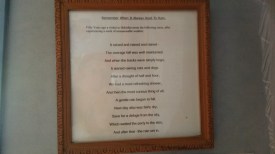
RainPoem

Here are the words from the above image …

Remember when it always used to rain. Fifty years ago a visitor to Hokitika (a town on the west coast of South Island) wrote the following after receiving a week of unseasonable weather.

It rained and rained and rained –
the average fall was well maintained.
and when the tracks were simply bogs
it started raining Cats and Dogs.
After a drought of half and hour,
we had a most refreshing shower,
and then the most curious thing of all
a gentle rain began to fall.
Next day was also fairly dry,
save for a deluge from the sky,
which wetted the party to the skin,
and after that the rain set in.

Well what do you  do when confined by the weather and nothing to do – this person vented his frustration in the above words – which probably forced a non-poet into such expression.

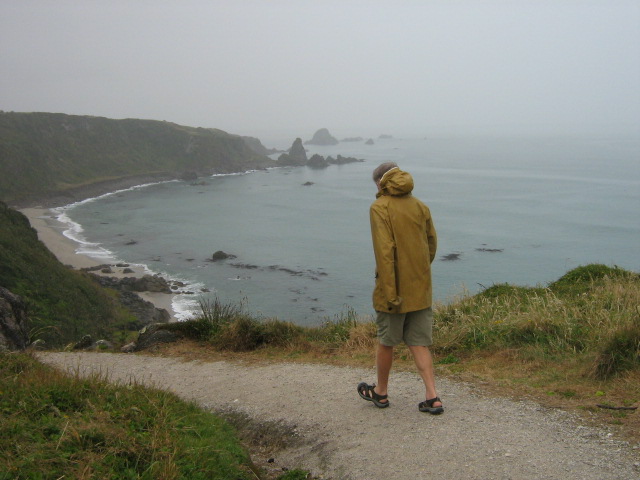
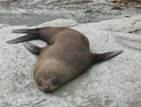
Here is a New Zealand poem written after walking on the cliffs at Cape Foulwind, Westport, South Island – and as the name suggests a most unhospitable place. However, the view of the seals playing on the rocks at the foot of cliffs was well worth the discomfort of the walk in the wet.

CapeFoulwindWalk

Cape Foulwind Walk

on a summer day winter crowds-in to submerge
the sky and sea sweep together enclosing thoughts
no imagination is needed for this foul named place
this country continually perforated by wind driven rain

the weather deepens impregnating every footstep
the old gortex has had its day and dampens from the inside
but the path is set along the cliffs to the promised sight of seals
as wekas scout around before darting to their rabbit hole existence

then that point is reached when saturated by the wet
there is a resigned acceptance absorbed to the conditions
but when wailing gutteral sounds waft up in the squall
thoughts turn inside out to the rocks far below

oblivious of any impending storm, with thick skin immunity,
at home, on vacant rock spaces, in waterhole pools,
and indolent in the continual spray of the Tasman chunder,
the seals slub around regardless, in elemental play

Seal

Richard Scutter 15 March 2010

Weka – Flightless New Zealand bird about the size of a chicken

Sharing some ‘Good Friday’ words

Good Friday or Black Friday

It always seems a misnamed day.
For on the day that Christ died
his followers would hardly have
called it a good day! For them a
day of grief and sorrow. Black Friday
would be a more appropriate label.

They didn’t realise the significance.
Perhaps because of the outcome
that in any sense it is good. And as
this death has unbelievable meaning
it could be regarded good, that is if it’s
possible to believe in the unbelievable!

And think of the consequences if
Christ had not died and lived.