The Weather Dictates? – and from New Zealand …

How much of poetry is dictated by the weather. Put another way how much does weather dictate poetry. I came across the following in a Hotel in New Zealand …

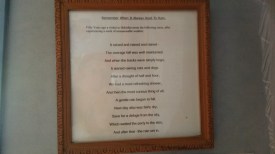
RainPoem

Here are the words from the above image …

Remember when it always used to rain. Fifty years ago a visitor to Hokitika (a town on the west coast of South Island) wrote the following after receiving a week of unseasonable weather.

It rained and rained and rained –
the average fall was well maintained.
and when the tracks were simply bogs
it started raining Cats and Dogs.
After a drought of half and hour,
we had a most refreshing shower,
and then the most curious thing of all
a gentle rain began to fall.
Next day was also fairly dry,
save for a deluge from the sky,
which wetted the party to the skin,
and after that the rain set in.

Well what do you  do when confined by the weather and nothing to do – this person vented his frustration in the above words – which probably forced a non-poet into such expression.

Here is a New Zealand poem written after walking on the cliffs at Cape Foulwind, Westport, South Island – and as the name suggests a most unhospitable place. However, the view of the seals playing on the rocks at the foot of cliffs was well worth the discomfort of the walk in the wet.

CapeFoulwindWalk

Cape Foulwind Walk

on a summer day winter crowds-in to submerge
the sky and sea sweep together enclosing thoughts
no imagination is needed for this foul named place
this country continually perforated by wind driven rain

the weather deepens impregnating every footstep
the old gortex has had its day and dampens from the inside
but the path is set along the cliffs to the promised sight of seals
as wekas scout around before darting to their rabbit hole existence

then that point is reached when saturated by the wet
there is a resigned acceptance absorbed to the conditions
but when wailing gutteral sounds waft up in the squall
thoughts turn inside out to the rocks far below

oblivious of any impending storm, with thick skin immunity,
at home, on vacant rock spaces, in waterhole pools,
and indolent in the continual spray of the Tasman chunder,
the seals slub around regardless, in elemental play

Seal

Richard Scutter 15 March 2010

Weka – Flightless New Zealand bird about the size of a chicken

Sharing some ‘Good Friday’ words

Good Friday or Black Friday

It always seems a misnamed day.
For on the day that Christ died
his followers would hardly have
called it a good day! For them a
day of grief and sorrow. Black Friday
would be a more appropriate label.

They didn’t realise the significance.
Perhaps because of the outcome
that in any sense it is good. And as
this death has unbelievable meaning
it could be regarded good, that is if it’s
possible to believe in the unbelievable!

And think of the consequences if
Christ had not died and lived.

Terra Australis – James McCauley – and Clive James

AustraliaDTwenty One Gun Salute at Regatta Point, Commonwealth Gardens Canberra

It is Australia Day today and below is the poem ‘Terra Australis’ by James McCauley. Clive James comments on this poem in his ‘2006 -2014 Poetry Notebook’  highlighting

‘Australia is within you as a land of imagination’ and quoting directly from his book … Armed with that language you are always coming home, even when you stay away. A treasure more important than nationalism, a fully developed poetic language is the essence of only patriotism that matters. It can do without red-back spiders and crocodiles, although those are nice too. What it can’t do without, what it embodies, is a way of speaking about freedom and justice both at once.

These words are apt as Clive James is nearing the end of his life and he will never be able to return to Sydney. However, the final stage of his life appears golden and according to recent interviews he is appreciating daily life with a new intensity. He quotes from Romeo and Juliet at the front of the above book –
How oft when men are at the point of death
Have they been merry! Which their keepers call
A lightning before death …

Here is the James McCauley poem with some comment after each of the four stanzas …

Terra Australis (see footnote)

Voyage within you on the fabled ocean,
And you will find that southern Continent,
Quiros’ vision – his hidalgo heart
And mythical Australia, where reside
All things in their imagined counterpart.

Quiros – In March 1603 the Portuguese navigator Queirós best known for his voyages with the Spanish fleet was authorized to return to Peru to establish another expedition, with the intention of finding Terra Australis, the mythical “great south land,” and claiming it for Spain and the Church.
hidalgo – a Spanish nobleman
counterpart – resembles another in a different system

It is your land of similes: the wattle
Scatters its pollen on the doubting heart;
The flowers are wide-awake; the air gives ease.
There you come home; the magpies call you Jack
And whistle like larrikins at you from the trees.

simile – a figure of speech drawing comparison between two different things
Jack – used to address a man who is a stranger
larrikins – disrespectful person behaving noisily in public

There two the angophora preaches on the hillsides
With the gestures of Moses; and the white cockatoo,
Perched on his limbs, screams with demoniac pain;
And who will say on what errand the insolent emu
Walks between morning and night on the edge of the plain?

Angophora – of the myrtle (myrtacea) family … Australian hills are covered in trees.
Moses – Hebrew prophet who led the Israelites from slavery in Egypt to the promised-land
(re: translate to convict slavery in the establishment of Australia)
errand – small job going to collect or give something
insolent – not showing respect … they collected my sausages at a BBQ several years ago!

But northward in the valleys of the fiery Goat
Where the sun like a centaur vertically shoots
His raging arrows with unerring aim,
Stand the ecstatic solitary pyres
Of unknown lovers, featureless with flame.

valleys of the fiery Goat – religious connotation, the land of hell-fire
centaur – Greek mythology – half man, half horse
pyres – a pile of burning wood on which a dead body is cremated

The unknown lovers of freedom and justice continue to burn in the flame of that intense Australian sun.

James McCauley (1917-1976)

Footnote … taking text from Wikipedia …

Terra Australis (Latin for South Land) was a hypothetical continent first posited in Antiquity and which appeared on maps between the 15th and 18th centuries. Although the landmass was drawn onto maps, Terra Australis was not based on any actual surveying of such a landmass but rather based on the hypothesis that continents in the Northern Hemisphere should be balanced by land in the south.[1] This theory of balancing land has been documented as soon as the 5th century on maps by Macrobius, who uses the term Australis on his maps.[2]

In the early 1800s, British explorer Matthew Flinders had popularized the naming of Australia after Terra Australis, giving his rationale that there was “no probability” of finding any significant land mass anywhere more south than Australia.[3] The continent that would come to be named Antarctica would be explored decades after Flinders’ 1814 book on Australia, which he had titled A Voyage to Terra Australis, and after his naming switch had gained popularity.

… and on the foundation of Australia – the reason today is the National Day …

The first recorded European sighting of the Australian mainland, and the first recorded European landfall on the Australian continent, are attributed to the Dutch navigator Willem Janszoon. He sighted the coast of Cape York Peninsula in early 1606, and made landfall on 26 February at the Pennefather River near the modern town of Weipa on Cape York.[50] The Dutch charted the whole of the western and northern coastlines and named the island continent “New Holland” during the 17th century, but made no attempt at settlement.[50] William Dampier, an English explorer and privateer, landed on the north-west coast of New Holland in 1688 and again in 1699 on a return trip.[51] In 1770, James Cook sailed along and mapped the east coast, which he named New South Wales and claimed for Great Britain.[52] With the loss of its American colonies in 1783, the British Government sent a fleet of ships, the “First Fleet”, under the command of Captain Arthur Phillip, to establish a new penal colony in New South Wales. A camp was set up and the flag raised at Sydney Cove, Port Jackson, on 26 January 1788,[15]a date which became Australia’s national day, Australia Day although the British Crown Colony of New South Wales was not formally promulgated until 7 February 1788. The first settlement led to the foundation of Sydney, the establishment of farming, industry and commerce; and the exploration and settlement of other regions.

Not just a birthday! – Some Christmas Day Words 2014

XmasPresents

If I could roll

If I could roll with all my strength
all the love in this wide world
I’d gather it up into one sweet ball
to give to eight children deserving more.

But these children are no more
their presents unopened on the floor.

Remembering the eight children who died last week at the hands of a disturbed mother in Cairns, Queensland – and as the mother is still alive she is one person who is very much in need of prayer.

Christmas Day

not just a birthday
but the birth of life eternal!
never forgotten

Enjoy life, enjoy Christmas, enjoy this special day with all your family and friends.

Richard Scutter

Feeling a little ‘mimsy’ perhaps? – Lewis Carroll

Looking at humour in poetry … the Victorian-age did produce some creative light relief from the conservative life of text … one of the most famous pieces being …

Jabberwocky
the first and last stanza …

“Twas brillig, and slithy toves
Did gyre and gimble in the wabe;
All mimsy were the borogoves,
And the mome raths outgrabe.

From Through the Looking-Glass, Chap 1

Lewis Carroll (1832 – 1898) = Charles Lutwidge Dodgson (Anglican deacon and lecturer in mathematics)

Humpty Dumpty’s explication:
Brillig = 4 O’Clock in the afternoon … the time for broiling things for dinner
Slithy = lithe and slimy … two meanings packed into one word -a portmanteau word
Toves = a combination of badger/lizard/corkscrew … make nests under sundials and live on cheese
Gyre = to go round and round like a gyroscope … it does in fact mean circular motion
Gimble = make holes like a gimlet = a small tool for making holes
Wabe = grass plot around a sundial … it goes a long way before it and a long way after it
Mimsy = flimsy and miserable
Borogrove = thin shabby looking bird with its feathers sticking out all around
Mome = short for ‘from home’, Rath = green pig
Outgrabe = outgribing = something between bellowing and whistling with a kind of sneeze
From Through the Looking-Glass, Chap 6

Out of all the nonsense words above slithy and mimsy have a wonderful feel and quite an acceptable explanation or should I say they are quite texplanable.

If you are feeling creative have a go at creating portmanteau words. (Portmanteau = a large suitcase consisting of two parts that fold together.) See if you can come up with something really interesting. For example – gentle and kind = kindle. However, a word of warning when working with children … work with an Alice who knows what is right and proper … we do not want to destroy the spelling of the correct words! … i.e. before becoming too proright.

You could also try the reverse and take a genuine word and break it into two components e.g. bright = brilliant and light … I’m not sure what you call this – the unpacking of the suitcase to view the contents?

It is no surprise though that such creative (all be it nonsensical) words were the result of writing for children who love such play and it is a wonder that more new words did not migrate to colloquial use.

… and here’s truly hoping you are not having a mimsy day!

and this is a Website link to the full Jabberwocky poem

Life After Death – Pindar – Remembrance Day

Life after Death

For them the sun shines ever in full might
Throughout our earthly night;
There, reddening with the rose, their paradise,
A fair green pleasance, lies,
Cool beneath shade of incense-bearing trees,
And rich with golden fruit:
And there they take their pleasure as they will,
In chariot-race, or young-limbed exercise
In wrestling, at the game of tables these,
And those with harp or lute:
And blissful where they dwell, beside them still
Dwells at full bloom perfect felicity:
And spreading delicately
Over the lovely region everywhere
Fragrance in the air
Floats from high altars where the fire is dense
With perfumed frankincense
Burned for the glory of Heaven continually.

Pindar – Greek lyric poet (c. 522 – c. 443 BC)

Translated by Walter Headlamhttp://en.wikipedia.org/wiki/Walter_George_Headlam

It is Remembrance Day today and we remember the many that suffered in the first World War. You may think this poem  is an unusual choice for this day. However, I intend reading my poem ‘The Fragrance at Flanders’ at a special University of the Third Age event to mark Remembrance Day followed by the above where ‘fragrance’  is also featured. It’s just that I think it would be nice (or poetic) if those that suffer greatly in life – those that never really have a life – have some sort of justice in an after-life – that is if of course there is an after-life.

And the first two lines of the poem remind me of those well known words … ‘they do not grow old as we that are left go old’.

I am, of course, using Pindar’s words thinking of war heroes but they were written in relation to the great sporting heroes of his day …

From Wikipedia … Almost all Pindar’s victory  odes are celebrations of triumphs gained by competitors in Panhellenic festivals such as the Olympian Games. The establishment of these athletic and musical festivals was among the greatest achievements of the Greek aristocracies. Even in the 5th century, when there was an increased tendency towards professionalism, they were predominantly aristocratic assemblies, reflecting the expense and leisure needed to attend such events either as a competitor or spectator. Attendance was an opportunity for display and self-promotion, and the prestige of victory, requiring commitment in time and/or wealth, went far beyond anything that accrues to athletic victories today, even in spite of the modern preoccupation with sport

Incidentally, Samuel Johnson (1709 – 1784) who started to compile a dictionary of English usage many years ago had a wonderful definition of ‘Justice’ – ‘the virtue by which we give every man what is his due’. Of course there is no such thing as justice in this life – but the after-life is another matter.

Even if you don’t believe in God or a creator with affinity for humanity it’s nice to create one in the mind, especially one capable of giving some form of justice to those that have suffered unduly.

Link – http://en.wikipedia.org/wiki/Pindar#Values_and_beliefs

And here is a bugle playing of The Last Post’ courtesy of You-Tube https://www.youtube.com/watch?v=McCDWYgVyps

U3A – Art/Poetry/Music Exhibition – Promoting Poetry

An Exhibition of Art, Poetry and Music was held by Canberra University of the Third Age (U3A) Groups on 20 October.

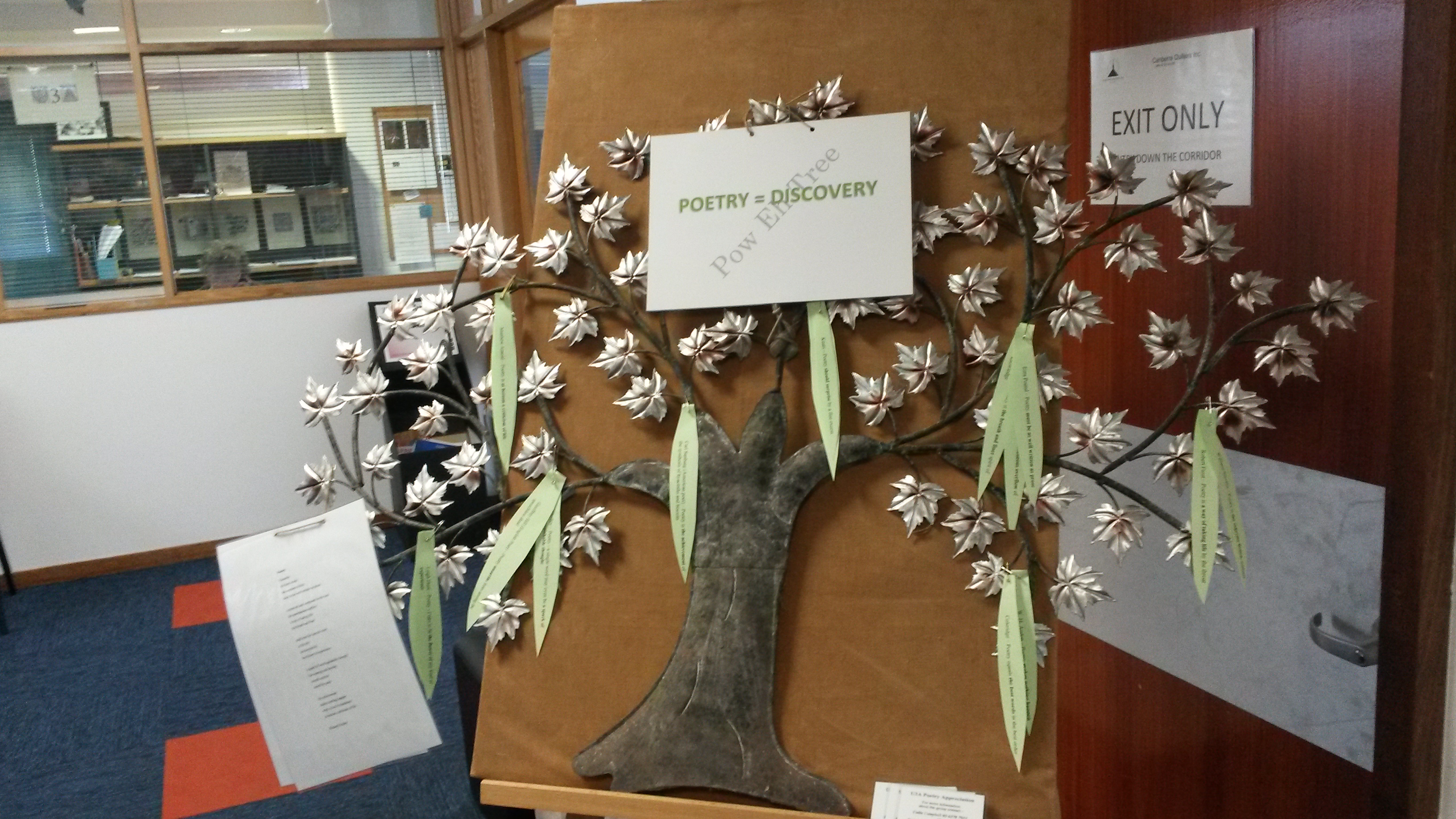
For interest, and to promote the Poetry Appreciation Group I created a POETRY TREE and attached twenty quotes on the nature of poetry by famous poets – Keats, Wordsworth, Auden, Frost, Owen, Hunt, Pound, Coleridge, Finch, Shelley, Sandburg, Arnold, Hill and Stevens.

PoetryTree
The Poetry Tree:   Poetry = Discovery

… and then a ‘Cento poem’ where each line takes text taken from the quotes –

Poetry

Unearths
the best words
the supreme fiction
must be as well written as prose

conceived and composed in the soul
the spontaneous outflow
a way of taking life
the breath and finer

shall tune her sacred voice
in the pity
the feverish fit
the flower of experience

a spark of inextinguishable thought
the opening and closing
should surprise
should be great

the achievement
makes nothing happen
what is lost in translation
at bottom a criticism

Richard Scutter

Context  – from the quotes …

Geoffrey Hill (English Poet) – Poetry unearths from among the speechless dead
Coleridge – Poetry equals the best words in the best order
Wallace Stevens – Poetry is the supreme fiction, madame.
Ezra Pound – Poetry must be as well written as prose
Mathew Arnold – Poetry is conceived and composed in the soul
Wordsworth – Poetry is the spontaneous overflow of powerful feelings
Robert Frost – Poetry is a way of taking life by the throat
Wordsworth – Poetry is the breath and finer spirit of knowledge
Samuel Johnson – Poetry shall tune her sacred voice, and wake
from ignorance the Western World
Wilfred Owen – Poetry is in the pity of war
Anne Finch (English Poet) Poetry’s the feverish fit, the overflowing of
unbounded wit
Leigh Hunt – Poetry – I take to be the flower of any kind of experience
Shelley – Poetry – a single word may even be a spark of inextinguishable thought
Carl Sanburg (American poet) – Poetry is the opening and closing of a door, …
Keats – Poetry should surprise by a fine excess
Keats – Poetry should be great and unobtrusive
Carl Sanburg (American poet) – Poetry is the achievement of the synthesis
of hyacinths and biscuits
W. H. Auden – Poetry makes nothing happen
Robert Frost – Poetry is what is lost in translation
Matthew Arnold – Poetry is at bottom a criticism of life

R-SpeakingTalking Poetry

In one word Poetry = Discovery … the poet discovers something in the creation process –  apart from the fact that achievment was possible! – perhaps a deeper personal understanding of experience … the reader discovers something of life disclosed by the poet and always something of the nature of the poet. And if art = looking and seeing and the repeat of this again and again then poetry = reading and absorbing and then repeating this again and again. Discovery is not a simple process. The U3A Poetry Appreciation Group hopefully helps insight by sharing within the group – especially where poems are a little difficult on first readings.

Love’s Arithmetic – Catullus

Love’s Arithemetic

Let’s live and love while yet we may,
My Lesbia: all the things they say,
Those crabbed old gossips, let’s agree,
Aren’t worth a farthing – what care we?
Each night the sun goes down, each morn
Another bright new day is born,
And when we quench our puny light,
Comes endless sleep, eternal night.
So kiss me, Lesbia, I implore,
A thousand times, a hundred more,
Another thousand, with again
A hundred kisses in their train,
And even after these I will
Demand eleven hundred still,
Whereat we’d better cease to tot
And mix together all the lot,
Lest envious eyes should keep the count
And grudge my lips the full amount.

Valerius Catullus born Verona (87bc – 47bc)
Reversed by Peter Hadley
From An anthology of classical verse (Epic to Epigram)

Lesbia – was the literary pseudonym of the great love of Catullus
Lesbos – an island in the Aegean sea.

Wonderful eight syllable rhythm … let’s live and love while yet we may … and count not what others do or say … enjoy, enjoy, enjoy your day!

But beware of love’s attraction … that it does not move from addiction to affliction! … see below on details of his love-life

From Wikipedia … It was probably in Rome that Catullus fell deeply in love with the “Lesbia” of his poems, who is usually identified with Clodia Metelli, a sophisticated woman from the aristocratic house of patrician family Claudii Pulchri, sister of the infamous Publius Clodius Pulcher, and wife to proconsul Quintus Caecilius Metellus Celer. In his poems Catullus describes several stages of their relationship: initial euphoria, doubts, separation, and his wrenching feelings of loss. Clodia was a woman with a ravenous sexual appetite; “From the poems one can adduce no less than five lovers in addition to Catullus: Egnatius (poem 37), Gellius (poem 91), Quintius (poem 82), Rufus (poem 77), and Lesbius (poem 79).” There is also some question surrounding her husband’s mysterious death in 59 B.C., some critics believing he was domestically poisoned. Yet, a sensitive and passionate Catullus could not relinquish his flame for Clodia, regardless of her obvious indifference to his desire for a deep and permanent relationship. In his poems, Catullus wavers between devout, sweltering love and bitter, scornful insults that he directs at her blatant infidelity (as demonstrated in poems 11 and 58). His passion for her is unrelenting— yet it is unclear when exactly the couple split up for good. Catullus’s poems about the relationship display striking depth and psychological insight.