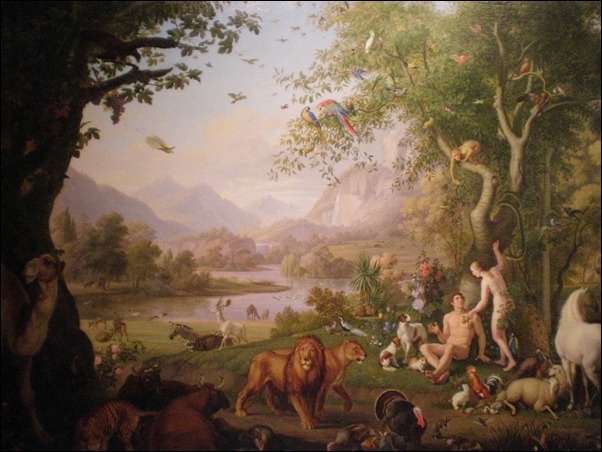
Perhaps the greatest love story

Paradise Ignored

(on viewing Wenzel Peter’s Painting Adam and Eve in the Garden of Eden)

greater love has no man than that he lay down his life for a friend

                                                                                                            John 15 v13

Images of more than two hundred animals
perfected in paint in unreal detail
carefully positioned in a still of verdant harmony
show an intricate love of the animal world
and for the very marvel of creation
in all its great variety and abundance.

For one brief moment
we are invited into this paradise
but as we enter this unreal world
there is a certain foreboding
an animal premonition prevails –

a flock of birds stir into the air
scurry above the tree of knowledge
give the danger warning

the wise owl sits at the top of another tree
knowing of the unknown perhaps
that knowledge is truly a dangerous thing

the cockerel at the foot of Eve
exhibits a full throttle crow –
an ominous omen

and the monkey appears to taunt
hanging down in a mischievous mood
proffering the reason for the disquiet

at Adam’s right hand
dogs sit true to the letters of their name

below the left foot of Eve
lambs bleat their concern,
unknowing the magnitude of the occasion for –

Eve has left the paradise party
never able to return
locked into a new and deadly life
a very different world from Adam
the two no longer gathered in one name
alone, cold, knowing that she must die
separated from eternal life
her skin has turned a shade pale.

And so Eve makes her plea
a plea for company
a plea not to die alone
and this defining moment is stilled
on canvass for all to see.

Now Eve is Adam’s own flesh and blood
Eve is his one and only friend
the only friend he has ever had
the only friend in the immensity of the world
and indeed a very special friend
a friend gifted by God
a friend created from him
so that he would not be alone.

Eve is in a state of desperate need.
Has Adam not enjoyed being with her
the time they have had together
has been pure paradise but
can he now stay in paradise by himself
surely he cannot ignore her plea.

Adam has no choice
there is no greater love
and any God would equally agree.

Richard Scutter

Context … the following image is from Wenzel Peter’s famous painting: Adam and Eve in the Garden of Eden held in the Vatican –

OLYMPUS DIGITAL CAMERA

Some information on this painting from the Vatican Website

The large canvas represents the climax of Wenzel Peter’s career.  He was an animalist painter, that is to say specialized in a very unique type of painting, and this led him to reproducing with extraordinary naturalism animals of the most varied species, as it were “photographed” in both standing and fighting positions.  The Garden of Eden is the proof of the highest virtuosity, since the artist gathers around the figures of Adam and Eve those of over two hundred animals from all over the world, reproduced not only with pictorial ability, but also with a detailed knowledge and scientific precision.  In 1831 Gregory XVI (pontiff from 1831 to 1846) purchased twenty works of the Austrian painter Wenzel Peter to furnish the Room of the Consistory in the Papal State Apartment.

I would add the importance of the positioning of the animals and the clear implied religious thought behind the design of the work.

Squaring up to the Sonnet

Here are two contrasting sonnets. The first by local Canberra poet Suzanne Edgar looks at the sonnet in traditional form … in the well-dressed format (with rhyming scheme abab cdcd aeae ff) and I must admit I do like the traditional – the well dressed woman with a subtle surprise to her name. We are too often told to think outside the square so it is nice to recognize the delights that are within and I love that first line … a light flavor without being too descriptive.

INSIDE THE SQUARE Suzanne Edgar (see footnote below)

A sonnet is a squarish-looking thing
Steady on its feet and neat, compact,
Not flighty like a bird upon the wing
or stealthy burglar startled in the act.
Sonnets always wear their hats and gloves’ –
conservative is not a tag they shun.
They never flirt about with loose-lipped loves,
avoid the wayward line and careless run,
but still they have their forceful little fling
which often turns assumptions upside down
permitting fourteen lines to dance and sing.
So if you meet one, do hold back a frown.
With even beat to captivate your ear
The sonnet will outlive the sceptic’s jeer.

Of course it is also nice to look outside the square. Paul Hetherington, another local poet, has done exactly that in his definition words below. Perhaps the casual sonnet can be more expressive allowing the street poet to exhibit quite uninhibited music. I guess it all depends upon your own personal taste and whether you think it scores more when a disciplined tune.

CASUAL SONNET Paul Hetherington

The casual sonnet
entrances because
it has the ease
of modernity
and none
of the old strictures.
It is free to embrace
the unknowable music
that the street vendor hums
and has the grace
of an outdoor cat
groomed by sunlight,
its manners
irrelevant.

This is basically two sentences broken into the mandatory requirement and to be a little different the “volta” is after six lines and not eight.

Poets are always trying to create something a little different. Don’t you think they are naturally outside the square sort of people?

Footnotes …
 
INSIDE THE SQUARE was first published in Kevin Brophy & Judith Rodriguez ed,  The 155th Sonnet by the Melbourne Shakespeare Society/ Hit & Miss Publications, Melb 2010; then in Suzanne Edgar’s The Love Procession 2012.

Paul Hetherington is an associate professor at the Canberra University on the team of the International Poetry Studies Institute.

A Mother-In-Law Problem (the original)

Apple and knife

A Mother-In-Law Problem

it is not a well-known fact
that Eve won the Miss Universe Contest
three years running

it was planned out from the beginning
the whole thing ribbed from above
stage-managed to perfection

nobody said ‘she was one in a million’
so she always took top honours
the decision a one-off personal affair

how could Adam vote for another
for he had magnetic affinity for dark hair
and he couldn’t vote for a blonde unseen

but the fourth year Adam simply had to abstain
it was all Eve’s doing in the cookery department
an unwise decision to make apple pie

for how could she emulate her Mother-in-law
when the recipe wasn’t God-given,
perhaps she just thought she could do better!

a bit unfair on poor old Adam though –
for he never ever looked at another woman
and always treated her as his very own body

so now we’re all eating Eve’s humble pie
and whether we realize we’re married or not
we can blame the Mother-in-law for dictating our lot

Richard Scutter 7 May 2010

Important lines from Milton’s ‘Paradise Lost’

At a recent U3A meeting one member of our group mentioned that when she was taught she was told that the following lines from ‘Paradise Lost’ were the most important (Book 4 lines 634 to 658 ) … my comments in bracketed italics after each section of this text  –

With thee conversing I forget all time,
All seasons and thir change, all please alike.

(This is a statement made by Adam to Eve … a statement on the importance of the communion with Eve. Adam and Eve is arguably the greatest love story and here we see Adam completely focused on Eve and time stops – the equivalent to eternity taking place … and coupled with this all the seasons and the changes in the seasons are meaningless. So what can I say, he is completely ‘lost’ in paradise!)

Sweet is the breath of morn, her rising sweet,
With charm of earliest Birds; pleasant the Sun
When first on this delightful Land he spreads
His orient Beams, on herb, tree, fruit, and flour,
Glistring with dew; fragrant the fertil earth
After soft showers; and sweet the coming on
Of grateful Eevning milde, then silent Night
With this her solemn Bird and this fair Moon,
And these the Gemms of Heav’n, her starrie train:

(Here we see a description of paradise in terms of environment … the beauty of the natural world and the start of the day defined by bird sound. Orient refers to the eastern part of the sky where the sun rises. Charm is a well-chosen word – the power to attract people – and people have a natural affinity to nature – well they are part of nature of course. Interesting  that the suggestion is that evening is grateful. Night is silent to birdlife – well not entirely. The stars the gems of heaven – the earth integrated with heaven)

But neither breath of Morn when she ascends
With charm of earliest Birds, nor rising Sun
On this delightful land, nor herb, fruit, floure,
Glistring with dew, nor fragrance after showers,
Nor grateful Eevning mild, nor silent Night
With this her solemn Bird, nor walk by Moon,
Or glittering Starr-light without thee is sweet.

(But this form of paradise is now negated but first a duplication of the opening description of paradise adding emphasis to the value of the natural world – the last four words give reason – ‘without thee is sweet’ – implying  without Eve paradise is a meaningless experience. We can of course extend this to life without communion with another – life has meaning only in terms of relationship and communion with your fellow man-woman.)

But wherfore all night long shine these, for whom
This glorious sight, when sleep hath shut all eyes?

(At night we can’t see the sky and we are oblivious to nature – dead as it were … perhaps it is the same for Adam without Eve, metaphorically speaking)

Finding Happiness

Finding Happiness

Happiness cannot be found
by searching for it on the ground.

Happiness is up to you –
say to life – I do love you!
Then by the little things you do
happiness may come to you.

For happiness is in each day.
It’s up to you to show the way.
Your inward smile can spread its face
to bring joy to the human race.

And happiness cannot be found
by walking with your head set down.
So look up into that bright blue sky
And love life with your head held high!

Richard Scutter 5 August 2013

The above sonnet was written for a recent Belconnen U3A course on ‘Happiness’.

Judith Beveridge on Poetry and Spirituality …

From an excellent article by Australian poet Judith Beveridge written for the New South Wales Writers Centre …

Throughout history, poetry has always been the most powerful and effective form for addressing and exploring deep spiritual questions.

Partly this is because poetry is connected so intimately with the breath. Poets know that the breath can act as an interpreting spirit, something which will help move, uplift and carry lived experience into rhythms and tones which allow both writer and reader to feel as if they are in communion and intense dialogue with the world around them.

The full article can be read on this link

A poem only comes alive when it is taken down from the book-shelf opened and a reader enters that unique word-world of the poet. The spirit of the read word then breathes into the living now and expands the consciousness of the reader in communion with the consciousness of the poet.

… (some poems could even take your breath away! – well you mustn’t take life too seriously must you).

Don’t drown in thought – Just Do it!

Looking at that famous T. S. Eliot Poem – ‘ The Love Song of J. Alfred Prufrock’ …

Lines 129 – 131

We have lingered in the chambers of the sea

By sea-girls wreathed with seaweed red and brown

Till human voices wake us, and we drown.

I think the whole poem is a dialogue by Prufrock with his own internal thoughts as he deliberates on a future confrontation in which he has to make his intentions known regards a certain lady. Something he obviously finds very demanding.

His underworld of thought is like the world below the sea. The sea is referenced through the text. He likens himself to a crab. And we have seen from the very beginning the reference to Dante and the shade underworld of the dead. This underworld even colours his view of the sky in that famous line at the start of the poem.

Prufrock has lingered below the surface within his own mind-chamber. In this chamber the sea-girls are wreathed with seaweed – the imagined girls are wreathed. A decoration for the dead perhaps and they could be considered as dead compared with the real-life women that are apparently dreaming of someone quite different. The sea-girls are wreathed in red and brown – quite a different image from the women he is about to meet. He has distorted them and the image is now removed from the beautiful singing mermaids in the previous lines.

The last line is an emergence from his underworld of thought into the world of action – human voices wake Prufrock from his internal sub-life – he has to respond, he is back in the real world – and he drowns, he dies – at least part of him dies – because he does not respond to the demands he has set-himself. And what a nice twist that he dies by drowning.

Note – Our thoughts about people are quite different from the actuality when we meet the person concerned, in fact what we rehearse is usually markedly different from the real-life transaction.

Some thoughts for discussion …

Thought … To what extent have we been ‘Prufrockian’ in life and not done what we know we should have done?

Thought … the more we rehearse the future the more we fear life and do not live or appreciate the present moment. What do you think?

Thought … To what extent do we feel overwhelmed with the trivialities of life?

Thought … There was a major comparison at the time TSE wrote the poem … the First World War and the Boston Scene … what exists today – that is for us, in a similar vein.

Thought … Do you think the word ‘defrock’ can be associated with the word prufrock – what would be your definition of this verb?

Defrock … take away the status, job, and authority of a priest or other member of the clergy, especially as a punishment for wrongdoing.

… and some more questions for consideration –

TSE started writing this poem at Harvard in 1911. It was published during the First World War. What impact did the war have on the poem? (explore the dedication)

TSE’s work is re-known for referencing other literary text … this is very much the case in this poem –

The epigraph is from Dante’s ‘Inferno’. The torture of Guido da Montefeltro in the eighth circle.

A literal translation – “If I thought that my answer were to one that could ever return to the World, this flame should quake no more; but since none ever did return from this depth, if what I hear is true, without fear of infamy I answer thee.”

Would you like your thoughts be made known to the whole wide world?

Here is a list of literary references in the poem …

Line 29 – “works and days of hands” – Hesoid

Line 52 – “voices dying with a dying fall” – Shakespeare

Line 81 – “I have wept and fasted, wept and prayed” – Matthew

Lines 82-83 – a reference to the story of John the Baptist

Line 89 – “among the porcelain” – Emily Dickinson

Line 92 – “sequenced the universe into a ball” – Marvel

Lines 94-95 – two Biblical stories concerning Lazarus

Lines 111-119 – the character of Hamlet and Polonius and the interplay between the two

Line 124 – “I have heard the mermaids singing each to each” – John Dunne

Explore these references – are they appropriate?

Do they add value to your reading of the poem?

The poem is a monologue spoken by Prufrock – but to whom?

What lines are important to you?

What does this poem say?

Which line in this poem is considered a turning point in poetic expression?

This poem is a statement of some of TSE’s themes which are explored again and again in his poetry – can you name a couple?

The full text of the poem can be found on the Poetry Foundation Website … http://www.poetryfoundation.org/poetrymagazine/poem/173476

The original text can also be found on the above Site … http://www.poetryfoundation.org/poetrymagazine/browse/6/3#!/20570428/0

… and more analysis can be referenced from this Internet Site …  http://www.sparknotes.com/poetry/eliot/section1.rhtml  

Promising Heaven at a Heavy cost

Paradise Replaced

Stop Press – heaven has been moved,
the door has been closed.

Well it was all in your imagination anyway
and you should know very well,
didn’t they teach you in Sunday School, –
paying the Devil is just not on.

Richard Scutter 22 July 2013

Context –

The new Australian Labour Party Prime Minister, Kevin Rudd, has stopped refugees from entry to Australia if they come by boat from Indonesia. Instead they will be processed and settled in Papua New Guinea – if deemed to be genuine. Papua New Guinea has entered into an agreement with Australia on this issue.

The reason for this change in policy is because refugees are being ‘taken for a ride’ (you could say a very dangerous sea-ride!) by people smugglers who are luring these people to travel in completely unseaworthy boats across the seas. After they have paid a large sum of money and with the promise of getting to Australia.

Many of these boats have sunk and many lives lost. This back-door traffic has been steadily  increasing and something has to be done to stop the rising death toll of innocent families especially the drowning of children. Hopefully this policy will reduce such needless deaths from occurring.

Australia is not against refugees. In my view Australia should increase its intake of refugees that come to this country by legitimate means – especially given the current state of turmoil in the World.