Anointing Ann Anonymous – leaving words

Anointing Ann Anonymous
when she was a child
and she was quite sure
that no one was looking
she picked up a stick
to scratch in concrete
‘I was here’
each day
as she walked to school
she would see her work
and laugh to herself
no one would know it was her
in her teenager years
she had that teenage crush
and melting against his name
cleared the dust on his car
with words that only she could write
‘I love you’
She thought he really knew
but she would never tell,
in later years
when thinking about him
she would laugh inside
with a little embarrassment
she had a long and ordinary life
a husband, children
and memories to drown
and if she could paint the sky
these would be her words
‘life is beautiful’
before she died
and with a knowing smile
she left these words
especially for you …

‘I was here
       I love you
       life is beautiful’
© Ann Anonymous

The following poem was included in a Yass Valley Writers anthology … Voices From the Valley.

I wanted to honour those that are not writers and have no prominent life in connection with using words, hence the title. Choice words are usually expressed by everybody at various critical times in the progression of life.

It does allude to consider what important words have been part of your life. And generally, if indeed words are important to you, what words would you like to leave behind? And what words do you think others remember you by. I still hear words my parents frequently used when I was growing up. And friends are often known by certain words they repeatedly use. To use the current vernacular enjoy your life today!


Poppies in October – Sylvia Plath and AI

Poppies in October
Even the sun-clouds this morning cannot manage such skirts.
Nor the woman in the ambulance
Whose red heart blooms through her coat so astoundingly –

A gift, a love gift
Utterly unasked for
By a sky

Palely and flamily
Igniting its carbon monoxides, by eyes
Dulled to a halt under bowlers.
Oh my God, what am I
That these late mouths should cry open
In a forest of frosts, in a dawn of cornflowers.
Sylvia Plath (27 October 1962)

Analysis …

Nothing in sun and sky can match the poppy skirts (petals) in their colour … nor the woman (reference to herself) in the ambulance whose red heart is amazingly kept alive … the woman (SP) close to death … others not so lucky … she has been rescued and will survive.

This late showing is out of context with the season … and is a gift unasked for …and in this regard, SP could be talking about her astoundingly good luck in surviving her earlier suicide attempt … her red heart did bloom … how come she was saved? … how come she was given a second chance? … SP did not ask for this … to be re-born … at least she acknowledges this gift as a ‘love-gift’ … even if she is not thankful.

… the medicos that saved her did not know her … see her red passion, her emotional state … how could they … they wear bowler hats … head-centric on their work

… and then the lament of not knowing who she is … the poppy in October … out of context … but still alive … she cries aloud for some understanding … why should she be alive in a ‘forest of frosts’ (in a deep tangle where growth is unlikely – how she saw her life) and in a ‘dawn of cornflowers’ (emerging against the bland mass of the common … a little arogance perhaps)

Note … this poem was written on SP’s last birthday (27 Oct 1962) … her 30th birthday … at a time when she was living by herself (with the two children) in London – separated from Ted Hughes  … she also wrote another poem ‘Ariel’ on the same day … so she had time to herself on this day to devote to poetry … and to question her existence … to question why she has survived out of season (like the poppy) … and to ask why she is still alive … and inferred – why is live so hard … it is a cry for an explanation from the deep intensity of her being for a meaning in her troubled world … questioned in a state of mental unrest.

… and whether any physical poppies were around on this her birthday is open to question … they could be mind-poppies … (refer also to a previous poem ‘Poppies in July’ written in Devon in the summer … when times were different.)

And this is what AI (CHATgpt) had to say about this poem illustrating the dangers of using AI without careful attention to the response …

“Poppies in October” is one of Sylvia Plath’s poignant poems, reflecting her complex relationship with nature, life, and death. In this poem, she explores themes of beauty, transience, and the inevitable decay that accompanies life.

The imagery of poppies, often associated with remembrance and sleep, takes on multiple layers of meaning in Plath’s hands. They are portrayed as fragile and ephemeral, yet their vibrant red hue contrasts sharply with the barrenness of autumn, suggesting a defiance against mortality.

Plath’s use of language is characteristic of her poetic style—rich in symbolism and laden with emotion. The juxtaposition of “scarecrow” and “blood-burned barns” evokes a sense of desolation and decay, while the “golden mummies” suggest a haunting beauty amidst the inevitable march of time.

The poem’s closing lines, “Now she is flying / More terrible than she ever was, red / Scar in the sky, red / Comet / Over the engine that killed her— / The mausoleum, the wax house,” hint at the speaker’s acceptance of death as a transformative force. The image of the poppy as a “red / Scar in the sky” suggests a lingering presence even in death, a reminder of the fragility and resilience of life.

Overall, “Poppies in October” is a powerful meditation on mortality, capturing both the beauty and sorrow inherent in the cycle of life and death. Plath’s adept use of imagery and language imbues the poem with a haunting quality that lingers in the mind of the reader long after the final lines have been read.

Quite clearly the text that I have highlighted in red above refers to the different SP poem Stings.

Here is the last stanza of Stings ...

Now she is flying
More terrible than she ever was, red
Scar in the sky, red comet
Over the engine that killed her ----
The mausoleum, the wax house.

It is interesting that AI picked up these lines. The red scar in the sky could have association with a poppy. And after her suicide attempt in the cellar she had a scar on her face enhancing personification. Stings was written in early October 1962. That month SP was really flying in terms of her poetic creativity.

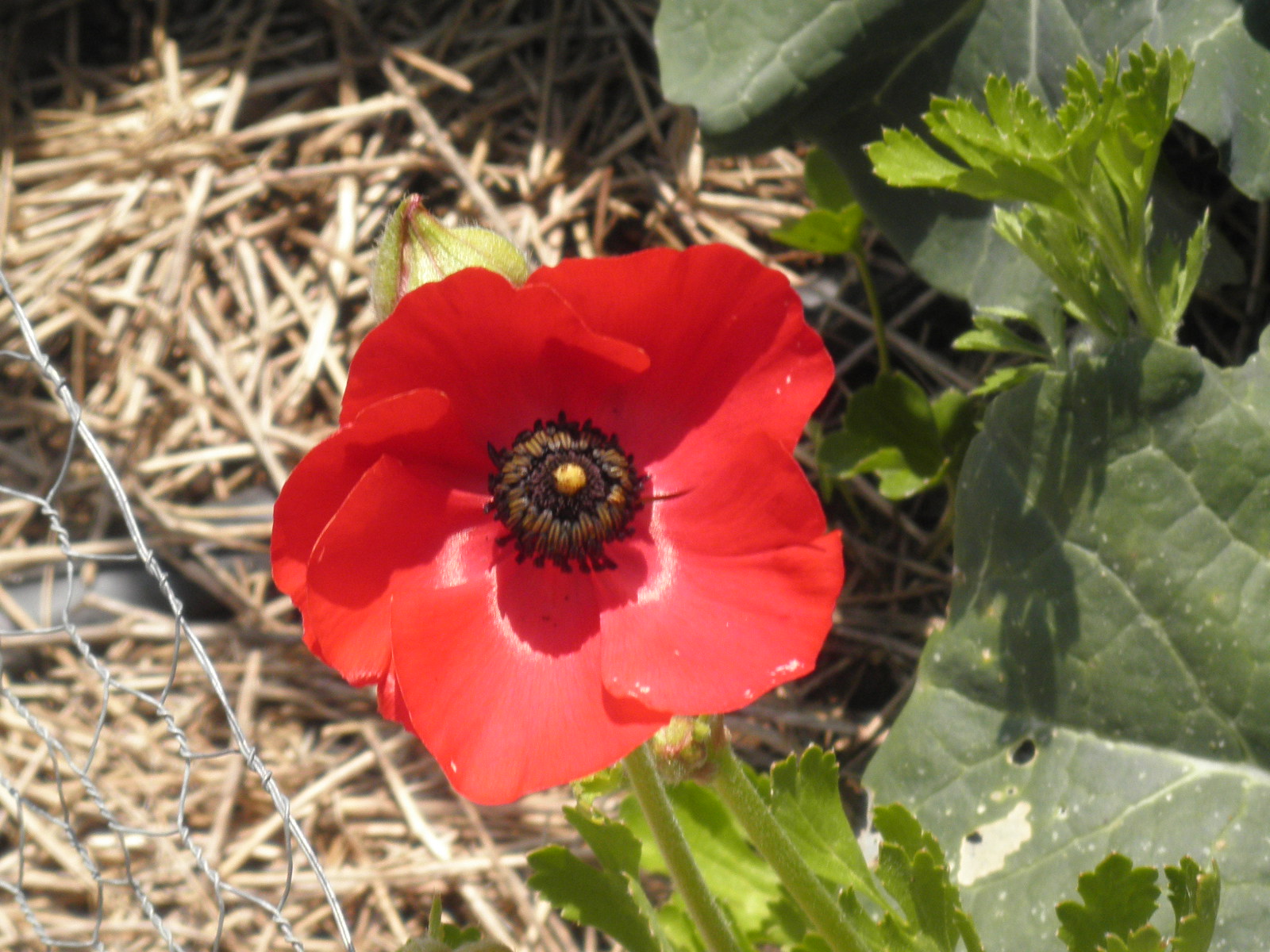
… and here is a poppy from the Australian spring a poppy very much in season.


The Bright Field – R. S. Thomas – Analysis

The Bright Field
I have seen the sun break through
to illuminate a small field
for a while, and gone my way
and forgotten it. But that was the
pearl of great price, the one field that had
the treasure in it. I realise now
that I must give all that I have
to possess it. Life is not hurrying
on to a receding future, nor hankering after
an imagined past. It is the turning
aside like Moses to the miracle
of the lit bush, to a brightness
that seemed as transitory as your youth
once, but is the eternity that awaits you.
R. S. Thomas (1913 – 2000)

R. S. Thomas was a Welsh poet and Anglican priest; so, it is not surprising that there are religious references. Moses and the ‘burning bush’ was the spectacular interaction where God defined the plan for Moses to lead the Israelites out of Egypt. So, ‘The Bright Field’ could be considered, metaphorically speaking, that spectacular event in life that defines a personal focus to living.

The poem asks the reader to consider such personal turning points that define purpose. And to stay focus on that purpose, independent of a religious high being part of the equation. And to concentrate on the now; for indeed life is not hurrying on to a receding future, nor hankering after an imagined past.

And the sun breaking through has that latent son religious thought of a spiritual connection whether or not so glaringly stated as in the case of Moses and the burning bush.

It is nice to carry those ‘golden moments’ with us especially if they are of such significance that they define purpose and meaning to life! Especially to remind ourselves when we are overwhelmed by modern day lock-downs and stress; and to continue to follow our dreams regardless.

Enough of the didactic! … here is a special moment from my youth when I had the whole wide world before me (forgive the pun) …

Stopping One Day
I remember one day in June.
The height of summer and the sun
still rising on one of those days
that calls all nature into song.

Biking the back lanes of the Hampshire countryside.
Stopping on a bridge over a stream
the clear sparkling chatter below, while beyond
the fields praising their contentment.

Footnote …

It was one of those startling English summer days in June.  The sun stretching and all nature responded as I cycled down a country lane thinking of my future. I stopped on a narrow bridge over a little stream totally intoxicated with the joy of life.

On Wikipedia – R. S. Thomas – Wikipedia

Anointing Ann Anonymous – Recognition and Beauty

Following on from my previous Post on John Keats and ‘Beauty’ and legacy … and recognising the so called ordinary in life’…

Anointing Ann Anonymous
when she was a child
and she was quite sure
that no one was looking
she picked up a stick
to scratch in concrete
                    ‘I was here’
each day
as she walked to school
she would see her work
and laugh to herself
no one would know it was her
in her teenager years
she had that teenage crush
and melting against his name
cleared the dust on his car
with words that only she could write
      ‘I love you’
She thought he really knew
but she would never tell,
in later years
when thinking about him
she would laugh inside
with a little embarrassment
she had a long and ordinary life
a husband, children
and memories to drown
and if she could paint the sky
these would be her words
     ‘life is beautiful’
Richard Scutter

Ann’s legacy – I was here / I love you / life is beautiful

The Wild Iris – Louise Gluck – Analysis

A week or so ago the poet Louise Glück became the first American woman to win the Nobel prize for literature in 27 years, cited for “her unmistakable poetic voice that with austere beauty makes individual existence universal”.

Glück is the 16th woman to win the Nobel, and the first American woman since Toni Morrison took the prize in 1993. The American singer-songwriter Bob Dylan was a surprise winner in 2016.

One of America’s leading poets, the 77-year-old writer has also won the Pulitzer prize and the National Book Award, tackling themes including childhood and family life, often reworking Greek and Roman myths.

The Wild Iris’ by Louise Glück is the title poem of her 1992 collection. This volume follows a specific sequence, poem to poem, describing the poet’s garden. In this piece, she considers the human soul, immortality associated with rebirth, and the commonalities between all life no matter how that life is manifested. 

Looking at the text …

The Wild Iris
At the end of my suffering
there was a door.

Hear me out: that which you call death
I remember.

Overhead, noises, branches of the pine shifting.
Then nothing. The weak sun
flickered over the dry surface.

It is terrible to survive
as consciousness
buried in the dark earth.

Then it was over: that which you fear, being
a soul and unable
to speak, ending abruptly, the stiff earth
bending a little. And what I took to be
birds darting in low shrubs.

You who do not remember
passage from the other world
I tell you I could speak again: whatever
returns from oblivion returns
to find a voice:

from the center of my life came
a great fountain, deep blue
shadows on azure seawater.
Louise Gluck (1943 –

The iris is wild as though it has a natural uncultivated presence.

The door is death and going through the door ends suffering and someone has gone through the door. It is not unreasonable to assume a person has died. But in the second stanza we see that the person wants to talk about ‘death’ – what you call death – after ‘death’ has actually taken place.

The next two stanzas change thoughts from personal death to the death of an iris. The dead iris is buried in the earth. However, the dead iris is not dead but has become a consciousness. This consciousness is ‘terrible’. The question is left for the reader to ponder meaning. Maybe it is terrible because it wants to become. Equally the reader can entertain the thought that all death might become latent consciousness.

Then it is over. That horrible time of the consciousness not being able to speak – not able to become living and have a voice and meaning. And we see the stiff earth bending a little, as though the iris has started to break through the earth.

Then the voice beyond ‘death’ speaks again to tell us that all re-birth seeks a voice.

In the last stanza the voice of the blue iris coming to life is described in dramatic terms. The voice of the iris in all its splendor is a great fountain. The whole purpose of the iris is to flower in glory.

While the speaker is talking about a flower, there are obvious implications for humanity, and the human soul. What are we meant to become? And is life a continual cycle of re-birth? And are we naturally beautiful?

Louise Gluck on Wikipedia

Easter Sunday Sunrise

Easter Sunday Sunrise

not just another day
another day of the same
of the no touch of distancing
of not being able to reach out in the community
of confinement to self
of being centered on the inside
not just another day
no!

this day is different
this day is the one day
the one day that opens into every day
the lifeline to eternal tomorrows
as our own tomorrow ending
is contemplated

Richard Scutter

Celebrate this special day with friends and family!

The Orange Tree – John Shaw Neilsen – Analysis

The Orange Tree

The young girl stood beside me. I
Saw not what her young eyes could see:
A light, she said, not of the sky
Lives somewhere in the Orange Tree.

Is it, I said, of east or west?
The heartbeat of a luminous boy
Who with his faltering flute confessed
Only the edges of his joy?

Was he, I said, born to the blue
In a mad escapade of Spring
Ere he could make a fond adieu
To his love in the blossoming?

Listen! the young girl said. There calls
No voice, no music beats on me;
But it is almost sound: it falls
This evening on the Orange Tree.

Does he, I said, so fear the Spring
Ere the white sap too far can climb?
See in the full gold evening
All happenings of the olden time?

Is he so goaded by the green?
Does the compulsion of the dew
Make him unknowable but keen
Asking with beauty of the blue?

Listen! the young girl said. For all
Your hapless talk you fail to see
There is a light, a step, a call,
This evening on the Orange Tree.

Is it, I said, a waste of love
Imperishably old in pain,
Moving as an affrighted dove
Under the sunlight or the rain?

Is it a fluttering heart that gave
Too willingly and was reviled?
Is it the stammering at a grave,
The last word of a little child?

Silence! the young girl said. Oh why,
Why will you talk to weary me?
Plague me no longer now, for I
Am listening like the Orange Tree.

John Shaw Neilson 1919

S1 … The young girl starts a conversation with a bystander. She sees (or senses) a ‘light’ in the Orange Tree; but not so the bystander (or the poet).

S2-3 … The bystander or poet then makes enquiry on the nature of the ‘light’ expressing his thoughts on that nature in poetic terms. All his energy is on his creative thoughts. He alludes to a boy and to love.

S4 … The young girl takes no notice of his poetic rapture instructing him to ‘listen’. It is almost like a sound in the Orange Tree.

S5-6 … The bystander goes into more poetic fantasy on the possible nature of the ‘light’. Again he equates his thoughts to that of a boy.

S7 … The young girl is now irritated by the hapless talk from the bystander. She instructs him emphatically to listen!

S8-9 … Unfortunately the bystander poet takes no notice and continues his poetic expression trying to pry out the nature of her experience in his creative words rather than try to experience the ‘light’ for himself.

S10 … The young girl has had enough of his hapless weary talk. The communication with the bystander poet has ended. She is now at one with the Orange Tree sharing totally with the Tree; and perhaps at one with the natural environment. And the poet is left none the wiser.

This is one of the most known poems of John Shaw Neilsen and perhaps one of his most important poems. Every poet, writer and especially those steeped in analysis should read these words. Analysing experience detracts from the experiencing and may, as in the case above, detract from the experience of another.

And perhaps The Orange Tree can be equated to Life and ‘light’ to beauty. Life must be experienced yourself! You must listen to understand; to be in tune with life rather than letting your own fancies distract.

I hope that my analysis has not stopped enjoyment of the poem!

One Art – Elizabeth Bishop – Analysis

One Art

The art of losing isn’t hard to master;
so many things seem filled with the intent
to be lost that their loss is no disaster.

Lose something every day. Accept the fluster
of lost door keys, the hour badly spent.
The art of losing isn’t hard to master.

Then practice losing farther, losing faster:
places, and names, and where it was you meant
to travel. None of these will bring disaster.

I lost my mother’s watch. And look! my last, or
next-to-last, of three loved houses went.
The art of losing isn’t hard to master.

I lost two cities, lovely ones. And, vaster,
some realms I owned, two rivers, a continent.
I miss them, but it wasn’t a disaster.

—Even losing you (the joking voice, a gesture
I love) I shan’t have lied. It’s evident
the art of losing’s not too hard to master
though it may look like (Write it!) like disaster.

Elizabeth Bishop (1911 – 1979)

This poem is a villanelle consisting of five tercets rhyming ‘aba’ and a quatrain of rhyming ‘abaa’ Traditionally the lines are iambic pentameter.

The title One Art.

The title cannot be understood until reading the poem. If the way life to be lived is defined as the ‘The Art of Living’ and if this can be subdivided into countless components such as ‘The Art of Working’, ‘The Art of Communication’, etc. then perhaps one such component could be defined by ‘The Art of Losing’ and this is what life is all about and so too this poem – ‘One Art’ one very important art!

Looking at each stanza –

The art of losing isn’t hard to master;
so many things seem filled with the intent
to be lost that their loss is no disaster.

Life can be regarded as a continual disappearance game as we lose things all the time – so this must be expected – it’s life! A villanelle as many repetitive lines so very appropriate to the nature of loss.

Lose something every day. Accept the fluster
of lost door keys, the hour badly spent.
The art of losing isn’t hard to master.

We mislay things often and find then quickly hopefully and quite often these are things we use all the time like keys. Annoying and time consuming events that are just part of everyday life and not hard to master!

Then practice losing farther, losing faster:
places, and names, and where it was you meant
to travel. None of these will bring disaster.

You meet many people visit many places and you lose them as they fade from current life. The question is – are they still latent in your life story. Perhaps of more importance to your thoughts are the places and people you have always been meaning to visit. This is a far different kind of loss because it engenders failure.

I lost my mother’s watch. And look! my last, or
next-to-last, of three loved houses went.
The art of losing isn’t hard to master.

No we start talking of those things of great value to who we are. Items of personal significance and places that have been are home through the years. We lose them as we move on but do not forget their significance or do we.

I lost two cities, lovely ones. And, vaster,
some realms I owned, two rivers, a continent.
I miss them, but it wasn’t a disaster.

Then geography and countries and cities are condemned to loss. More so of course as you age and are confined to place after many years of experiencing travel and life in different countries. Elizabeth Bishop lived in Brazil for 15 years before her return to Massachusetts. Maybe not a disaster in that happy memories instils warmth to current life.

—Even losing you (the joking voice, a gesture
I love) I shan’t have lied. It’s evident
the art of losing’s not too hard to master
though it may look like (Write it!) like disaster.

Here we end with the greatest loss perhaps – that of a close loved one; whether a partner or family member. And (Write it!) says with such emphatic voice that ‘losing’ is so hard.

This poem is the ‘Art of Losing’ and quite different from ‘The Art of forgetting’.

Elizabeth Bishop on Wikipedia

And an excellent analysis of this poem is on this Site