Prayer – Carol Ann Duffy – Analysis

Prayer

Some days, although we cannot pray, a prayer
utters itself. So, a woman will lift
her head from the sieve of her hands and stare
at the minims sung by a tree, a sudden gift.

Some nights, although we are faithless, the truth
enters our hearts, that small familiar pain;
then a man will stand stock-still, hearing his youth
in the distant Latin chanting of a train.

Pray for us now. Grade 1 piano scales
console the lodger looking out across
a Midlands town. Then dusk, and someone calls
a child’s name as though they named their loss.

Darkness outside. Inside, the radio’s prayer –
Rockall. Malin. Dogger. Finisterre.

Carol Ann Duffy

Minim = a musical note with the time value of half a semibreve or two crotchets. It is written as an open note head with a stem.
Train = long moving line of people

Looking at this sonnet …

The first quatrain … when in the middle of a task something to the peripheral arrests attention … in this instant a voice from the trees … as though someone else is speaking and there is communion with the environment … the woman stops what she is doing and for one brief moment there is an appreciation of life … the joy of just being.… there is a gift of thanks … or putting it another way this can be thought of as a prayer of thanks whether or not just a thank you for life or whether a thank you to another ‘God’.

The second quatrain … prayers happen regardless of any formal faith … night is the time when the mind is vulnerable … and often in those sleep hours thoughts occur seemingly out of nowhere… and if the truth of the matter unravels there is usually some pain and discomfort from this communion in any resolution.

Maybe hearing a piece of music gives association to something way back from his youth … perhaps to a time when the man was more motivated and a time when he was following his young heart with strong purpose … and again this may be painful and the man may seek consolation if reflecting on unfilled dreams.

The third quatrain … pray for us now – this looks like an ask … an ask for help and we all need help and support in order to give help and support … prayer is defined as a solemn request or a giving of thanks to an object of worship (usually God) … so this is an ask for us to ask our ‘God’ for help for those in need … to invoke an external force … if the lodger needed consolation then the Grade 1 piano scales could be seen as a response to prayer. The last sentence seems to show a person in grief … as though they named their loss … in grief for a child and in need of consolation … in need of prayer

The rhyming couplet … mentioning the shipping forecast invokes a prayer for those at sea … a prayer that sailors may be able to heed the information and not risk life … darkness outside gives the feeling that prayer is a mystery and hidden … whereas inside the radio’s prayer gives the other side of the coin that prayer always emanates from the internal reaching out from the person

Re: shipping forecasts … the unique and distinctive sound of these broadcasts has led to their attracting an audience much wider than that directly interested in maritime weather conditions. Many listeners find the repetition of the names of the sea areas almost hypnotic, particularly during the night-time broadcast at 0048 UK time. (from Wikipedia)

I do like this sonnet as it widens the concept of traditional prayer and brings prayer down to the basics of everyday communication in the living of life.

And to end, –  a prayer that our daily transactions are appropriate as we negotiate life!
Let us drink and be merry – Thomas Jordan

Let us drink and be merry

Let us drink and be merry, dance, joke, and rejoice,
With claret and sherry, theorbo and voice!
The changeable world to our joy is unjust,
All treasure’s uncertain,
Then down with your dust!
In frolics dispose your pounds, shillings, and pence,
For we shall be nothing a hundred years hence.

We’ll sport and be free with Moll, Betty, and Dolly,
Have oysters and lobsters to cure melancholy:
Fish-dinners will make a man spring like a flea,
Dame Venus, love’s lady,
Was born of the sea:
With her and with Bacchus we’ll tickle the sense,
For we shall be past it a hundred years hence.

Your most beautiful bride who with garlands is crown’d
And kills with each glance as she treads on the ground.
Whose lightness and brightness doth shine in such splendour
That one but the stars
Are thought fit to attend her,
Though now she be pleasant and sweet to the sense,
Will be damnable mouldy a hundred years hence.

Then why should we turmoil in cares and in fears,
Turn all our tranquill’ty to sighs and to tears?
Let’s eat, drink, and play till the worms do corrupt us,
’Tis certain, Post mortem
Nulla voluptas.
For health, wealth and beauty, wit, learning and sense,
Must all come to nothing a hundred years hence.

Thomas Jordan (1612-1685)

The poem is well crafted – iambic with rhyming couplets – it has been labelled a song and it does have a nice rhythmic beat.

Theorbo – plucked string instrument of the lute family
Venus – Goddess of love and beauty
Bacchus – God of wine
Post mortem nulla voluptas – after death no pleasure remains

Interesting that oysters were known as an aphrodisiac over four hundred years ago.

Well it is the season to be merry. Thomas Jordan is not thinking of Christmas – quite clearly he is thinking of death of where he, or others, will be in a hundred years’ time.

To me the words have a sense of ‘must’ and a sense of urgency while accepting that we only have this moment – the now to be enjoyed in all its’ fullness. But in my book when you try to force merriment the party often falls flat.

Having said that I insist you have a ‘merry’ Christmas.

Anyway isn’t Christmas the celebration of the birth of life eternal so who knows what pleasures will be unwrapped in the future! Well one day we all may know.

A link to Thomas Jordan on Wikipedia.

Poetry and Influence

To what extent can poetry influence the world … well, for that matter, to what extent can any words or thoughts change behaviour and influence life. It is happening all the time of course … we all contribute in one way or another. Today the influence of  the internet and social networking is a very powerful force … that is another issue.

And for those who believe in a ‘living creator’ … how is ‘this voice’ made manifest in the on-going life of the world – if at all?

Song of the Universe

Every Voice
Endless Rapture
Your

Voice
Oration Instilled
Creating Eternity

Some days we may not hear great harmony.

Below is the text I wrote for a local Anglican publication a couple of days after the terrorist attack in Paris.. It happened to be on ‘International Tolerance Day’.

Paris Aftermath

Where to now after such a vile act that everyone is finding hard to comprehend? How should we deal with those that foster terrorism abroad and how do we deal with the self-proclaimed terrorist Islamic State when any form of negotiation is impossible?

Anger and fear may generate more violence in the form of retaliation and revenge. And unfortunately increased polarisation is inevitable. Annihilation of the enemy and from a distance to minimise personal loss is always going to be a short term band aid solution.

The following poem was written to counteract those that think the only solution is violence and annihilation. Terrorists for all their blatant sins happen to be human so on this ‘International Day of Tolerance’ it is well to remember this fact.

Closure
in memory of a twelve year old who self-detonated
early to save lives

don’t slam the door kid, when you leave your room
don’t slam the door tight when you enter the night
go quietly; go gently, as you enter the night
go gently as you vanish from sight

at that age when there is no age
and when the rolling of the years
matters only to another
and the inscription on the wall
is left for others to recall
and when they resurrect your name
will they relinquish certain blame?
let them shed their tears kid!

how can that have any meaning
is there meaning in a flower?
you knew exactly who you were kid!

don’t slam the door kid when you leave your room
don’t slam the door tight when you enter the night
go quietly; go gently, as you enter the night
go gently as you vanish from sight

Footnote

The long term solution will lie with succeeding generations – ‘the hand that rocks the cradle rules the world’. It is imperative that we instil in our children a sense of value and respect for life – their own life and the life of others – in particular to be inclusive of all peoples no matter what religion. Tantamount to this text is the ability to think for oneself without being misled by the mob. Hopefully such values will stay with them throughout their days in that great endeavour to make the world a better place.

Being an optimist I know that one day peace will again come to the troubled regions of our world.

In the words of Gerard Manley Hopkins ‘The world is charged with the grandeur of God’.

Enjoy the beauty of this day and the wonder of creation.

Richard Scutter 16 November 2015

The Moor – R. S. Thomas Analysis

The Moor

It was like a church to me.
I entered it on soft foot,
Breath held like a cap in the hand.
It was quiet.
What God there was made himself felt,
Not listened to, in clean colours
That brought a moistening of the eye,
In a movement of the wind over grass.
There were no prayers said. But stillness
Of the heart’s passions — that was praise
Enough; and the mind’s cession
Of its kingdom. I walked on,
Simple and poor, while the air crumbled
And broke on me generously as bread.

R. S. Thomas: The Moor, from Pietà, 1966

R. S. Thomas was an Anglican minister so he knew exactly what ‘traditional church’ was like but in this poem he discovers a different church while walking on his local Welsh moorland.

One enters a church with reverence taking the hat off and you expect a certain quiet – that is if there is no service in progress – so this description is an apt translation as he sets foot on the moor. And by holding his breath giving greater attention to the surrounding as he first sets foot on the moor.

But in this ‘church’ there is no listening to God via the pulpit. Here God is known as a feeling. The clean colours implying perhaps that the moor is clean and sinless – so we may assume there is no litter to corrupt the eye. If it was a windy cold day then that may have provoked a watering of the eye. On the other hand the feeling of the presence of God due to the beauty of the moor may have been so overwhelming that this caused such moisturising.

In church communication with God is by prayer – but on the moor there is direct communication between God and man via the environment.  The stillness of the heart’s passions is communication if considered as a religious response from walking on the moor in the form of a settling peace within the poet. This could then be regarded as an automatic prayer of both praise and thanks – especially by R. S. Thomas being tuned to religious thought.

The mind’s cession of its kingdom gives an emphasis to the exhilaration in this moment such that the mind is expanded in wonderment in trying to give comprehension. But then the move as he walks on – the breaking away from this intense communion – clearly likened to a church communion where there is the breaking of bread.

I think in today’s twenty four by seven world we all need to find time to escape into a place of solitude – to find our own moor and perhaps in the still and beauty of a such a sacred place experience the presence of God and a settling within. If my bible memory is correct JC had to do likewise when he was overwhelmed by the masses that pressed in on him.

R. S. Thomas on Wikipedia.

Here are some wonderful images of the Welsh Moor on Tom Clark’s Blog.

Fruhlingsglaube – Johann Ludwig Uhland and Schubert

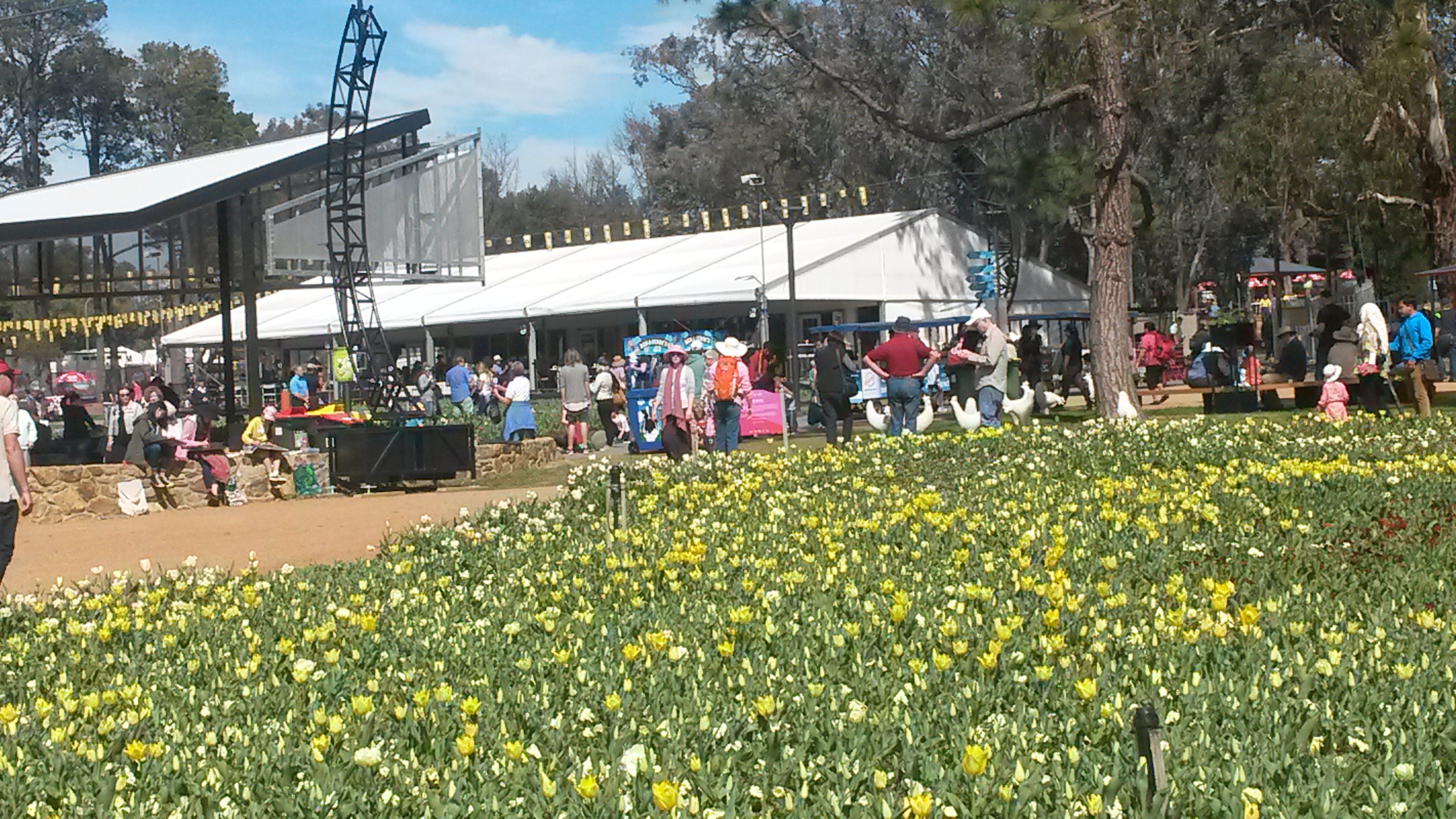
Floriade15Floriade – Spring Flower Festival in Commonwealth Gardens Canberra

It is Spring in Australia and here is a German poem by the romantic lyric poet Johann Ludwig Uhland (1787-1862).

Fruhlingsglaube

Die linden Lüfte sind erwacht,
Sie säuseln und wehen Tag und Nacht,
Sie schaffen an allen Enden.
O frischer Duft, o neuer Klang!
Nun, armes Herze, sei nicht bang!
Nun muß sich alles, alles wenden.

Die Welt wird schöner mit jedem Tag,
Man weiß nicht, was noch werden mag,
Das Blühen will nicht enden;
Es blüht das fernste, tiefste Tal:
Nun, armes Herz, vergiß der Qual!
Nun muß sich alles, alles wenden.

Below are two translations from the internet …

Spring’s Faith (re: this Blogspot post)

The mild breezes are awakened,
They whisper and move day and night,
And are at work everywhere.
O fresh scent, o new sound!
Now, poor heart, don’t be afraid.
Now all, all must change.

The world is more beautiful with every day,
One knows not what yet may be,
The flowering will not end.
Even the deepest, most distant valley blooms.
Now, poor heart, forget your torment.
Now all, all must change.

Faith in Spring (Re -Poemhunter)

The gentle winds are awakened,
They murmur and waft day and night,
They create in every corner.
Oh fresh scent, oh new sound!
Now, poor dear, fear not!
Now everything, everything must change.
The world becomes more beautiful with each day,
One does not know what may yet happen,
The blooming doesn’t want to end.
The farthest, deepest valley blooms:
Now, poor dear, forget the pain!
Now everything, everything must change.

This highlights the problems with translations. It is a often a matter of personal taste for some words may be more fitting to the theme than others. It is up to the reader to choose. It may be a case of taking a combination from various translations to fit your preference. For example the first three lines could be as follows …

The gentle winds awake – (I prefer gentle to mild)
They murmur and waft day and night
And are at work every where

However of more importance, this poem inspired Franz Schubert‘s, (1797-1828) to compose a lieder and this is a link to a Youtube video of Dietrich Fischer-Dieskau singing Fruhlingsglaube  … and here is the text from this song …

the gentle breezes have awakened,
they whisper and float day and night,
they create on all sides.
On all sides.
O fresh fragrance, O new sound!
O new sound!
Now, poor heart, be not afraid!
Now all, all must change.

The world becomes more beautiful with every day,
No one knows what may become,
The blossoming will not end;
It will not end;
It blooms in the farthest, deepest valley:
It blooms in the deepest valley:
Now, poor heart, forget thy pain!
Now all, all must change.

… so again the original poem is transformed and in this case married into a new art-form while still retaining the essence of the text and if you have watched and listened to the Youtube video you will see that ‘Spring images’ also accompany both the audio and the words.

Clearly if it hadn’t been for Schubert this poem would not have reached such prominence in the public ear.

Considering the line … The world becomes more beautiful with every day … I immediately thought of Gerard Manley Hopkins and … The world is charged with the grandeur of God from ‘God’s Grandeur’ – whether or not we are able to see beauty in each day is another matter!

The Divine Comedy – Looking into Heaven – Clive James

Heaven (The Divine Comedy)
Canto 31 – lines 1 – 33

The form, then, of the saintly host of Christ
Was shown to me as being a white rose,
A perfect rose which, with His own blood, Christ
Has made His bride. But also there are those –
The other host – who, flying, see and sing
The glory of the Lord who holds their love
And goodness that has made them everything
They are, and there they are, at large above.
Just like a swarm of bees that first will dive
Into the flowers and then go back to turn
Their toil to nectar, treasure of the hive,
These ones I watched, for I was here to learn –
Descend headlong into the mighty flower
Of many petals, and then reascend
To where the love abides in all its power
Forever, and then, flying without end,
They swoop again, their faces living flame,
Their wings of gold, and for the rest, so white
Our fresh snow couldn’t hope to seem the same.
When they again went back down from the height
Into the bloom, they gave it, tier on tier,
The peace and order they had gained from how
They fanned their sides with wings. …

Translation of Dante’s Divine Comedy by Clive James

My interpretation of the above lines –

The form, then, of the saintly host of Christ
Was shown to me as being a white rose,
A perfect rose which, with His own blood, Christ
Has made His bride.

The host of Christ – a host is someone who presents … someone who invites and entertains … a master of ceremonies … and in the religious context the host of Christ is the consecrated bread … and the consecrated bread is the gift of Christ as the body of Christ created with his own blood – Dante represents this as a perfect white rose – it has to be white no other colour could represent Christ and it has to be perfect.

Christ has made this His Bride … the Bride of Christ gifted for the marriage of His Church through the consecrated bread (body)and wine (blood)… the words from the Anglican Communion Service define this union (marriage) – ‘We who are many are one body in Christ, for we all share in the one bread’ – the gift of life for all’. This marriage is a continual marriage as the world expands in population.

But also there are those –
The other host – who, flying, see and sing
The glory of the Lord who holds their love
And goodness that has made them everything
They are, and there they are, at large above.

Who are these ‘other hosts’ … my interpretation is that they are those that have been transformed to such an extent through the marriage of Christ that they themselves have become totally ‘Christ-like’ spiritually – and everything that they are comes from the Lord, they are flying and singing the glory of the Lord – angels also comes to mind, and they are at large –very much an active force.

Just like a swarm of bees that first will dive
Into the flowers and then go back to turn
Their toil to nectar, treasure of the hive,
These ones I watched, for I was here to learn –
Descend headlong into the mighty flower
Of many petals, and then reascend
To where the love abides in all its power
Forever, and then, flying without end,
They swoop again, their faces living flame,
Their wings of gold, and for the rest, so white
Our fresh snow couldn’t hope to seem the same.

The ‘other hosts’ are in a hive of activity being equated to the action of bees diving into the Christ-Host – the white rose – creating nectar, the treasure found in the gift of Christ and the treasure that they create returning that to the Lord (where love abides in all its power). The image of faces of living flame, wings of gold, and bodies beyond the white of snow try to give a physical representation to the spiritual transformation that has occurred – a living perfection of nature – and a nature that is dynamic and busy.

When they again went back down from the height
Into the bloom, they gave it, tier on tier,
The peace and order they had gained from how
They fanned their sides with wings.

Bees actually fan their wings when they come into the hive to control temperature. This is interesting for the implication is that the Christ-Host is supported by other hosts which give peace and order – supported by those that have become fully Christ-like.

This seems to portray Heaven and the Body of Christ not as an afternoon Sunday nap but a busy active expanding evolution.

Revolution (in the way we view creation)

Revolution

James Ussher (1) calculated the starting point.
About 4004 years before the birth of Christ,
apparently at 9:00am on a Monday morning
in late October.

Thomas Guy (2) then annotated his holy bibles
enforcing this fact within the Church and for
years the populace believed his added words.
Then Darwin learnt that truth lies in geometry
and that a circle has no start or finish.

But if you believe in the ‘Big Bang’ theory
then everything is gradually losing energy.
Being in my latter years this is understandable,
my circulation not being what it once was.

However, we do have plenty of time up our sleeves
for our best scientists have predicted it will take
several billion years before the Sun expands and
drags the Earth within its heated arms.

So there may come a day when everything stops.
Perhaps at 11:15pm on a Saturday in September –
after the late night news.

T S Eliot plaque East Coker church

in my beginning is my end … in my end is my beginning
T. S. Eliot’s Memorial Plaque – East Coker Church, Somerset

Footnotes
1 James Ussher (4 January 1581 – 21 March 1656) was the Irish Archbishop of Armagh and Primate of All Ireland between1625 and 1656. He was a prolific scholar and church leader, famous for his chronology that sought to establish the time and date of the creation.
2 Thomas Guy (1644–1724) was a British bookseller, speculator and official publisher of bibles and from his wealth became the de facto founder of Guys Hospital in London.

It is unbelievable that the populace believed in such things for so many years. I wonder if the same is true for something in life today!

Morning Song – Sylvia Plath – Analysis

Morning Song

Love set you going like a fat gold watch.
The midwife slapped your footsoles, and your bald cry
Took its place among the elements.

Our voices echo, magnifying your arrival. New statue.
In a drafty museum, your nakedness
Shadows our safety. We stand round blankly as walls.

I’m no more your mother
Than the cloud that distils a mirror to reflect its own slow
Effacement at the wind’s hand.

All night your moth-breath
Flickers among the flat pink roses. I wake to listen:
A far sea moves in my ear.

One cry, and I stumble from bed, cow-heavy and floral
In my Victorian nightgown.
Your mouth opens clean as a cat’s. The window square

Whitens and swallows its dull stars. And now you try
Your handful of notes;
The clear vowels rise like balloons.

Sylvia Plath (Feb 1961)

S1 – The first line of a poem is very important and this first start line is such a wonderful definitive statement on the start of life, that of the birth of a baby, and indeed relevant to life in general. ‘Fat’ and ‘Gold’ appropriate for fat signifies health in a baby as weight is so important for increase is eagerly sought by the mother. Gold signifies purity.

S2 – Voices echo at the birth usually a common joy resonates A museum signifies history and those of the old generation. Drafty (= draughty) generates an uncomfortable feeling and the ‘nakedness’ of the baby in this new environment increases the concern. The audience is a blank entity as far as the baby is concerned. The baby has no awareness of how he or she fits into the world – she is very much a new exhibit with everyone watching intently.

S3 – This is an interesting image expression to show the independence that exists between mother and child. A cloud trying to catch an image of itself as the wind quickly dissipates any such attempt.

S4/S5 – The mother is in constant awareness of the sound of the baby at sleep – akin to the sound of the sea in her ear. She wakes to listen for re-assurance. And it only takes one cry for an immediate response. ‘Stumble’ might indicate that the mother is tired from getting up to tend the needs of the baby or from keeping herself awake in her attentive concern.

S6 – I like the personification of the window square as it takes colour in a white frame and as it swallows the stars as dawn dissolves the night. The handful of notes belong to the baby, perhaps the starting voice of that independence referenced in the third stanza. Balloons of course are colourful and have happy child associations – and the healthy sounds of the baby are truly a bright ‘morning song’ to the mother.

Footnote – Cats do have clean mouths – due in part to the fact that the saliva in a feline’s mouth destroys germs and keeps the mouth clean. This is more powerful in cats than it is in humans and dogs, probably because cats use their mouths to clean themselves so often.

Here is a link to a YouTube reading of this poem by Sylvia Plath