Autumn is always afternoon

Autumn is always afternoon

Autumn is always afternoon
that time after lunch in the garden
the plates scattered to one side
but still some wine in the glass

the children at play in the background
the old swing objecting strongly
while discussion leads to friends they’ve known

far-off the low moan from the motorway
and the sun still gives some comfort
as shadows stretch into the lawn
soon it will be time to call the children to task
but now they talk and laugh oblivious

a gust of wind detracts and for a moment
she looks down to the end of the garden
where the children are at play
her fingers feel her woollen jacket on the chair

And if you could hold time in a photograph
it would be caught in this moment forever
in a picture of complete happiness

Richard Scutter

May – John Shaw Neilson – Analysis

May

SHYLY the silver-hatted mushrooms make
Soft entrance through,
And undelivered lovers, half awake,
Hear noises in the dew.

Yellow in all the earth and in the skies,
The world would seem
Faint as a widow mourning with soft eyes
And falling into dream.

Up the long hill I see the slow plough leave
Furrows of brown;
Dim is the day and beautiful: I grieve
To see the sun go down.

But there are suns a many for mine eyes
Day after day:
Delightsome in grave greenery they rise,
Red oranges in May.

John Shaw Neilson (1872 – 1942)

John Shaw Neilson was born to a Scottish family who came to Australia in the late nineteenth century and took up farming in very difficult country. The family was very poor and their attempts at farming in dry tough Australian land was never very successful. He never had a formal education but his father wrote poetry and had an interested in literature.

It is now autumn in Australia so I thought I would look at this poem. And looking at the lines … the soft entrance of silver-hatted mushrooms – typifies the movement in the damp autumn ground … undelivered lovers – perhaps these are the early morning gatherers of mushrooms – the best time to pick them – but a note that you must be careful to pick mushrooms and not poisonous fungi!

Yellow features in quite a few of his poems – I equate it to sunshine … and in autumn you could regard the sunshine to be in the earth as well as in the skies – and the whole world takes on a golden softness  – and in autumn there is a feeling of loss – that summer is over, so the image of a widow faint and mourning is quite appropriate … and so too  falling into dream – autumn being an approach to the sleep of winter

Well,  he would have had plenty of experience of rural life … and in the preparation of the land, there is a ‘slowness’ to life … he grieves the shortening days and dim light in line with the mourning widow, but for him there is also great beauty – (in other poems such as ‘The Poor, Poor Country’ he finds a joy in the harsh landscape that his family is trying to farm).

He reiterates the beauty of the autumn sun … and the Australian sun delights each day … rising in the grave greenery– some trees would appear to be just head stones – and trees would be in their grave so to speak, but a green grave of course.  The final line combines the  two colours of red and orange … this indicates to me a loss of intensity – and a visual change from the summer sun … at the same time the May sun is seen as the round fruit of the orange – autumn being a time for fruit.

His most famous poem is ‘The Orange Tree’ – see this link.

Also, the collected poems of John Shaw Neilson have been digitised by Sydney University and they can be found on the following Internet Site –

Click to access v00042.pdf

The Last Word – Matthew Arnold – Analysis

The Last Word

Creep into thy narrow bed,
Creep, and let no more be said!
Vain thy onset! all stands fast.
Thou thyself must break at last.

Let the long contention cease!
Geese are swans, and swans are geese.
Let them have it how they will!
Thou art tired; best be still.

They out-talk’d thee, hiss’d thee, tore thee?
Better men fared thus before thee;
Fired their ringing shot and pass’d,
Hotly charged – and sank at last.

Charge once more, then, and be dumb!
Let the victors, when they come,
When the faults of folly fall,
Find thy body by the wall!

Matthew Arnold (1822-1888)

I don’t know whether this was the last poem that Matthew Arnold wrote but it is the last poem in the set of poems recorded against his name in my ‘The Harvard Classics’ edition.

S1 – well we all have to break sometime … leave the world that is … creep (go slowly) into your narrow bed (perhaps a link to that wooden box which awaits) … and it’s a bit silly if we ever thought we were going to change the world, all stands fast … we have no choice but to break.

S2 – Geese are swans, and swans are geese … well, you would have to be a goose not to know the difference, however there are some people who never learn – no matter how hard you try to educate – so unfortunately you must accept that others may always be a bit of a goose and not understand reality, not know the truth, not know the beauty of the swan – so there is a plea not to continue to try to make others understand, suggesting you are tired and maybe you need that rest … and indeed you will have no choice but to be very still!

S3 – they hiss’d thee – well if they are a bit of a goose this is an apt statement … and if it is any comfort others better than you have tried and failed – they sank like a drowning, appropriate considering swans are always seen with water

S4 – OK have one more attempt, one more charge at trying to make them see that swans are swans – but they the ‘victors’ with their faults of folly and will find your body by the wall – the wall that they have created in not letting your message get through

Of course you may not agree with all the sentiments expressed by this poem and I am sure that you will leave the world a better place! – but realistically there will always be some who you’ve tried to influence that have never heeded the message you wanted to convey.

Love and Complacency – Geoffrey Dutton – Analysis

Love and Complacency

At Christmas, sometimes, even for disbelievers,
Angels come slanting down across the firebreak
Over flecks of summer grass on the sheep-tracked hill.
Dragonflies mirrored in the dam, weavers
Of transparencies gyrate
Cerulean and ruby images of free-will.

Dipping and drifting, they couple in mid-air
Like helicopters refuelling, carrying on
Mutual flirtations with the bronze face
Of the deep dam, their fuselages clear
As noon sky in the desert, or the red clarion
Venus sometimes flashes through the black space.

They float through the branches of the mirrored trees.
A trout rises. They cross the concentric rings,
Wings transparent as angels’, though the treasure
Of sex ballasts their jewelled bodies.
They brush the waters’ gum-blossoms with their wings.
The trout leaps. At least they died for pleasure.

Geoffrey Dutton  (1922 – 1998)

Complacency = gratification

S1 – Christmas in Australia – summer time and hot, and even if you don’t believe in Christmas it might come while sitting down by a dam watching nature on a sheep property. The sheep form tracks across the hill. Dragonflies become angels – their transparent wings perpendicular to their clear bodies – movement aptly defined by ‘weavers of transparencies gyrate’ … Cerulean – sapphire

S2 – The movement must have been captivating – especially to Geoff Dutton who was in the Air Force in the war – not that you have to know how helicopters refuel! The dam reflection gives a display of the flirtation. The water is certainly bronze (brown) and not blue and would be still on a hot mid-day … and a contrast with the clarity of the fuselages!

S3 – A trout enters the scene … only three words (a trout rises) … then back to the main theatre of operations … the sex play of dragonflies above the dam … I really like the words – the treasure of sex ballasts their jewelled bodies … and they are caught in pleasure in the still of a moment just above the water. Then another three words on the trout (the trout leaps) … and it is the end of the performance. Isn’t it wonderful that the trout only gets six words in the whole poem – and these words dedicated to action.

Apparently dragonflies are among the fastest flying insects in the world. Dragonflies can fly backwards, change direction in mid-air and hover for up to a minute so helicopters is qute an appropriate comparison.

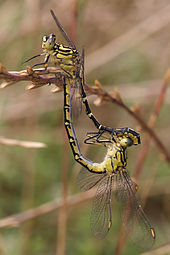
… and below is a photograph courtesy of Wikipedia of two yellow striped hunter dragonflies fully focused …

Yellow_striped_hunter_mating


Geoff Dutton was one of the co-founders of the AustraliankBook Review (ABR) and for more details see


A Dante Poem on Love and Beauty

Love is in the air and Valentine’s Day approaches …

From the ‘Love Poems’ of Dante Alighieri …

XXXIV*

“I am a young girl, lovely and a marvel,
And have come here to show to men on earth
Some beauties of the place that gave me birth.

I came from heaven and there I shall return,
Delighting with my light the souls above;
The man who looks on me and does not burn
Will never have the mind to compass love;
For there is nothing fair He failed to give
Who granted Nature the full gift of me
And placed me, ladies, in your company.

There is no star which does not share its light
And power with these eyes; my beauties are
A marvel to the world, for from the height
Of heaven they came down, and from afar;
Knowledge of them cannot be found save where
There lives a man who in himself knows truly
How love makes entrance through another’s beauty.”

These words all men may read upon the face
Of the young angel here revealed, and I
Who gazed on it so fixedly to trace
Her form more truly, now am like to die;
For when I boldly looked her in the eye
I felt the wound which never lets me cease
From weeping, and since then I have no peace.

Dante – the above poem was translated from the Italian by Anthony Mortimer.

Note – * This poem was included in the collection Rhime – essentially a conglomeration of miscellaneous poems written by Dante over the course of his adult life-time.

Looking at the translation, and the line that stirs my thoughts …

How love makes entry through another’s beauty
^ ^ ^ ^^/ ^ ^^ ^^ … we see it is iambic pentameter. How truly the original rhyming flows through is unknown but it appears that Anthony Mortimer has put a lot of thought and poetic skill in producing this translation.

Commenting on each stanza –

S1 – A very strong, and you might say arrogant, statement on the merits of this young girl. But she is saying this as an example of the beauties found in the place of her heavenly birth.

The mind of the reader responds by creating an appropriate image of a beautiful young woman.

S2 – her statement continues … reinforcing her beauty and that she will eventually return to heaven where she delights the souls that live there … and if the man that looks on her does not burn then he knows not love … for she has been given every gift that nature can bestow … she is placed with other ladies (presumably older women and no comparison, highlighting her beauty)

S3 – this is the end of her statement … and it is here that she makes that definitive statement about love in the last line of the stanza … love makes entry through another’s beauty … love is nothing to do with ourselves as such it is how we respond to the beauty that is around us and in recognising that beauty we then have a chance of knowing something of the beauty within heaven

S4 – Dante is saying that everyone can face beauty and know love … note that when he became besotted and tried to trace her form more truly he was wounded without peace … hard to imagine a beauty of such intensity – but then we approach the divine who we can never see with our veiled eyes

… but it might be that he has been distracted from Beatrice  – the ultimate in beauty in his climb through the inferno … for looking at the background to this work …

This poem may well be connected with an incident in Purgatory XXXI (58-60) where Beatrice reproaches Dante for having been led astray by the love of a young girl (pargoletta)

You never should have let your either wing
Flag, for some further blows from some young girl
Or any trumpery, or ephemeral thing.

Reference – Love Poems – Dante Alighieri – Translated by Anthony Mortimer and J.G. Nichols – ALMA Classics (isbn 978-1-84749-345-3)

Summer Sketches: Sydney – Vivian Smith – Analysis

CoralTreeThe striking colour of the Coral Tree

Summer Sketches: Sydney

i
City of yachts and underwater green
with blue hydrangeas fading in between
the walls of sloping gardens full of sails,
and sudden as a heart the sunlight fails
and over all the city falls again
a change of light, the neon’s coloured rain.
ii
Tourists in their lives of sudden ease
stare through dark glasses at the coral-trees
and know at once that only colour’s true:
the red in green, within the green the blue.
iii
At night the cool precision of the stars,
the neon-glitter and the sexy cars,
the easy pick-up in the close green bars.
iv
A holiday like some smooth magazine;
how photos can improve the simplest scene.
They isolate the image that endures;
beyond the margins is the life that cures.
But when the surface gloss is thought away
Some images survive through common day
and linger with a touch of tenderness:
the way you brushed your hair, your summer dress.

Vivian Smith (1933 –

Some analysis …

The poem is created as four distinct stanzas … each a sketch or postcard on scenes in Sydney. The discrete components labelled with roman numerals … also the number of lines vary across stanzas adding to separate identity. Each stanza has some sort of personal reference … heart-stop / tourists / pick-up /  a special person

This poem means much more if you know Sydney and the coral-tree (a good choice corresponding to bright tourist imagery), but why the green bars … was that the going décor of the time?

I like the image of the neon’s coloured rain … the falling light activating spotted city lights … and sunset like a heart-stop … so quick compared to the northern hemisphere (unless you live in Tasmania of course)

A honing in of intimacy in stanza iii … strengthened by the close rhyming (stars, cars, bars)
Why do you think stanza iv is long compared to iii? What is important in real life?

Do you think holidays are life-margins? … unreal life perhaps, a pit-stop on the journey … of importance when you meet someone special of course! … but would you remember a summer dress? … more the person first and then the little things that identify … I like the fact that there are no personal detail like colour of hair or eyes – the reader is left to fill in the details from his or her life thus molding the poem into the experience of the reader in a form of joint creation

Vivian Smith is an Australian poet born in 1933. He is considered one of the most lyrical and observant Australian poets of his generation. Here is the Wikipedia link

The Whitsun Weddings – Philip Larkin – Analysis

The Whitsun Weddings is the first poem by Philip Larkin in his collection of that name.

I have been reading Clive James’ ‘Poetry Notebook’ and this is one of his five favourite poetry collections the others being – Richard Wilbur (Poems 1943-1956), W. H. Auden (Look Stranger! 1936), Robert Frost (Collected Poems) and W. B. Yeats (The Tower, 1928).

Considering The Whitsun Weddings – There are eight ten line stanzas. The poem’s rhyming scheme is – abab (Shakespearian quatrain) followed by cdecde (Petrachan sestet).

The first two stanzas …

That Whitsun, I was late getting away:
Not till about
One-twenty on the sunlit Saturday
Did my three-quarters-empty train pull out,
All windows down, all cushions hot, all sense
Of being in a hurry gone. We ran
Behind the backs of houses, crossed a street
Of blinding windscreens, smelt the fish-dock; thence
The river’s level drifting breadth began,
Where sky and Lincolnshire and water meet.

All afternoon, through the tall heat that slept
For miles inland,
A slow and stopping curve southwards we kept.
Wide farms went by, short-shadowed cattle, and
Canals with floatings of industrial froth;
A hothouse flashed uniquely: hedges dipped
And rose: and now and then a smell of grass
Displaced the reek of buttoned carriage-cloth
Until the next town, new and nondescript,
Approached with acres of dismantled cars.

The poem is about a train journey in England on a hot Whitsun weekend in June 1954. If you read these lines aloud you will get into the ‘clickity-clack’ rhythm as you follow the syllabic track of the words. I consider the journey as one from Hull to London and if you ever traveled by steam train through England in those years you would identify with the created imagery.

Stanzas three and four …

At first, I didn’t notice what a noise
The weddings made
Each station that we stopped at: sun destroys
The interest of what’s happening in the shade,
And down the long cool platforms whoops and skirls
I took for porters larking with the mails,
And went on reading. Once we started, though,
We passed them, grinning and pomaded, girls
In parodies of fashion, heels and veils,
All posed irresolutely, watching us go

As if out on the end of an event
Waving goodbye
To something that survived it. Struck, I leant
More promptly out next time, more curiously,
And saw it all again in different terms:
The fathers with broad belts under their suits
And seamy foreheads; mothers loud and fat;
An uncle shouting smut; and then the perms,
The nylon gloves and jewelry-substitutes,
The lemons, mauves, and olive-ochers that

In these two stanzas we see that out of the lethargic heat (sun destroys/
The interest of what’s happening in the shade) something is happening at each station. The sounds of gaiety (considered as noise) are initially thought to be porters larking around with the mail in fact it is wedding parties seeing bride and groom depart – perhaps to a honeymoon in London. Larking about is a nice pun on Larkin himself who was probably in the clouds in word thought taking time to be arrested on what was going on around him.

Stanzas five and six …

Marked off the girls unreally from the rest.
Yes, from cafes
And banquet-halls up yards, and bunting-dressed
Coach-party annexes, the wedding-days
Were coming to an end. All down the line
Fresh couples climbed aboard: the rest stood round;
The last confetti and advice were thrown,
And, as we moved, each face seemed to define
Just what it saw departing: children frowned
At something dull; fathers had never known

Success so huge and wholly farcical;
The women shared
The secret like a happy funeral;
While girls, gripping their handbags tighter, stared
At a religious wounding. Free at last,
And loaded with the sum of all they saw,
We hurried towards London, shuffling gouts of steam.
Now fields were building-plots, and poplars cast
Long shadows over major roads, and for
Some fifty minutes, that in time would seem

He now takes close notice at each marriage farewell and there is some generalisation … a happy funeral is that nice contrast in the death of one life and the start of another … weddings being a happy occasion, however a mother may lament at no longer having a daughter at home – on the other hand she may be glad to have her married. Marriage considered a religious wounding – words that marry with that famous arrow-shower in the last line – and typical Larkin negativity however realistic.

Stanzas seven and eight …

Just long enough to settle hats and say
I nearly died,
A dozen marriages got under way.
They watched the landscape, sitting side by side
—An Odeon went past, a cooling tower,
And someone running up to bowl—and none
Thought of the others they would never meet
Or how their lives would all contain this hour.
I thought of London spread out in the sun,
Its postal districts packed like squares of wheat:

There we were aimed. And as we raced across
Bright knots of rail
Past standing Pullmans, walls of blackened moss
Came close, and it was nearly done, this frail
Traveling coincidence; and what it held
Stood ready to be loosed with all the power
That being changed can give. We slowed again,
And as the tightened brakes took hold, there swelled
A sense of falling, like an arrow-shower
Sent out of sight, somewhere becoming rain.

Twelve marriages – brides and grooms – hopefully they wouldn’t be considering all the others they would never meet – having stated religiously that they have met their one and only – nor indeed would they be thinking of how life had now been contained by their commitment to each other.

The last two sentences bring the journey to a close and all the young lovers disappear into the clouds never to be seen again in an arrow-shower. Larkin obviously thinks there are stormy times ahead and the arrows of Eros (love and Cupid) become the arrows of Mars—the arrows of war, shot by a body of archers. (Apparently Philip Larkin claimed he discovered the idea in Laurence Olivier’s film of Henry V.)

But out of the storm comes rain and rain has that nice rejuvenating effect on nature. It is nice to know that Larkin thinks marriage is environmentally friendly!

Clive James states that although there may not be much ‘joy in Larkin’ he does get ‘the whole truth of life’s transience into unforgettable beautiful poetry, and it is hard to think of a greater joy than that’.

Wikipedia link 

Dover Beach – Matthew Arnold – Analysis

The following are my thoughts on the well-known poem ‘Dover Beach’ by Matthew Arnold (1822-1888) –

Dover Beach

The sea is calm to-night,
The tide is full, the moon lies fair
Upon the straits; on the French coast the light
Gleams and is gone; the cliffs of England stand,
Glimmering and vast, out in the tranquil bay.
Come to the window, sweet is the night-air!
Only, from the long line of spray
Where the sea meets the moon-blanched land,
Listen! you hear the grating roar
Of pebbles which the waves draw back, and fling,
At their return, up the high strand,
Begin, and cease, and then again begin,
With tremulous cadence slow, and bring
The eternal note of sadness in. ……….…………………. 14

S1 … Lines 1 – 14 …

The first sentence is factual describing the scene. It looks like a full moon on the straits of water which separate Dover and Calais. It is evening and the light fading in the west towards France. Whether the French coastline is actually visible is debatable – it is a distance of 21 miles and conditions must be favourable – but in contrast the Dover Cliffs are outstanding if you forgive the pun! But it is a peaceful tranquil setting bathed in moonlight (I like – moon-blanched).

The second sentence is a personal invitation to come to the window to see the scene. Matthew Arnold was at Dover twice and in 1851 when this was written he was newly married so it could have been an invitation to his wife to come to the window. But this does not matter what he wants to point out in the sweet night air is the continual push of the waves as they draw back and then fling forward with grating roar – for Mathew Arnold this is an eternal note of sadness.

Sophocles long ago
Heard it on the Aegean, and it brought
Into his mind the turbid ebb and flow
Of human misery; we
Find also in the sound a thought,
Hearing it by this distant northern sea ………………………. 20

S2 … Lines 15 – 20 …

The sound of the sea gave thoughts to the Greek Playwright Sophocles. Sophocles likened the swelling tide to the continual ruin that could be passed on by the Gods from one generation to the next in his play Antigone. This might link in to Arnold’s own melancholic mood and his statement on eternal sadness. But from this Arnold now moves to his own personal thoughts prompted by the grating action of the sea.

The Sea of Faith
Was once, too, at the full, and round earth’s shore
Lay like the folds of a bright girdle furled.
But now I only hear
Its melancholy, long, withdrawing roar,
Retreating, to the breath
Of the night-wind, down the vast edges drear
And naked shingles of the world. …………………………. 28

S3 … lines 21 – 28 …

It looks like there was a time when faith was easy and comfortable to his being – but now the situation is different and he finds his faith-foundation-stone eroded. It helps to know that Matthew Arnold, an inspector of schools, was a deeply religious person and in 1851 when this was probably written the world was in upheaval. Rapid change was taking place not only from industrialisation but in the understanding of life through the advancement of science and especially the birth of evolutionary thought through Darwin. I like that word shingles because apart from being a reference to the beach-pebbles it is a nasty medical condition – a great irritation to the skin. Of course in this context Arnold is threatened by change and is experiencing a mental irritation.

Ah, love, let us be true
To one another! for the world, which seems
To lie before us like a land of dreams,
So various, so beautiful, so new,
Hath really neither joy, nor love, nor light,
Nor certitude, nor peace, nor help for pain;
And we are here as on a darkling plain
Swept with confused alarms of struggle and flight,
Where ignorant armies clash by night …………………. 37

S4 … lines 29 – 37 … Apparently he may have been on his honeymoon and in the first two lines he could have been talking to his new wife=love. Despite the down sliding world (the darkling plain) it is important to be true to one another – a concentration on the micro personal world where there is some control. I see this as a glimmer of light in his depressed state. And as we enter a new year with the horrors of the world continually brought to our attention by the media such advice might be relevant today.

The last line really wraps it all up, my interpretation – Matthew Arnold is in a state of unresolved thinking … the two armies at large the old world concepts and the challenge of the new … both of course are ignorant armies … a unresolved chaotic state of affairs and at night we don’t always see things too clearly.

It is also worth noting that this free-verse poem is a clear break from the poetic expression of his day … so in a sense he has already advanced to new thinking in the development of this poem.

From the analysis of this poem on Wikipedia … The metaphor with which the poem ends is most likely an allusion to a passage in Thucydides’s account of the Peloponnesian War (Book 7, 44). He describes an ancient battle that occurred on a similar beach during the Athenian invasion of Sicily. The battle took place at night; the attacking army became disoriented while fighting in the darkness and many of their soldiers inadvertently killed each other.

Note … Matthew Arnold remained a believer in God and religion, although he was open to—and advocated—an overhaul of traditional religious thinking. In God and the Bible, he wrote: “At the present moment two things about the Christian religion must surely be clear to anybody with eyes in his head. One is, that men cannot do without it; the other, that they cannot do with it as it is.”