Anointing Ann Anonymous – leaving words

Anointing Ann Anonymous
when she was a child
and she was quite sure
that no one was looking
she picked up a stick
to scratch in concrete
‘I was here’
each day
as she walked to school
she would see her work
and laugh to herself
no one would know it was her
in her teenager years
she had that teenage crush
and melting against his name
cleared the dust on his car
with words that only she could write
‘I love you’
She thought he really knew
but she would never tell,
in later years
when thinking about him
she would laugh inside
with a little embarrassment
she had a long and ordinary life
a husband, children
and memories to drown
and if she could paint the sky
these would be her words
‘life is beautiful’
before she died
and with a knowing smile
she left these words
especially for you …

‘I was here
       I love you
       life is beautiful’
© Ann Anonymous

The following poem was included in a Yass Valley Writers anthology … Voices From the Valley.

I wanted to honour those that are not writers and have no prominent life in connection with using words, hence the title. Choice words are usually expressed by everybody at various critical times in the progression of life.

It does allude to consider what important words have been part of your life. And generally, if indeed words are important to you, what words would you like to leave behind? And what words do you think others remember you by. I still hear words my parents frequently used when I was growing up. And friends are often known by certain words they repeatedly use. To use the current vernacular enjoy your life today!


Another uncomfortable visit

Another uncomfortable visit

why do they do it
everything named bolded in large font
yes, he is sitting in the LOUNGE
and yes, I do know he is JOHN
for the last two years unknown to self
well, he maybe JOHN to someone else
the body that must be fed
the body that must be clean
the body that must be monitored
the JOHN that provides an income
John this is Peter, you remember me
PETER it doesn’t matter how big the font
or if I raise my voice, he doesn’t remember
and never will I guess, we played tennis
together for many years, invincible at doubles
John and Peter champions
but he is focused on the electronic screen
I don’t know why they have it on all the time
at least it’s muted …
SILENCE.
I always have my eye on the CLOCK
the minutes that are hours
and I can’t wait to escape
to go to the exit
the exit that is not obvious
the exit that they can never find
locked forever on the inside
and then into fresh air, and let John
flood back in memory
another uncomfortable visit
 Richard Scutter

Poppies in October – Sylvia Plath and AI

Poppies in October
Even the sun-clouds this morning cannot manage such skirts.
Nor the woman in the ambulance
Whose red heart blooms through her coat so astoundingly –

A gift, a love gift
Utterly unasked for
By a sky

Palely and flamily
Igniting its carbon monoxides, by eyes
Dulled to a halt under bowlers.
Oh my God, what am I
That these late mouths should cry open
In a forest of frosts, in a dawn of cornflowers.
Sylvia Plath (27 October 1962)

Analysis …

Nothing in sun and sky can match the poppy skirts (petals) in their colour … nor the woman (reference to herself) in the ambulance whose red heart is amazingly kept alive … the woman (SP) close to death … others not so lucky … she has been rescued and will survive.

This late showing is out of context with the season … and is a gift unasked for …and in this regard, SP could be talking about her astoundingly good luck in surviving her earlier suicide attempt … her red heart did bloom … how come she was saved? … how come she was given a second chance? … SP did not ask for this … to be re-born … at least she acknowledges this gift as a ‘love-gift’ … even if she is not thankful.

… the medicos that saved her did not know her … see her red passion, her emotional state … how could they … they wear bowler hats … head-centric on their work

… and then the lament of not knowing who she is … the poppy in October … out of context … but still alive … she cries aloud for some understanding … why should she be alive in a ‘forest of frosts’ (in a deep tangle where growth is unlikely – how she saw her life) and in a ‘dawn of cornflowers’ (emerging against the bland mass of the common … a little arogance perhaps)

Note … this poem was written on SP’s last birthday (27 Oct 1962) … her 30th birthday … at a time when she was living by herself (with the two children) in London – separated from Ted Hughes  … she also wrote another poem ‘Ariel’ on the same day … so she had time to herself on this day to devote to poetry … and to question her existence … to question why she has survived out of season (like the poppy) … and to ask why she is still alive … and inferred – why is live so hard … it is a cry for an explanation from the deep intensity of her being for a meaning in her troubled world … questioned in a state of mental unrest.

… and whether any physical poppies were around on this her birthday is open to question … they could be mind-poppies … (refer also to a previous poem ‘Poppies in July’ written in Devon in the summer … when times were different.)

And this is what AI (CHATgpt) had to say about this poem illustrating the dangers of using AI without careful attention to the response …

“Poppies in October” is one of Sylvia Plath’s poignant poems, reflecting her complex relationship with nature, life, and death. In this poem, she explores themes of beauty, transience, and the inevitable decay that accompanies life.

The imagery of poppies, often associated with remembrance and sleep, takes on multiple layers of meaning in Plath’s hands. They are portrayed as fragile and ephemeral, yet their vibrant red hue contrasts sharply with the barrenness of autumn, suggesting a defiance against mortality.

Plath’s use of language is characteristic of her poetic style—rich in symbolism and laden with emotion. The juxtaposition of “scarecrow” and “blood-burned barns” evokes a sense of desolation and decay, while the “golden mummies” suggest a haunting beauty amidst the inevitable march of time.

The poem’s closing lines, “Now she is flying / More terrible than she ever was, red / Scar in the sky, red / Comet / Over the engine that killed her— / The mausoleum, the wax house,” hint at the speaker’s acceptance of death as a transformative force. The image of the poppy as a “red / Scar in the sky” suggests a lingering presence even in death, a reminder of the fragility and resilience of life.

Overall, “Poppies in October” is a powerful meditation on mortality, capturing both the beauty and sorrow inherent in the cycle of life and death. Plath’s adept use of imagery and language imbues the poem with a haunting quality that lingers in the mind of the reader long after the final lines have been read.

Quite clearly the text that I have highlighted in red above refers to the different SP poem Stings.

Here is the last stanza of Stings ...

Now she is flying
More terrible than she ever was, red
Scar in the sky, red comet
Over the engine that killed her ----
The mausoleum, the wax house.

It is interesting that AI picked up these lines. The red scar in the sky could have association with a poppy. And after her suicide attempt in the cellar she had a scar on her face enhancing personification. Stings was written in early October 1962. That month SP was really flying in terms of her poetic creativity.

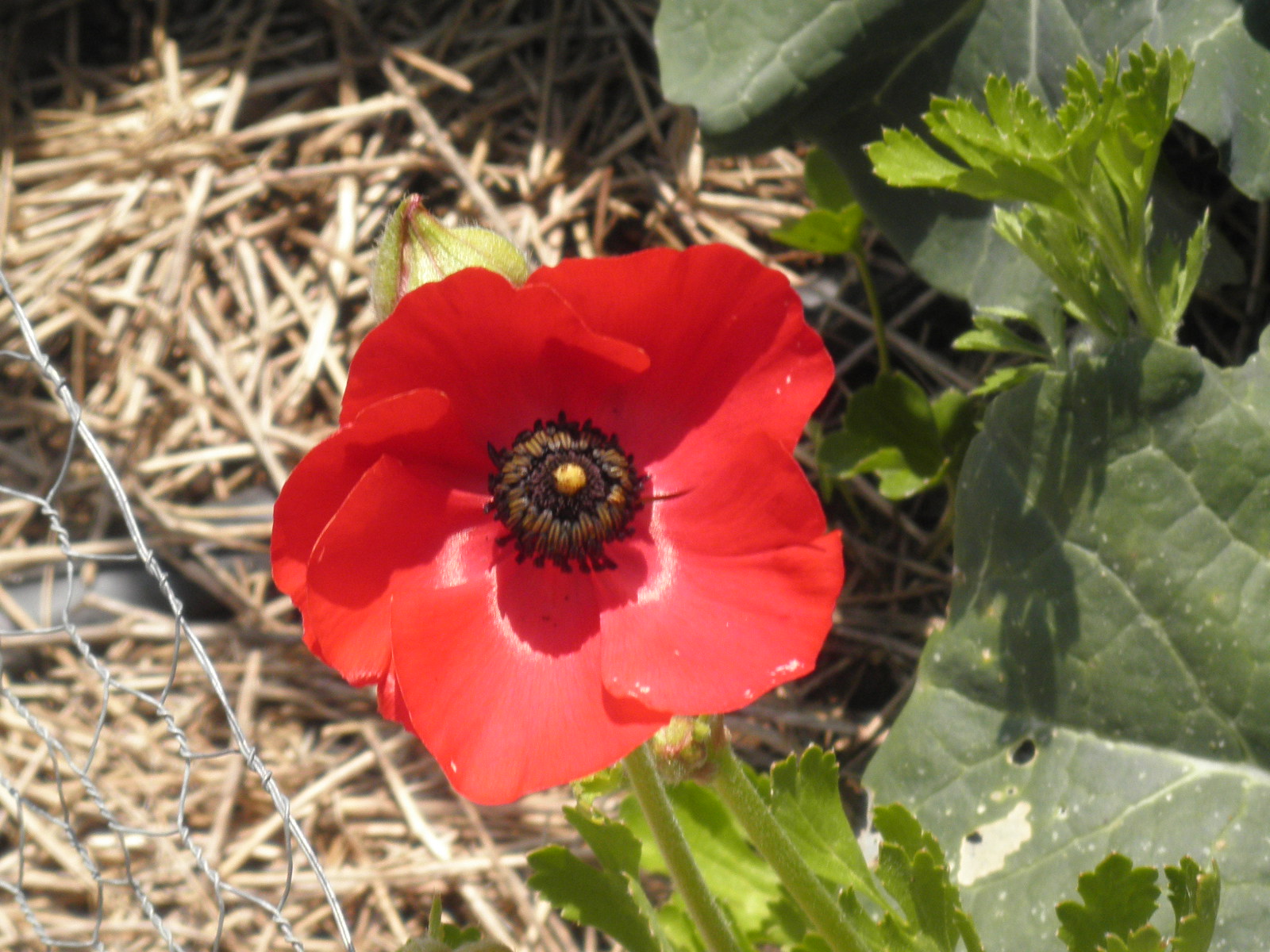
… and here is a poppy from the Australian spring a poppy very much in season.


Postscript – Mother and Jesus on Mother’s Day

A postscript Post – For Mother’s Day, 12 May in Australia

There are two important passages concerning Jesus and his close caring contact with his mother.

The Wedding at Cana (John 2:1-11): This is where Jesus performs his first miracle, turning water into wine, at a wedding feast in Cana. Jesus’ mother Mary plays a significant role in this event, as she informs Jesus that the hosts have run out of wine. Although Jesus initially seems hesitant to intervene, Mary instructs the servants to do whatever Jesus tells them to do, prompting him to perform the miracle. It is the start of his public ministry at the bequest of Mary.

The Crucifixion (John 19:25-27): During the crucifixion of Jesus, we see Mary standing near the cross along with other women, witnessing her son’s suffering. Jesus, in his final moments, entrusts the care of his mother to the beloved disciple (traditionally identified as John), saying to Mary, “Woman, behold your son!” and to the disciple, “Behold your mother!” This passage highlights Jesus’ concern for his mother’s well-being.

In the time of Jesus the stereotype image of mother is one of subservience and background duties as an adjunct to male dominance. Today the mother image has changed but father image has become tainted by current domestic violence concerns. Those victims of such abuse might well hold negativity in the reference to our father and heaven in the Lord’s Prayer. Especially those outside the traditional church view of Father. And those that equate creation with love outside personification.

I attempted to find some balance by including a reference to mother in the following contemporary version below …

Our Father

Our Father, Mother of all life living in timeless beauty
        your name is sacred always to be praised and adored
you created our world and continue to transform
                                          the wonder of your creation

we thank you each day for having given us your son

forgive our wrong behaviour
as we forgive the wrongs of others

                       you know us intimately,  
                                                    guide our lives and protect us from harm

for you are all good, pure love, and perfect
            all honour, power, and glory are yours now and forever.


 Richard Scutter (first published in a Yass Valley Writers anthology)

Well, the time has come … the Richard said …

Well, the time has come … the Richard said … reaching the leadup to that transition stage in life … for I have personal projects that must take priority, so I must refrain from continuing Posting on this Site … at least until further notice … in the meantime here are some statistics on the viewing of Posts from my WordPress account …

From 5 April 2011 to 25 December 2022 … 479 Posts created …

Twelve of the most popular Posts …

When all others were away at Mass – Seamus Heaney
Dance me to the end of love – Lenard Cohen
Journey to the interior – Margaret Attwood
Recognition – Carol Ann Duffy

Yussouf – James Russell Lowell
Wuthering Heights – Sylvia Plath
Gold Leaves – G. K. Chesterton
Winter – Shakespeare

Silver – Walter De La Mare
The History Teacher – Billy Collins
I remember, I remember – Philip Larkin

Words – Sylvia Plath

This Word is not the last word …
… and the bottom line, well never the last line …


I will be in touch, well at least by your touch LOL     X Richard


This Site will continue to remain open and Ad free.


December 23 – Celebration of a birthday

December 23

A sip and a smoke on the back porch,
then its starts to snow;
it seems the night
has decided to number
its ghosts.

No snowflakes settle; beyond reproach,
all absolved — go, go,
a cull of light;
as my birthday remembers
its lost.

Carol Ann Duffy (1955 -

December 23

pavlova and BBQ on the beach
the day full of light
and gives warmth
to all the cells
of my now

so many memories have rescinded
like missing snowflakes
that once came to my window
and momentarily settled
before melting away

Richard Scutter

Well interesting that I share a birthday with Carol Ann Duffy. And that she mentions the snow in relation to the passing years as people like ghosts are recalled before fading like disappearing flakes of snow.

It was snowing heavily when I was born. It was so cold, I got quite a shock. I am still recovering.

Along by merry Christmas time – Henry Lawson – Comments

Along by merry Christmas time

Along by merry Christmas time they buy the aged goose,
And boil the dread plum pudding, because of ancient use.
But to sneer at old time customs would be nothing but a crime,|
For the memory of the Past is all bound up in Christmas time.

Then Jim comes home from shearing, and he puts a few away,
With Dad, perhaps, or Uncle, but they’re right on Christmas Day:
For be it on the Never, or ‘neath the church bells’ chime,
The family gets together, if they can, at Christmas time.

And, after tea at Christmas, they clear the things away
And play the dear old silly games our grand-folk used to play
And Dad gives a recitation that used to be the joy
Of all the Western countryside, when Father was a boy.

Along by merry Christmas time, and ere the week is o’er
We meet and fix up quarrels that each was sorry for.
Our hearts are filled with kindness and forgiveness sublime,
For no one knows where one may be next merry Christmas time.

Henry Lawson (1867 – 1922)


S1 – Christmas is all about remembering the past. The birth of Christ and friends and family that are, or have been, dear to us.

At Christmas we reflect on people that are not with us … always hard to come to terms with loss of the precious in our life. But can love deal with the loss of a recent family member. Here is a poignant poem by Louisa Lawson, the mother of Henry Lawson – A Mother’s Answer – Louisa Lawson | my word in your ear

Henry Lawson’s easy flowing rhymed poem was written in 1913, maybe the plum pudding was not what it is today. An aged goose doesn’t sound attractive either. How many people in Australia are planning to eat goose this year, not exactly a first choice! In fact a meat I have never eaten.

S2 – Christmas is all about bringing family and friends together. And regardless of where the family gather – the Never, Never – the outback, or whether the family congregates at Church together. Food and drink are always to the fore. The variety of food and drink on offer has expanded considerably since I was a boy. And many items that were a luxury for us at Christmas are now commonplace throughout the year.

S3 – Christmas is all about sharing family play. And being accepting of the previous generation in the games they used to play. There are always well-known familiar stories associated with relatives in conjunction with the play. And listening without comment maybe hard for the younger generation, however boring! And when I was growing up music renditions by those who could play, piano and violin from my mother and an uncle come to mind.

S4 – Christmas is all about forgetting squabbles and forgiving. And the last line tells us unequivocally to make the best of the time together; for who knows where family and friends will be next Christmas.

Henry Lawson is best known for being a master of the short story – ‘While the Billy Boils’ – rather than his poetry. Although an Australian theme the Christmas expression in this poem has wide universal association in the Western World.


So what can I say – make the most of this coming Christmas Day.

Henry Lawson on Wikipedia