Song for a Summer’s Day – Sylvia Plath

This is a different Sylvia Plath poem from many poems that people usually associate with her name. This poem was written in the summer of 1956 before her pending marriage to Ted Hughes. The scene is Cambridge when at the University and exploring the countryside with Ted Hughes.

Song for a Summer's Day

Through fen and farmland walking
With my own country love
I saw slow flocked cows move
White hulks on their day's cruising;
Sweet grass sprang for their grazing.

The air was bright for looking:
Most far in blue, aloft,
Clouds steered a burnished drift;
Larks' nip and tuck arising
Came in for my love's praising.

Sheen of the noon sun striking
Took my heart as if
It were a green-tipped leaf
Kindled by my love's pleasing
Into an ardent blazing.

And so, together, talking,
Through Sunday's honey-air
We walked (and still walk there —-
Out of the sun's bruising)
Till the night mists came rising.

Sylvia Plath composed the summer of 1956
(1932 - 1963)

There is a lot of action taking place in the repetitive use of the doing words such as walking, cruising, and praising. Especially talking with her country love. Ted Hughes had a strong affinity for the countryside and the animal life therein. In fact, SP wrote an Ode to Ted Hughes on this aspect of his nature at a similar time as this poem. And in this poem TH comments on the distinct movement of larks as they nip and tuck.

SP likens her heart to a green-tipped leaf in the blaze of her mid-day talk with TH. She is in love and her love flows to all around her as she walks. And Sunday was always a more sacred day in 1956. I do like the honey-air of a Sunday in relaxed recreation. The sweet coloured contented fellowship of sharing the beauty of summer sunshine with TH.

The last three lines indicate reflection and a recall of her walk with TH; indicative of her love still very much evident – We walked (and still walk there —- Out of the sun’s bruising)

The last line could be a little prophetic – Till the night mists came rising.

In your pink wool knitted dress – Marriage Day Ted Hughes and Sylvia Plath

Ted Hughes in his reflective poem In your pink wool knitted dress describes the day of his marriage to Sylvia Plath on 16th June 1956; Bloomsday. The poem appears in Birthday Letters which was a surprise poetry collection released only months before Hughes’s death in 1998. The Birthday Letters collection gives his poetic voice on his life with Sylvia Plath. The collection won multiple awards. Here is the poem –

In your pink wool knitted dress

Before anything had smudged anything
You stood at the altar. Bloomsday.

Rain - so that a just-bought umbrella
Was the only furnishing about me
Newer than three years inured.
My tie - sole, drab, veteran RAF black -
Was the used-up symbol of a tie.
My chord jacket - thrice-dyed black, exhausted,
Just hanging on to itself.

I was a post-war, utility son-in-law!
Not quite the Frog-Prince. Maybe the Swineherd
Stealing this daughter's pedigree dreams
From under her watchtowered searchlit future.

No ceremony could conscript me
Out of my uniform. I wore my whole wardrobe -
Except for the odd, spare, identical item.
My wedding, like Nature, wanted to hide.
However, - if we were going to be married
It had better be Westminster Abbey. Why not?
The Dean told us why not. That is how
I learned that I had a Parish Church.
St George of the Chimney Sweeps.

So we squeezed into marriage finally.
Your mother, brave even in this
US Foreign Affairs gamble.
Acted all bridesmaids and all guests,
Even - magnanimity - represented
My family
Who had heard nothing about it.
I had invited only their ancestors.
I had not even confided my theft of you
To a closest friend. 

For best man - my squire
To hold the meanwhile rings -
We requisitioned the sexton. Twist the outrage:
He was packing children into a bus,
Taking them to the Zoo - in that downpour!
All the prison animals had to be patient
While we married.

You were transfigured.
So slender and new and naked,
A nodding spray of wet lilac.
You shook, you sobbed with joy, you were ocean depth
Brimming with God.
You said you saw the heavens open
And show riches, ready to drop upon us.
Levitated beside you, I stood subjected
To a strange tense: the spellbound future.

In that echo-gaunt, weekday chancel I see you 
Wrestling to contain your flames 
In your pink wool knitted dress 
And in your eye-pupils – great cut jewels 
Jostling their tear-flames, truly like big jewels 
Shaken in a dice-cup and held up to me.

Ted Hughes (1930 - 1998) from Birthday Letters

The title is based on the dress Sylvia wore at her wedding. She didn’t have a dress organised and her mother, who had arrived from the States, had bought this for herself and ended up giving it to Sylvia to wear.

S1 … well, there was certainly some smudging going on in their relationship as the years unfolded. TH and SP chose Bloomsday because of their budding poetic interest. Bloomsday being the day associated with the 1992 James Joyce novel Ulysses based on the one day Thursday 16 June 1904.

S2 … TH had old clothing from his RAF days … a little tattered … perhaps appropriate not to be concerned with attire … like a true bohemian poet.

S3 … Utility was a key term after the war, something fit for purpose. I think Sylvia was stronger in the desire for marriage. It is interesting that TH identifies with the Swineherd. In Homer’s Odyssey, the swineherd, named Eumaeus, is a loyal servant of Odysseus. Much later in their marriage that loyalty was sorely tested. He may have felt he was stealing Sylvia from family in America. Sylvia had informed her brother Warren about the marriage who was in France at the time.

S4 … It was wishful to try for Westminster Abbey so TH was duly told he had to use his parish church. An interesting name St George of the Chimney sweeps. Apparently the Church was known for giving Christmas dinners to Chimney sweeps from all over London.

S5 … They had such difficulty in making it happen with just Sylvia, Ted and Sylvia’s mother the only family to attend. Squeezing into marriage a very appropriate verb. TH’s family were magnaminous or so it seems when TH reports after the actual event. I don’t think TH’s sister Carol had a particular liking for Sylvia.

S6 … He didn’t have a bestman organised and had to requisition the sexton who had to holdup taking children on an outing to the Zoo. Presumably all the children had to wait on the bus while the sexton performed the bestman duties inside the church. The prison animals could have a double interpretation. Both children and animals had to wait.

S7 … We finally get to that crucial moment in the ceremony likened to the beauty of SP’s slender naked body in a transfiguration. Appropriate metaphor given the church setting. Sylvia levitating God like with all heaven before her in total happiness. TH thinking of the future. The strange tense of a spellbound future with Sylvia. It was a very tense future. TH unaware that he had experienced an extreme SP emotional state akin to a bi-polar high. This association reflected appropriatley by TH’s dramatic choice of words in this stanza..

S8 … TH an emotional bystander to Sylvia in her euphoric state as Sylvia wrestles to contain her happiness. Her eyes dazzled like clear cut tear flamed jewels held up for Ted in the shaken dice thrown future.

The Applicant – Sylvia Plath – On marriage

The Applicant

First, are you our sort of a person?
Do you wear
A glass eye, false teeth or a crutch,
A brace or a hook,
Rubber breasts or a rubber crotch,

Stitches to show something's missing? No, no? Then
How can we give you a thing?
Stop crying.
Open your hand.
Empty? Empty. Here is a hand

To fill it and willing
To bring teacups and roll away headaches
And do whatever you tell it.
Will you marry it?
It is guaranteed

To thumb shut your eyes at the end
And dissolve of sorrow.
We make new stock from the salt.
I notice you are stark naked.
How about this suit----

Black and stiff, but not a bad fit.
Will you marry it?
It is waterproof, shatterproof, proof
Against fire and bombs through the roof.
Believe me, they'll bury you in it.

Now your head, excuse me, is empty.
I have the ticket for that.
Come here, sweetie, out of the closet.
Well, what do you think of that ?
Naked as paper to start

But in twenty-five years she'll be silver,
In fifty, gold.
A living doll, everywhere you look.
It can sew, it can cook,
It can talk, talk , talk.

It works, there is nothing wrong with it.
You have a hole, it's a poultice.
You have an eye, it's an image.
My boy, it's your last resort.
Will you marry it, marry it, marry it.

Sylvia Plath (1932 - 1963)

If you want to get married, consider the criteria that existed around the ninty-sixties and what Sylvia Plath had to say in this poem. It was written at the time of her seperation from Ted Hughes in October 1962.

S1, S2 … You must have the right appearance with no physical disabilities including evidence of unsightly body repair. Quite simply, if you haven’t the right body you have nothing to offer. Stop crying and look at yourself – empty.

S3 … The typical subservient role … care and cooking combined with compliance to the wishes of the male

S4 … The new stock implies the rewrite to a new person, or animal along with all the others in the stock yard of the owner, and being naked the loss of everything personal in the process. And no complaints please just obey and accept.

S5 … If you put on the stereo type black suit in the accepted way marriage should be for a woman the you will be safe all your life and be protected by the establishment.

S6, S7 … the rewriting of the mind … like a blank sheet of paper … told what to think and deny yourself as you take up the form of a mindless doll … a mindless toy doll that has a life dedicating to sewing, cooking, and talking … think of it over the marriage years of silver and gold

S8 … you are a hole metaphorically speaking … it’s a poultice … a soft moist mass spread on cloth and placed over the skin to treat an inflamed body … do you want to live all your years with this poultice … a shadow of subservience that can never heal in your give up … have a look at yourself what do you see … and this image … is this what you really want!

Poppies in October – Sylvia Plath and AI

Poppies in October
Even the sun-clouds this morning cannot manage such skirts.
Nor the woman in the ambulance
Whose red heart blooms through her coat so astoundingly –

A gift, a love gift
Utterly unasked for
By a sky

Palely and flamily
Igniting its carbon monoxides, by eyes
Dulled to a halt under bowlers.
Oh my God, what am I
That these late mouths should cry open
In a forest of frosts, in a dawn of cornflowers.
Sylvia Plath (27 October 1962)

Analysis …

Nothing in sun and sky can match the poppy skirts (petals) in their colour … nor the woman (reference to herself) in the ambulance whose red heart is amazingly kept alive … the woman (SP) close to death … others not so lucky … she has been rescued and will survive.

This late showing is out of context with the season … and is a gift unasked for …and in this regard, SP could be talking about her astoundingly good luck in surviving her earlier suicide attempt … her red heart did bloom … how come she was saved? … how come she was given a second chance? … SP did not ask for this … to be re-born … at least she acknowledges this gift as a ‘love-gift’ … even if she is not thankful.

… the medicos that saved her did not know her … see her red passion, her emotional state … how could they … they wear bowler hats … head-centric on their work

… and then the lament of not knowing who she is … the poppy in October … out of context … but still alive … she cries aloud for some understanding … why should she be alive in a ‘forest of frosts’ (in a deep tangle where growth is unlikely – how she saw her life) and in a ‘dawn of cornflowers’ (emerging against the bland mass of the common … a little arogance perhaps)

Note … this poem was written on SP’s last birthday (27 Oct 1962) … her 30th birthday … at a time when she was living by herself (with the two children) in London – separated from Ted Hughes  … she also wrote another poem ‘Ariel’ on the same day … so she had time to herself on this day to devote to poetry … and to question her existence … to question why she has survived out of season (like the poppy) … and to ask why she is still alive … and inferred – why is live so hard … it is a cry for an explanation from the deep intensity of her being for a meaning in her troubled world … questioned in a state of mental unrest.

… and whether any physical poppies were around on this her birthday is open to question … they could be mind-poppies … (refer also to a previous poem ‘Poppies in July’ written in Devon in the summer … when times were different.)

And this is what AI (CHATgpt) had to say about this poem illustrating the dangers of using AI without careful attention to the response …

“Poppies in October” is one of Sylvia Plath’s poignant poems, reflecting her complex relationship with nature, life, and death. In this poem, she explores themes of beauty, transience, and the inevitable decay that accompanies life.

The imagery of poppies, often associated with remembrance and sleep, takes on multiple layers of meaning in Plath’s hands. They are portrayed as fragile and ephemeral, yet their vibrant red hue contrasts sharply with the barrenness of autumn, suggesting a defiance against mortality.

Plath’s use of language is characteristic of her poetic style—rich in symbolism and laden with emotion. The juxtaposition of “scarecrow” and “blood-burned barns” evokes a sense of desolation and decay, while the “golden mummies” suggest a haunting beauty amidst the inevitable march of time.

The poem’s closing lines, “Now she is flying / More terrible than she ever was, red / Scar in the sky, red / Comet / Over the engine that killed her— / The mausoleum, the wax house,” hint at the speaker’s acceptance of death as a transformative force. The image of the poppy as a “red / Scar in the sky” suggests a lingering presence even in death, a reminder of the fragility and resilience of life.

Overall, “Poppies in October” is a powerful meditation on mortality, capturing both the beauty and sorrow inherent in the cycle of life and death. Plath’s adept use of imagery and language imbues the poem with a haunting quality that lingers in the mind of the reader long after the final lines have been read.

Quite clearly the text that I have highlighted in red above refers to the different SP poem Stings.

Here is the last stanza of Stings ...

Now she is flying
More terrible than she ever was, red
Scar in the sky, red comet
Over the engine that killed her ----
The mausoleum, the wax house.

It is interesting that AI picked up these lines. The red scar in the sky could have association with a poppy. And after her suicide attempt in the cellar she had a scar on her face enhancing personification. Stings was written in early October 1962. That month SP was really flying in terms of her poetic creativity.

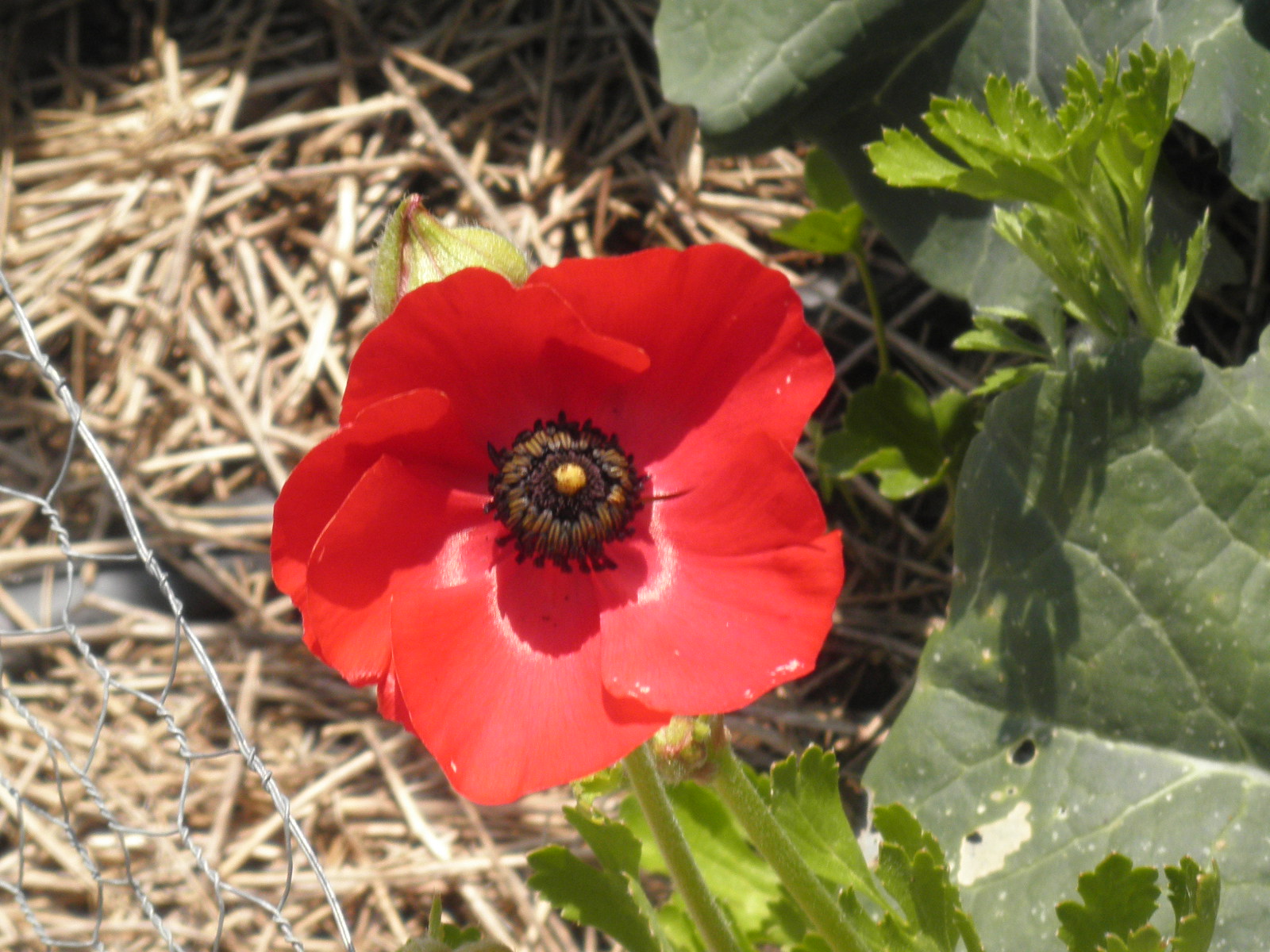
… and here is a poppy from the Australian spring a poppy very much in season.


The Moon and the Yew Tree – Sylvia Path – Comments

The Moon and The Yew Tree
This is the light of the mind, cold and planetary 
The trees of the mind are black. The light is blue.
The grasses unload their griefs on my feet as if I were God
Prickling my ankles and murmuring of their humility
Fumy, spiritous mists inhabit this place.
Separated from my house by a row of headstones.
I simply cannot see where there is to get to.

The moon is no door. It is a face in its own right,
White as a knuckle and terribly upset.
It drags the sea after it like a dark crime; it is quiet
With the O-gape of complete despair. I live here.
Twice on Sunday, the bells startle the sky --
Eight great tongues affirming the Resurrection
At the end, they soberly bong out their names.

The yew tree points up, it has a Gothic shape.
The eyes lift after it and find the moon.
The moon is my mother. She is not sweet like Mary.
Her blue garments unloose small bats and owls.
How I would like to believe in tenderness -
The face of the effigy, gentled by candles,
Bending, on me in particular, its mild eyes.

I have fallen a long way. Clouds are flowering
Blue and mystical over the face of the stars
Inside the church, the saints will all be blue,
Floating on their delicate feet over the cold pews,
Their hands and faces stiff with holiness.
The moon sees nothing of this. She is bald and wild.
And the message of the yew tree is blackness - blackness and silence.
Sylvia Plath (1932 – 1963)

This poem was composed in October 1961 when SP was living at ‘Court Green’ cottage North Tawton, Devon. At that stage her marriage with Ted Hughes was still intact. The cottage was close to St Peter’s Church which was visible when she was writing. And at some stage she would have ventured inside.

A carefully designed poem of four seven-line stanzas with distinct sentence punctuation.

S1 … Clearly written at nighttime where SP invokes a ghostly graveyard presence. And there was a mist evident to add to such a scene. The moon has that association with the mind and lunacy. The griefs being the gravestones in rows. As if I was God – well, SP is not God and cannot perform miracles on the dead. The trees stand out black and the light from the moon blue. She cannot see the path through to the Church

S2 … This stanza has two distinct parts. SP personifies her emotional state on to the moon – white as a knuckle and terribly upset. I like the image of the moon dragging or sucking up the sea like a thief. It conjures up a rain squall coming off the sea. SP says this is where she lives, and she knows the sound the church bells make every Sunday morning.

Christianity and resurrection then come to mind in relation to the dead and the gravestones. But the bells only bong out their names – the names on the gravestones. SP is clearly dead to the thoughts of any resurrection to an afterlife.

S3 … The yew tree points up. Gothic shape implying dark and morbid.  It is worth considering the symbolic representation of the yew tree –

Christian stories of resurrection led the tree to become a symbol of eternal life. As the trunk of the tree begins to decay, a new tree can form. This represents the cycle of life that makes Yew trees a symbol of rebirth as well.

But there is no tenderness, sadly only a Mother Moon image associated with a wild nature represented by seeing bats and owls fly up unleashed against the ghostly blue light.

How SP would like it to be otherwise.

S4 … It looks like clouds are causing the firmaments to be seen and not seen. The inside of the church is the scene of fixed figures and maybe the stained-glass windows can record saints seen above the pews. Again, a cold dead image of being stiff with holiness as in no resurrection. The moon is wild and full of life unknowing of such human quandaries concerning death. The message of the Yew tree is black. SP is displaying her view on religion and the resurrection. The poem ends with a dark depressive feeling.

See this link for a video of Court Green and the Church – Sylvia Plath Video & Picture Post: Court Green (sylviaplathinfo.blogspot.com) … and courtesy of this Site –

Court Green – from the Church of St Peter’s
at North Tawton, Devon

Watercolour of Grantchester Meadows – Sylvia Plath – comments

Watercolour of Grantchester Meadows

There, spring lambs jam the sheepfold. In air
Stilled, silvered as water in a glass
Nothing is big or far.
The small shrew chitters from its wilderness
Of grassheads and is heard.
Each thumb-sized bird
Fits nimble-winged in thickets, and of good colour.

Cloudrack and owl-hollowed willows slanting over
The bland Granta double their white and green
World under the sheer water
And ride that flux at anchor, upside down.
The punter sinks his pole.
In Byron’s pool
Cattails part where the tame cygnets steer.

It is a country on a nursery plate.
Spotted cows revolve their jaws and crop
Red clover or gnaw beetroot
Bellied on a nimbus of sun-glazed buttercup.
Hedging meadows of benign
Arcadian green
The blood-berried hawthorn hides its spines with white.

Droll, vegetarian, the water rat
Saws down a reed and swims from his limber grove,
While the students stroll or sit,
Hands laced, in a moony indolence of love —
Black-gowned, but unaware
How in such mild air
The owl shall stoop from his turret, the rat cry out.

Sylvia Plath (1932 – 1963)

King’s College Cambridge owns Grantchester Meadows, a riverside beauty spot south of Cambridge. This area would be familiar to SP when at Cambridge. There may have been a Watercolour at the University. Apparently, it was written when she was in America in 1959 after returning there with Ted Hughes after their marriage.

The Granta is a tributary of the Cam.

Byron’s Pool is a well-known beauty spot where Byron used to bathe.

It is an ekphrastic poem before that word had poetic coinage. According to the Poetry Foundation, “an ekphrastic poem is a vivid description of a scene or, more commonly, a work of art.”. You can appreciate the text without needing a sighting of the Watercolour. And it is an SP poem which is easy to understand.

Students would be familiar with punting on the Cam. It is a nursery plate image; a quintessential image associated with England by those overseas.

Nimbus – a luminous vapor, cloud, or atmosphere about a god or goddess when on earth. I do like that line – bellied on a nimbus of sun-glazed buttercup – it conjures up bright summer meadow flower sunshine relevant to my England heritage.

And we learn that water rats are vegetarians. I am always impressed by SP in how she uses her wide vocabulary in the choice of appropriate words. In the case of the water rat the verb saws = rapid two and throw motion, and the adjective limber = lithe. Implying skill in movement in the water.

Students and tourists often travel from Cambridge by punt to picnic in the meadows or take tea at The Orchard tea-rooms. But do the students really listen to the environment; especially when minds are locked in thought or otherwise engaged in romancing with a lover. And today locked in mobile use while walking.

Sylvia Plath on Wikipedia.

Stillborn – Sylvia Plath – Analysis

Stillborn

These poems do not live: it’s a sad diagnosis.
They grew their toes and fingers well enough,
Their little foreheads bulged with concentration.
If they missed out on walking about like people
It wasn’t for any lack of mother-love.

O I cannot understand what happened to them!
They are proper in shape and number and every part.
They sit so nicely in the pickling fluid!
They smile and smile and smile at me.
And still the lungs won’t fill and the heart won’t start.

They are not pigs, they are not even fish,
Though they have a piggy and a fishy air –
It would be better if they were alive, and that’s what they were.
But they are not dead, and their mother near dead with distraction,
And they stupidly stare, and do not speak of her.

Sylvia Plath (1932 – 1963)

This is an appropriate poem on her birthday seeing most remember her death day more than her birthday; and nice to be on the brighter side of life.

This is a poem all about the creation process, the giving of birth to a poem. For SP her poems were always her special babies. This is in contrast to Ted Hughes who regarded his poems as animals.

A poem has to live and the irony is that this is a poem that actually lives. We must assume she is talking about all her other poems, all those poems that never quite made it to her own requirement. Interestingly, at least according to TH, she never threw anything away so she would have had a workshop of pickled poems so in that sense they are not dead. They are still alive within the poet even if not breathing.

She does state there was a birth but perhaps it only lived in her mind. The thing is, it is all to do with the transfer of mind thought to actual physical words. Quite often the poet has a marvellous Aha at night but when recalled in the hard light of day finds it is not quite right and it goes in the waste paper bin.

Poems always say something about the poet, just as a child carries DNA from parents. The strong link between mother and baby or poet and poem is emphasised by the repetition of ‘smile’ in the line ‘they smile and smile and smile at me’. This may indicate that the poem is near completion. And the last line is quite appropriate as SP is left frustrated and unsung – they do not speak. A strong sense of wanting to achieve and be recognised as a poet and be heard.

So what makes a good birth … maybe assistance is needed … a midwife perhaps … or a nurse to bring the baby to the breathing state. It is important to share poetry before finalisation, but to what extent and who to share with?

Anyway SP babies live on in abundance breathing their existence, even if some have a depressive tint.

To end on a bright note here is a link to her poem ‘Morning Song, the first poem of her Ariel collection – a different birth!

Lady Lazarus – Sylvia Plath – Analysis

Lay Lazarus

I have done it again.
One year in every ten
I manage it——

A sort of walking miracle, my skin
Bright as a Nazi lampshade,
My right foot

A paperweight,
My face a featureless, fine
Jew linen.

Peel off the napkin
O my enemy.
Do I terrify?——

The nose, the eye pits, the full set of teeth?
The sour breath
Will vanish in a day.

Soon, soon the flesh
The grave cave ate will be
At home on me

And I a smiling woman.
I am only thirty.
And like the cat I have nine times to die.

This is Number Three.
What a trash
To annihilate each decade.

What a million filaments.
The peanut-crunching crowd
Shoves in to see

Them unwrap me hand and foot——
The big strip tease.
Gentlemen, ladies

These are my hands
My knees.
I may be skin and bone,

Nevertheless, I am the same, identical woman.
The first time it happened I was ten.
It was an accident.

The second time I meant
To last it out and not come back at all.
I rocked shut

As a seashell.
They had to call and call
And pick the worms off me like sticky pearls.

Dying
Is an art, like everything else.
I do it exceptionally well.

I do it so it feels like hell.
I do it so it feels real.
I guess you could say I’ve a call.

It’s easy enough to do it in a cell.
It’s easy enough to do it and stay put.
It’s the theatrical

Comeback in broad day
To the same place, the same face, the same brute
Amused shout:

‘A miracle!’
That knocks me out.
There is a charge

For the eyeing of my scars, there is a charge
For the hearing of my heart——
It really goes.

And there is a charge, a very large charge
For a word or a touch
Or a bit of blood

Or a piece of my hair or my clothes.
So, so, Herr Doktor.
So, Herr Enemy.

I am your opus,
I am your valuable,
The pure gold baby

That melts to a shriek.
I turn and burn.
Do not think I underestimate your great concern.

Ash, ash—
You poke and stir.
Flesh, bone, there is nothing there——

A cake of soap,
A wedding ring,
A gold filling.

Herr God, Herr Lucifer
Beware
Beware.

Out of the ash
I rise with my red hair
And I eat men like air.

Sylvia Plath (1932 – 1963)

The title Lady Lazarus rolls off the tongue with alliteration and assonance. She uses interior rhyme. Colloquial expression gives emphasis to the passion of her delivery –
I do it so it feels like hell.
I do it so it feels real.
She mentions her age of 30 years … I am only thirty … she turned 30 on the 27th October 1962 … so this dates the poem … her most productive time as a poet.

There are 28 three line stanzas involving reference to –
SP’s previous suicide attempts – with personal details … like her scars
The Holocaust … she identifies her ‘death and resurrection’ in terms of those that died in the gas chambers. In her final attempt she dies with her head in an oven.
Religion – Lazarus – resurrection – She details what her ‘resurrection’ signifies.
Her life … she sees herself as an artist …
Dying
Is an art, like everything else.
I do it exceptionally well.

It is a very strong stand-up ‘I’ poem declared in strong passionate terms. And rallying against those guilty of inhumanity. A confrontation with Herr God, Herr Doktor, Herr Lucifer.

SP was only nine years old when her father died and this caused an anger against death in taking him away, he had a German heritage … she became aware of the holocaust and the terrors of death in the camps when a child being born in 1932 … again angry with such death … caused by man … and at the time of writing this poem, in October 1962, Ted Hughes had left her and perhaps an ’emotional death’ and distrust created similar anger against man. This poem is often seen as a statement for female emancipation.

SP identifies with those who died in the Holocaust … she herself as of lampshade skin … and the picture of body decay presents distastful morbid imagery to the reader as …
Soon, soon the flesh
The grave cave ate will be
At home on me
(note the internal structure to the middle line)

SP sees herself as an expert at attempted suicide and returning … and she considers her skill as a theatrical performance … before the peanut-crunchers … performing a miracle for all to see. She did get much recognition in regard to her suicide attempts and there is always a certain context shadow when reading some of her poetry.

But she will survive like Lazarus … the great miracle … and when she is ‘unwrapped’ it will be the big strip tease … regarding her revival as exciting entertainment … to see what’s underneath … to see her new born again body (peel off my napkin)

Her second attempt nearly took her life … she was discovered just ‘as the worms were setting in’
They had to call and call
And pick the worms off me like sticky pearls.

And there she is in the Holocaust as just ash … the Holocaust being defined by …
A cake of soap,
A wedding ring,
A gold filling.

And there is nothing there … but there is a charge for the rebirth … a restitution for the unjust dead? … and she will rise out of this …out of the ashes … representing all those that died … she will arise and give rebirth … new life … a little far-fetched but perhaps she imagined herself as some sort of warped female Christ
Herr God, Herr Lucifer
Beware
Beware.

And SP states that this is for you … for humanity … with a hatred for man
I am your opus,
I am your valuable,
The pure gold baby
(opus – creative piece of work … pure gold)

In summary … this is clearly a personal poem of anger … defining herself in strong Ok terms … about death (and unjust death) … about her challenge of defying death … and beating death and those that have caused terrible death … laughing back at them … returning to life with fire and energy as a female … and devouring terrible MAN … clearly seen by the last stanza …
Out of the ash
I rise with my red hair
And I eat men like air.

Sylvia Plath on Wikipedia

RIP – SP