Summer – Judith Wright : Analysis

Summer is here again and already we have had a few very hot days in Canberra. This poem by Judith Wright relates to Edge, her former home in Braidwood, and to the Australian summer and how nature must accommodate the disturbance by man and the effect of bush fire. It was written towards the end of her life.

Summer

This place’s quality is not its former nature
but a struggle to heal itself from many wounds.
Upheaved ironstone, mudstone, quartz and clay
drank dark blood once, heard cries and the running of feet.
Now that the miners’ huts are a tumble of chimney-stones
shafts near the river shelter a city of wombats.
Scabs of growth form slowly over the rocks.
Lichens, algae, wind-bent saplings grow.
I’ll never now it’s inhabitants. Evening torchlight
catches the moonstone eyes of big wolf-spiders.
All day the jenny-lizard dug hard ground
watching for shadows of hawk or kookaburra.
At evening, her pearl-eggs hidden, she raked back earth
over the tunnel, wearing a wide grey smile.
In a burned-out summer, I try to see without words
as they do. But I live through a web of language.

from Judith Wright Collected Poems – The Shadow of Fire (Ghazals)

JW shows strong identity to the land commenting on the effects of man  … a land which drank dark blood once … the killing of Aborigines … and a land once  subject to mining … her words describe the attempted recovery by nature  … the attempt to revert to previous conditions – which of course can never happen.

JW also shows strong empathy with the natural environment … with knowledge of local animals and insects seen at Edge. The environment adjusts to the disturbance by man … shafts near the river shelter a city of wombats … and the environment must adjust to the destruction of nature by bush fire … suggesting this is a greater problem …  trying to see without words … … creating words always detracts … many survivors of bush fires would identify with the intensity of thought conveyed by such words.

… it is fascinating to see how diversity manifests through continual evolution … species adapting to changes to environment and the resultant changes to other species … the total connectivity of life as it creates a future by the process of the survival of the fittest … or put another way survival by those best able to adapt to change.

… now this may be Ok when evolution is gradual, although of course some species become extinct, but what happens to this evolutionary process under sudden dramatic disturbances, humanity-made or not … and more important how can humanity act to ‘better the evolutionary process’ … humanity being the prime custodian of the world … having the key role in the very determination of the nature of existence. Global warming is of course one consideration for attention.

… there may of course be other influences at play in the evolutionary process such as spiritual connectivity … but a little foolish and quite a cop-out to think that God will protect the world from destruction … however this could become an indirect truth … if humanity allows God to work through humanity … by humanity listening and responding as appropriate.

… I really love the first two lines … This place’s quality is not its former nature / but a struggle to heal itself from many wounds … the quality of nature is in its resilience and ability to adapt to change and to heal … I am an an optimist of course.

Here is a link to the ‘Braidwood property Edge’ where Judith Wright lived.
and a link  to Judith Wright on Wikipedia

The Uncertainty of the Poet – Wendy Cope – Analysis

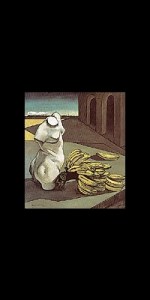
Wendy Cope wrote the poem below in response to viewing a painting of the same name by surrealist artist Giorgio de chirico . Here is an image of the painting. The statue is the torso of Aphrodite (and a link to more detail).

UncertaintyPoet

The Uncertainty of the Poet (by Wendy Cope)

I have annotated her lines with my comments.

I am a poet,

I am very fond of bananas.

Wendy Cope is a poet and by the look of things she very much likes bananas. Now this poem was written in conjunction with the above painting – a female statue and a hand of bananas. So we could easily equate the first sentence response with these objects.

I am bananas,
I am very fond of a poet.

Personifying bananas is certainly very poetic … and from the bananas point of view they are very touched by her fondness – a strong two-fold link.

I am a poet of bananas.

Indeed she is a poet of bananas … just as the artist portrayed bananas in his work.

I am very fond.

… perhaps she considers herself very loving, affectionate, caring

A fond poet of ‘I am, I am’ –

Very bananas.

… it is very true that many poets are ‘very fond I am’ sort of people … but the next phrase denigrates any infatuation

Fond of ‘Am I bananas?
… and to stress the point such fondness for herself could send her … well you know where bananas will take you!

Am I? – a very poet.

Well I certainly think she is a ‘very poet’! … but it’s always good to question oneself and indeed ask it of others!

Bananas of a poet!
Am I fond? Am I very?

The thought of being bananas of a poet … well that certainly needs an exclamation mark. But is she caring? … is she very (caring)? … well we have uncertainty … the uncertainty of person as well as poet

Poet bananas! I am

Forget poetry – ‘I am’ and that’s what matters! – how true

I am fond of a ‘very’.
She perhaps is one of those rare persons who always likes doing her best!

I am of very fond bananas.
In a poetic sense this statement is so true!

Am I a poet?

This question must be answered by the reader!

Wendy cope

There are only eight unique words in the entire poem – a wonderful play on words – perhaps a little ‘dadaism’ is in evidence.

My thoughts on looking at the painting … there are obviously two key objects … one representing ‘Art’ (and I will include poetry under that label – especially given the title of the painting) … the other very much down to earth … day to day living – something we can easily digest and recognise. Something we can internalise in a very real way but disappears from sight very quickly. The torso as an artistic object is more permanent but more difficult to digest (excuse the pun). And indeed what can be more permanent than the manifestation of love represented by the torso of Aphrodite. The artist/poet is always uncertain on how his or her art will be received and always uncertain about the quality of work and about living up to any personal expectations.

Feeling a little ‘mimsy’ perhaps? – Lewis Carroll

Looking at humour in poetry … the Victorian-age did produce some creative light relief from the conservative life of text … one of the most famous pieces being …

Jabberwocky
the first and last stanza …

“Twas brillig, and slithy toves
Did gyre and gimble in the wabe;
All mimsy were the borogoves,
And the mome raths outgrabe.

From Through the Looking-Glass, Chap 1

Lewis Carroll (1832 – 1898) = Charles Lutwidge Dodgson (Anglican deacon and lecturer in mathematics)

Humpty Dumpty’s explication:
Brillig = 4 O’Clock in the afternoon … the time for broiling things for dinner
Slithy = lithe and slimy … two meanings packed into one word -a portmanteau word
Toves = a combination of badger/lizard/corkscrew … make nests under sundials and live on cheese
Gyre = to go round and round like a gyroscope … it does in fact mean circular motion
Gimble = make holes like a gimlet = a small tool for making holes
Wabe = grass plot around a sundial … it goes a long way before it and a long way after it
Mimsy = flimsy and miserable
Borogrove = thin shabby looking bird with its feathers sticking out all around
Mome = short for ‘from home’, Rath = green pig
Outgrabe = outgribing = something between bellowing and whistling with a kind of sneeze
From Through the Looking-Glass, Chap 6

Out of all the nonsense words above slithy and mimsy have a wonderful feel and quite an acceptable explanation or should I say they are quite texplanable.

If you are feeling creative have a go at creating portmanteau words. (Portmanteau = a large suitcase consisting of two parts that fold together.) See if you can come up with something really interesting. For example – gentle and kind = kindle. However, a word of warning when working with children … work with an Alice who knows what is right and proper … we do not want to destroy the spelling of the correct words! … i.e. before becoming too proright.

You could also try the reverse and take a genuine word and break it into two components e.g. bright = brilliant and light … I’m not sure what you call this – the unpacking of the suitcase to view the contents?

It is no surprise though that such creative (all be it nonsensical) words were the result of writing for children who love such play and it is a wonder that more new words did not migrate to colloquial use.

… and here’s truly hoping you are not having a mimsy day!

and this is a Website link to the full Jabberwocky poem

Life After Death – Pindar – Remembrance Day

Life after Death

For them the sun shines ever in full might
Throughout our earthly night;
There, reddening with the rose, their paradise,
A fair green pleasance, lies,
Cool beneath shade of incense-bearing trees,
And rich with golden fruit:
And there they take their pleasure as they will,
In chariot-race, or young-limbed exercise
In wrestling, at the game of tables these,
And those with harp or lute:
And blissful where they dwell, beside them still
Dwells at full bloom perfect felicity:
And spreading delicately
Over the lovely region everywhere
Fragrance in the air
Floats from high altars where the fire is dense
With perfumed frankincense
Burned for the glory of Heaven continually.

Pindar – Greek lyric poet (c. 522 – c. 443 BC)

Translated by Walter Headlamhttp://en.wikipedia.org/wiki/Walter_George_Headlam

It is Remembrance Day today and we remember the many that suffered in the first World War. You may think this poem  is an unusual choice for this day. However, I intend reading my poem ‘The Fragrance at Flanders’ at a special University of the Third Age event to mark Remembrance Day followed by the above where ‘fragrance’  is also featured. It’s just that I think it would be nice (or poetic) if those that suffer greatly in life – those that never really have a life – have some sort of justice in an after-life – that is if of course there is an after-life.

And the first two lines of the poem remind me of those well known words … ‘they do not grow old as we that are left go old’.

I am, of course, using Pindar’s words thinking of war heroes but they were written in relation to the great sporting heroes of his day …

From Wikipedia … Almost all Pindar’s victory  odes are celebrations of triumphs gained by competitors in Panhellenic festivals such as the Olympian Games. The establishment of these athletic and musical festivals was among the greatest achievements of the Greek aristocracies. Even in the 5th century, when there was an increased tendency towards professionalism, they were predominantly aristocratic assemblies, reflecting the expense and leisure needed to attend such events either as a competitor or spectator. Attendance was an opportunity for display and self-promotion, and the prestige of victory, requiring commitment in time and/or wealth, went far beyond anything that accrues to athletic victories today, even in spite of the modern preoccupation with sport

Incidentally, Samuel Johnson (1709 – 1784) who started to compile a dictionary of English usage many years ago had a wonderful definition of ‘Justice’ – ‘the virtue by which we give every man what is his due’. Of course there is no such thing as justice in this life – but the after-life is another matter.

Even if you don’t believe in God or a creator with affinity for humanity it’s nice to create one in the mind, especially one capable of giving some form of justice to those that have suffered unduly.

Link – http://en.wikipedia.org/wiki/Pindar#Values_and_beliefs

And here is a bugle playing of The Last Post’ courtesy of You-Tube https://www.youtube.com/watch?v=McCDWYgVyps

An Arundel Tomb – Philip Larkin – Analysis

ArundelTombChichester

An Arundel Tomb

Side by side, their faces blurred,
The earl and countess lie in stone,
Their proper habits vaguely shown
As jointed armour, stiffened pleat,
And that faint hint of the absurd–
The little dogs under their feet.

The sculpture is of the Earl of Arundel and his second wife Eleanor of Lancaster and it resides in Chichester Cathedral … in art dogs are a sign of fidelity … apparently over the years the sculpture has been vandalised and repaired

Such plainness of the pre-baroque
Hardly involves the eye, until
It meets his left hand gauntlet, still
Clasped empty in the other; and
One sees, with sharp tender shock,
His hand withdrawn, holding her hand.

In all the cathedrals and churches Larkin visited he never saw such tenderness depicted in stone and he was quite moved by the sight … generating this poem.

They would not think to lie so long.
Such faithfulness in effigy
Was just a detail friends could see:
A sculptor’s sweet commissioned grace
Thrown off in helping to prolong
The Latin names around the base.

They have been together for centuries in stone whereas in life they would never lie so close given that marriages were very much a political arrangement … there is a double take too on the word ‘lie’ as there probably would have been a lot of deceit in the arrangement. The Latin names around the base probably ignored by those visiting the cathedral today – but the holding of hands an attraction to the eye.

They would not guess how early in
Their supine stationary voyage
Their air would change to soundless damage,
Turn the old tenantry away;
How soon succeeding eyes begin
To look, not read. Rigidly they

Well, the nature of marriage has changed over the years and those visiting today would view the holding of hands perhaps as a more loving union. Supine = lying on the back without energy.

Persisted, linked, through lengths and breadths
Of time. Snow fell, undated. Light
Each summer thronged the grass. A bright
Litter of birdcalls strewed the same
Bone-riddled ground. And up the paths
The endless altered people came,

I like the view of the outside while the tomb is fixed and oblivious to the changing seasons. Apparently the grounds of Chichester Cathedral are known for bird song.

Washing at their identity.
Now, helpless in the hollow of
An unarmorial age, a trough
Of smoke in slow suspended skeins
Above their scrap of history,
Only an attitude remains:

People today don’t understand the history and context … washing over the sculpture … history becomes a scrap – unarmorial = not decorated with a coat of arms

Time has transfigured them into
Untruth. The stone finality
They hardly meant has come to be
Their final blazon, and to prove
Our almost-instinct almost true:
What will survive of us is love.

Philip Larkin

We have the contrast – the truth of love – the reality of love being something different from what this time-frozen stone fixture might suggest … the important things that survive are not so much the physical –but ‘love’ (whatever this means to the reader) … but then the physical may be needed as a catalyst or prompt. It certainly prompted Larkin to think about love – and he was certainly not a ‘love’ poet – but it has been said that he was haunted by such notions although of a melancholic nature.

A YouTube video of Philip Larkin reading this poem

Only Two Lips – A Spring Poem

Floriade is the name of the  spring flower festival in Canberra in the Commonwealth Gardens near the centre of the city. Mainly a showing of bulbs including of course tulips. It is quite a tourist attraction and many come to Canberra to see the displays.

OLYMPUS DIGITAL CAMERA

The U3A ‘Arts’ Exhibition had a theme of tulips, poppies and spring. I wrote the following poem for the opening day (see the previous post) …

Tulips in a vase, focus on flower in foreground

Only Two Lips

who do you think you are
standing so pert and penal
asserting yourself in rich colour
arrogant, obvious
demanding my attention

well I’m not falling for it!
such a brazen showing
with your closed-mouth talk
I will give you what you deserve –
lip service, and just you wait

your day will come
believe me, you will bend
becoming quite dishevelled
falling to kiss the ground
in total disarray

Richard Scutter  2 August 2014

It is always very interesting when you read a poem in public because you never quite know what reception will follow. The audience was mainly  women and  in the older bracket, so that was appropriate. A few realized that I was not actually talking about tulips so much and there were a couple of wry smiles – which was encouraging!

There were a few hangups on the word ‘penal’. Well penal = punishing – and from a male perspective the beautiful can be quite punishing in many ways especially when young, ‘manipulative’ and of a demanding nature.

U3A – Art/Poetry/Music Exhibition – Promoting Poetry

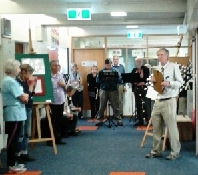
An Exhibition of Art, Poetry and Music was held by Canberra University of the Third Age (U3A) Groups on 20 October.

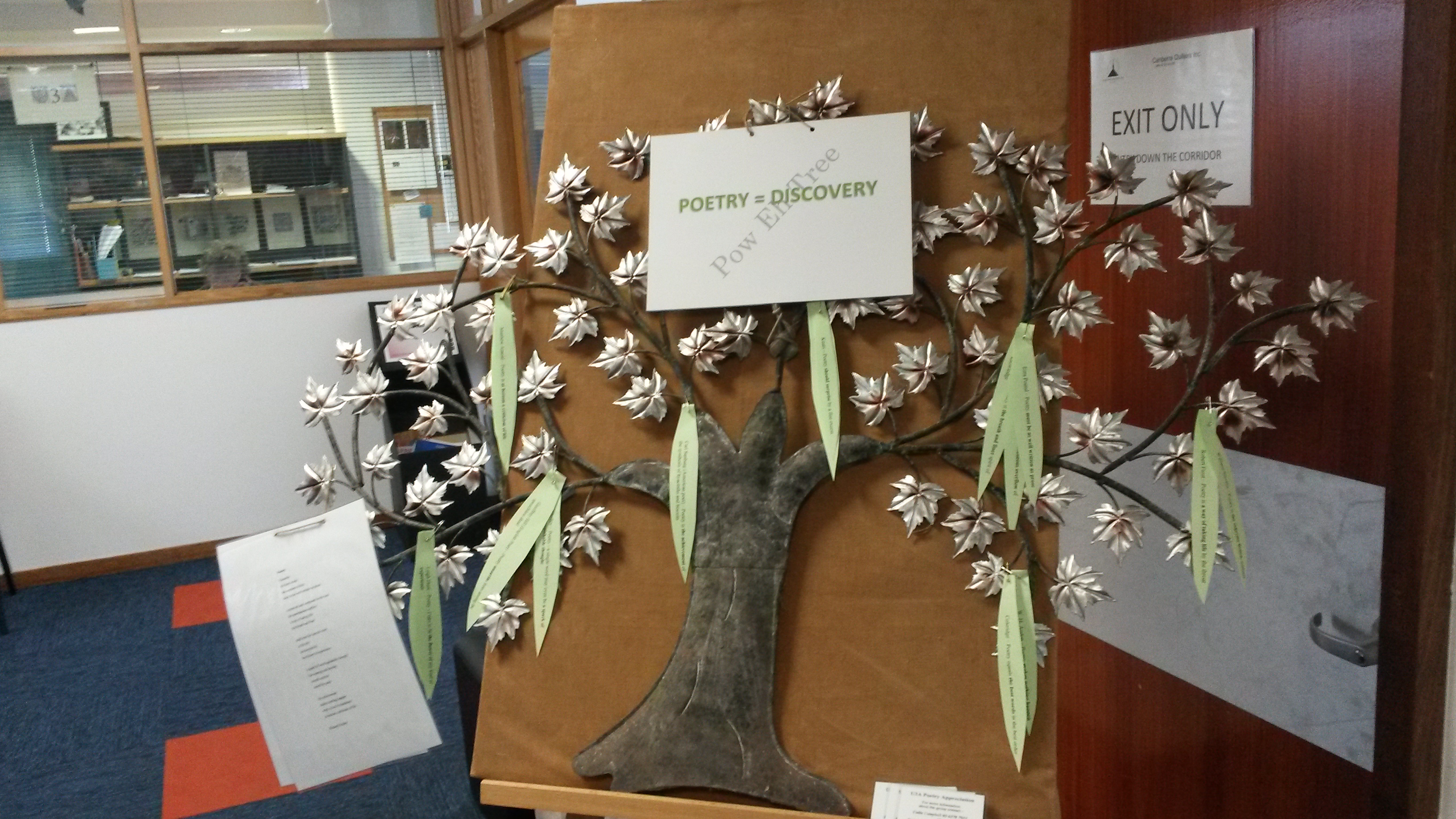
For interest, and to promote the Poetry Appreciation Group I created a POETRY TREE and attached twenty quotes on the nature of poetry by famous poets – Keats, Wordsworth, Auden, Frost, Owen, Hunt, Pound, Coleridge, Finch, Shelley, Sandburg, Arnold, Hill and Stevens.

PoetryTree
The Poetry Tree:   Poetry = Discovery

… and then a ‘Cento poem’ where each line takes text taken from the quotes –

Poetry

Unearths
the best words
the supreme fiction
must be as well written as prose

conceived and composed in the soul
the spontaneous outflow
a way of taking life
the breath and finer

shall tune her sacred voice
in the pity
the feverish fit
the flower of experience

a spark of inextinguishable thought
the opening and closing
should surprise
should be great

the achievement
makes nothing happen
what is lost in translation
at bottom a criticism

Richard Scutter

Context  – from the quotes …

Geoffrey Hill (English Poet) – Poetry unearths from among the speechless dead
Coleridge – Poetry equals the best words in the best order
Wallace Stevens – Poetry is the supreme fiction, madame.
Ezra Pound – Poetry must be as well written as prose
Mathew Arnold – Poetry is conceived and composed in the soul
Wordsworth – Poetry is the spontaneous overflow of powerful feelings
Robert Frost – Poetry is a way of taking life by the throat
Wordsworth – Poetry is the breath and finer spirit of knowledge
Samuel Johnson – Poetry shall tune her sacred voice, and wake
from ignorance the Western World
Wilfred Owen – Poetry is in the pity of war
Anne Finch (English Poet) Poetry’s the feverish fit, the overflowing of
unbounded wit
Leigh Hunt – Poetry – I take to be the flower of any kind of experience
Shelley – Poetry – a single word may even be a spark of inextinguishable thought
Carl Sanburg (American poet) – Poetry is the opening and closing of a door, …
Keats – Poetry should surprise by a fine excess
Keats – Poetry should be great and unobtrusive
Carl Sanburg (American poet) – Poetry is the achievement of the synthesis
of hyacinths and biscuits
W. H. Auden – Poetry makes nothing happen
Robert Frost – Poetry is what is lost in translation
Matthew Arnold – Poetry is at bottom a criticism of life

R-SpeakingTalking Poetry

In one word Poetry = Discovery … the poet discovers something in the creation process –  apart from the fact that achievment was possible! – perhaps a deeper personal understanding of experience … the reader discovers something of life disclosed by the poet and always something of the nature of the poet. And if art = looking and seeing and the repeat of this again and again then poetry = reading and absorbing and then repeating this again and again. Discovery is not a simple process. The U3A Poetry Appreciation Group hopefully helps insight by sharing within the group – especially where poems are a little difficult on first readings.