Tho’ hid in spiral myrtle Wreath – Coleridge

Tho’ hid in spiral myrtle Wreath

Tho’hid in spiral myrtle Wreath,
Love is a sword that cuts its Sheath:
And thro’ the Slits, itself has made,
We spy the Glitter of the Blade.

But thro’ the Slits, itself had made,
We spy no less too, that the Blade
Is eat away or snap atwain,
And nought but Hilt and Stump remain.

Samuel Coleridge (1772 – 1834)

This poem on love from Coleridge equates love as a sword and love hiding in a wreath … showing the duality of love … the glitter of the blade only to be followed by a self-destructive nature … a sword that cuts its sheath … and all that is left is the hilt and the stump … the remnants … hopefully to be viewed in a positive light. Just an aspect of humanity … pain and joy … that’s the story of life … but special pain and special joy!

Another understanding of this poem may come from the first line. The ‘Tho’ could be an actual person who is to blame for the broken relationship – a person hiding ‘in spiral myrtle wreath’ … which doesn’t sound very nice and a little sinister. Perhaps Coleridge is being nice by saying the ubiquitous ‘love’ is to blame rather than the nature of any individual lover.

I do not know the context and the date of writing which could provide more insight.

Myrtle – evergreen bush with blue-black fruit
Wreath – a memorial on a grave
Sheath – a case for the blade of a knife
Hilt – the handle of a sword

Coleridge on Wikipedia … https://en.wikipedia.org/wiki/Samuel_Taylor_Coleridge
since feeling is first – e e cummings – analysis

Since feeling is first

since feeling is first
who pays any attention
to the syntax of things
will never wholly kiss you;
wholly to be a fool
while Spring is in the world

my blood approves
and kisses are a better fate
than wisdom
lady i swear by all flowers. Don’t cry
—the best gesture of my brain is less than
your eyelids’ flutter which says

we are for each other: then
laugh, leaning back in my arms
for life’s not a paragraph

and death i think is no parenthesis

e e cummings (1894 – 1962)

S1 – eec did not pay any attention to traditional syntax (he developed his own unique syntactical way of expression) … he is talking about love and feelings and how love is expressed, and if you think of syntax in relation to love – which to me relates to discipline and order – then it becomes an inhibiter of full expression, and in relation to a kiss it will not be a full kiss in all its enormity – scary, because if you are totally uninhibited in your love life you may become the stereotyped fool – love and fool both being four letter words that combine to form a bit of an oxymoron.

S2 – Perhaps everyone becomes a bit of a moron when spring is in the air, not me of course for I have English heritage. eec swears by all the flowers that his best brain gesture stands no match for the flutter of an eyelid which dissolves all reason. Love and flattery always have connection, so too love and laughter.

S3-4 Interestingly, you can’t put death in brackets and life is not a paragraph … eec indicates he is putting his writing to one side for the sake of love … (it is a whole story of many chapters … the question is whether there is a full stop to the last sentence … well of course there is a no full stop as you can see in the above!)

Details of e e cummings on Wikipedia … https://en.wikipedia.org/wiki/E._E._Cummings

NB Syntax – the ordering of and relationship between the words and other structural elements in phrases and sentences. The syntax may be of a whole language, a single phrase or sentence, or of an individual speaker.

May all those love-fools enjoy this day with a laugh!

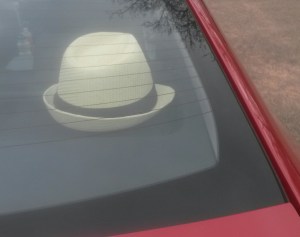
Retirement Arrival – A warning to drivers!

In my last Post in the poem ‘Warning’ Jenny Joseph alluded to a characteristic of ladies of a certain age – the propensity to choose purple as a favourite dress colour. This prompted thought on what would be an equivalent characteristic in the male population and how that could be used in creating a poetic response. Dress is so important to ladies whereas gentlemen have more attachment to their motor vehicles. I have noticed quite a common driving trait of those advancing in age. I have also combined dress in the following …

carhat

Retirement arrival

now is the day of much content
made so glorious by the thought
of this new road ahead

he places his hat carefully
on the sill against the back glass
declaring his status for all to see

he has arrived and when
he drives off taking the right turn
with the left indicator flashing

it is not totally unexpected
for he has arrived and this
unfortunately, must be accepted

Richard Scutter

All I can say is just be cautious while driving when you see a hat on the back sill of a car – especially if there are a couple and one is purple!

Warning – Jenny Joseph – Comments

Warning

When I am an old woman I shall wear purple
With a red hat which doesn’t go, and doesn’t suit me.
And I shall spend my pension on brandy and summer gloves
And satin sandals, and say we’ve no money for butter.
I shall sit down on the pavement when I’m tired
And gobble up samples in shops and press alarm bells
And run my stick along the public railings
And make up for the sobriety of my youth.
I shall go out in my slippers in the rain
And pick flowers in other people’s gardens And learn to spit.

You can wear terrible shirts and grow more fat
And eat three pounds of sausages at a go
Or only bread and pickle for a week
And hoard pens and pencils and beermats and things in boxes.

But now we must have clothes that keep us dry
And pay our rent and not swear in the street
And set a good example for the children.
We must have friends to dinner and read the papers.

But maybe I ought to practice a little now?
So people who know me are not too shocked and surprised
When suddenly I am old, and start to wear purple.

Jenny Joseph (1932 –

This well-known poem topped the most popular stakes in a 1996 BBC survey. Its popularity led to the formation of the ‘Red Hat Society’.

S1 … In a way this is a ‘list poem’ … JJ lists those slightly disobedient actions that may have crossed her mind at one stage when that she has been conditioned otherwise or told not to do so as a child. I can remember walking home from school when I picked a flower that was hanging over a garden wall, a teacher saw me and I was told off!

S2 … JJ thinks of some outlandish actions that suits her temperament – she obvious likes sausages and pickles!

S3 … reality strikes – she is bound by society expectations and she is young – so her desire for freer personal expression must wait another day

S4 … JJ gives humour to her ending twist … may be to start practising now! – so that others may recognise her later! … balancing the purple of the first line with the purple in the ending line! … and her ending marries so well with the title ‘Warning’.

Apparently Jenny Joseph wrote this poem when she was 29 so she may have been contemplating a future release of freedom to time when she could be a little naughty and a little defiant. Perhaps she was feeling constrained in her current life. Perhaps she knew a few old people that led dull lives. I do like both the expression of defiant nature, and that with age, a careless freedom to do as you please may open up a new life. These sentiments certainly hit immediate recognition with the poetry reading population in the UK.

But looking at ‘purple’ – what is it with this colour? So many ladies of a certain age really like to wear purple – akin to young girls liking pink. Of course ladies that wear this identity by colour are not always the audacious type who may be inclined to gorge themselves on sausages and other delights when you are not looking. So if you see such persons walking down the street they may be leading quite ordinary lives.

‘The Prelude’ William Wordsworth – Nature

William Wordsworth (1770-1850) was born in Cockermouth in the Lake District in England, an area known for its exceptional beauty. This countryside had a profound influence on his childhood and later in life he came back to live in the Lake District with his sister Dorothy.

His autobiographic epic poem ‘The Prelude’ is his most famous work. It is a long poem of 14 sections written in the form of a self-exploration. Reading this poem gives a clear understanding of how deeply he absorbed nature into his thinking. At times it seems he walked into a kind of romantic celestial field of daffodils. ‘The Prelude’ traces the growth of his mind through dark regions of intellect to an escape into his connectivity with nature. This was especially so following his great disappointment after going to France and becoming actively involved in the French Revolution. His invented life-force being called ‘Nature’ provided both great joy as well as a spiritual answer to his life.

He was certainly a great appreciator of nature and although not a ‘political environmentalist’ in terms of the sensitivity of today he does highlight humanity as being subservient within the forces of a greater natural world. How this ‘animal’ called nature responds to the threats posed by an indignant humanity is another question.

Some selected lines from ‘The Prelude’ (First Book, lines 401 to 424)

Wisdom and Spirit of the universe!
Thou Soul that art the eternity of thought!
That giv’st to forms and images a breath
And everlasting motion! not in vain,
By day or star-light thus from my first dawn
Of Childhood didst Thou intertwine for me
The passions that build up our human Soul,
Not with the mean and vulgar works of Man,
But with high objects, with enduring things,
With life and nature, purifying thus
The elements of feeling and of thought,
And sanctifying, by such discipline,
Both pain and fear, until we recognize
A grandeur in the beatings of the heart.

Nor was this fellowship vouchsaf’d to me
With stinted kindness. In November days,
When vapours, rolling down the valleys, made
A lonely scene more lonesome; among woods
At noon, and ‘mid the calm of summer nights,
When, by the margin of the trembling Lake,
Beneath the gloomy hills I homeward went
In solitude, such intercourse was mine;
‘Twas mine among the fields both day and night,
And by the waters all the summer long.

William Wordsworth

WW also poses the question on whether we (you, I and humanity in general) have dim hearing to the voice of nature – are we caught up in the ‘vulgar works of man’.

A link to WW on Wikipedia

The Journey of the Magi by T. S. Eliot

The Journey of the Magi by T. S. Eliot is a favourite Christmas poems. It is what I might call a factual poetic view of what the journey would have been like. At the same time giving latent links to events described in the bible. And of course giving the full implication of the birth of Christ.

Here is a link to this poem and more discussion


Visitant – A. D. Hope – Analysis

Visitant

Earth swings away to the cold.
Though I have what I came here to find,
Time changes and alters the mould.
As a new age replaces the old
I feel the world leave me behind.

It is not my world anymore;
But of course was it ever mine?
Bred up to a different law,
I came from a distant shore
To watch, to appraise, to divine.

Yet much which I saw became dear;
Some few were close to my heart;
Although it was perfectly clear
I was a stranger here
Standing aloof and apart.

Now it is time to return,
I shall miss this world more than I thought.
All I came here merely to learn
Holds me now with such love and concern,
To whom do I make my report?

A. D. Hope

There are four five line stanzas with rhyming scheme ‘abaab’.

We are here for such a short time and it is not our real ‘home’. We are only taking up temporary accommodation. So it is quite alright to consider ourselves as a visitor to the world – well that is the thought behind these words – so what has this visitation been like? And when we return to our true ‘home’ what report will be rendered (and to whom)?

The other underlying thought concerns age when the world of our youth is remembered with affection – was it ever ours anyway. As we age the changing world leaves us behind as much as we are about to leave the world behind too.

The world has been kind and will be missed. I like the nice sentiment to be held in the love of all that has been learnt.

Perhaps we should leave a written report below before that final journey then when we get to ‘wherever’ hopefully (excuse the pun) we may be able to reference it and then we won’t forget anything! Lines of communication may be a problem of course – a special type of Email?

Here is a link to the Australian poet A. D. Hope on Wikipedia … https://en.wikipedia.org/wiki/A._D._Hope

A Poem Just For Me – Roger McGough – Comments

A Poem Just For Me

Where am I now when I need me
Suddenly where have I gone?
I’m so alone here without me
Tell me please what have I done?

Once I did most things together
I went for walks hand in hand
I shared my life so completely
I met my every demand.

Tell me I’ll come back tomorrow
I’ll keep my arms open wide
Tell me that I’ll never leave me
My place is here at my side.

Maybe I’ve simply mislaid me
Like an umbrella or key
So until the day that I come my way
Here is a poem just for me.

Roger McGough

Well, some days you wake up and you just don’t feel your normal self … you’re not just there. What have you got to do to regain your Me! … who is this depressing foreigner that has walked into your skin while you have been sleeping … remove at once I want my Me back again … to feel good … like yesterday. Well, we all experience such feelings so it is easy to identify with these words … the question is how do we remove this imposter that has caused such an uncomfortable feeling.

Perhaps Roger’s poem helped him feel better … perhaps a poet always feels happier after creating a poem – well a poem that he thinks is Ok! … and looking at the text above he has put some work in construction and there is a nice flow of rhyme. A nice touch of humour with self-deprecation.

But do we know ourselves enough to know what we really should be doing in life … the true ‘Me’ that fits the jigsaw of existence. Even so we all have our down days and that is part of life – but getting to and doing something always helps don’t you think – so perhaps it is time to put the kettle  on (metaphorically speaking).

A link to Roger McGough on Wikipedia … https://en.wikipedia.org/wiki/Roger_McGough