When Lilacs Last in the Dooryard Bloom’d – Walt Whitman

Walt Whitman Walt Whitman – Wikipedia … 1819 – 1892
Abraham Lincoln – Abraham Lincoln – Wikipedia – 1809 – 1865

Considering the death of the famous and words from poets. Looking at the sixteen sections from the famous Walt Whitman poem When Lilacs Last in the Dooryard Bloom’d, written after the assignation of Abraham Lincoln. It is a very lengthy poem but nonetheless it is a fitting tribute to the life of Abraham Lincoln.

The first section

When lilacs last in the dooryard bloom’d,
And the great star early droop’d in the western sky in the night,
I mourn’d, and yet shall mourn with ever-returning spring.

That great guiding star in the heavens has disappeared.

It is spring in Australia and a time of renewal after winter. And although there is always grief spring is the eternal birth. The return point after winter. Mourning will fade and be brightened by spring flowering. Abraham Lincoln died in April in America at the equivalent springtime of the year.

And the second section

O powerful western fallen star!
O shades of night—O moody, tearful night!
O great star disappear’d—O the black murk that hides the star!
O cruel hands that hold me powerless—O helpless soul of me!
O harsh surrounding cloud that will not free my soul.

The ‘O’ lamentation lines are like hyperbole bible text. And the power of grief is often equated to the power of the love of the departed. A question, how long does it take to start to see the spring flowering; well, that’s always an individual affair.

Sections three and four are appreciation of spring in terms of the lilac bush and a solitary thrush. The spring blooming of the lilac trigger memory of the death of Lincoln. He died in April in New York. These two sections are descriptive of the time of year. The now that draws away from the now to thoughts on the life and death of Lincoln. And in future years there will be our personal triggers that remind us of the death of the Queen. At the time of the coronation as a small boy I was standing at Winchfield Station in Hampshire as our family, along with many, waited for the Queen to travel through by train to London.

In the dooryard fronting an old farm-house near the white-wash’d palings,
Stands the lilac-bush tall-growing with heart-shaped leaves of rich green,
With many a pointed blossom rising delicate, with the perfume strong I love,
With every leaf a miracle—and from this bush in the dooryard,
With delicate-color’d blossoms and heart-shaped leaves of rich green,
A sprig with its flower I break.
In the swamp in secluded recesses,
A shy and hidden bird is warbling a song.

Solitary the thrush,
The hermit withdrawn to himself, avoiding the settlements,
Sings by himself a song.

Song of the bleeding throat,
Death’s outlet song of life, (for well dear brother I know,
If thou wast not granted to sing thou would’st surely die.)

But section five is all about the coffin travelling by train through America. And here we see contrast between birth and death. It is spring in Canberra and the annual flower festival ‘Floriade’ is about to open. It is quite a contrast to the autumn happenings in the UK as the funeral service for the Queen approaches.

Over the breast of the spring, the land, amid cities,
Amid lanes and through old woods, where lately the violets peep’d from the ground, spotting the gray debris,
Amid the grass in the fields each side of the lanes, passing the endless grass,
Passing the yellow-spear’d wheat, every grain from its shroud in the dark-brown fields uprisen,
Passing the apple-tree blows of white and pink in the orchards,
Carrying a corpse to where it shall rest in the grave,
Night and day journeys a coffin.

And in section six the shroud of black as the populace recognises the passing coffin. And Walt Whitman simply offers a sprig of lilac.

Coffin that passes through lanes and streets,
Through day and night with the great cloud darkening the land,
With the pomp of the inloop’d flags with the cities draped in black,
With the show of the States themselves as of crape-veil’d women standing,
With processions long and winding and the flambeaus of the night,
With the countless torches lit, with the silent sea of faces and the unbared heads,
With the waiting depot, the arriving coffin, and the sombre faces,
With dirges through the night, with the thousand voices rising strong and solemn,
With all the mournful voices of the dirges pour’d around the coffin,
The dim-lit churches and the shuddering organs—where amid these you journey,
With the tolling tolling bells’ perpetual clang,
Here, coffin that slowly passes,
I give you my sprig of lilac.

And in section seven the coffin covered over by flowers becomes death itself covered by flowers.

(Nor for you, for one alone,
Blossoms and branches green to coffins all I bring,
For fresh as the morning, thus would I chant a son
 for you O sane and sacred death.

All over bouquets of roses,
O death, I cover you over with roses and early lilies,
But mostly and now the lilac that blooms the first,
Copious I break, I break the sprigs from the bushes,
With loaded arms I come, pouring for you,
For you and the coffins all of you O death.)

And section eight takes up again the falling star in the west to be akin to the loss of Lincoln.

O western orb sailing the heaven,
Now I know what you must have meant as a month since I walk’d,
As I walk’d in silence the transparent shadowy night,
As I saw you had something to tell as you bent to me night after night,
As you droop’d from the sky low down as if to my side, (while the other stars all look’d on,)
As we wander’d together the solemn night, (for something I know not what kept me from sleep,)
As the night advanced, and I saw on the rim of the west how full you were of woe,
As I stood on the rising ground in the breeze in the cool transparent night,
As I watch’d where you pass’d and was lost in the netherward black of the night,
As my soul in its trouble dissatisfied sank, as where you sad orb,
Concluded, dropt in the night, and was gone.

While this is happening there is interruption by the song of the thrush detailed in section nine.  But the falling star takes precedence.

Sing on there in the swamp,
O singer bashful and tender, I hear your notes, I hear your call,
I hear, I come presently, I understand you,
But a moment I linger, for the lustrous star has detain’d me,
The star my departing comrade holds and detains me.

Section ten is the personal response to that of the thrush with an appropriate pause after the first three lines.

O how shall I warble myself for the dead one there I loved?
And how shall I deck my song for the large sweet soul that has gone?
And what shall my perfume be for the grave of him I love?

Sea-winds blown from east and west,
Blown from the Eastern sea and blown from the Western sea, till there on the prairies meeting,
These and with these and the breath of my chant,
I’ll perfume the grave of him I love.

And in section elven the hanging picture on the wall of Walt Whitman’s remembrance is that from the train journey of the coffin. And the train journey is quite extensive compared to the flight from Edinburgh to London of the Queen’s coffin.


O what shall I hang on the chamber walls?
And what shall the pictures be that I hang on the walls,
To adorn the burial-house of him I love?

Pictures of growing spring and farms and homes,
With the Fourth-month eve at sundown, and the gray smoke lucid and bright,
With floods of the yellow gold of the gorgeous, indolent, sinking sun, burning, expanding the air,
With the fresh sweet herbage under foot, and the pale green leaves of the trees prolific,
In the distance the flowing glaze, the breast of the river, with a wind-dapple here and there,
With ranging hills on the banks, with many a line against the sky, and shadows,
And the city at hand with dwellings so dense, and stacks of chimneys,
And all the scenes of life and the workshops, and the workmen homeward returning.

And section twelve considers the setting of the sun in his home city of New York. And there is a change of mood – the coming eve delicious, the welcome night and the stars. The start of a transformation of thought taking place, from sadness to joy.

Lo, body and soul—this land,
My own Manhattan with spires, and the sparkling and hurrying tides, and the ships,
The varied and ample land, the South and the North in the light, Ohio’s shores and flashing Missouri,
And ever the far-spreading prairies cover’d with grass and corn.

Lo, the most excellent sun so calm and haughty,
The violet and purple morn with just-felt breezes,
The gentle soft-born measureless light,
The miracle spreading bathing all, the fulfill’d noon,
The coming eve delicious, the welcome night and the stars,
Over my cities shining all, enveloping man and land.

In thirteen the departed star, the song of the thrush and the perfume from lilac still have that death remembered hold.

Sing on, sing on you gray-brown bird,
Sing from the swamps, the recesses, pour your chant from the bushes,
Limitless out of the dusk, out of the cedars and pines.

Sing on dearest brother, warble your reedy song,
Loud human song, with voice of uttermost woe.

O liquid and free and tender!
O wild and loose to my soul—O wondrous singer!
You only I hear—yet the star holds me, (but will soon depart,)
Yet the lilac with mastering odor holds me.

Section fourteen is a long contemplation that marries the beauty of the universe to the nature of death. And there is an associated joy – come lovely and soothing death. And this is recognised in the song of the thrush – I float this carol with joy, with joy to thee O death.

Now while I sat in the day and look’d forth,
In the close of the day with its light and the fields of spring, and the farmers preparing their crops,
In the large unconscious scenery of my land with its lakes and forests,
In the heavenly aerial beauty, (after the perturb’d winds and the storms,)
Under the arching heavens of the afternoon swift passing, and the voices of children and women,
The many-moving sea-tides, and I saw the ships how they sail’d,
And the summer approaching with richness, and the fields all busy with labor,
And the infinite separate houses, how they all went on, each with its meals and minutia of daily usages,
And the streets how their throbbings throbb’d, and the cities pent—lo, then and there,
Falling upon them all and among them all, enveloping me with the rest,
Appear’d the cloud, appear’d the long black trail,
And I knew death, its thought, and the sacred knowledge of death.

Then with the knowledge of death as walking one side of me,
And the thought of death close-walking the other side of me,
And I in the middle as with companions, and as holding the hands of companions,
I fled forth to the hiding receiving night that talks not,
Down to the shores of the water, the path by the swamp in the dimness,
To the solemn shadowy cedars and ghostly pines so still.

And the singer so shy to the rest receiv’d me,
The gray-brown bird I know receiv’d us comrades three,
And he sang the carol of death, and a verse for him I love.

From deep secluded recesses,
From the fragrant cedars and the ghostly pines so still,
Came the carol of the bird.

And the charm of the carol rapt me,
As I held as if by their hands my comrades in the night,
And the voice of my spirit tallied the song of the bird.

Come lovely and soothing death,
Undulate round the world, serenely arriving, arriving,
In the day, in the night, to all, to each,
Sooner or later delicate death.

Prais’d be the fathomless universe,
For life and joy, and for objects and knowledge curious,
And for love, sweet love—but praise! praise! praise!
For the sure-enwinding arms of cool-enfolding death.

Dark mother always gliding near with soft feet,
Have none chanted for thee a chant of fullest welcome?
Then I chant it for thee, I glorify thee above all,
I bring thee a song that when thou must indeed come, come unfalteringly.

Approach strong deliveress,
When it is so, when thou hast taken them I joyously sing the dead,
Lost in the loving floating ocean of thee,
Laved in the flood of thy bliss O death.

From me to thee glad serenades,
Dances for thee I propose saluting thee, adornments and feastings for thee,
And the sights of the open landscape and the high-spread sky are fitting,
And life and the fields, and the huge and thoughtful night.

The night in silence under many a star,
The ocean shore and the husky whispering wave whose voice I know,
And the soul turning to thee O vast and well-veil’d death,
And the body gratefully nestling close to thee.

Over the tree-tops I float thee a song,
Over the rising and sinking waves, over the myriad fields and the prairies wide,
Over the dense-pack’d cities all and the teeming wharves and ways,
I float this carol with joy, with joy to thee O death.

Section fifteen gives respect to the soldiers that died to secure the union of the United States. A legacy to the great life of Abraham Lincoln. Their suffering is over and they live on in memory.

To the tally of my soul,
Loud and strong kept u
 the gray-brown bird,
With pure deliberate notes spreading filling the night.

Loud in the pines and cedars dim,
Clear in the freshness moist and the swamp-perfume,
And I with my comrades there in the night.

While my sight that was bound in my eyes unclosed,
As to long panoramas of visions.

And I saw askant the armies,
I saw as in noiseless dreams hundreds of battle-flags,
Borne through the smoke of the battles and pierc’d with missiles I saw them,
And carried hither and yon through the smoke, and torn and bloody,
And at last but a few shreds left on the staffs, (and all in silence,)
And the staffs all splinter’d and broken.

I saw battle-corpses, myriads of them,
And the white skeletons of young men, I saw them,
I saw the debris and debris of all the slain soldiers of the war,
But I saw they were not as was thought,
They themselves were fully at rest, they suffer’d not,
The living remain’d and suffer’d, the mother suffer’d,
And the wife and the child and the musing comrade suffer’d,
And the armies that remain’d suffer’d.

Section sixteen culminates with the ‘lilac and star and bird twined with the chant of soul’. A thankyou in appreciation of life and death in terms of those three triggers.

Passing the visions, passing the night,
Passing, unloosing the hold of my comrades’ hands,
Passing the song of the hermit bird and the tallying song of my soul, 
Victorious song, death’s outlet song, yet varying ever-altering song,
As low and wailing, yet clear the notes, rising and falling, flooding the night,
Sadly sinking and fainting, as warning and warning, and yet again bursting with joy,
Covering the earth and filling the spread of the heaven,
As that powerful psalm in the night I heard from recesses,
Passing, I leave thee lilac with heart-shaped leaves,
I leave thee there in the door-yard, blooming, returning with spring.

I cease from my song for thee,
From my gaze on thee in the west, fronting the west, communing with thee,
O comrade lustrous with silver face in the night.

Yet each to keep and all, retrievements out of the night,
The song, the wondrous chant of the gray-brown bird,
And the tallying chant, the echo arous’d in my soul,
With the lustrous and drooping star with the countenance full of woe,
With the holders holding my hand nearing the call of the bird,
Comrades mine and I in the midst, and their memory ever to keep, for the dead I loved so well,
For the sweetest, wisest soul of all my days and lands—and this for his dear sake,
Lilac and star and bird twined with the chant of my soul,
There in the fragrant pines and the cedars dusk and dim.
Machines – Michael Donaghy – Analysis

Machines
Dearest, note how these two are alike;
This harpsichord pavane by Purcell
And the racer's twelve-speed bike.

The machinery of grace is always simple.
This chrome trapezoid, one wheel connected
To another of concentric gears,
Which Ptolemy dreamt of and Schwinn perfected,
Is gone. The cyclist, not the cycle, steers.
And in the playing, Purcell's chords are played away.

So this talk, or touch if I were there,
Should work its effortless gadgetry of love,
Like Dante's heaven, and melt into the air.

If it doesn't, of course, I've fallen. So much is chance,
So much agility, desire, and feverish care,
As bicyclists and harpsicordists prove

Who only by moving can balance,
Only by balancing move.
Michael Donaghy (1954 – 2004)
from ‘Dances Learned Last Night’

Pavane – a stately court dance
Ptolemy – An ancient Greek astronomer, who proposed a way of calculating the movements of the planets on the assumption that they, along with the sun and the stars, were embedded in clear spheres that revolved around the Earth.
Schwinn – Ignaz Schwinn’s passion for bicycles led him to produce some of the most iconic designs and significant mechanical innovations in cycling.
Dante – famous Italian poet who wrote ‘The Inferno’

The conceit is to compare the bicycle with the harpsicord. Two very unlike machines and I found it hard to identify the harpsicord as a machine, but both are human built to perform quite different functions. The poem explores the similarities. And at the forefront of the comparison both requite human skill for successful operation. And both require the use of hands and feet.

The key attribute is balance. And unlike the harpsichord if you lose balance on a bike, you can easily fall and injure yourself. When starting to use a bike you start to move and then balance. Perhaps there is a bit of a wobble at first. And, if successful, you continue to balance as you move. Balance in playing a musical instrument is another matter.

But by mentioning Ptolemy the entire world can be considered a machine. His mathematical ideas falsely equated the earth as the center with all other bodies revolving around in concentric circular motion. And the concept is that by the effortless gadgetry of love the machines can be used to create something quite beautiful like Dante’s journey to Heaven in his famous Inferno poem.

For the world to move and evolve with love as the blood force balance is perhaps the key. This is quite difficult of course for- ‘so much is chance, so much agility, desire, and feverish care’. And the world of today is out of balance as we try to correct for the injuries made by humans to the environment.

People love their machines. And on a personal note, as a keen cyclist, I have come to love a racing bike I acquired about eighteen months ago. But it has taken me about that time to really adjust to it including adapting a few accessories to make it exactly as I want it when riding. And after extensive service and new chain and different gear set it is just wonderful to glide along the many cycle paths in Canberra. And I am sure we all have a particular special item we adore. And if we extend the thought from this poem to the world and the life we lead then love is needed as we evolve. Quite a balancing act

Michael Donaghy on Wikipedia Michael Donaghy – Wikipedia

I am the great sun – Charles Causley – Analysis

The following sonnet was composed by Charles Causley when he was inspired after viewing a 1632 Normandy crucifix.

I am the great sun 

I am the great sun, but you do not see me,
  I am your husband, but you turn away.
I am the captive, but you d o not free me,
  I am the captain but you will not obey.

I am the truth, but you will not believe me,
  I am the city where you will not stay.
I am your wife, your child, but you will leave me,
  I am that God to whom you will not pray.

I am your counsel, but you will not hear me,
  I am your lover whom you will betray.
I am the victor, but you do not cheer me,
  I am the holy dove whom you will slay.

I am your life, but if you will not name me,
  Seal up your soul with tears, and never blame me.

Charles Causley (1917 – 2003)

Each of the three quartets gives metaphoric representation to the attributes that might be associated with Christ.

sun, husband, captive, captain,
truth, city, wife, God,
counsel, lover, victor, dove

There are many I am statements in the Bible …
I am the Bread of Life (John 6:35)
I am the Light of the World (John 8:12)
I am the Door (John 10:9)
I am the Good Shepherd (John 10:11,14)
I am the Resurrection and the Life (John 11:25)
I am the Way and the Truth and the Life (John 14:6)
I am the Vine (John 15:1,5)

The Crucifix is such an emotive icon. What it represents to the individual is unique. The personal response is so varied. I am are the most important two words in the whole of the Bible?

Looking at the first line. The Sun is great. The sun is the Centre of our solar system. We revolve around the Sun. The Sun gives life, warmth, energy, and growth. It is a fact that the Earth is actually falling towards the Sun, but only very slowly!

But the poem is a lamentation on the failure of mankind; failure to be enlightened. And considering what is happening in the world today perhaps it is man-unkind.

Following the list quartets, the closing couplet gives emphatic statement that recognition is up to you. There is personal choice involved.

I am the seed that you must water
I am the plant that you must nurture 
you are the fruit I want to see 
harvested for the sake of me

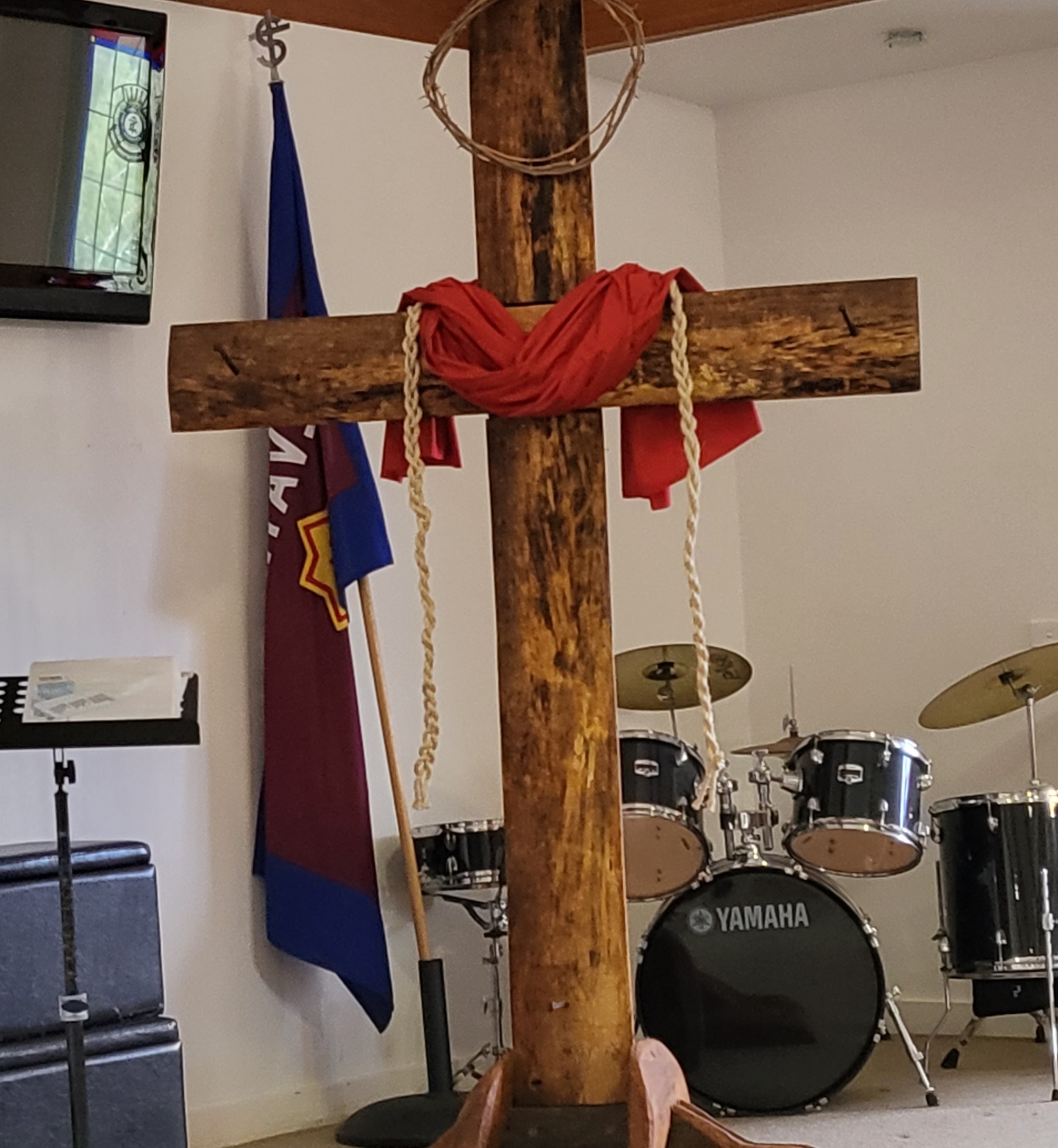
The following image is the Cross at the Salvation Army Hall, Batemans Bay, NSW. This Cross an empty crucifix. We may wonder where Christ is today!

Christ is within for all to discover.

Charles Causley is a background underrated poet. Ted Hughes highly regarded him, and they were good friends. Charles Causley on Wikipedia – Charles Causley – Wikipedia

And here is another of his famous poems concerning disability.

The Liverpool Poets – Roger McGough – Comeclose and Sleepnow

At a recent U3A meeting we looked at ‘The Liverpool Poets’ who were were/are a number of influential 1960s poets from Liverpool, England, influenced by 1950s Beat poetry. They were involved in the 1960s Liverpool scene that gave rise to The Beatles.

Their work is characterised by its directness of expression, simplicity of language, suitability for live performance and concern for contemporary subjects and references. There is often humour, but the full range of human experience and emotion is addressed.

The poets that are most associated with this label are Adrian Henri, Roger McGough and Brian Patten. They were featured in a 1967 book The Liverpool Scene edited by Edward Lucie-Smith, with a blurb by Ginsberg and published by Donald Carroll.

The anthology The Mersey Sound was published by Penguin in 1967, containing the poems of Adrian Henri, Roger McGough and Brian Patten, and has remained in print ever since, selling in excess of 500,000 copies. It brought the three poets to “considerable acclaim and critical fame”, and has been widely influential. In 2002 they were given the Freedom of the City of Liverpool.

Consider the following period student piece poem by Roger McGough …

Comeclose and Sleepnow 

it is afterwards 
and you walk on tiptoe 
happy to be part 
of the darkness 
lips becoming limp 
a prelude to tiredness. 
Comeclose and Sleepnow 
for in the morning 
when a policeman 
disguised as the sun 
creeps into the room 
and your mother 
disguised as birds 
calls from the trees 
you will put on a dress of guilt
and shoes with broken high ideals 
and refusing coffee 
run 
alltheway 
home. 

Roger McGough (1937 …)

You have to look back to the sixties when the pill was in its infancy – perhaps an unfortunate choice of words and when sex before marriage was frowned on by families for many reasons. And this is a poem about loss of virginity perhaps. And it is about a female partner participating in sex written from a male perspective.

The first six lines set the scene describing the aftermath after being thrown in at the first line. And the ‘happy to be part of the darkness’ sets the mood of female guilt at what has happened.

And then the repeat of the title ‘Comeclose and Sleepnow’. This gives emphasis to the male plea to focus away from the guilt to be together and sleep. And what RM has cleverly done is to create two new joined words that emphasise the demand for being together and sleeping.

But the morning will bring the coverup. Dressed in guilt with broken high ideals.  The sun will show light on what has happened and the birds will be unheard as mother’s voice is all the focus. And refusing coffee is a such a heavy sentence and worse than roast beef in that rush home.

Consider that well known nursery rhyme.

This little piggy went to market, 
This little piggy stayed home, 
This little piggy had roast beef, 
This little piggy had none.

This little piggy went ... 
Wee, wee, wee, 
all the way home!

The modern construction of this poem would imply that it was written as a reflective piece later in life. And on a personal note, I can easily identify with the period relevant to this poem. I spent three years in the West Riding of Yorkshire in the nineteen sixties where I studied for a mathematics and statistics degree at Bradford University.

Roger McGough is a performance poet, broadcaster, children’s author and playwright. He presents the BBC Radio 4 programme Poetry Please, as well as performing his own poetry. McGough was one of the leading members of the Liverpool poets, a group of young poets influenced by Beat poetry and the popular music and culture of 1960s Liverpool. He is an honorary fellow of Liverpool John Moores University, fellow of the Royal Society of Literature and President of the Poetry Society.

Roger McGough on Wikipedia

A link to Poetry Please

The Birds – Philip Hodgins – Comments

The Birds
The time is nearly five a.m.
and all the birds are on the go.
They sound just like the frequencies
of many twiddled radios.

It's really bad the way it's gone ―
I always used to sleep okay
and dream and miss the rural life
and never see the break of day.

But since I got the only part
in cancer's scripted dialogue
I've heard those birds a million times
and seen the sun come up a lot.

I've been rehearsing death each night,
and still I haven't got it right.

Philip Hodgins (1959 – 1995)

Philip Hodgins died at such an early age after having a blood cancer. Much of his later poetry was associated with living with such a debilitating and terminal condition. And the closing couplet of this sonnet defines his despair at still being alive – ‘I’ve been rehearsing death each night’.

Clearly the bird chorus of early dawn irritates him. And who hasn’t been irritated by fiddling with the frequencies on a radio in trying to find a station? And in the second stanza it looks as though he used to sleep-in in the morning, indicating a fully engaged vibrant social nightlife.

He considers life to be a play where he has been given a nasty script. And he alone has that once only part indicating that all his contemporaries will live on as he waits for the final act.

Philip Hodgins on Wikipedia – Philip Hodgins – Wikipedia

Of interest, the legislative authority of the Australian Capital Territory is about to consider how to deal with the legality of euthanasia.

euthanasia = the painless killing of a patient suffering from an incurable and painful disease or in an irreversible coma

The Eagle – Alfred Lord Tennyson

The Eagle
He clasps the crag with crooked hands;
Close to the sun in lonely lands,
Ringed with the azure world, he stands.
The wrinkled sea beneath him crawls;
He watches from his mountain walls,
And like a thunderbolt he falls.
Alfred Lord Tennyson (1850 - 1892)

When I first started taking an interest in poetry this poem was given to me as an entry point to define poetic expression in terms of a simple text. It certainly did that and looking at it again today it still invokes admiration.

L1 … Rhyme, rhythm, and alliteration and then personification as claws are transformed into hands. We have become the eagle. Clasps give strength to the fact of maintaining a strong hold. It gives a sense of safety. The many times I go to a lookout I make sure I am safe as I look down.

L2 … Of course, the Eagle is not close to the sun. We know the sun and moon appear to be the same size though the sun is millions of miles away. But this is where the eagle lives and it is not our world, another lonely world. Hopefully, a world far away from the flight path of planes. But lonely suggests the eagle has the sky space to itself.

L3 … He is now standing rather than perched and he is ringed with the azure (bright blue cloudless sky). And we immediately have a picture of dominance against a perfect sky background. Of all birds the eagle is the lion of the sky.

L4 … You will not get a better word than wrinkled to describe the sea from a great height on a quiet day. And the fact that it crawls gives emphasis that it is below and subservient to the eagle.

L5 … This is his lookout where he spends time watching. This is his nature and way of living. So you have a still set in the mind of the reader. A waiting and that comma is so important at the end of the line. When reading it give a pause!

L6 … The thunderbolt dynamism of the last line. The contrast from being still and the crawling sea as we become the falling eagle (not diving or swooping) but falling. I am told birds do close in their feathers tight to provide greater speed in movement at the start of their dive. Therefore, falls may have a factual element as well.

Some time ago my daughter took a photograph of a sea-eagle. When she zoomed the image it had a fish in its claws. You must hand it to the eagle for such fishing skill.

Alfred Lord Tennyson on Wikipedia

Gratitude to Old Teachers – Robert Bly – Comments

Gratitude to Old Teachers

When we stride or stroll across the frozen lake,
We place our feet where they have never been.
We walk upon the unwalked. But we are uneasy.
Who is down there but our old teachers?

Water that once could take no human weight—
We were students then— holds up our feet,
And goes on ahead of us for a mile.
Beneath us the teachers, and around us the stillness.

Robert Bly (1926 – 2021)

I did like this simple poem as Robert Bly is not always easy to fathom (excuse the pun).

The journey of life is like a walk across a frozen lake. And I remember as an eight-year-old testing a frozen pond with parts too thin to walk on. Our walk or life journey is unique, and we walk on the unwalked.

We have underneath support from others all our life. Sometimes completely unknown to us of course. And if we have a spiritual belief maybe we have some form of spiritual guidance. Robert Bly is saying the ice is thickest when we are young for it is at that stage that we need most support; not getting ourselves runover on the roads or in his poem not drowning. And indeed, maybe others prepare for our future stepping in the journey of life, whether a mile or greater distance.

The ‘all around us the stillness’ text does suggest that those that have provided support are no longer alive, or alive to us. And the title ‘Gratitude to Old Teachers’ would suggest the same. And we should be thankful to those that have helped keep us dry.

Something to consider – to what extent do we carry latent within ourselves the influence of others. And is there help when the ice is thin? And like the iceberg is memory all underneath until perhaps it is needed and comes to the surface.

And Teachers of course never retire.

Robert Bly – Wikipedia

Lost words of Shelley – The Existing State of Things – Politics

Friday 8 July marked the bicentenary of Shelley (4 August 1792 – 8 July 1822) and below are some lost words only discovered in 2006 from a political pamphlet.

Shelley’s poem was “lost” for nearly 200 years, before a single copy of the pamphlet was “rediscovered” in 2006, and a decade later bought by Oxford’s Bodleian Library, so finally it could be read by the public again

“Shall rank corruption pass unheeded by, 
Shall flattery’s voice ascend the wearied sky;
And shall no patriot tear the veil away
Which hides these vices from the face of day?
Is public virtue dead? – is courage gone?”

These lines are taken from Poetical Essay on the Existing State of Things, an excoriation of the moral devastation wreaked in late Georgian Britain two centuries ago. It was written by Percy Bysshe Shelley and published anonymously in 1811, in support of the radical Irish journalist Peter Finnerty, who had been imprisoned for seditious libel after accusing the Anglo-Irish politician Viscount Castlereagh of the torture and executions of Irish rebels challenging British rule.
(I came across them from a recent article in the Guardian Newspaper by Kenan Malik … Long gone, but speaking clearly to our age – Shelley, the poet of moral and political corruption | Kenan Malik | The Guardian)

The lines can relate to the sad state of humanity across the ages. And they are apt today in lamentation at what is happening in many places across the world.

Shelley astounds me by his great productive flow of words throughout his short life.

Shelley on Wikipedia