Today – Billy Collins – Comments

Well spring is here in Australia and the initial thrust is now behind us but there were certain days that exploded in delight and Billy Collins uses this theme in a rather exaggerated way in the following poem –

Today

If ever there were a spring day so perfect,
so uplifted by a warm intermittent breeze
that it made you want to throw
open all the windows in the house
and unlatch the door to the canary's cage,
indeed, rip the little door from its jamb,
a day when the cool brick paths
and the garden bursting with peonies
seemed so etched in sunlight
that you felt like taking
a hammer to the glass paperweight
on the living room end table,
releasing the inhabitants
from their snow-covered cottage
so they could walk out,
holding hands and squinting
into this larger dome of blue and white,
well, today is just that kind of day.

Billy Collins ( 1941 -

It is based on a Northern Hemisphere spring when snow is often around as spring makes itself known. Snow covered cottages are not really the scene in Australia.

Spring is certainly the time for getting outdoors and appreciating the environment and the changes in colour and the burst of growth. And if you have been locked up by winter and the virus just getting out in the sunshine is a real treat.

And there may be a day that you feel so elated and alive that, as Billy Collins suggests, you feel like releasing the inhabitants from their inside bondage. Breaking loose with poetical damage to the home. A very effective way of emphasising a state of high emotion. Setting the canary free so to speak.

Of course, not everybody may share your enthusiasm for getting out and about. But I must add it is now a delight to be out in the Canberra spring and in a virus free city.

Billy Collins on Wikipedia.

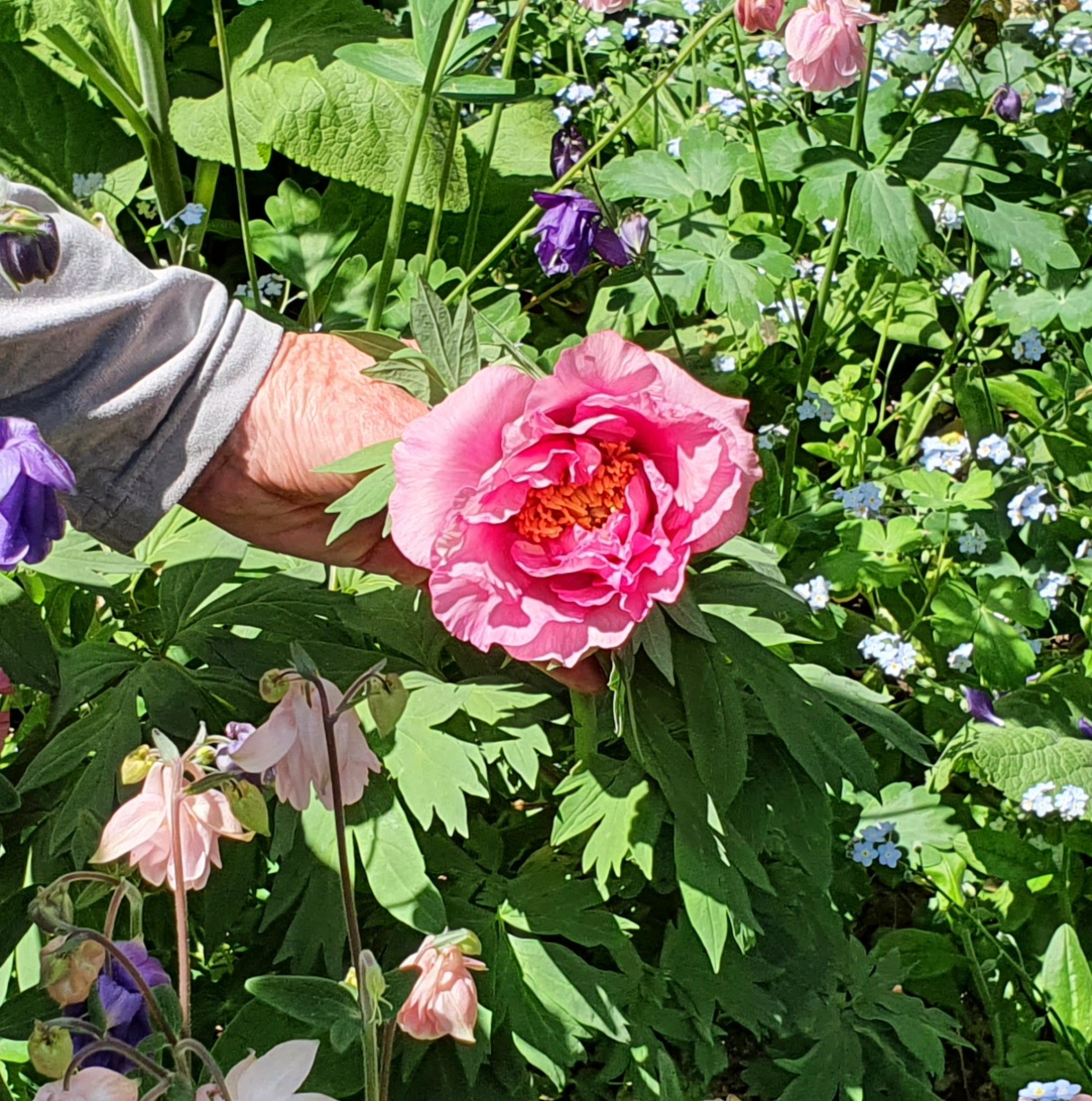
A peony in bloom seen at The Red Cow Farm at Sutton Forrest NSW.

The Wild Iris – Louise Gluck – Analysis

A week or so ago the poet Louise Glück became the first American woman to win the Nobel prize for literature in 27 years, cited for “her unmistakable poetic voice that with austere beauty makes individual existence universal”.

Glück is the 16th woman to win the Nobel, and the first American woman since Toni Morrison took the prize in 1993. The American singer-songwriter Bob Dylan was a surprise winner in 2016.

One of America’s leading poets, the 77-year-old writer has also won the Pulitzer prize and the National Book Award, tackling themes including childhood and family life, often reworking Greek and Roman myths.

The Wild Iris’ by Louise Glück is the title poem of her 1992 collection. This volume follows a specific sequence, poem to poem, describing the poet’s garden. In this piece, she considers the human soul, immortality associated with rebirth, and the commonalities between all life no matter how that life is manifested. 

Looking at the text …

The Wild Iris
At the end of my suffering
there was a door.

Hear me out: that which you call death
I remember.

Overhead, noises, branches of the pine shifting.
Then nothing. The weak sun
flickered over the dry surface.

It is terrible to survive
as consciousness
buried in the dark earth.

Then it was over: that which you fear, being
a soul and unable
to speak, ending abruptly, the stiff earth
bending a little. And what I took to be
birds darting in low shrubs.

You who do not remember
passage from the other world
I tell you I could speak again: whatever
returns from oblivion returns
to find a voice:

from the center of my life came
a great fountain, deep blue
shadows on azure seawater.
Louise Gluck (1943 –

The iris is wild as though it has a natural uncultivated presence.

The door is death and going through the door ends suffering and someone has gone through the door. It is not unreasonable to assume a person has died. But in the second stanza we see that the person wants to talk about ‘death’ – what you call death – after ‘death’ has actually taken place.

The next two stanzas change thoughts from personal death to the death of an iris. The dead iris is buried in the earth. However, the dead iris is not dead but has become a consciousness. This consciousness is ‘terrible’. The question is left for the reader to ponder meaning. Maybe it is terrible because it wants to become. Equally the reader can entertain the thought that all death might become latent consciousness.

Then it is over. That horrible time of the consciousness not being able to speak – not able to become living and have a voice and meaning. And we see the stiff earth bending a little, as though the iris has started to break through the earth.

Then the voice beyond ‘death’ speaks again to tell us that all re-birth seeks a voice.

In the last stanza the voice of the blue iris coming to life is described in dramatic terms. The voice of the iris in all its splendor is a great fountain. The whole purpose of the iris is to flower in glory.

While the speaker is talking about a flower, there are obvious implications for humanity, and the human soul. What are we meant to become? And is life a continual cycle of re-birth? And are we naturally beautiful?

Louise Gluck on Wikipedia

Dead Musicians – Siegfried Sassoon – Analysis

Siegfried Loraine Sassoon, was an English poet, writer, and soldier. Decorated for bravery on the Western Front, he became one of the leading poets of the First World War. He is best remembered for his angry and compassionate poems about World War I, which brought him public and critical acclaim.

Dead Musicians.

I

From you, Beethoven, Bach, Mozart,
The substance of my dreams took fire.
You built cathedrals in my heart,
And lit my pinnacled desire.
You were the ardour and the bright
Procession of my thoughts toward prayer.
You were the wrath of storm, the light
On distant citadels aflare.

II

Great names, I cannot find you now
In these loud years of youth that strives
Through doom toward peace: upon my brow
I wear a wreath of banished lives.
You have no part with lads who fought
And laughed and suffered at my side.
Your fugues and symphonies have brought
No memory of my friends who died.

III

For when my brain is on their track,
In slangy speech I call them back.
With fox-trot tunes their ghosts I charm.
‘Another little drink won’t do us any harm.’
I think of rag-time; a bit of rag-time;
And see their faces crowding round
To the sound of the syncopated beat.
They’ve got such jolly things to tell,
Home from hell with a Blighty wound so neat…
. . . .
And so the song breaks off; and I’m alone.
They’re dead … For God’s sake stop that gramophone.

Siegfried Sassoon (1886 – 1967)

This poem is in three distinct parts remembering that Sassoon was very much involved on the battlefield and after returning to England lived into his eighties.

S1 … This stanza is all to do with Sassoon’s appreciation of the great composers Beethoven, Bach and Mozart. And his soul stimulation when a youth is described in terms of fire, cathedrals, and citadels. These dead musicians meant much to him in his formative years. He was a member of the upper class and such music common to his ear.

S2 … These great composers are meaningless to the rank and file soldiers who strived towards peace in their youth in the Great War. And they are equally meaningless to Sassoon when he recalls the dead soldiers he fought with. The metaphorical cathedrals and citadels are in ruins. This is a memory stanza as Sassoon reflects back perhaps after many years.

S3 … The music associated with his soldier compatriots is defined in terms of fox-trot tunes and rag-time jazz. And moreover the together times of jolly mate ship is remembered, especially of those who returned even though they were wounded. A Blighty Wound was serious enough to require recuperation away from the trenches, but not serious enough to kill or maim the victim.

S4 … Time to stop the music, the music playing in his mind. He is alone all his mates long dead. And very appropriate to say – stop that gramophone as though it is outside his control.

The dead musicians that are significant to Sassoon are not Beethoven, Bach or Mozart.

Gramophone

life a recording
expanding from the center 
playing its music
lost notes of the departed
needle the mind of the living

Siegfried Sassoon on Wikipedia

Football – Kate Llewellyn – Comments

Football

I found myself wishing this persona… to be brave and strong and to tell me
about anything else;
art, football, ice hockey, plasma physics, philosophy… anything but love…

It's a game
I saw it once or twice
when I was twelve
standing by a fence in a coat and scarf
with my best friend
local farmers leapt and ran
thuds and clouts and kicks
made the noise of drums and blood
in the dark part of the heart
goals were signalled
with a cheer
and a man waved two white flags
as if he wanted peace
men ran out with oranges
the players sucked them
and began again
it got cold
and we went home
I forget who won
my Mother's pinafore was green
it had red berries on it
we made toast on a fork
in the kitchen stove
it tasted of smoke and butter
my Father didn't play football
I don't think he knew how
the ball seemed an odd shape
perverse

Kate Llewellyn (1936 –

The story of going to a football game with a friend at the age of twelve, so it must have been just after the war in 1948. It looks like winter weather as a coat and scarf is involved. And it looks like a local event where the farming community come in to town to play. And it seeds as though Kate is a little sensitive to all the supporting uproar – made the noise of drums and blood / in the dark part of the heart.

Why the waving of white flags? An understanding of the game seems to be in question later in the poem. But the next thing of note was the half-time break and the distributing of cut oranges to the players. But then it got cold so you had the feeling it was not really very pleasant to be standing around.

The main memory then is the after game warmth of being home again and having toast and being with her mother to the extend of remembering colours in her mother’s pinafore.

Her father did not play football. If he had been involved she may have been educated in the game at a much earlier age. This gives force that she just went along with another girl for an introduction. One thing that obviously struck her was the strange perverse shape of the ball – balls should be round, so why this shape!

You must remember at that time sport was more male than female. And that this girl had little understanding and involvement with the game. And maybe her girl friend had more knowledge of ‘football’ and had asked her if she would like to come along for company. This poem is a statement of a view of the game from this perspective.

Our appreciation and involvement of sport is highly influenced by family and friends. Parents often get their children involved when very young. This can be a positive or negative. I am still interested to see how Southampton Football Club in the UK are going; at a great distance of course. This is purely because of going to see games with my father when I was about the same age as Kate in the above poem.

My father finished work at mid-day on a Saturday. And if ‘The Saints’ were playing at home I would sit with my brother in the back seat of the Morris Isis for the drive to Southampton. We did not go straight to the ground, there was always a stop at ‘The Sun’ pub where we waited in the back of the car with a soft drink and ‘Smiths’ crisps. It was dark and cold at the end of the day when we got back home so I can relate to Kate’s warm home words in her poem. Such pleasant memories wrap around me when I think of those times. And of course the ball was round!

Kate Llewellyn is is an award-winning Australian poet, author, diarist and travel writer. A link to Wikipedia.

False Prophet – Bob Dylan – Analysis

False Prophet

Another day without end – another ship going out
Another day of anger – bitterness and doubt
I know how it happened – I saw it begin
I opened my heart to the world and the world came in

Hello Mary Lou – Hello Miss Pearl
My fleet footed guides from the underworld
No stars in the sky shine brighter than you
You girls mean business and I do too

I’m the enemy of treason – the enemy of strife
I’m the enemy of the unlived meaningless life
I ain’t no false prophet – I just know what I know
I go where only the lonely can go

I’m first among equals – second to none
I’m last of the best – you can bury the rest
Bury ‘’em naked with their silver and gold
Put ’em six feet under and pray for their souls

What are you lookin’ at – there’s nothing to see
Just a cool breeze encircling me
Let’s walk in the garden – so far and so wide
We can sit in the shade by the fountain side

I’ve searched the world over for the Holy Grail
I sing songs of love – I sing songs of betrayal
Don’t care what I drink – don’t care what I eat
I climbed a mountain of swords on my bare feet

You don’t know me darlin’ – you never would guess
I’m nothing like my ghostly appearance would suggest
I ain’t no false prophet – I just said what I said
I’m here to bring vengeance on somebody’s head

Put out your hand – there’s nothin’ to hold
Open your mouth – I’ll stuff it with gold
Oh you poor Devil – look up if you will
The City of God is there on the hill

Hello stranger – Hello and goodbye
You rule the land but so do I
You lusty old mule – you got poisoned brain
I’m gonna marry you to ball and chain

You know darlin’ the kind of life that I live
When your smile meets my smile – something’s got to give
I ain’t no false prophet – I’m nobody’s bride
Can’t remember when I was born and I forgot when I died

Bob Dylan (1941 –

This is a recent poem/song written by Bob Dylan from his album ‘Rough and Rowdy Ways’. It was released this year … see this link

Each of the ten four-line stanzas comprise rhyming couplets.

Looking at each stanza, my immediate response …

S1 – If we open ourselves to the world without reservation pain can be the travelling companion. And this of course can course emotional turmoil. How big a backpack is another matter.

S2 – ‘Hello Mary Lou’ was the name of a song first recorded by Ricky Nelson. And Miss Pearl is another song … girls that influence the heart … girls that mean business and this is reciprocated.

S3 – Great to seek good. Great to know yourself and know where you’re going in life. Great not to be false to yourself. Great expectations!

S4 – To be inclusive and equal but not seeking gold … gold and silver are false things to hold.

S5 – There’s nothing special, special about Dylan … come to myside in the garden … then you will see, you will see and will feel … all that is special – special and real together

S6 – I’ve (Dylan) done a lot of searching … love and betray … I’ve struggled up mountains so hard not to fail … climbed a mountain of swords on my bare feet … it doesn’t matter any more about food and drink … I’m beyond that old searching game

S7 – Don’t go on appearances I’m not what you see … you don’t know me … I’ll get my own back on life … but who is to blame … vengeance on somebody’s head

S8 – I can’t give you anything … don’t look to me …you will be led astray … the swallow of gold … gold will choke you, it’s not a food … look up to the hill to God behold

S9 – Hello and good by … false prophet – true prophet, both rule the land … but to prison I send the false holding of hand

S10 … You know me and I know you … in confrontation something must give … I’m no false prophet … when was love born and when did it die!

Here is the official audio on You Tube 

Bob Dylan won the Nobel Prize for Literature in 2016 and all his lyrics have been thought provoking. He is remembered by most for his early days of coming to fame with songs such as ‘It Ain’t me Babe’ here is a YouTube link … and his involvement in the Counterculture of the sixties.

My Darling Turns to Poetry at Night – Anthony Lawrence – Analysis

My Darling Turns to Poetry at Night

My darling turns to poetry at night.
What began as flirtation, an aside
Between abstract expression and first light

Now finds form as a silent, startled flight
Of commas on her face — a breath, a word …
My darling turns to poetry at night.

When rain inspires the night birds to create
Rhyme and formal verse, stanzas can be made
Between abstract expression and first light.

Her heartbeat is a metaphor, a late
Bloom of red flowers that refuse to fade.
My darling turns to poetry at night.

I watch her turn. I do not sleep. I wait
For symbols, for a sign that fear has died
Between abstract expression and first light.

Her dreams have night vision, and in her sight
Our bodies leave ghost prints on the bed.
My darling turns to poetry at night
Between abstract expression and first light.

Anthony Lawrence (1957 –

This is a nineteen-line villanelle; five three-line stanzas and ending with a four-line.

The first and third lines of the first stanza appear repeatedly throughout the villanelle structure. They form the rhyming couplet in the last stanza. These are the most important lines and once defined eight lines have been created. Much thought must be given in creating these lines.

My darling turns to poetry at night
Between abstract expression and first light.

Looking at the above lines and what they say to me. The poet’s sleeping partner is pure poetry as he/she changes in facial expression. It is clever to use the double meaning of turns.

The other lines cleverly elaborate on this theme with poetry in mind. For example –

Her heartbeat is a metaphor, a late
Bloom of red flowers that refuse to fade.

We now know that a ‘she’ is involved and not a ‘he’. There is an underlying sense of beauty. And I do like the way commas appear as separation in the silent breathing of words by the sleeping person.

The facial expression of a person varies throughout the journey of the night. What you can read from viewing the continual changes is another matter. This poem is all about facial expression translation to poetic thoughts. I think there is an incredible beauty in the sleeping face of someone in peace with the world whether adult of child. In this poem it appears that fear must be eliminated before this can occur. And it is very thoughtful for partner to wait for this to be seen visually. Perhaps using this time to compose poetic words.

I watch her turn. I do not sleep. I wait
For symbols, for a sign that fear has died

The end rhyming words must flow through the villanelle too, so it is not an easy structure to adhere to. In this case – night, flight, sight, light

And for those not familiar with the villanelle this is a link to that well-know Dylan Thomas poem as another example, together with more detail on the villanelle.

Anthony Lawrence is a contemporary Australian poet and novelist.


Donal Og – Lady Augusta Gregory – Comments

Donal Og (young Donal)

It is late last night the dog was speaking of you;
the snipe was speaking of you in her deep marsh.
It is you are the lonely bird through the woods;
and that you may be without a mate until you find me.

You promised me, and you said a lie to me,
that you would be before me where the sheep are flocked;
I gave a whistle and three hundred cries to you,
and I found nothing there but a bleating lamb.

You promised me a thing that was hard for you,
a ship of gold under a silver mast;
twelve towns with a market in all of them,
and a fine white court by the side of the sea.

You promised me a thing that is not possible,
that you would give me gloves of the skin of a fish;
that you would give me shoes of the skin of a bird;
and a suit of the dearest silk in Ireland.

When I go by myself to the Well of Loneliness,
I sit down and I go through my trouble;
when I see the world and do not see my boy,
he that has an amber shade in his hair.

It was on that Sunday I gave my love to you;
the Sunday that is last before Easter Sunday
and myself on my knees reading the Passion;
and my two eyes giving love to you for ever.

My mother has said to me not to be talking with you today,
or tomorrow, or on the Sunday;
it was a bad time she took for telling me that;
it was shutting the door after the house was robbed.

My heart is as black as the blackness of the sloe,
or as the black coal that is on the smith’s forge;
or as the sole of a shoe left in white halls;
it was you put that darkness over my life.

You have taken the east from me, you have taken the west from me;
you have taken what is before me and what is behind me;
you have taken the moon, you have taken the sun from me;
and my fear is great that you have taken God from me!

Anonymous (8th century Irish ballad)
Translated by Lady Augusta Gregory

From WikipediaIsabella Augusta, Lady Gregory was an Irish dramatist, folklorist and theatre manager. With William Butler Yeats and Edward Martyn, she co-founded the Irish Literary Theatre and the Abbey Theatre, and wrote numerous short works for both companies.

From the Guardian
The translation from the Gaelic leaves much of the original’s grammatical structure in place, giving her English remarkable energy

Well, in the 8th century a woman needed a man for financial support and a living apart from love getting in the way.

And it is the same old story of a lover promising the world and the beloved half believing through misty eyes. The promises detailed in terms of agricultural life – that you would be before me where the sheep are flocked. And she giving three hundred cries and none were heard. She knew his promises were meaningless – you promised me a thing that is not possible. But did that matter? Lovers are generally  prone to be forgiving of the faults in others.

And religion joins forces with her passion it being Passion Sunday the day she gave herself to him and to him forever – my two eyes giving love to you for ever.

She is in deep depression at the loss of love; the loss of him – it was you put that darkness over my life.

The counsel of her mother was too late – it was a bad time she took for telling me that; / it was shutting the door after the house was robbed.

That last line brings in religion again – and my fear is great that you have taken God from me! Perhaps she believes that if she does commit suicide God would be taken from her. And perhaps she is feeling suicidal. Commit is not the word to use today in that association.

This lament is the story of love, grief and despair which flows endless through the centuries.

Days – Philip Larkin – Analysis

Days

What are days for?
Days are where we live.
They come, they wake us
Time and time over.
They are to be happy in:
Where can we live but days?

Ah, solving that question
Brings the priest and the doctor
In their long coats
Running over the fields.

Philip Larkin (1922 – 1985)

I read this poem some time ago. However, recently I took out a book from the library by Robert Dessaix ‘What Days Are For – A memoir’ and that renewed my interest is this poem.

Robert Dessaix had a heart attack and was rescued off the streets in Sydney. He spent a long time in hospital recovering from what was a near death experience. This poem featured very much in his thinking during his eventual recovery. Some text from his book –

I don’t find this poem disheartening at all. On the contrary, it gives me heart. I don’t know a lot about Philip Larkin, not being much of a one for poetry, having found so little of it transporting, but I do know that he rarely gives anyone heart. He skewers, pricks, amuses, lances, stuns. He was too aware that, while most things might never happen, death certainly would to give anyone heart. And all we can do, from Larkin’s perspective, I gather, is ruefully endure.

And this morning I can do more than that: I can simply enjoy myself. For the time being I need not contemplate anything except the euphoric upswing of convalescence.

A rather cynical response on Larkin and keyed into the stereotype but I must say that contrary to this image of Larkin I think he very much enjoyed life.

There are two questions asked of the reader. Instead of contemplating the meaning of life meaning is brought down to daily existence. Days being the stepping stones in the day to day journey of our existence and as Mr Larkin so well states they just can’t be ignored. Another one will appear tomorrow – hopefully! The question is answered quite emphatically they are to give happiness – they are to be happy in. Life is to be enjoyed; life is rather nice and gives pleasure – not all the time of course. And how happiness manifests itself is another matter.

And it was a certain joy that came to Dessaix that on a day of recovery and despite the woes of his aging body be felt so much better. This is clearly shown in his text below –

I feel undeniably much, much better. Yes, little by little “the million-petalled flower / of being here” another phrase of Larkin’s – may indeed be losing its vibrant hues and shrivelling up, but it can be contemplated with pleasure for what it is today.

A nice thought that as we deteriorate we can be happy in our deterioration. Finding happiness may not be easy but it may be around somewhere.

The second question – where can we live but days – is perhaps one that should not be contemplated too much unless we want to go mad. We cannot go out of this reality into something beyond imagination. Some may attempt this through religious fervour or because of mental breakdown so a doctor and priest are well chosen.

Death of course may be an answer but do we really want to summon last rites from a priest and a doctor for confirmation. In his book Dessaix spends time arguing that too much wasted time is spent considering the after-life, if there is such. And there is a clear distinction between religion and spirituality – religion getting in the way of the truth perhaps.

My comment … ‘God’ can only be touched through the cloud of unknowing – that is if you can actually ‘touch’ God of course.

The poem ends in the macabre but as Dessaix says not despairing or dour.

Enjoy “the million-petalled flower / of being here”! – I do like that. From Philip Larkin’s poem ‘The Old Fools’.

And of course make the most of this day!