Dover Beach – Matthew Arnold – Analysis

The following are my thoughts on the well-known poem ‘Dover Beach’ by Matthew Arnold (1822-1888) –

Dover Beach

The sea is calm to-night,
The tide is full, the moon lies fair
Upon the straits; on the French coast the light
Gleams and is gone; the cliffs of England stand,
Glimmering and vast, out in the tranquil bay.
Come to the window, sweet is the night-air!
Only, from the long line of spray
Where the sea meets the moon-blanched land,
Listen! you hear the grating roar
Of pebbles which the waves draw back, and fling,
At their return, up the high strand,
Begin, and cease, and then again begin,
With tremulous cadence slow, and bring
The eternal note of sadness in. ……….…………………. 14

S1 … Lines 1 – 14 …

The first sentence is factual describing the scene. It looks like a full moon on the straits of water which separate Dover and Calais. It is evening and the light fading in the west towards France. Whether the French coastline is actually visible is debatable – it is a distance of 21 miles and conditions must be favourable – but in contrast the Dover Cliffs are outstanding if you forgive the pun! But it is a peaceful tranquil setting bathed in moonlight (I like – moon-blanched).

The second sentence is a personal invitation to come to the window to see the scene. Matthew Arnold was at Dover twice and in 1851 when this was written he was newly married so it could have been an invitation to his wife to come to the window. But this does not matter what he wants to point out in the sweet night air is the continual push of the waves as they draw back and then fling forward with grating roar – for Mathew Arnold this is an eternal note of sadness.

Sophocles long ago
Heard it on the Aegean, and it brought
Into his mind the turbid ebb and flow
Of human misery; we
Find also in the sound a thought,
Hearing it by this distant northern sea ………………………. 20

S2 … Lines 15 – 20 …

The sound of the sea gave thoughts to the Greek Playwright Sophocles. Sophocles likened the swelling tide to the continual ruin that could be passed on by the Gods from one generation to the next in his play Antigone. This might link in to Arnold’s own melancholic mood and his statement on eternal sadness. But from this Arnold now moves to his own personal thoughts prompted by the grating action of the sea.

The Sea of Faith
Was once, too, at the full, and round earth’s shore
Lay like the folds of a bright girdle furled.
But now I only hear
Its melancholy, long, withdrawing roar,
Retreating, to the breath
Of the night-wind, down the vast edges drear
And naked shingles of the world. …………………………. 28

S3 … lines 21 – 28 …

It looks like there was a time when faith was easy and comfortable to his being – but now the situation is different and he finds his faith-foundation-stone eroded. It helps to know that Matthew Arnold, an inspector of schools, was a deeply religious person and in 1851 when this was probably written the world was in upheaval. Rapid change was taking place not only from industrialisation but in the understanding of life through the advancement of science and especially the birth of evolutionary thought through Darwin. I like that word shingles because apart from being a reference to the beach-pebbles it is a nasty medical condition – a great irritation to the skin. Of course in this context Arnold is threatened by change and is experiencing a mental irritation.

Ah, love, let us be true
To one another! for the world, which seems
To lie before us like a land of dreams,
So various, so beautiful, so new,
Hath really neither joy, nor love, nor light,
Nor certitude, nor peace, nor help for pain;
And we are here as on a darkling plain
Swept with confused alarms of struggle and flight,
Where ignorant armies clash by night …………………. 37

S4 … lines 29 – 37 … Apparently he may have been on his honeymoon and in the first two lines he could have been talking to his new wife=love. Despite the down sliding world (the darkling plain) it is important to be true to one another – a concentration on the micro personal world where there is some control. I see this as a glimmer of light in his depressed state. And as we enter a new year with the horrors of the world continually brought to our attention by the media such advice might be relevant today.

The last line really wraps it all up, my interpretation – Matthew Arnold is in a state of unresolved thinking … the two armies at large the old world concepts and the challenge of the new … both of course are ignorant armies … a unresolved chaotic state of affairs and at night we don’t always see things too clearly.

It is also worth noting that this free-verse poem is a clear break from the poetic expression of his day … so in a sense he has already advanced to new thinking in the development of this poem.

From the analysis of this poem on Wikipedia … The metaphor with which the poem ends is most likely an allusion to a passage in Thucydides’s account of the Peloponnesian War (Book 7, 44). He describes an ancient battle that occurred on a similar beach during the Athenian invasion of Sicily. The battle took place at night; the attacking army became disoriented while fighting in the darkness and many of their soldiers inadvertently killed each other.

Note … Matthew Arnold remained a believer in God and religion, although he was open to—and advocated—an overhaul of traditional religious thinking. In God and the Bible, he wrote: “At the present moment two things about the Christian religion must surely be clear to anybody with eyes in his head. One is, that men cannot do without it; the other, that they cannot do with it as it is.”

Passengers are reminded – Melinda Smith – Analysis

Geoff+Melinda

Canberra Poets Melinda Smith and Geoff Page at the ACT Writers Christmas Party, Gorman House, Canberra

Closing the year with a post recognizing the outstanding achievement of Canberra poet Melinda Smith who recently took-out a major poetry award – the Prime Ministers Award for Poetry with her book ‘Drag Down to Unlock or Place an Emergency Call’.

Looking at the first poem in that publication ‘Passengers are reminded’… my commentary appears below the text.

Passengers are reminded

The 11.44 Emu Plains service will depart in six minutes … L1
a cigarette butt is stuck to the black spiked heel of my left shoe … L2
L1-2 … the announcement of the imminent departure is synchronised with this passenger noticing that her shoes have spiked a cigarette butt – perhaps implying concern for her dress.
This service is experiencing a slight delay due to a sick customer at Town Hall … L3
in L3 we see that there will be delay … concern for a different passenger on another station
I have been carrying the lilies too long … L4
in L4 the waiting passenger is more concerned about the lilies she is carrying – so there is some urgency in the matter
This service is experiencing continuing delays due to a sick customer at Town Hall … L5
the petal edges fray to bruised brown, like old lettuce … L6
L5-6 extents the situation in each direction greater delay/ greater urgency – reflected in the state of the lilies
Customers wishing to travel on the Western line are advised to proceed to platform twelve … L7
my black stockings are bunched and twisted … L8
L7 appears to be incidental and the waiting passenger is again concerned about her dress this time her twisted stockings in L8
Customers are reminded … L9
The 13.00 funeral service … L10
will commence promptly at the appointed time … L11
whether I am there or not … L12
L9-12, appear to be a thought response back to the platform announcer … the service that she wants to attend is a funeral service – it is something one could easily do while waiting – especially if a little annoyed at the delay – re: ‘whether I am there or not’.
This is the 12.09 Lithgow service … L13
First stop – … L14
Rust-coloured crumbs of lily pollen on my black suit … L15
L13-14 give more incidental train announcements– but the focus is on her dress and the crumbs of lily pollen in L15
– then all stations to – … L16
my mind is still not full enough … L17
L16 – the continuing incidental announcement on the Lithgow service is in the background … to the exasperation of the passenger asking the telling question in L17- my mind is still not full enough– the question being how much longer must she fill her mind with distracting thoughts before the bloody train arrives!
Doors closing. Please stand clear. … L18
L18 – I think this is a very clever three-way closure – closure in the train announcement, closure in what she is saying in her mind-dialogue (L13), and closure to the poem.

Melinda Smith 2013

Summary

I love the duality of the interplay between a passenger waiting for a train and the station announcements on the train service. And who has not been in a similar situation. Expecting a train to arrive on time only to be thwarted by continual delay. Well, what do you do while you are waiting … talk with others, go for coffee, look at the station Ads, play with your mobile or just stand in thought … and what you think at the time may not always be poetic if annoyed at having to wait!

In the publication there are gaps of blank lines between lines. I think this is intentional to highlight the waiting situation experienced on the station. In other poems of this nature it is common to differentiate voices using italics or changes in font. By not doing this it adds to the mystery of the station environment and it leaves the poem open to different interpretation. The last line also adds some mystery in that we don’t actually know if this is her train and she is about to enter. But does this really matter? A good poem should always make the reader think.

In that regard others that have reviewed this poem have commented that the poem is a ‘memento mori’  poem – a reminder of death and mortality ‘Passengers are reminded’. Life being a journey. And that we try to fill our mind with other things to avoid thinking about death. This is the reason there are lines with incidental ‘noise’ and why the penultimate line is ‘my mind is still not full enough’ – seeing the waiting woman as one who does not want to think about death and the death of the person. But the final line makes it clear that there is no avoiding the inevitable separation – with every death the doors close and the rest of us just have to stand clear.

I must admit I had not thought of the poem in that light concentrating my focus on her need to be at the funeral and perhaps not being able to say her final good-bye in the company with friends.  But taking this direction it is certainly not her actual train that is moving off and the woman continues to wait – whether or not thinking of her own mortality in the meantime.

A wonderful thought provoking poem to include as the first poem in Melinda’s book.

Here is a link to Melinda’s Blog with more information on this poem … http://melindasmith.wordpress.com/2013/05/20/passengers-are-reminded/

Summer – Judith Wright : Analysis

Summer is here again and already we have had a few very hot days in Canberra. This poem by Judith Wright relates to Edge, her former home in Braidwood, and to the Australian summer and how nature must accommodate the disturbance by man and the effect of bush fire. It was written towards the end of her life.

Summer

This place’s quality is not its former nature
but a struggle to heal itself from many wounds.
Upheaved ironstone, mudstone, quartz and clay
drank dark blood once, heard cries and the running of feet.
Now that the miners’ huts are a tumble of chimney-stones
shafts near the river shelter a city of wombats.
Scabs of growth form slowly over the rocks.
Lichens, algae, wind-bent saplings grow.
I’ll never now it’s inhabitants. Evening torchlight
catches the moonstone eyes of big wolf-spiders.
All day the jenny-lizard dug hard ground
watching for shadows of hawk or kookaburra.
At evening, her pearl-eggs hidden, she raked back earth
over the tunnel, wearing a wide grey smile.
In a burned-out summer, I try to see without words
as they do. But I live through a web of language.

from Judith Wright Collected Poems – The Shadow of Fire (Ghazals)

JW shows strong identity to the land commenting on the effects of man  … a land which drank dark blood once … the killing of Aborigines … and a land once  subject to mining … her words describe the attempted recovery by nature  … the attempt to revert to previous conditions – which of course can never happen.

JW also shows strong empathy with the natural environment … with knowledge of local animals and insects seen at Edge. The environment adjusts to the disturbance by man … shafts near the river shelter a city of wombats … and the environment must adjust to the destruction of nature by bush fire … suggesting this is a greater problem …  trying to see without words … … creating words always detracts … many survivors of bush fires would identify with the intensity of thought conveyed by such words.

… it is fascinating to see how diversity manifests through continual evolution … species adapting to changes to environment and the resultant changes to other species … the total connectivity of life as it creates a future by the process of the survival of the fittest … or put another way survival by those best able to adapt to change.

… now this may be Ok when evolution is gradual, although of course some species become extinct, but what happens to this evolutionary process under sudden dramatic disturbances, humanity-made or not … and more important how can humanity act to ‘better the evolutionary process’ … humanity being the prime custodian of the world … having the key role in the very determination of the nature of existence. Global warming is of course one consideration for attention.

… there may of course be other influences at play in the evolutionary process such as spiritual connectivity … but a little foolish and quite a cop-out to think that God will protect the world from destruction … however this could become an indirect truth … if humanity allows God to work through humanity … by humanity listening and responding as appropriate.

… I really love the first two lines … This place’s quality is not its former nature / but a struggle to heal itself from many wounds … the quality of nature is in its resilience and ability to adapt to change and to heal … I am an an optimist of course.

Here is a link to the ‘Braidwood property Edge’ where Judith Wright lived.

and a link  to Judith Wright on Wikipedia

The Uncertainty of the Poet – Wendy Cope – Analysis

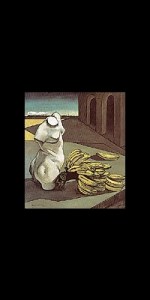
Wendy Cope wrote the poem below in response to viewing a painting of the same name by surrealist artist Giorgio de chirico . Here is an image of the painting. The statue is the torso of Aphrodite (and a link to more detail).

UncertaintyPoet

The Uncertainty of the Poet (by Wendy Cope)

I have annotated her lines with my comments.

I am a poet,

I am very fond of bananas.

Wendy Cope is a poet and by the look of things she very much likes bananas. Now this poem was written in conjunction with the above painting – a female statue and a hand of bananas. So we could easily equate the first sentence response with these objects.

I am bananas,
I am very fond of a poet.

Personifying bananas is certainly very poetic … and from the bananas point of view they are very touched by her fondness – a strong two-fold link.

I am a poet of bananas.

Indeed she is a poet of bananas … just as the artist portrayed bananas in his work.

I am very fond.

… perhaps she considers herself very loving, affectionate, caring

A fond poet of ‘I am, I am’ –

Very bananas.

… it is very true that many poets are ‘very fond I am’ sort of people … but the next phrase denigrates any infatuation

Fond of ‘Am I bananas?
… and to stress the point such fondness for herself could send her … well you know where bananas will take you!

Am I? – a very poet.

Well I certainly think she is a ‘very poet’! … but it’s always good to question oneself and indeed ask it of others!

Bananas of a poet!
Am I fond? Am I very?

The thought of being bananas of a poet … well that certainly needs an exclamation mark. But is she caring? … is she very (caring)? … well we have uncertainty … the uncertainty of person as well as poet

Poet bananas! I am

Forget poetry – ‘I am’ and that’s what matters! – how true

I am fond of a ‘very’.
She perhaps is one of those rare persons who always likes doing her best!

I am of very fond bananas.
In a poetic sense this statement is so true!

Am I a poet?

This question must be answered by the reader!

Wendy cope

There are only eight unique words in the entire poem – a wonderful play on words – perhaps a little ‘dadaism’ is in evidence.

My thoughts on looking at the painting … there are obviously two key objects … one representing ‘Art’ (and I will include poetry under that label – especially given the title of the painting) … the other very much down to earth … day to day living – something we can easily digest and recognise. Something we can internalise in a very real way but disappears from sight very quickly. The torso as an artistic object is more permanent but more difficult to digest (excuse the pun). And indeed what can be more permanent than the manifestation of love represented by the torso of Aphrodite. The artist/poet is always uncertain on how his or her art will be received and always uncertain about the quality of work and about living up to any personal expectations.

An Arundel Tomb – Philip Larkin – Analysis

ArundelTombChichester

An Arundel Tomb

Side by side, their faces blurred,
The earl and countess lie in stone,
Their proper habits vaguely shown
As jointed armour, stiffened pleat,
And that faint hint of the absurd–
The little dogs under their feet.

The sculpture is of the Earl of Arundel and his second wife Eleanor of Lancaster and it resides in Chichester Cathedral … in art dogs are a sign of fidelity … apparently over the years the sculpture has been vandalised and repaired

Such plainness of the pre-baroque
Hardly involves the eye, until
It meets his left hand gauntlet, still
Clasped empty in the other; and
One sees, with sharp tender shock,
His hand withdrawn, holding her hand.

In all the cathedrals and churches Larkin visited he never saw such tenderness depicted in stone and he was quite moved by the sight … generating this poem.

They would not think to lie so long.
Such faithfulness in effigy
Was just a detail friends could see:
A sculptor’s sweet commissioned grace
Thrown off in helping to prolong
The Latin names around the base.

They have been together for centuries in stone whereas in life they would never lie so close given that marriages were very much a political arrangement … there is a double take too on the word ‘lie’ as there probably would have been a lot of deceit in the arrangement. The Latin names around the base probably ignored by those visiting the cathedral today – but the holding of hands an attraction to the eye.

They would not guess how early in
Their supine stationary voyage
Their air would change to soundless damage,
Turn the old tenantry away;
How soon succeeding eyes begin
To look, not read. Rigidly they

Well, the nature of marriage has changed over the years and those visiting today would view the holding of hands perhaps as a more loving union. Supine = lying on the back without energy.

Persisted, linked, through lengths and breadths
Of time. Snow fell, undated. Light
Each summer thronged the grass. A bright
Litter of birdcalls strewed the same
Bone-riddled ground. And up the paths
The endless altered people came,

I like the view of the outside while the tomb is fixed and oblivious to the changing seasons. Apparently the grounds of Chichester Cathedral are known for bird song.

Washing at their identity.
Now, helpless in the hollow of
An unarmorial age, a trough
Of smoke in slow suspended skeins
Above their scrap of history,
Only an attitude remains:

People today don’t understand the history and context … washing over the sculpture … history becomes a scrap – unarmorial = not decorated with a coat of arms

Time has transfigured them into
Untruth. The stone finality
They hardly meant has come to be
Their final blazon, and to prove
Our almost-instinct almost true:
What will survive of us is love.

Philip Larkin

We have the contrast – the truth of love – the reality of love being something different from what this time-frozen stone fixture might suggest … the important things that survive are not so much the physical –but ‘love’ (whatever this means to the reader) … but then the physical may be needed as a catalyst or prompt. It certainly prompted Larkin to think about love – and he was certainly not a ‘love’ poet – but it has been said that he was haunted by such notions although of a melancholic nature.

A YouTube video of Philip Larkin reading this poem

London Rain – Louis MacNeice

This year many of the the poets visited in our U3A (University of Third Age) sessions have had some connection with religious ministry. When you come to think about it it is not surprising. Ministers are thought-full people – don’t you think!

Louis MacNeice was no exception. His father was a Protestant minister who later became a bishop of the Anglican Church of Ireland. Below is Louis MacNeice’s poem ‘London Rain’, written at a time of conflict in Europe. He wrestles with thoughts on God as he looks out late at night on the rain. Sharing my comments which are shown in italics after each stanza.

 London Rain

The rain of London pimples
The ebony street with white
And the neon lamps of London
Stain the canals of night
And the park becomes a jungle
In the alchemy of night.

London night-time rain … I love that word pimples and the catch of light in the pimple from the street lamps … ebony = rich dark black wood … giving a little gloss to the dark … and there is a whole new mapping of the streets … as in a chemical reaction …the light staining, leaving it’s mark

My wishes turn to violent
Horses black as coal–
The randy mares of fancy,
The stallions of the soul–
Eager to take the fences
That fence about my soul.

This looks like dissatisfaction on where he is in life … in terms of violent horses … he wants to break free … and this may be a spiritual unrest when we look at later stanzas

Across the countless chimneys
The horses ride and across
The country to the channel
Where warning beacons toss,
To a place where God and No-God
Play at pitch and toss.

Well his thoughts travel across the channel to the war and this occupies his mind … God and No-God (the Good and the Bad) playing pitch and toss = a game of skill and chance

Whichever wins I am happy
For God will give me bliss
But No-God will absolve me
From all I do amiss
And I need not suffer conscience
If the world was made amiss.

He is talking about the God/No-God battle going on in his mind. If there is a God – everything will be OK and if No-God then it doesn’t matter about all the conscience problems … these are his on-going thoughts as he watches the rain … his logic…dare I say late-night logic!

Under God we can reckon
On pardon when we fall
But if we are under No-God
Nothing will matter at all,
Adultery and murder
Will count for nothing at all.

Expounding his thoughts from the previous stanza … bad behaviour will not matter … no accountability… and under God we will be absolved of all our missdemeanours.

So reinforced by logic
As having nothing to lose
My lust goes riding horseback
To ravish where I choose,
To burgle all the turrets
Of beauty as I choose.

So his logic suggests to him that this horse can ride amuck with no consequence … taking the No-God ride so to speak … and using this to justify any course of action

But now the rain gives over
Its dance upon the town,
Logic and lust together
Come dimly tumbling down,
And neither God nor No-God
Is either up or down.

It looks as though it has stopped raining for a while … and in sync. with this his God/No-God thinking seems to fall away too … well it is late night and he is a little confused

The argument was wilful,
The alternatives untrue,
We need no metaphysics
To sanction what we do
Or to muffle us in comfort
From what we did not do.

The argument was very wilful = headstrong … and indeed ‘we need no metaphysics = abstract thinking’ … and in his case no ‘God/No-God’ thoughts to work out what we should be doing or to justify our actions. (I might add that those that shout God is on our side are often using God to justify their ungodly actions.)

Whether the living river
Began in bog or lake,
The world is what was given,
The world is what we make.
And we only can discover
Life in the life we make.

Bog and lake are references to his Irish / English heritage. For me this is the key stanza … it is up to us to make what we will of the world, of this gift … and we can only discover how we should live in living life. In a sense it is up to us – our responsibility to create our own God (and if we do happen to believe in an external God then perhaps our understanding of God may come clearer). Focus on the gift of the present, the here and now…don’t worry about what is happening overseas!

So let the water sizzle
Upon the gleaming slates,
There will be sunshine after
When the rain abates
And rain returning duly
When the sun abates.

Well, rain and sun one will follow the other in an endless cycle (good and bad) – that is the way of the world and we have to accept it – (hopefully life improves over time!)

My wishes now come homeward,
Their gallopings in vain,
Logic and lust are quiet,
And again it starts to rain;
Falling asleep I listen
To the falling London rain.

His mind is now back on where he is … in his room looking out on the falling rain … the logic/lust distraction of thought in vain … and the wild horses that took his thoughts away at the beginning of the poem bring him home again … he notices it has started to rain again … falling rain and enough thinking for one night falls asleep… let’s hope he has pleasant dreams!

(The rhyming scheme is a b c b d b – with a repeat end word in lines four and six of each stanza).

New Fruit – Ann Drysdale

New Fruit

In the last knockings of the evening sun
Eve drinks Calvados. Elsewhere in her life
She has played muse and mistress, bitch and wife.
Now all that gunpoint gamesmanship is done.
She loves the garden at this time of day.
Raising her third glass up to God, she grins;
If this is her come-uppance for her sins
It’s worth a little angst along the way.
A fourth. Again the cork’s slow squeaky kiss.
If, as the liquor tempts her to believe,
The Lord has one more Adam up His sleeve
He’s going to have to take her as she is—
Out in the garden in a dressing-gown
Breathing old apples as the sun goes down.

Here is a very entertaining sonnet from Ann Drysdale. We were looking at poetry from Wales at a U3A session and a member brought in this poem. Ann Drysdale is now living in Wales but previously spent much of her life in north Yorkshire.

Last knockings = the final stages of something … it is not just the evening sun as we will see later in the poem – a very apt choice of words

Calvados = an apple brandy from France – again later in the poem we will see how apt it is that it is apple brandy – Eve being connected with apple and seducing.

And Eve has obviously led quite an abundant life in a number of relationships including wife and mistress – but all that ‘gunshot gamesmanship’ is over – to me this implies a lack of effort now due to current circumstances – a feeling that she can’t be bothered in making the play of previous years.

She is in the garden by herself, apart of course from the gin bottle – raising her third glass she grins – well how can she do otherwise after drinking gin – and she contemplates her sins and thinks if this is the outcome it’s not too bad – it’s Ok to sin if this is all that happens, but of course there is the downside that she is alone and needs someone.

The fourth gin gives new hope that perhaps there is another Adam to be caught (looking hopefully to God who has supplied previous opportunities) – I love the ‘squeaky kiss’ of the cork bottle – but she lets a future Adam now that she is to be taken as she is, undressed – well apart from her dressing gown and breathing old apples  … the wounds of past relationships  … and you have the distinct feeling she is not what you might call a fresh young pippin – not new fruit!

What a wonderful witty entertaining poem with such well-chosen words.

Here is a link to more of her poetry.

The Silken Tent – Robert Frost

THE SILKEN TENT

She is as in a field a silken tent
At midday when a sunny summer breeze
Has dried the dew and all the ropes relent,
So that in guys it gently sways at ease,
And its supporting central cedar pole,
That is its pinnacle to heavenward
And signifies the sureness of the soul,
Seems to owe nought to any single cord,
But strictly held by none is loosely bound
By countless silken ties of love and thought
To everything on earth the compass round,
And only by one’s going slightly taut
In the capriciousness of summer air
Is of the slightest bondage made aware.

Robert Frost (1874 – 1963)

Here is a fine example of the English sonnet by Robert Frost that takes my fancy. Iambic Pentameter with structure abab cdcd efef for the three quatrains and then the rhyming summary couplet

The opening line although a little cumbersome is perhaps ‘as good as’ … she walks in beauty like the night (Byron)

Interesting word used ‘guys‘ a double take in today’s usage that happens to fit the theme of the sonnet.

… what a wonderful way to walk the world … being special, gentle, at ease with life, and bonded to all in a loose sort of way in love and thought connected … by countless silken ties of love and thought

… and of more importance tied by a strong spiritual sense … not dependent on any one alone but everyone giving something to hold her in place to a heavenly position (to the central cedar pole) … and this heavenly connection making her effective in coverage … making the person effective in life as well as making the tent usable … imagine a sagging tent without an upright central pole

… I really like the suggested ambience in the closing couplet … and the word capricious = fanciful, unpredictable … quite fitting … moving freely in the lightness of a summer breeze – and only by going slightly taught does she (or indeed we) become aware of that heavenly connection that binds – always subtle, always latent

Here is a link to Robert Frost on Wikipedia