The Broad Bean Sermon – Les Murray – Analysis

BroadBean2

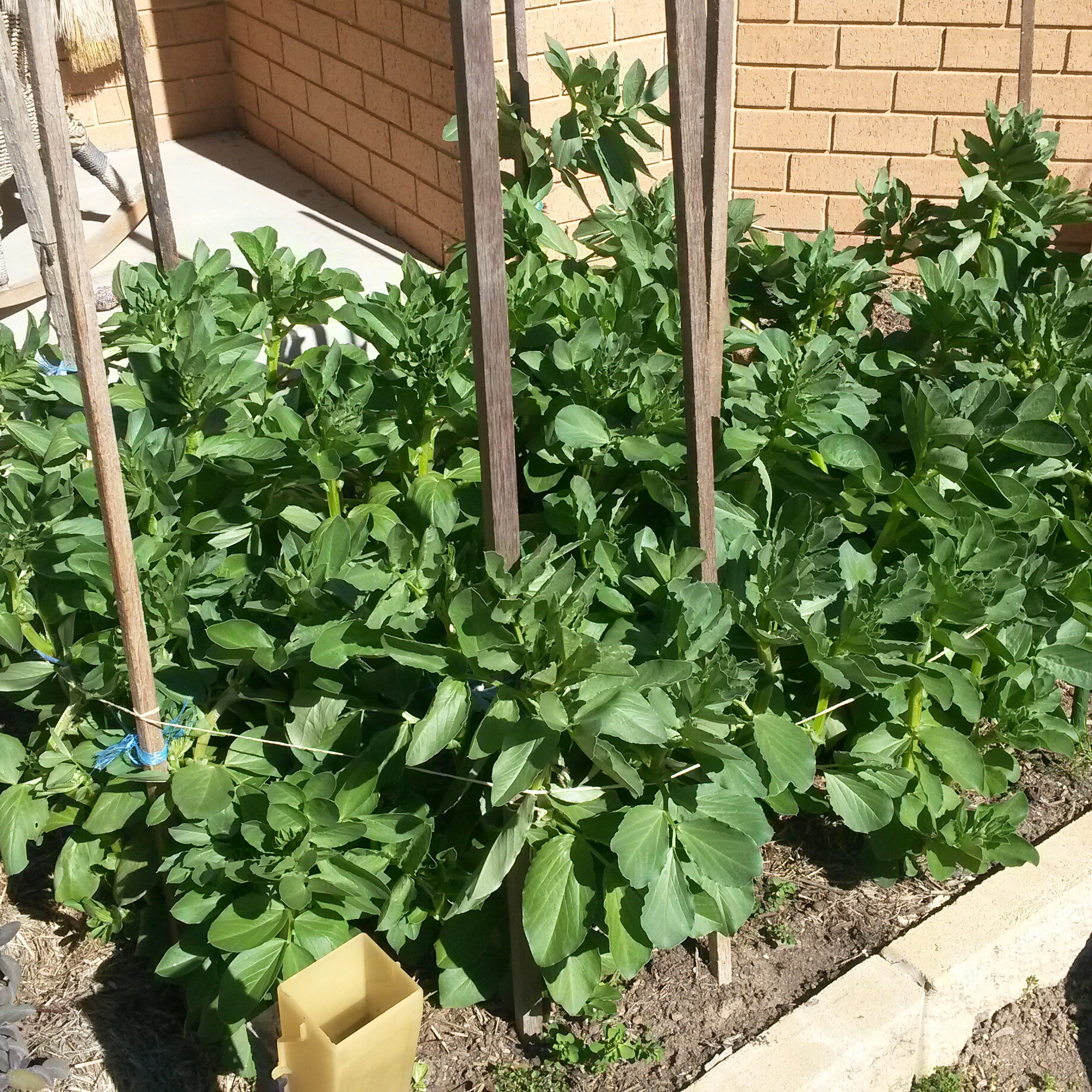
A Young Crop of Broad Beans – Canberra

Any object can be the subject for a poem, and Broad Beans was chosen by Les Murray as you can see in his poetry sermon below … it is such a wonderful imaginative portrayal of the broad bean it all its glory … those that grow this magnificent vegetable will surely appreciate his well-chosen words describing the nature of the vegetable.

Broad beans will survive the most severe of frosts as shown by the image at the end of the poem and then rebound – as shown in the above photo of the same crop.

I have included my own italics commentary after each stanza …

The Broad Bean Sermon

Beanstalks, in any breeze, are a slack church parade
without belief, saying trespass against us in unison,
recruits in mint Air Force dacron, with unbuttoned leaves.

It does not take much wind to bend a broad bean and unless you tie them up they can easily become a motly ragbag showing … in the context of church propriety they could be asking for the company of sinners. Dacron = an artificial fibre, typically of a specific broad bean green colour.

Upright with water like men, square in stem-section
they grow to great lengths, drink rain, keel over all ways,
kink down and grow up afresh, with proffered new greenstuff.

The broad bean has a clear square cut nature to the stem and although the plant will fall over in all directions it will rise up afresh … in fact the stem can be half broken and it will still survive and recover.

Above the cat-and-mouse floor of a thin bean forest
snails hang rapt in their food, ants hurry through several dimensions:
spiders tense and sag like little black flags in their cordage.

A wonderful forest for a cat and mouse to play hide and seek and the foliage does attract snails – especially to the underside of leaves.

Going out to pick beans with the sun high as fence-tops, you find
plenty, and fetch them. An hour or a cloud later
you find shirtfulls more. At every hour of daylight

It is so easy to miss beans when you go out to pick … note you can pick them when they are not fully formed and treat them as you would a runner bean eating the sliced pod and bean.

appear more than you missed: ripe, knobbly ones, fleshy-sided,
thin-straight, thin-crescent, frown-shaped, bird-shouldered, boat-keeled                                                                                                             ones,
beans knuckled and single-bulged, minute green dolphins at suck,

I love these descriptive words that hang on the nature of the pod – minute green dolphins at suck – so apt.

Beans upright like lecturing, outstretched like blessing fingers
in the incident light, and more still, oblique to your notice
that the noon glare or cloud-light or afternoon slants will uncover

Yes, some of the bean pods will stretch out and be obvious and in a cluster while others will be erect next to a stem … so again you do have to look very closely when you go out picking the pods.

till you ask yourself Could I have overlooked so many, or
do they form in an hour? unfolding into reality
like templates for subtly broad grins, like unique caught expressions,

Each pod is very individual in its own knobby way … and when they are in full production you really need to pick daily

like edible meanings, each sealed around with a string
and affixed to its moment, an unceasing colloquial assembly,
the portly, the stiff, and those lolling in pointed green slippers …

They are by nature an informal or colloquial bunch and the pods do become very stiff and knarred the older they get … at that stage they need to be picked or the bean inside will be become too big and woody … the green slippers – a good choice as the pods hold the beans in a furry bed.

Wondering who’ll take the spare bagfulls, you grin with happiness
– it is your health – you vow to pick them all
even the last few, weeks off yet, misshapen as toes.

Misshapen toes fitting nicely to the slippers … and yes, you do vow to pick them all … for they can be blanched and frozen … so there are no worries about the excess … and of course they are good for you – If you don’t put too much cheese source on top!

Les Murray born 1938 (from The Vernacular Republic)

His poetry has won many awards and he is regarded as “the leading Australian poet of his generation” for full details on Australian poet Les Murray.
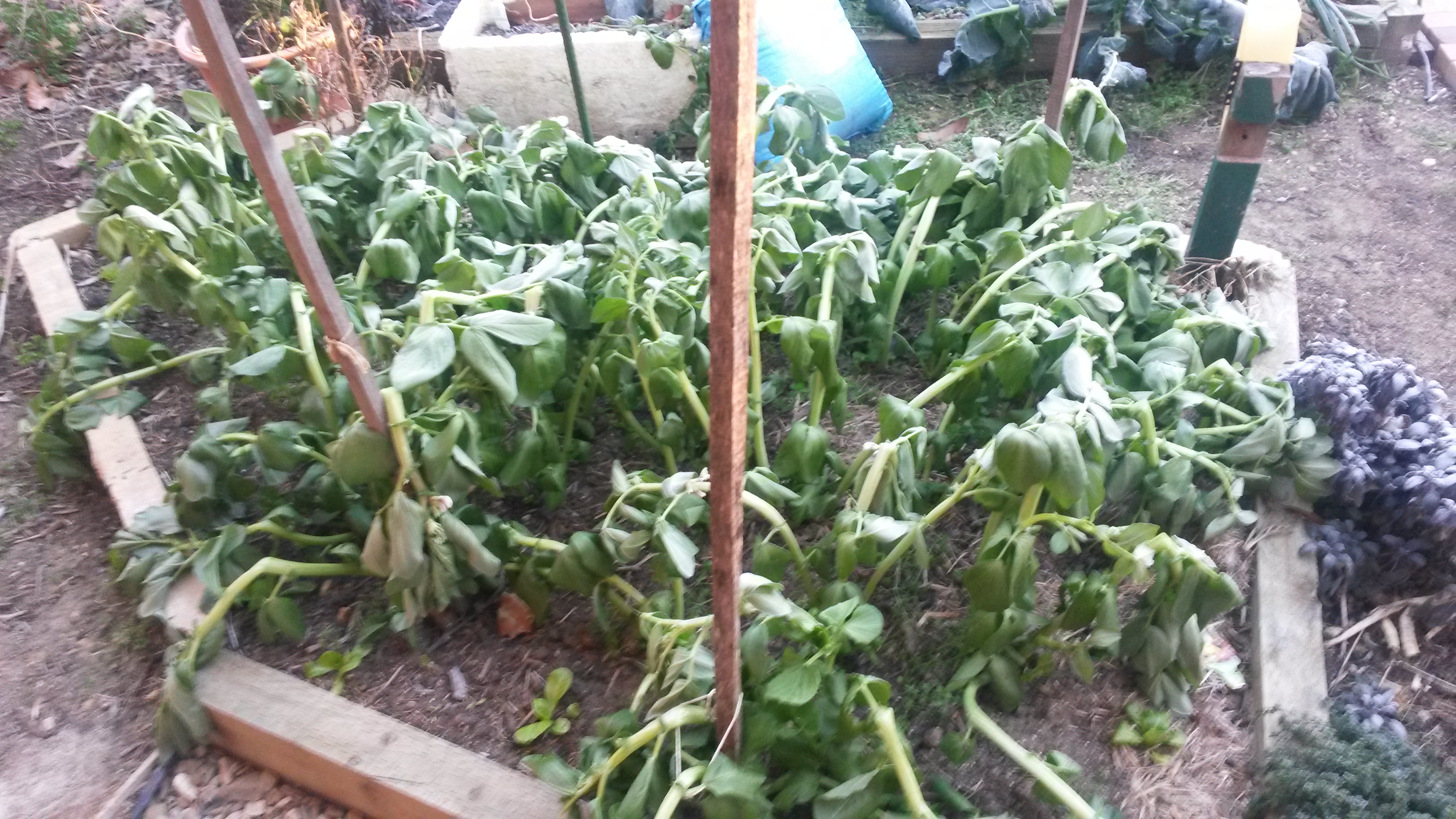
ColdBroadBeansBroad Beans – Early Morning – after minus 7.1 temperature – Canberra

Love’s Arithmetic – Catullus

Love’s Arithemetic

Let’s live and love while yet we may,
My Lesbia: all the things they say,
Those crabbed old gossips, let’s agree,
Aren’t worth a farthing – what care we?
Each night the sun goes down, each morn
Another bright new day is born,
And when we quench our puny light,
Comes endless sleep, eternal night.
So kiss me, Lesbia, I implore,
A thousand times, a hundred more,
Another thousand, with again
A hundred kisses in their train,
And even after these I will
Demand eleven hundred still,
Whereat we’d better cease to tot
And mix together all the lot,
Lest envious eyes should keep the count
And grudge my lips the full amount.

Valerius Catullus born Verona (87bc – 47bc)
Reversed by Peter Hadley
From An anthology of classical verse (Epic to Epigram)

Lesbia – was the literary pseudonym of the great love of Catullus
Lesbos – an island in the Aegean sea.

Wonderful eight syllable rhythm … let’s live and love while yet we may … and count not what others do or say … enjoy, enjoy, enjoy your day!

But beware of love’s attraction … that it does not move from addiction to affliction! … see below on details of his love-life

From Wikipedia … It was probably in Rome that Catullus fell deeply in love with the “Lesbia” of his poems, who is usually identified with Clodia Metelli, a sophisticated woman from the aristocratic house of patrician family Claudii Pulchri, sister of the infamous Publius Clodius Pulcher, and wife to proconsul Quintus Caecilius Metellus Celer. In his poems Catullus describes several stages of their relationship: initial euphoria, doubts, separation, and his wrenching feelings of loss. Clodia was a woman with a ravenous sexual appetite; “From the poems one can adduce no less than five lovers in addition to Catullus: Egnatius (poem 37), Gellius (poem 91), Quintius (poem 82), Rufus (poem 77), and Lesbius (poem 79).” There is also some question surrounding her husband’s mysterious death in 59 B.C., some critics believing he was domestically poisoned. Yet, a sensitive and passionate Catullus could not relinquish his flame for Clodia, regardless of her obvious indifference to his desire for a deep and permanent relationship. In his poems, Catullus wavers between devout, sweltering love and bitter, scornful insults that he directs at her blatant infidelity (as demonstrated in poems 11 and 58). His passion for her is unrelenting— yet it is unclear when exactly the couple split up for good. Catullus’s poems about the relationship display striking depth and psychological insight.

Dead Poets Readings – Canberra 2014

Poems read at the Dead Poets Dinner on 22 July 2014

The Dead Poets Dinner, run by Geoff Page as an annual event, was held at ‘The Gods’ Cafe at the Australian National University Canberra on the 22nd of July. This event started in 1998 and as usual it was a very lively and entertaining evening.

For interest below is a list of readers and the poems read. Full marks to Laurie McDonald in his rendition of David Meyers’ poem ‘Fencing in the Dark’– an excellent choice … an entertaining, humorous and easily accessible poem … it is difficult to choose deep poems at such events … that is unless the audience is already aware of the poem. David Meyers was a local poet and for many years he was involved with the Queanbeyan Bush Poets. He died of cancer at the age of 63.

Colin Campbell / Thomas Blackburn – A Smell of Burning, and Hospital for Defectives
Marion Halligan / Yeats – Sailing to Byzantium
Joyce Freedman / Siegfriend Sassoon – Everyone Sang
Hazel Hall / Hilaire Belloc – Tarantella
Chris Dorman / William Baine – The Archery of William Tell
Kathy Kituai / Muso Susaki – Sun in Midnight
Nicola Bowery / Sarah Broom – About Me, and That Moon
Wendy McMahon Bell / Seamus Heaney – Digging
P.S. Cottier / Catherine Martin – The Mouse Tower
Geoff Page / Seamus Heaney – From the Republic of Conscience
Laurie McDonald / David Meyers – Fencing in the Dark
Carmel Summers / Janice Bostok – Amongst the Graffiti
Moya Pacey / Elizabeth Bishop – One Art, and Louis MacNeice Wolves
Rosa O’Kae / Seamus Heaney – Skunk
Sue Edgar / J.L. Borges – Mirror, and Sylvia Plath – Mirror
Adrienne Johns / Hugh McDiarmid – Vanitas, and Balmorality
John Stokes / R.F. Brissenden – The Whale in Darkness
Mary Besemeres / Wizlawa Szymborska – View With a Grain of Sand
Sarah Rice / T.S. Eliot excerpts from Little Gidding
Emily Rice / Ted Hughes – Tractor
Annie Didcott / Keats – Ode to a Nightingale
Tony Williams / Neruda – The Dead Woman
Arlene Williams / J.J. Bray – Address to Pigeons in Hurtle Square, and William Carlos Williams – This is just to say
John Van de Graaff / Seamus Heaney – Follower, and D.H. Lawrence – Piano
Adrian Caesar / R.S. Thomas – The Owl
Michael Thorley / Thomas Hardy – Channel Firing, and They
Andrew McDonald / poems by two Scottish poets (Norman McCaig?)
Lesley Lebkowicz / poems by Soseki
Alan Gould / a song by Hamish Henderson
Alinta Leaver / Kenneth Koch – Variations on a Theme by William Carlos Williams
Richard Scutter / Auden – Musee des Beaux Arts, and Hopkins – Inversnaid
Martin Dolan / Dylan Thomas – Prologue
Marlene Hall / Thomas Wyatt – Whoso list upon the slipper top
Melinda Smith / Francis Webb – Cap and Bells, and The Bells of St Peter Mancroft
Ruth Pieloor / C.J. Dennis – The Australaise
Janette Pieloor / Gwen Harwood -The Secret Life of Frogs

Fern Hill – Dylan Thomas – Analysis

‘Fern Hill’ is one of Dylan Thomas’s most read poems. Dylan Thomas happens to be a favourite poet of The Prince of Wales (Prince Charles that is, and how appropriate). Prince Charles visited the poet’s birthplace in Swansea in September 2013. The following is a YouTube video of his reading of ‘Fern Hill’ …

Here are the words of the poem, my commentary appears after each stanza  …

Now as I was young and easy under the apple boughs
About the lilting house and happy as the grass was green,
The night above the dingle starry,
Time let me hail and climb
Golden in the heydays of his eyes,
And honoured among wagons I was prince of the apple towns
And once below a time I lordly had the trees and leaves
Trail with daisies and barley
Down the rivers of the windfall light.

(lilting house – a touch of music and song in the house, dingle = a small wooded valley or dell … this reflects to the green apple days of his youth – nice that when young ‘time let him climb golden in the heydays of his eyes’ – wonderful expression of how time lets the young stretch to the sky … and the young are always honoured by those older as he rode on the wagons and he himself lord of his rural environment invoked by easy movement as he went his merry way – another great line ‘down the rivers of the windfall light’- again linking with apples and movement)

And as I was green and carefree, famous among the barns
About the happy yard and singing as the farm was home,
In the sun that is young once only,
Time let me play and be
Golden in the mercy of his means,
And green and golden I was huntsman and herdsman, the calves
Sang to my horn, the foxes on the hills barked clear and cold,
And the sabbath rang slowly
In the pebbles of the holy streams.

(Invokes a very joyous outside childhood … I too can remember time spent as a child playing with friends on a farm … wonderful environment so many things to explore … so I can identify strongly with this stanza … here we have time again … time gives such a lot to the young – very merciful … the Sabbath rang slowly … the holy day distant, and defined in terms of the outside and nature – his holy place … the sound of water on pebbles his Sabbath bell)

All the sun long it was running, it was lovely, the hay
Fields high as the house, the tunes from the chimneys, it was air
And playing, lovely and watery
And fire green as grass.
And nightly under the simple stars
As I rode to sleep the owls were bearing the farm away,
All the moon long I heard, blessed among stables, the nightjars
Flying with the ricks, and the horses
Flashing into the dark.

(the haystacks as high as a house – the sound of wind in the chimney and the fireplace empty for this is summer his mind is fired by rich green grass … and as he falls asleep the farm is still much within his soul … the sound of owls fall away – what a great line ‘as I rode to sleep the owls were bearing the farm away’ … the movement of the night farm sleeps within him as he rides to sleep)

And then to awake, and the farm, like a wanderer white
With the dew, come back, the cock on his shoulder: it was all
Shining, it was Adam and maiden,
The sky gathered again
And the sun grew round that very day.
So it must have been after the birth of the simple light
In the first, spinning place, the spellbound horses walking warm
Out of the whinnying green stable
On to the fields of praise.

(the farm is personified in white dew … a religious reference to the first garden … and it was as though everything was reborn for him as the simple light defined the environment anew … the fields in praise for the gift of light and sun) 

And honoured among foxes and pheasants by the gay house
Under the new made clouds and happy as the heart was long,
In the sun born over and over,
I ran my heedless ways,
My wishes raced through the house high hay
And nothing I cared, at my sky blue trades, that time allows
In all his tuneful turning so few and such morning songs
Before the children green and golden
Follow him out of grace,

(I can imagine the trophies of pheasants and foxes and he equally honoured … and the endless days of happy sun-rich care free wanderings – that is before time starts to diminish and ‘follow him out of grace’)

Nothing I cared, in the lamb white days, that time would take me
Up to the swallow thronged loft by the shadow of my hand,
In the moon that is always rising,
Nor that riding to sleep
I should hear him fly with the high fields
And wake to the farm forever fled from the childless land.
Oh as I was young and easy in the mercy of his means,
Time held me green and dying
Though I sang in my chains like the sea.

(in the days of childhood there were no cares on how time would swallow and leave forever the days of innocent joy – he was ‘young and easy in the mercy of his means’ – we are all chained if you like, like the sea is chained by land – but it’s great to sing in our chains whether in childhood or a little older – nice that in childhood the chains are well hidden)


Yesterday and Today

Yesterday and Today

Yesterday God decided to take a holiday
and I really can’t blame him at all, I mean
he must have been a little disappointed
with one of his projects going a little off track,
and working twenty-four by seven over the
centuries is, I imagine, quite demanding.
I am sure God knows where to go for a break
and I am sure he won’t want us to turn up!

Today is a little different, I’m happy to report that
the sun is breaking through threatening clouds and
the waste-paper bin is empty, sprawled out on
his desk are the original drawings, a little crumpled,
maybe he believes things can be straightened out –
perhaps he has far more faith than you or I.

Richard Scutter 20 July 2014

The news of late has been so sickening and I have felt physically sick inside. Goodness knows  how others feel that are immediately affected by the inhumanity in whatever country. I just had to get out into fresh air and wash the mind from the media concentration on the horrific events fracturing the world.

We went for a walk on part of the Canberra Centenary Trail. It was a typical beautiful winter sky after night temperatures below freezing and then sunshine all day. Perfect conditions for bushwalking although you had to be careful because the track was quite slippery after recent rains and the melting of icy mud. The image below is from the Red Rocks Lookout along the Murrumbidgee river between Kambah Pool and Tuggeranong Town Centre, Canberra.

RedRockLookOut

And here is a link to a poem by W. H. Auden in relation to suffering.

Hospital for Defectives – Thomas Blackburn

Hospital for Defectives

By your unnumbered charities
A miracle disclose,
Lord of the Images, whose love,
The eyelid and the rose
Takes for a language, and today
Tell to me what is said
By these men in a turnip field
And their unleavened bread.

For all things seem to figure out
The stirrings of your heart,
And two men pick the turnips up
And two men pull the cart;
And yet between the four of them
No word is ever said
Because the yeast was not put in
Which makes the human bread.
But three men stare on vacancy
And one man strokes his knees;
What is the meaning to be found
In such dark vowels as these?

Lord of the Images, whose love
The eyelid and the rose
Takes for a metaphor, today,
Beneath the warder’s blows
The unleavened man did not cry out
Or turn his face away;
Through such men in a turnip field
What is it that you say?

Thomas Blackburn

Occasionally the first reading of a poem strikes you with some force. The above certainly falls into that category. A poem that engages the mind well after the last stanza is read.

This poem was written more than half a century ago when there was not so much acceptance and sensibility for those with physical or mental handicaps. I have it from a friend who was tutored by Blackburn that it was written while Blackburn travelled into his poetry position at Leeds University for he passed close to an asylum where those interned could be seen in the grounds from the road.

The poem has contrasting images – the rose which is a symbol of beauty and love, the eyelid which has beauty in its intricate and delicate nature (also likened to rose petals by the German language -Austrian poet Rilke) and then the great contrast in the images of handicapped people moving in silence and being subjected to abuse without complaint. How do we come to terms with a creator that can produce such contrast in life and to what purpose are the creation of ‘defectives’.

There is also an interesting contrast in language. Images have no language as such, the viewer constructs his or her own internal reading. And in the poem those interned are without language too – so there is a nice internal balance within the poem.

For me, the two lines that standout are … Because the yeast was not put in / Which makes the human bread.

It was not until we discussed the poem in a group that I realised a certain discomfort with these lines – as though the ‘defectives’ were not human … i.e. not ‘human bread’ … this of course becomes very worrying suggesting a ‘them/us’ difference … so perhaps in the sensitivity of today these lines would not be acceptable by readers. The fact that punishment/mal-treatment is accepted without reaction also gives an inhuman feel. Hopefully today we are more inclusive of handicapped people than when this poem was written.

I think one of the problems coming to terms with the lives of those with severe handicaps is our projection of our own life-value on to that of another. We feel such people must be severely restricted in the appreciation of life and all that life has to offer and therefore wonder what meaning life has for these people. Consider the debate on euthanasia in such terms.

However, I think that those that are involved with such people have a deeper appreciation of the situation and the extent of life-appreciation and have a better understanding in the way life has meaning and indeed realise that the handicapped have much to give to others.

The line In such dark vowels as these? is a clever take on the construction of words for vowels alone are defective in the creation of words.

In summary, this is a confronting poem that must be time-stamped when read.

Thomas Blackburn is not a well-known poet and here are some details courtesy of Wikipedia.

Inversnaid – Gerard Manley Hopkins

Inversnaid

THIS darksome burn, horseback brown,
His rollrock highroad roaring down,
In coop and in comb the fleece of his foam
Flutes and low to the lake falls home.

A windpuff-bonnet of fáwn-fróth
Turns and twindles over the broth
Of a pool so pitchblack, féll-frówning,
It rounds and rounds despair to drowning.

Degged with dew, dappled with dew
Are the groins of the braes that the brook treads through,
Wiry heathpacks, flitches of fern,
And the beadbonny ash that sits over the burn.

What would the world be, once bereft
Of wet and of wildness? Let them be left,
O let them be left, wildness and wet;
Long live the weeds and the wilderness yet.

Gerard Manley Hopkins (1844–89).

Inversnaid is a small hamlet on the north-eastern shore of Lock Lomond, Scotland. There is a famous waterfall and hotel there and I wouldn’t be surprised if Gerard Manley Hopkins stayed there at some stage.

This poem is an excellent example of alliteration, but more so onomatopoeia – where the sound of the word suggests the meaning of the word – as in hiss, snap and bang.

And you notice that the very first word falls into this category. But what about the makeup word ‘twindles’ – a mixture of twists, twitches and dwindles. To me twindles just sounds so right for the movement of water in the stream – it has a certain sparkle-life to it, compare to trundles for example.

But look at some other make-up words –

Rollrock – a combination of rolling and rocking frown on the moor
Heathpacks = clumps of heathland, maybe including heather
wind-puff-bonnet – froth which sits like a hat lightly on the water and created by the wind
fawn-froth – suggests a light brown-yellow (fawn = young deer)
Fell-frowning fell = high barren field or moor – the water creates a
Beadbonny – this word conjures up the look of the branches of an ash tree – bonnie = beautiful beads (black from memory).

And the poem contains Scottish specific words – Burn = stream, Brae = hillside along a river, and Degged = sprinkled.

Comb = a rippling stretch of water.

… and I like the use of the word ‘groins’ that suggest the body curves of the hillside

The last stanza is an environmentalist cry. But this is a poem to be heard, here is a link to a BBC audio plus visual images of the scenery –
http://www.bbc.co.uk/schools/gcsebitesize/english_literature/poetryhopkins/1hopkins_inversubjectrev1.shtml

… and if you are interested in discovering Scottish words this is a good site … http://mudcat.org/scots/index.cfm

To Time – An early Sylvia Plath Sonnet

The following sonnet was written by Sylvia Plath about 1952-53 at the age of 19-20, and probably as a student as a class assignment for her English professor, Alfred Young Fisher, at Smith College. Apparently SP followed the annotated suggestions of her professor.

Sonnet: To Time

Today we move in jade and cease with garnet
amid the clicking jewelled clocks that mark
our years. Death comes in a casual steel car, yet
we vaunt our days in neon, and scorn the dark.

But outside the diabolic steel of this
most plastic-windowed city, I can hear
the lone wind raving in the gutter, his
voice crying exclusion in my ear.

So cry for the pagan girl left picking olives
beside a sun-blue sea, and mourn the flagon
raised to toast a thousand kings, for all gives
sorrow: weep for the legendary dragon.

Time is a great machine of iron bars
that drains eternally the milk of stars.

Sylvia Plath

This poem was taken from the Juvenilia section of ‘SP Collected Poems’.

Here are some questions to promote discussion …

What type of sonnet … what is the rhyming scheme and metre?

What is the overall issue of concern?

How does jade and garnet relate to time?

Why does the poet view the city as plastic-windowed?

What is the overall feeling conveyed by the second stanza?

Why a ‘legendary dragon’ … why weep for the dragon?

What is missed by the reader if only the couplet is read?

And for the creative, write an alternative couplet based on a positive perspective of time in relation to the universe, for example …

time endlessly spreads the rays of the sun
throughout our world touching everyone.