The Hour is Lost – John Shaw Neilson – Comments

The Hour is Lost

The hour is lost. Was ever hour so sweet?
Fruitful of blessing, friends and honeyed words —
The sunlight in our faces — at our feet
The world bright, beautiful, its flocks and herds,
Foliage of forests, choruses of birds . .
O happy time, why did we stand downcast?
We should have leapt for love: but now, the hour is past.

The hour is lost. Scarce had we time to mark
The glory of the green, the sky’s soft blue;
It came as silently as comes the dark,
Our hearts burned hot within us ere we knew . .
Then suddenly we said, Can it be true
This golden time was ours? — and now downcast
We stand dumb and amazed. Alas! the hour is past.

John Shaw Neilson (1872 -1942)

This sonnet is broken into two distinct seven line stanzas with rhyming scheme ‘ababbcc’.

If we think of life as condensed into an hour then we realize the brevity of our existence.

S1 … When we look back on life as the hour completes then according to the first stanza we may regret not making the most of our time. Life is beautiful, the world is beautiful, friends have been wonderful with honeyed words, nature has been bright before our eyes – did we not see that! We should have leapt for love!

S2 … Time has gone so quickly and our sight has been blinkered by our downcast attitude. We stand dumb and amazed that we did not appreciate the beauty of life to the full. Perhaps we are experiencing the beauty of life for the first time, and then a sad lament that it is late in life and ‘our hour’ could have had more meaning.

So whether you have a few minutes or half an hour or more take time to rejoice and live life to the full in appreciation of your own unique personal experience. Colour the gravity of those bleak news headlines with optimistic eyes seeing beyond the dark shadows to the bright amazing world that abounds around us!

Here are the links to two well know carpe diem (seize the day) poems –

From A. E. Housman …

Loveliest of trees … A. E. Housman (carpe diem)

And from Andrew Marvell …

To His Coy Mistress – Andrew Marvell

Sonnet V – Edna St. Vincent Millay – Comments

Sonnet V

If I should learn, in some quite casual way,
That you were gone, not to return again–
Read from the back-page of a paper, say,
Held by a neighbour in a subway train,
And such a street (so are the papers filled)
A hurrying man–who happened to be you–
At noon to-day had happened to be killed,
I should not cry aloud–I could not cry
Aloud, or wring my hands in such a place–
I should but watch the station lights rush by
With a more careful interest on my face,
Or raise my eyes and read with greater care
Where to store furs and how to treat the hair.

Edna St. Vincent Millay (1892 – 1950)

A sonnet with rhyming scheme ‘abab cdcd efef gg’ with a clear volta breaking the text into the notice of a death and the corresponding effect on the person hearing the news.

There is an ‘if’ about this poem – If I should learn. But it strikes me as being close to the experience of many who have suddenly been made aware of an unexpected death. Recently I was informed of the death of a friend who had limited life but it was quite unexpected that death would arrive quickly and I was immediately stunned by the news. It took me quite awhile to refocus and become emotionally stable enough in order to share with others who knew her.

The poem relates to such a notification but in a public place and by the chance reading of the back page of a paper being read by a fellow traveller on the seat opposite. It is up to the reader to infer the extent of personal connection with the death. We do not know whether it is a close family member or a work college not seen for several years. I have that feeling it might have been someone from the past such as a previous lover. I think there was quite a depth in the relationship with the ‘you’ in the text.

But this is irrelevant for the poem describes the catering of the emotional shock by a somewhat artificial concentration on the station lights and other text on the back of the paper. Self-control is evident in not wishing to draw attention from others on the train. But perhaps this represents an immediate internalisation of the death in coming to terms with the sudden shock unexpected news. It does not, of course, preclude a private emotive release a little later and under different circumstances.

Edna St. Vincent Millay was an American poet and playwright.  She received the Pulitzer Prize for poetry in 1923,  and she was known for her feminist activism.  A link to her on Wikipedia.

Love’s Coming – John Shaw Neilson – Analysis

Love’s Coming

Quietly as rosebuds
Talk to thin air,
Love came so lightly
I knew not he was there.

Quietly as lovers
Creep at the middle noon,
Softly as players tremble
In the tears of a tune;

Quietly as lilies
Their faint vows declare,
Came the shy pilgrim:
I knew not he was there.

Quietly as tears fall
On a wild sin,
Softly as griefs call
In a violin;

Without hail or tempest,
Blue sword or flame,
Love came so lightly
I knew not that he came.

John Shaw Neilson (1872 -1942)

This simple poem concentrates on one aspect of ‘Love’ namely that it is of an imperceptible quiet background nature. Latent to life but not readily recognised.

The four four line opening stanzas are a poetic transfer of this thought in terms of rosebuds, lovers, lilies and tears. The emphasis is on ‘quiet’ the first word of each opening line. The second and last lines of these stanzas rhyme and in a way a ‘list’ introduction.

It is a case of hearing or not hearing love’s coming as it gives subtle voice to its underlying existence. Love’s coming requires an acute sensitivity for any awareness.
There is no fanfare – without hail or tempest.

And the last stanza states that perhaps recognition is only known in retrospect. Love came so lightly / I knew not that he came. It is personified as masculine, I think feminine would be more appropriate given the quiet soft nature described. Perhaps when we look back on life we see how we have been cared for in terms of our spiritual understanding of life.

Now God and ‘Love’ are often equated. If this is the case then perhaps God has a similar subtle positive imperceptible influence on life as it evolves. Many believe that God created the world. However, some think that God then sat back on a cloud and switched to a different channel!

A link to John Shaw Neilson on Wikipedia

Why I Wake Early – Mary Oliver – A tribute

Why I Wake Early

Hello, sun in my face.
Hello, you who make the morning
and spread it over the fields
and into the faces of the tulips
and the nodding morning glories,
and into the windows of, even, the
miserable and crotchety–

best preacher that ever was,
dear star, that just happens
to be where you are in the universe
to keep us from ever-darkness,
to ease us with warm touching,
to hold us in the great hands of light–
good morning, good morning, good morning.

Watch, now, how I start the day
in happiness, in kindness.

Mary Oliver (1935 – 2019)

Mary Oliver died on 17 January. She was an American poet who won the National Book Award and the Pulitzer Prize in 2007. The New York Times described her as ‘far and away, America’s best-selling poet’.

This short poem is a tribute to her wonderful sun-life philosophy. She was, like Emily Dickenson, not one for the limelight. It is not easy to start each day with the sun in your eyes and to say thank you, thank and treat each day anew in such a disciplined positive way. But the dear star defines life and recognition is quite appropriate even if there is a cloud in the sky.

Here is a fitting link to a tribute from Alan Storey (Methodist Minister of Cape Town, South Africa) …
https://www.dailymaverick.co.za/opinionista/2019-01-22-finally-comes-the-poet-a-tribute-to-mary-oliver/

Mary Oliver on Wikipedia – https://en.wikipedia.org/wiki/Mary_Oliver

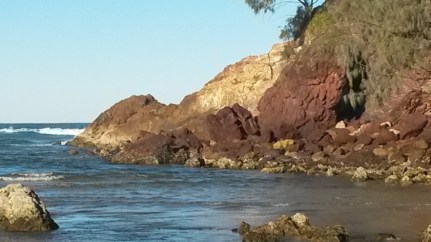
Red Rock Headland

red rock headland

The base of Red Rock Headland, Red Rock New South Wales

Red Rock Headland

the first thing you should know
about Red Rock, that is
it’s not Red Rock
Blood Rock is the name
and blood rock it will remain

the sea took up its charge
lovingly far-away
to a place remote, deep
to gracefully nurture
both mother and child
who now rest at peace
in the bosom of her silence

but the sea will never forget
her anger never assuaged
and in indefatigable red rage
continually pit relentlessly
against this headland

for at this headland human flesh
was wantonly herded into her arms
and so, spitting indignation
the surge of a disquiet spray
washes the blood rock red
immovable rock, red rock,
blood rock
for all to witness
a permanent reminder

The NSW National Park memorial plaque on Red Rock Headland …

plaque

In memory of the victims and survivors of the Blood Rock Massacres. Understanding their sacrifice will make us stronger. We as Gumbaingirr people have survived many conflicts over ownership of our traditional lands including a massacre where many were driven off the headland at Red Rock (Blood Rock)

When we checked in at the camp ground I mentioned that I would be walking up to the headland. The receptionist told me it was really ‘Blood Rock’ and told me the history. In the development of Australia there was a lot of pain associated with the mis-treatment of the indigenous population. This must be recognised no matter how uncomfortable.

This poem was included in the latest anthology publication of the ‘Yass Valley Writers’.

Richard Scutter

Old Botany Bay – Mary Gilmore

Today is Australia Day, the 26th of January, the day that the First Fleet landed at Sydney Cove. Botany Bay was the designated settlement for the first fleet when it arrived in 1788. It was a settlement intended for the transport of convicts but Govenor Phillip deemed it unsuitable and moved to Port Jackson, Sydney Cove. James Cook had previously landed on the southern banks of Botany Bay, on Sunday 29 April 1770.

Old Botany Bay

“I’m old
Botany Bay;
stiff in the joints,
little to say.

I am he
who paved the way,
that you might walk
at your ease to-day;

I was the conscript
sent to hell
to make in the desert
the living well;

I bore the heat,
I blazed the track-
furrowed and bloody
upon my back.

I split the rock;
I felled the tree:
The nation was-
Because of me!

Old Botany Bay
Taking the sun
from day to day…
shame on the mouth
that would deny
the knotted hands
that set us high!

Mary Gilmore (1865 – 1962)

And this poem clearly celebrates the convicts that made Australia through their hard work. And if it had not been for convicts there would not have been a developed Australia in the first place; at least not by the British.

The key words in this poem are ‘knotted hands’ – their hands made to work but hands that were not free. A day to remember the convict heritage that began the journey in the development of Australia.

Botany Bay became associated in England as the place where convicts were destined even though it was not used as a penal settlement. And that well known song ‘Botany Bay’ was oftten sung in relation to those unfortunates bound for Australia …

Farewell to old England for ever,
Farewell to my rum coes as well,
Farewell to the well-known Old Bailey

Singing too-ral-li, oo-ral-li, addity,
Singing too-ral-li, oo-ral-li, ay,
Singing too-ral-li, oo-ral-li, addity,
And we’re bound for Botany Bay.

See … https://en.wikipedia.org/wiki/Botany_Bay_(song)

And some more words from Mary Gilmore (from ‘The Passionate Heart’ 15 February 1919) celebrating those that developed Australia who are now at rest with God … or working with God under more favourable conditions!

Even the old, long roads will remember and say,
“Hither came they!”
And the rain shall run in the ruts like tears;
And the sun shine on them all the years,
Saying, “These are the roads they trod” —
They who are away with God.

Mary Gilmore had a long and very interesting life … a great thinker far beyond her times. She remains current when you use an Australian $10 note.

A link to Mary Gilmore on Wikipedia.

The history behind Botany Bay.


To His Coy Mistress – Andrew Marvell

To His Coy Mistress

Had we but world enough and time,
This coyness, lady, were no crime.
We would sit down, and think which way
To walk, and pass our long love’s day.
Thou by the Indian Ganges’ side
Shouldst rubies find; I by the tide
Of Humber would complain. I would
Love you ten years before the flood,
And you should, if you please, refuse
Till the conversion of the Jews.
My vegetable love should grow
Vaster than empires and more slow;
An hundred years should go to praise
Thine eyes, and on thy forehead gaze;
Two hundred to adore each breast,
But thirty thousand to the rest;
An age at least to every part,
And the last age should show your heart.

For, lady, you deserve this state,
Nor would I love at lower rate.
But at my back I always hear
Time’s wingèd chariot hurrying near;
And yonder all before us lie
Deserts of vast eternity.
Thy beauty shall no more be found;
Nor, in thy marble vault, shall sound
My echoing song; then worms shall try
That long-preserved virginity,
And your quaint honour turn to dust,
And into ashes all my lust;
The grave’s a fine and private place,
But none, I think, do there embrace.

Now therefore, while the youthful hue
Sits on thy skin like morning dew,
And while thy willing soul transpires
At every pore with instant fires,
Now let us sport us while we may,
And now, like amorous birds of prey,
Rather at once our time devour
Than languish in his slow-chapped power.
Let us roll all our strength and all
Our sweetness up into one ball,
And tear our pleasures with rough strife
Through the iron gates of life:
Thus, though we cannot make our sun
Stand still, yet we will make him run.

Andrew Marvell (1621 – 1678)

It is certainly a carpe diem poem but more than that it speaks to me of the very clever use of seductive words to a lady known to the author. The poem never met recognition until three years after the his death giving weight to the personal nature of the poem.

It is, of course, one of his most well-known poems, especially the following lines from the second stanza. They show his distinct hungering for action using a threatening note by comparing the likes of death on her now beautiful body; something that she has probably never thought about.

Time’s wingèd chariot hurrying near;
And yonder all before us lie
Deserts of vast eternity.
Thy beauty shall no more be found;
Nor, in thy marble vault, shall sound
My echoing song; then worms shall try
That long-preserved virginity,
And your quaint honour turn to dust,
And into ashes all my lust;

And the following lines in the last stanza emphasize his impatience and frustration –

Let us roll all our strength and all
Our sweetness up into one ball,
And tear our pleasures with rough strife
Through the iron gates of life:

He wants to take his beloved to the ‘ball’ … some ball! … he wants to gate crash to get what he wants! … note the gates are made of iron … a certain sense of imprisonment. You cannot stand outside life as an observer! … immediate action please.

Many details on this poem can be found on Wikipedia … https://en.wikipedia.org/wiki/To_His_Coy_Mistress

And here is a ‘carp diem’ poem from another famous poet considering the brevity of life at an early age …

Loveliest of trees … A. E. Housman (carpe diem)

So just do it … if you know what you should be doing! … but don’t be pressured into something you are not ready for.

The Sunne Rising – John Donne

The Sunne Rising

Busy old fool, unruly sun,
Why dost thou thus,
Through windows, and through curtains call on us?
Must to thy motions lovers’ seasons run?
Saucy pedantic wretch, go chide
Late school boys and sour prentices,
Go tell court huntsmen that the king will ride,
Call country ants to harvest offices,
Love, all alike, no season knows nor clime,
Nor hours, days, months, which are the rags of time.

Thy beams, so reverend and strong
Why shouldst thou think?
I could eclipse and cloud them with a wink,
But that I would not lose her sight so long;
If her eyes have not blinded thine,
Look, and tomorrow late, tell me,
Whether both th’ Indias of spice and mine
Be where thou leftst them, or lie here with me.
Ask for those kings whom thou saw’st yesterday,
And thou shalt hear, All here in one bed lay.

She’s all states, and all princes, I,
Nothing else is.
Princes do but play us; compared to this,
All honor’s mimic, all wealth alchemy.
Thou, sun, art half as happy as we,
In that the world’s contracted thus.
Thine age asks ease, and since thy duties be
To warm the world, that’s done in warming us.
Shine here to us, and thou art everywhere;
This bed thy center is, these walls, thy sphere.

John Donne (1572 – 1631)

Three ten line stanza with rhyming scheme ‘abbacdcdee’. The sun personified she is indeed quiet ‘unruly’ highly emotional in her flaring and of course very old and busy. I do like that word ‘wink’ in the second stanza our lifespan so infinitesimal in comparison.

Well the Solar System does sort of control life or the way life is lived. We do have to operate on a time and season basis. But love is beyond such bounds quite independent and outside such realms of the artificial breakup so eloquently defined as ‘the rags of time’. Love is a timeless entity.

Love, all alike, no season knows, nor clim
Hours, days, months, which are the rags of time

The eyes of the sun are blind compared to the personal eyes of love which retains history. Not like the inanimate sun who knows nothing of yesterday.

If her eyes have not blinded thine,
Look, and tomorrow late, tell me, …

The world is so much more. The the sun creates life, and bountiful meaning to life. And the sun has a duty to give warmth and life to humanity. It is the centre of everything.

Shine here to us, and thou art everywhere;
This bed thy center is, these walls, thy sphere.

From memory on the nature of the sun millions of sub-atomic particles actually pass through our thumb nail every second!

And from a spiritual Christian perspective there is a lot of similarity between sun and son; and John Donne being the master of the metaphysical.