An Arundel Tomb – Philip Larkin – Analysis

ArundelTombChichester

An Arundel Tomb

Side by side, their faces blurred,
The earl and countess lie in stone,
Their proper habits vaguely shown
As jointed armour, stiffened pleat,
And that faint hint of the absurd–
The little dogs under their feet.

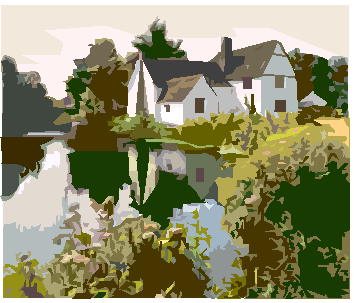
The sculpture is of the Earl of Arundel and his second wife Eleanor of Lancaster and it resides in Chichester Cathedral … in art dogs are a sign of fidelity … apparently over the years the sculpture has been vandalised and repaired

Such plainness of the pre-baroque
Hardly involves the eye, until
It meets his left hand gauntlet, still
Clasped empty in the other; and
One sees, with sharp tender shock,
His hand withdrawn, holding her hand.

In all the cathedrals and churches Larkin visited he never saw such tenderness depicted in stone and he was quite moved by the sight … generating this poem.

They would not think to lie so long.
Such faithfulness in effigy
Was just a detail friends could see:
A sculptor’s sweet commissioned grace
Thrown off in helping to prolong
The Latin names around the base.

They have been together for centuries in stone whereas in life they would never lie so close given that marriages were very much a political arrangement … there is a double take too on the word ‘lie’ as there probably would have been a lot of deceit in the arrangement. The Latin names around the base probably ignored by those visiting the cathedral today – but the holding of hands an attraction to the eye.

They would not guess how early in
Their supine stationary voyage
Their air would change to soundless damage,
Turn the old tenantry away;
How soon succeeding eyes begin
To look, not read. Rigidly they

Well, the nature of marriage has changed over the years and those visiting today would view the holding of hands perhaps as a more loving union. Supine = lying on the back without energy.

Persisted, linked, through lengths and breadths
Of time. Snow fell, undated. Light
Each summer thronged the grass. A bright
Litter of birdcalls strewed the same
Bone-riddled ground. And up the paths
The endless altered people came,

I like the view of the outside while the tomb is fixed and oblivious to the changing seasons. Apparently the grounds of Chichester Cathedral are known for bird song.

Washing at their identity.
Now, helpless in the hollow of
An unarmorial age, a trough
Of smoke in slow suspended skeins
Above their scrap of history,
Only an attitude remains:

People today don’t understand the history and context … washing over the sculpture … history becomes a scrap – unarmorial = not decorated with a coat of arms

Time has transfigured them into
Untruth. The stone finality
They hardly meant has come to be
Their final blazon, and to prove
Our almost-instinct almost true:
What will survive of us is love.

Philip Larkin

We have the contrast – the truth of love – the reality of love being something different from what this time-frozen stone fixture might suggest … the important things that survive are not so much the physical –but ‘love’ (whatever this means to the reader) … but then the physical may be needed as a catalyst or prompt. It certainly prompted Larkin to think about love – and he was certainly not a ‘love’ poet – but it has been said that he was haunted by such notions although of a melancholic nature.

A YouTube video of Philip Larkin reading this poem

Only Two Lips – A Spring Poem

Floriade is the name of the  spring flower festival in Canberra in the Commonwealth Gardens near the centre of the city. Mainly a showing of bulbs including of course tulips. It is quite a tourist attraction and many come to Canberra to see the displays.

OLYMPUS DIGITAL CAMERA

The U3A ‘Arts’ Exhibition had a theme of tulips, poppies and spring. I wrote the following poem for the opening day (see the previous post) …

Tulips in a vase, focus on flower in foreground

Only Two Lips

who do you think you are
standing so pert and penal
asserting yourself in rich colour
arrogant, obvious
demanding my attention

well I’m not falling for it!
such a brazen showing
with your closed-mouth talk
I will give you what you deserve –
lip service, and just you wait

your day will come
believe me, you will bend
becoming quite dishevelled
falling to kiss the ground
in total disarray

Richard Scutter  2 August 2014

It is always very interesting when you read a poem in public because you never quite know what reception will follow. The audience was mainly  women and  in the older bracket, so that was appropriate. A few realized that I was not actually talking about tulips so much and there were a couple of wry smiles – which was encouraging!

There were a few hangups on the word ‘penal’. Well penal = punishing – and from a male perspective the beautiful can be quite punishing in many ways especially when young, ‘manipulative’ and of a demanding nature.

London Rain – Louis MacNeice

This year many of the the poets visited in our U3A (University of Third Age) sessions have had some connection with religious ministry. When you come to think about it it is not surprising. Ministers are thought-full people – don’t you think!

Louis MacNeice was no exception. His father was a Protestant minister who later became a bishop of the Anglican Church of Ireland. Below is Louis MacNeice’s poem ‘London Rain’, written at a time of conflict in Europe. He wrestles with thoughts on God as he looks out late at night on the rain. Sharing my comments which are shown in italics after each stanza.

 London Rain

The rain of London pimples
The ebony street with white
And the neon lamps of London
Stain the canals of night
And the park becomes a jungle
In the alchemy of night.

London night-time rain … I love that word pimples and the catch of light in the pimple from the street lamps … ebony = rich dark black wood … giving a little gloss to the dark … and there is a whole new mapping of the streets … as in a chemical reaction …the light staining, leaving it’s mark

My wishes turn to violent
Horses black as coal–
The randy mares of fancy,
The stallions of the soul–
Eager to take the fences
That fence about my soul.

This looks like dissatisfaction on where he is in life … in terms of violent horses … he wants to break free … and this may be a spiritual unrest when we look at later stanzas

Across the countless chimneys
The horses ride and across
The country to the channel
Where warning beacons toss,
To a place where God and No-God
Play at pitch and toss.

Well his thoughts travel across the channel to the war and this occupies his mind … God and No-God (the Good and the Bad) playing pitch and toss = a game of skill and chance

Whichever wins I am happy
For God will give me bliss
But No-God will absolve me
From all I do amiss
And I need not suffer conscience
If the world was made amiss.

He is talking about the God/No-God battle going on in his mind. If there is a God – everything will be OK and if No-God then it doesn’t matter about all the conscience problems … these are his on-going thoughts as he watches the rain … his logic…dare I say late-night logic!

Under God we can reckon
On pardon when we fall
But if we are under No-God
Nothing will matter at all,
Adultery and murder
Will count for nothing at all.

Expounding his thoughts from the previous stanza … bad behaviour will not matter … no accountability… and under God we will be absolved of all our missdemeanours.

So reinforced by logic
As having nothing to lose
My lust goes riding horseback
To ravish where I choose,
To burgle all the turrets
Of beauty as I choose.

So his logic suggests to him that this horse can ride amuck with no consequence … taking the No-God ride so to speak … and using this to justify any course of action

But now the rain gives over
Its dance upon the town,
Logic and lust together
Come dimly tumbling down,
And neither God nor No-God
Is either up or down.

It looks as though it has stopped raining for a while … and in sync. with this his God/No-God thinking seems to fall away too … well it is late night and he is a little confused

The argument was wilful,
The alternatives untrue,
We need no metaphysics
To sanction what we do
Or to muffle us in comfort
From what we did not do.

The argument was very wilful = headstrong … and indeed ‘we need no metaphysics = abstract thinking’ … and in his case no ‘God/No-God’ thoughts to work out what we should be doing or to justify our actions. (I might add that those that shout God is on our side are often using God to justify their ungodly actions.)

Whether the living river
Began in bog or lake,
The world is what was given,
The world is what we make.
And we only can discover
Life in the life we make.

Bog and lake are references to his Irish / English heritage. For me this is the key stanza … it is up to us to make what we will of the world, of this gift … and we can only discover how we should live in living life. In a sense it is up to us – our responsibility to create our own God (and if we do happen to believe in an external God then perhaps our understanding of God may come clearer). Focus on the gift of the present, the here and now…don’t worry about what is happening overseas!

So let the water sizzle
Upon the gleaming slates,
There will be sunshine after
When the rain abates
And rain returning duly
When the sun abates.

Well, rain and sun one will follow the other in an endless cycle (good and bad) – that is the way of the world and we have to accept it – (hopefully life improves over time!)

My wishes now come homeward,
Their gallopings in vain,
Logic and lust are quiet,
And again it starts to rain;
Falling asleep I listen
To the falling London rain.

His mind is now back on where he is … in his room looking out on the falling rain … the logic/lust distraction of thought in vain … and the wild horses that took his thoughts away at the beginning of the poem bring him home again … he notices it has started to rain again … falling rain and enough thinking for one night falls asleep… let’s hope he has pleasant dreams!

(The rhyming scheme is a b c b d b – with a repeat end word in lines four and six of each stanza).

New Fruit – Ann Drysdale

New Fruit

In the last knockings of the evening sun
Eve drinks Calvados. Elsewhere in her life
She has played muse and mistress, bitch and wife.
Now all that gunpoint gamesmanship is done.
She loves the garden at this time of day.
Raising her third glass up to God, she grins;
If this is her come-uppance for her sins
It’s worth a little angst along the way.
A fourth. Again the cork’s slow squeaky kiss.
If, as the liquor tempts her to believe,
The Lord has one more Adam up His sleeve
He’s going to have to take her as she is—
Out in the garden in a dressing-gown
Breathing old apples as the sun goes down.

Here is a very entertaining sonnet from Ann Drysdale. We were looking at poetry from Wales at a U3A session and a member brought in this poem. Ann Drysdale is now living in Wales but previously spent much of her life in north Yorkshire.

Last knockings = the final stages of something … it is not just the evening sun as we will see later in the poem – a very apt choice of words

Calvados = an apple brandy from France – again later in the poem we will see how apt it is that it is apple brandy – Eve being connected with apple and seducing.

And Eve has obviously led quite an abundant life in a number of relationships including wife and mistress – but all that ‘gunshot gamesmanship’ is over – to me this implies a lack of effort now due to current circumstances – a feeling that she can’t be bothered in making the play of previous years.

She is in the garden by herself, apart of course from the gin bottle – raising her third glass she grins – well how can she do otherwise after drinking gin – and she contemplates her sins and thinks if this is the outcome it’s not too bad – it’s Ok to sin if this is all that happens, but of course there is the downside that she is alone and needs someone.

The fourth gin gives new hope that perhaps there is another Adam to be caught (looking hopefully to God who has supplied previous opportunities) – I love the ‘squeaky kiss’ of the cork bottle – but she lets a future Adam now that she is to be taken as she is, undressed – well apart from her dressing gown and breathing old apples  … the wounds of past relationships  … and you have the distinct feeling she is not what you might call a fresh young pippin – not new fruit!

What a wonderful witty entertaining poem with such well-chosen words.

Here is a link to more of her poetry.

Bimbo – Bruce Dawe

Bimbo

The house and garden are in joint
ambush to jolt us into remembering
the lawns where you rolled whenever we returned,
the scratched back door when it was thundering,
the spot by the fowl-house where you sat,
pricked-ears, for hours, listening to the chickens,
the raised flooring where you slept every night
– all around us now the plot thickens,
the lines of your life run deep: the book closed,
you run on in our own mortal quest
and where we had thought the story ended
we can see now you will not let us rest
but compel us to attend you just the same,
lamenting the bones buried deep
under the latest seed-beds and defying
your present muddy-nosed long sleep,
rousing yourself at the needle’s first touch,
shrewd, beautiful as always, and the storm
of feelings in our hearts is where you now lay your head
and we stroke your ears, velvet warm.

Bruce Dawe

This is a very poignant poem on the loss of a much loved family dog. Bimbo had obviously been part of home and garden for many years. The absence defines the grief – the house and garden never quite the same and they continue to give joint ambush.

But in line eight the plot thickens … there are more lines, as there are more lines to the story of the family who must attend to the aftermath of the dog who has left bones buried deep.

And then the death of the dog is remembered – rousing yourself at the needle’s first touch and the intense feelings still lie warm – touching the family as before in a very direct way.

This is very much a poem about grief associated with the early days of loss. Thomas Hardy’s poem ‘The Walk’ comes to mind, incidentally Hardy was very much a dog lover.

A link to Bruce Dawe on Wikipedia

The Listeners – Walter de la Mare – Analysis

‘The Listeners’ by Walter de la Mare is one of the most popular poems of all-time … often in the top in any peoples’ poetry poll …

The Listeners

‘Is there anybody there?’ said the Traveller,
Knocking on the moonlit door;
And his horse in the silence champed the grasses
Of the forest’s ferny floor:
And a bird flew up out of the turret,
Above the Traveller’s head
And he smote upon the door again a second time;
‘Is there anybody there?’ he said.
But no one descended to the Traveller;
No head from the leaf-fringed sill
Leaned over and looked into his grey eyes,
Where he stood perplexed and still.
But only a host of phantom listeners
That dwelt in the lone house then
Stood listening in the quiet of the moonlight
To that voice from the world of men:
Stood thronging the faint moonbeams on the dark stair,
That goes down to the empty hall,
Hearkening in an air stirred and shaken
By the lonely Traveller’s call.
And he felt in his heart their strangeness,
Their stillness answering his cry,
While his horse moved, cropping the dark turf,
‘Neath the starred and leafy sky;
For he suddenly smote on the door, even
Louder, and lifted his head:-
‘Tell them I came, and no one answered,
That I kept my word,’ he said.
Never the least stir made the listeners,
Though every word he spake
Fell echoing through the shadowiness of the still house
From the one man left awake:
Ay, they heard his foot upon the stirrup,
And the sound of iron on stone,
And how the silence surged softly backward,
When the plunging hoofs were gone.

Walter de la Mare

… the atmosphere and imagery created by the words is very direct and it is easy to think of experiences where we have waited impatiently after knocking at a door … and such circumstances force our mind to look at the surrounds as we wait, taking more note of these than we usually do – concentrating on hearing and hopeful that someone will come.

… there is a certain mystery conjured up giving thought to such things as … why is it so important for the Traveller to be heard … what is the history harboured behind the walls of this somewhat isolated house in the country … there is very much a ghostly feel to the words such as ‘a host of phantom listeners’.

… it poses a question … does the environment have a voice, all be it in the stillness … does each object exude a message … the Traveller speaks to the house and surrounds as though he is talking to a person, as well as speaking to himself

… I do like the bird flying up out of the turret … the immediate response to the initial demands of the Traveller … a taking of flight from the disturbance – a certain omen

… does the ‘world of men’ rudely intrude on nature … and when man is an intricate part of nature what is the response in any ‘conversation’ … the Traveller actually talks to the innate objects in his state of annoyance and to the extent of asking the house to respond back to the person he wishes to see after he has left the scene

… the opening words straight away pose a question … is anybody there and at the end of the poem the answer is left for the reader to decide … clearly there is no human response, other than a non-response … someone may be inside who will not answer … but the house has ‘answered’ of course … it is up to the Traveller and the reader to make interpretation of this too

… you could also say this is a poem about poetry, about being heard … the poet trying to converse with the reader … in the end the poet has tried, leaving behind his or her words and that is all a poet can do … imploring the reader to respond and ‘shouting’ at his words it is up to you to deliver!

SilentHouse

What does this silent house say?

A link to Walter de la Mare on Wikipedia

The Broad Bean Sermon – Les Murray – Analysis

BroadBean2

A Young Crop of Broad Beans – Canberra

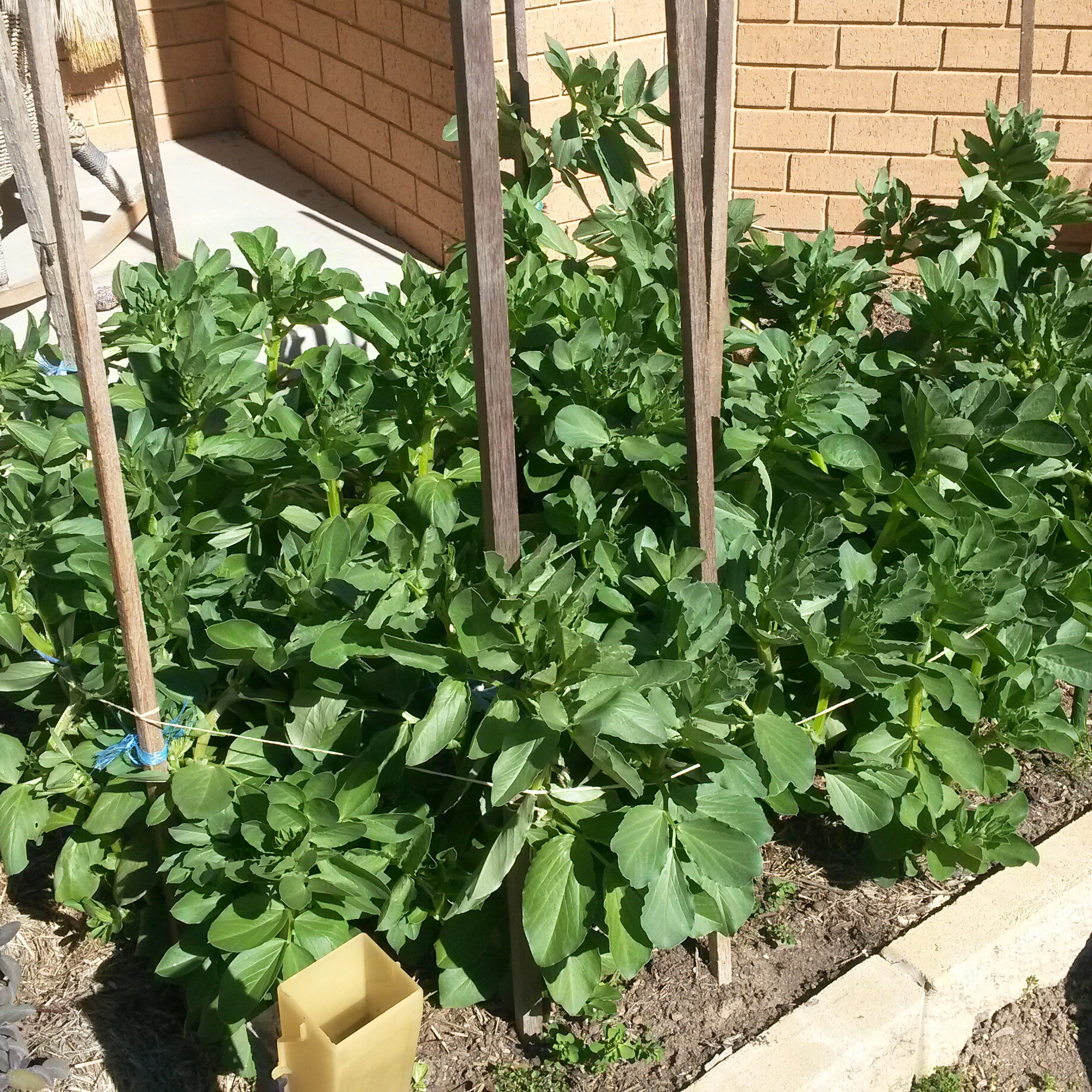
Any object can be the subject for a poem, and Broad Beans was chosen by Les Murray as you can see in his poetry sermon below … it is such a wonderful imaginative portrayal of the broad bean it all its glory … those that grow this magnificent vegetable will surely appreciate his well-chosen words describing the nature of the vegetable.

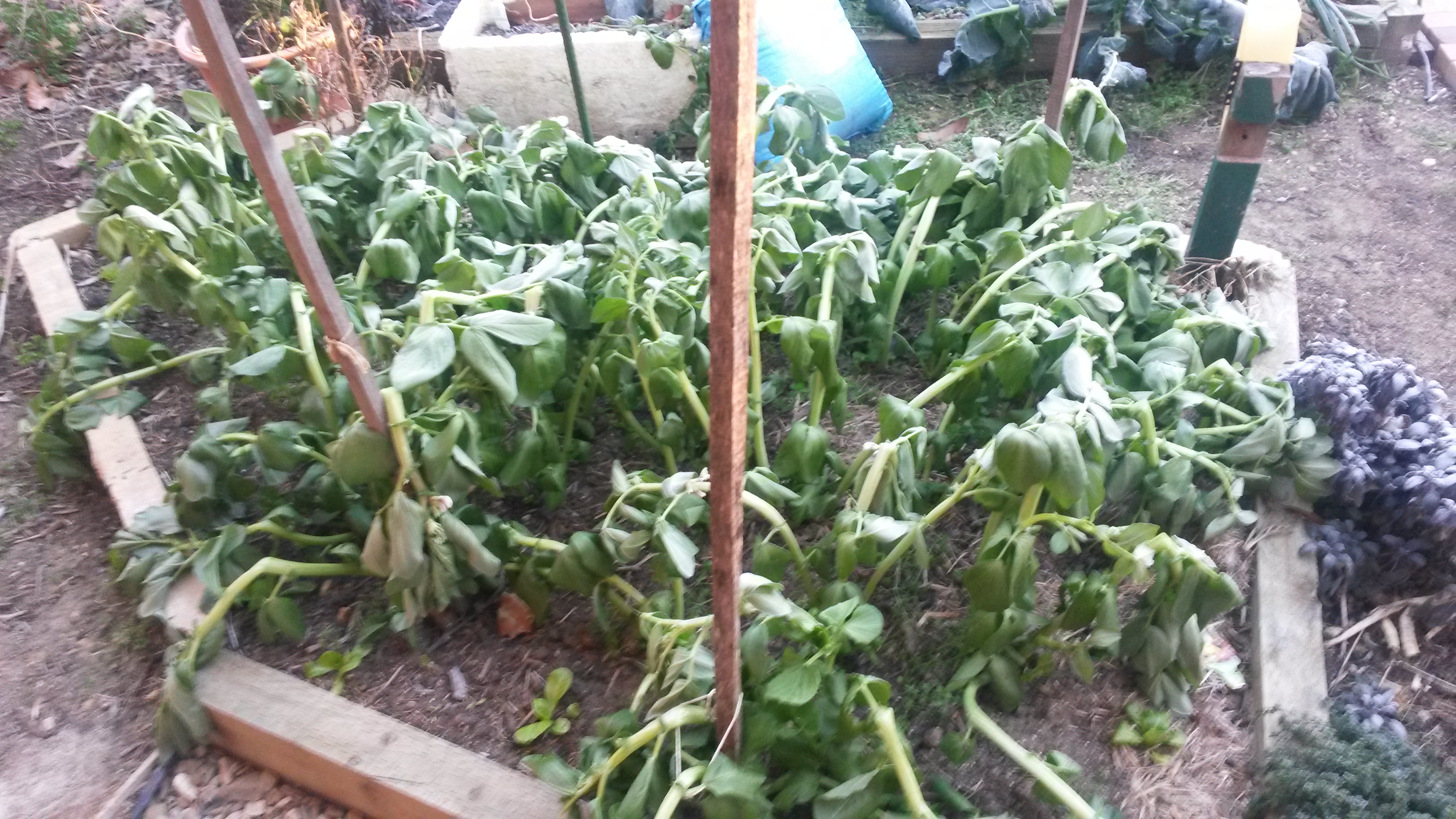
Broad beans will survive the most severe of frosts as shown by the image at the end of the poem and then rebound – as shown in the above photo of the same crop.

I have included my own italics commentary after each stanza …

The Broad Bean Sermon

Beanstalks, in any breeze, are a slack church parade
without belief, saying trespass against us in unison,
recruits in mint Air Force dacron, with unbuttoned leaves.

It does not take much wind to bend a broad bean and unless you tie them up they can easily become a motly ragbag showing … in the context of church propriety they could be asking for the company of sinners. Dacron = an artificial fibre, typically of a specific broad bean green colour.

Upright with water like men, square in stem-section
they grow to great lengths, drink rain, keel over all ways,
kink down and grow up afresh, with proffered new greenstuff.

The broad bean has a clear square cut nature to the stem and although the plant will fall over in all directions it will rise up afresh … in fact the stem can be half broken and it will still survive and recover.

Above the cat-and-mouse floor of a thin bean forest
snails hang rapt in their food, ants hurry through several dimensions:
spiders tense and sag like little black flags in their cordage.

A wonderful forest for a cat and mouse to play hide and seek and the foliage does attract snails – especially to the underside of leaves.

Going out to pick beans with the sun high as fence-tops, you find
plenty, and fetch them. An hour or a cloud later
you find shirtfulls more. At every hour of daylight

It is so easy to miss beans when you go out to pick … note you can pick them when they are not fully formed and treat them as you would a runner bean eating the sliced pod and bean.

appear more than you missed: ripe, knobbly ones, fleshy-sided,
thin-straight, thin-crescent, frown-shaped, bird-shouldered, boat-keeled                                                                                                             ones,
beans knuckled and single-bulged, minute green dolphins at suck,

I love these descriptive words that hang on the nature of the pod – minute green dolphins at suck – so apt.

Beans upright like lecturing, outstretched like blessing fingers
in the incident light, and more still, oblique to your notice
that the noon glare or cloud-light or afternoon slants will uncover

Yes, some of the bean pods will stretch out and be obvious and in a cluster while others will be erect next to a stem … so again you do have to look very closely when you go out picking the pods.

till you ask yourself Could I have overlooked so many, or
do they form in an hour? unfolding into reality
like templates for subtly broad grins, like unique caught expressions,

Each pod is very individual in its own knobby way … and when they are in full production you really need to pick daily

like edible meanings, each sealed around with a string
and affixed to its moment, an unceasing colloquial assembly,
the portly, the stiff, and those lolling in pointed green slippers …

They are by nature an informal or colloquial bunch and the pods do become very stiff and knarred the older they get … at that stage they need to be picked or the bean inside will be become too big and woody … the green slippers – a good choice as the pods hold the beans in a furry bed.

Wondering who’ll take the spare bagfulls, you grin with happiness
– it is your health – you vow to pick them all
even the last few, weeks off yet, misshapen as toes.

Misshapen toes fitting nicely to the slippers … and yes, you do vow to pick them all … for they can be blanched and frozen … so there are no worries about the excess … and of course they are good for you – If you don’t put too much cheese source on top!

Les Murray born 1938 (from The Vernacular Republic)

His poetry has won many awards and he is regarded as “the leading Australian poet of his generation” for full details on Australian poet Les Murray.

ColdBroadBeansBroad Beans – Early Morning – after minus 7.1 temperature – Canberra

Dead Poets Readings – Canberra 2014

Poems read at the Dead Poets Dinner on 22 July 2014

The Dead Poets Dinner, run by Geoff Page as an annual event, was held at ‘The Gods’ Cafe at the Australian National University Canberra on the 22nd of July. This event started in 1998 and as usual it was a very lively and entertaining evening.

For interest below is a list of readers and the poems read. Full marks to Laurie McDonald in his rendition of David Meyers’ poem ‘Fencing in the Dark’– an excellent choice … an entertaining, humorous and easily accessible poem … it is difficult to choose deep poems at such events … that is unless the audience is already aware of the poem. David Meyers was a local poet and for many years he was involved with the Queanbeyan Bush Poets. He died of cancer at the age of 63.

Colin Campbell / Thomas Blackburn – A Smell of Burning, and Hospital for Defectives
Marion Halligan / Yeats – Sailing to Byzantium
Joyce Freedman / Siegfriend Sassoon – Everyone Sang
Hazel Hall / Hilaire Belloc – Tarantella
Chris Dorman / William Baine – The Archery of William Tell
Kathy Kituai / Muso Susaki – Sun in Midnight
Nicola Bowery / Sarah Broom – About Me, and That Moon
Wendy McMahon Bell / Seamus Heaney – Digging
P.S. Cottier / Catherine Martin – The Mouse Tower
Geoff Page / Seamus Heaney – From the Republic of Conscience
Laurie McDonald / David Meyers – Fencing in the Dark
Carmel Summers / Janice Bostok – Amongst the Graffiti
Moya Pacey / Elizabeth Bishop – One Art, and Louis MacNeice Wolves
Rosa O’Kae / Seamus Heaney – Skunk
Sue Edgar / J.L. Borges – Mirror, and Sylvia Plath – Mirror
Adrienne Johns / Hugh McDiarmid – Vanitas, and Balmorality
John Stokes / R.F. Brissenden – The Whale in Darkness
Mary Besemeres / Wizlawa Szymborska – View With a Grain of Sand
Sarah Rice / T.S. Eliot excerpts from Little Gidding
Emily Rice / Ted Hughes – Tractor
Annie Didcott / Keats – Ode to a Nightingale
Tony Williams / Neruda – The Dead Woman
Arlene Williams / J.J. Bray – Address to Pigeons in Hurtle Square, and William Carlos Williams – This is just to say
John Van de Graaff / Seamus Heaney – Follower, and D.H. Lawrence – Piano
Adrian Caesar / R.S. Thomas – The Owl
Michael Thorley / Thomas Hardy – Channel Firing, and They
Andrew McDonald / poems by two Scottish poets (Norman McCaig?)
Lesley Lebkowicz / poems by Soseki
Alan Gould / a song by Hamish Henderson
Alinta Leaver / Kenneth Koch – Variations on a Theme by William Carlos Williams
Richard Scutter / Auden – Musee des Beaux Arts, and Hopkins – Inversnaid
Martin Dolan / Dylan Thomas – Prologue
Marlene Hall / Thomas Wyatt – Whoso list upon the slipper top
Melinda Smith / Francis Webb – Cap and Bells, and The Bells of St Peter Mancroft
Ruth Pieloor / C.J. Dennis – The Australaise
Janette Pieloor / Gwen Harwood -The Secret Life of Frogs