Performance – Les Murray – Comments

Performance
I starred that night, I shone:
I was footwork and firework in one,
a rocket that wriggled up and shot
darkness with a parasol of brilliants
and a peewee descant on a flung bit;
I was blusters of glitter-bombs expanding
to mantle and aurora from a crown,
I was fouéttes, falls of blazing paint,
para-flares spot-welding cloudy heaven,
loose gold off fierce toeholds of white,
a finale red-tongued as a haka leap:
that too was a butt of all right!
As usual after any triumph, I was
of course, inconsolable.
Les Murray (1938 – 2019)

fouéttes = a pirouette performed with a circular whipping movement of the raised leg to the side
haka = a ceremonial dance in New Zealand Māori culture, with quite an aggressive end-shout

Well, it is approaching the year end and a time to reflect on goals achieved. How have we performed. Although in this poem we probably think of performance in relation to stage and audience.

It is a list poem, a list of superlatives in self appraisal in terms of originality in word expression. Brilliance and fire feature throughout with a nice butt ending as in the throwing away of a cigarette.

I do like that word inconsolable in the last two lines. It has a certain ambivalent mind feel. It usually refers to a person unable to be comforted. Perhaps inconsolable because of the immense empty hole that follows such flaming achievement that can never ever be repeated. And perhaps comfort is needed to bring down from the heights of self-emotional gratification.

My advice is to have a succession of goals to keep you on your toes. And I will in no way elaborate on my successes over the year!

I am reminded of a wonderful poem by Thomas Hardy concerning a superb church performance by an Anglican Minister – In Church – Thomas Hardy – Analysis | my word in your ear

Irrespective of his quick minded erudite nature there is a certain irony about this poem in that I attended several readings by LM and from the recipient end I found his readings and repour with attendees not akin to justify such extravagant words.

Les Murray was arguably of that standing in Australian Poetry to be considered a de facto Australian Poet Laureate but Australia does not have a ‘Poet Laureate’ as such. In 1998 LM received the Queen’s Medal for Poetry.

Les Murray on Wikipedia – Les Murray (poet) – Wikipedia

The Christmas Word – An Advent Poem

What word is this

what word is this that sullies forth
its annual opening of eye
that generates such hope that more
meaning such to the hopeful gives
bandied before the year does end
but no end if known of knowing blend

what word is this that bleeds the heart
to pray suffer such indigent love unknown
yet same vein courses all life through
in never-ending beauty, unveiling of
eternal body splendid, that imperfect
diamond creator spirit shines

tis Christmas
Christmas!
where the forever gift is born
and in the perpetrators mind 
becomes again that one great joy
everlasting in the flesh absorbed

Richard Scutter Advent 2021

The Moon and the Yew Tree – Sylvia Path – Comments

The Moon and The Yew Tree
This is the light of the mind, cold and planetary 
The trees of the mind are black. The light is blue.
The grasses unload their griefs on my feet as if I were God
Prickling my ankles and murmuring of their humility
Fumy, spiritous mists inhabit this place.
Separated from my house by a row of headstones.
I simply cannot see where there is to get to.

The moon is no door. It is a face in its own right,
White as a knuckle and terribly upset.
It drags the sea after it like a dark crime; it is quiet
With the O-gape of complete despair. I live here.
Twice on Sunday, the bells startle the sky --
Eight great tongues affirming the Resurrection
At the end, they soberly bong out their names.

The yew tree points up, it has a Gothic shape.
The eyes lift after it and find the moon.
The moon is my mother. She is not sweet like Mary.
Her blue garments unloose small bats and owls.
How I would like to believe in tenderness -
The face of the effigy, gentled by candles,
Bending, on me in particular, its mild eyes.

I have fallen a long way. Clouds are flowering
Blue and mystical over the face of the stars
Inside the church, the saints will all be blue,
Floating on their delicate feet over the cold pews,
Their hands and faces stiff with holiness.
The moon sees nothing of this. She is bald and wild.
And the message of the yew tree is blackness - blackness and silence.
Sylvia Plath (1932 – 1963)

This poem was composed in October 1961 when SP was living at ‘Court Green’ cottage North Tawton, Devon. At that stage her marriage with Ted Hughes was still intact. The cottage was close to St Peter’s Church which was visible when she was writing. And at some stage she would have ventured inside.

A carefully designed poem of four seven-line stanzas with distinct sentence punctuation.

S1 … Clearly written at nighttime where SP invokes a ghostly graveyard presence. And there was a mist evident to add to such a scene. The moon has that association with the mind and lunacy. The griefs being the gravestones in rows. As if I was God – well, SP is not God and cannot perform miracles on the dead. The trees stand out black and the light from the moon blue. She cannot see the path through to the Church

S2 … This stanza has two distinct parts. SP personifies her emotional state on to the moon – white as a knuckle and terribly upset. I like the image of the moon dragging or sucking up the sea like a thief. It conjures up a rain squall coming off the sea. SP says this is where she lives, and she knows the sound the church bells make every Sunday morning.

Christianity and resurrection then come to mind in relation to the dead and the gravestones. But the bells only bong out their names – the names on the gravestones. SP is clearly dead to the thoughts of any resurrection to an afterlife.

S3 … The yew tree points up. Gothic shape implying dark and morbid.  It is worth considering the symbolic representation of the yew tree –

Christian stories of resurrection led the tree to become a symbol of eternal life. As the trunk of the tree begins to decay, a new tree can form. This represents the cycle of life that makes Yew trees a symbol of rebirth as well.

But there is no tenderness, sadly only a Mother Moon image associated with a wild nature represented by seeing bats and owls fly up unleashed against the ghostly blue light.

How SP would like it to be otherwise.

S4 … It looks like clouds are causing the firmaments to be seen and not seen. The inside of the church is the scene of fixed figures and maybe the stained-glass windows can record saints seen above the pews. Again, a cold dead image of being stiff with holiness as in no resurrection. The moon is wild and full of life unknowing of such human quandaries concerning death. The message of the Yew tree is black. SP is displaying her view on religion and the resurrection. The poem ends with a dark depressive feeling.

See this link for a video of Court Green and the Church – Sylvia Plath Video & Picture Post: Court Green (sylviaplathinfo.blogspot.com) … and courtesy of this Site –

Court Green – from the Church of St Peter’s
at North Tawton, Devon

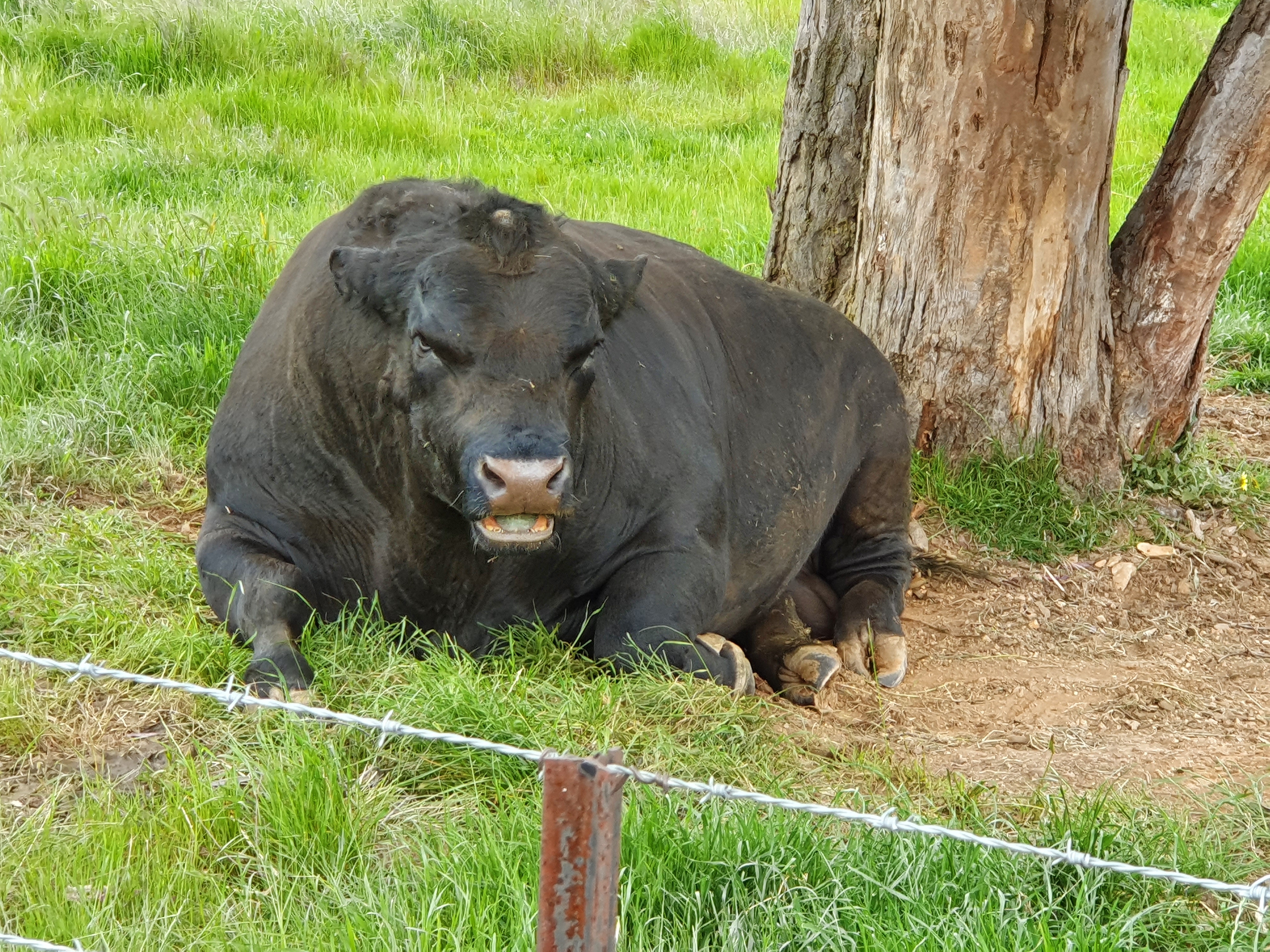
‘No Bull’ – A personal encounter

No Bull
No bull, this is real 
he looks at me chewing cud
I look at him
you have quite a bit of muscle
I’m glad the fence is in-between
how many press-ups, weights? 
or is all just natural with you
he doesn’t ruffle to my thoughts
and just goes on a-chewing
but I can imagine action, 
I wouldn’t want to get in his way! 
it reminded me, as a boy, when camping 
with the ‘Scouts’ in Scotland
No bull, this is true history 
we pulled up late at dusk
and hurriedly put the tents up in the corner
of a field and were soon fast asleep
it was in unsuspecting morning light 
and you can guess!
when opening the tent flap door
to be confronted so!
No bull, it was shock of the first degree
then ‘Scout’ action never seen before 
and ever since then I have, what can I say 
a certain face-to-face respect.
Richard Scutter October 2021

The context of this poem is embedded in the text, what is more interesting is what prompted these words. We were visiting an historic cemetery in Canberra which entailed walking along a path adjacent to a paddock with this bull close by and the photograph above is of that animal. And by association it took me back to camping with the Scouts in Scotland. This triggered a latent experience long forgotten. And Scottish highland cattle are quite something to behold but this animal certainly had a touch of menace as I looked at him with interest.

Everyone Sang – Siegfried Sassoon

Everyone Sang
Everyone suddenly burst out singing;
And I was filled with such delight
As prisoned birds must find in freedom,
Winging wildly across the white
Orchards and dark-green fields; on - on - and out of sight.
Everyone's voice was suddenly lifted; 
And beauty came like the setting sun:
My heart was shaken with tears; and horror
Drifted away ... O, but Everyone
Was a bird; and the song was wordless; the singing will never be done.
Siegfried Sassoon (1886 – 1967)

Yesterday was ‘Remembrance Day’ it also coincided with the easing in Canberra of the restrictions associated with the virus.

This well-known poem is all about freedom and release from war.

The first stanza highlights the immediacy of the release in a sudden outburst of joy. But there is a hint of the transient nature of this emotion with the disappearance of the birds in the last line of the stanza on – and out of sight.

The second stanza shows the joy to be short lived being counteracted by grief – and beauty came like the setting sun. And ends with the dramatic statement – and the song was wordless; the singing will never be done. The song being wordless; without meaning. Siegfried Sassoon remembers those that died in the war and those that are maimed and unable to join the celebration.

In similar fashion there is a degree of immediate relief at the easing of virus-restrictions counteracted by the unease that the virus is still a threat to life. And for those families that have lost members there is that on-going shadow to life. We are fortunate for currently there are no virus-related patients in Canberra hospitals.

Siegfried Sassoon on Wikipedia     

Ancient Egyptian Love Poems – John L Foster translator

Ancient Egyptian Love Poems – John L Foster translation

We explored some Egyptian Love Poems created 3,000 years ago at a recent U3A Poetry Appreciation session.

They were translated from the Ancient Egyptian by John L Foster from the book Love Songs of the New Kingdom (Charles Scribner’s Sons – New York 1974)

In 2003 the ABC Radio National program ‘Poetica’ explored this work … the summary text –
Four small collections of anonymous poems have survived from the New Kingdom of pharaonic Egypt. Written on papyri and a stone vase, they are approximately 3,000 years old, but John L Foster’s translations make them seem very contemporary, fresh and erotic. This program presents a selection of the poems accompanied by music from Michael Atherton and the Musicians of the Nile.

Here are two of the poems …

How clever my love with a lasso  

How clever my love with a lasso -  
she'll never need a kept bull!  
She lets fly the rope at me  
(from her dark hair),  
Draws me in with her comehither eyes,  
wrestles me down between her bent thighs,  
Branding me hers with her burning seal. 
(Cowgirl, the fire from those thighs!) 

… this example is quite contemporary … and makes that universal statement on how passionate love flows endlessly through the years

Your love, dear man, is as lovely to me 

Your love, dear man, is as lovely to me  
As sweet soothing oil to the limbs of the restless,  
as clean ritual robes to the flesh of gods,  
As fragrance of incense to one coming home 
It is like nipple-berries ripe in the hand,  
like the tang of grain-meal mingled with beer  
Like wine to the palate when taken with white bread.  
While unhurried days come and go,  
Let us turn to each other in quiet affection,  
walk in peace to the edge of old age.   
And I shall be with you each unhurried day,  
a woman given her one wish:      to see  
For a lifetime the face of her lord. 

… love, food wine nicely married … and oil is referenced so important in ancient times … and it does say something about the culture of the day and the place of woman in society … that very last word Lord … if it was changed to love it would remove the subservient nature

… but I do like the line – walk in peace to the edge of old age … taking quiet affectionate togetherness to the precipice … implying parting at death

It is interesting to see how love is articulated through the centuries in words. And the importance given to love by making it remembered by transcribing on material objects.

Surprised by Joy – William Wordsworth – comments

Surprised by Joy

Surprised by joy—impatient as the Wind
I turned to share the transport—Oh! with whom
But Thee, long buried in the silent Tomb,
That spot which no vicissitude can find?
Love, faithful love, recalled thee to my mind—
But how could I forget thee?—Through what power,
Even for the least division of an hour,
Have I been so beguiled as to be blind
To my most grievous loss!—That thought’s return
Was the worst pang that sorrow ever bore,
Save one, one only, when I stood forlorn,
Knowing my heart’s best treasure was no more;
That neither present time, nor years unborn
Could to my sight that heavenly face restore.
William Wordsworth (1750 – 1830)

This sonnet is based on Wordsworth’s daughter Catherine, who died in 1812, aged just three. The poem reflects on a moment of happiness that instinctively came to him in relation to the joy brought to him by his daughter. And it could be a moment long after the death based on long buried.


Looking at that memorable first line – Surprised by joy—impatient as the Wind. It appears that something has triggered remembrance and a joyful remembrance. It could have been an object associated with the infant or a word spoken by someone; but whatever it was it brought instant joy. And whatever it was love was at the core – love, faithful love, recalled thee to my mind. And the effect was a need for an expansion of this feeling. The Wind is personified; and the wind is impatient. It often comes rattling at your door demanding recognition. In the same way Wordsworth is impatient for an expansion to his joy. And then he states emphatically that it is impossible to forget his daughter – But how could I forget thee? Indicating perhaps that it is a renewed reflection, suggesting a little guilt.

The last six lines promote the grievous thought on never ever seeing Catherine again; and never ever being able to share again. And time does continually distance us from those we love and have died. And, like Wordsworth, we all must come to terms with this as time minimises the gold in our own personal life.

Metaphorically we collect gold coins over the years and quite often we forget we hold them in our pocket. However, from time to time we take them out and look at their face value.

vicissitude = change in circumstance or fortune


William Wordsworth on Wikipedia

Watercolour of Grantchester Meadows – Sylvia Plath – comments

Watercolour of Grantchester Meadows

There, spring lambs jam the sheepfold. In air
Stilled, silvered as water in a glass
Nothing is big or far.
The small shrew chitters from its wilderness
Of grassheads and is heard.
Each thumb-sized bird
Fits nimble-winged in thickets, and of good colour.

Cloudrack and owl-hollowed willows slanting over
The bland Granta double their white and green
World under the sheer water
And ride that flux at anchor, upside down.
The punter sinks his pole.
In Byron’s pool
Cattails part where the tame cygnets steer.

It is a country on a nursery plate.
Spotted cows revolve their jaws and crop
Red clover or gnaw beetroot
Bellied on a nimbus of sun-glazed buttercup.
Hedging meadows of benign
Arcadian green
The blood-berried hawthorn hides its spines with white.

Droll, vegetarian, the water rat
Saws down a reed and swims from his limber grove,
While the students stroll or sit,
Hands laced, in a moony indolence of love —
Black-gowned, but unaware
How in such mild air
The owl shall stoop from his turret, the rat cry out.

Sylvia Plath (1932 – 1963)

King’s College Cambridge owns Grantchester Meadows, a riverside beauty spot south of Cambridge. This area would be familiar to SP when at Cambridge. There may have been a Watercolour at the University. Apparently, it was written when she was in America in 1959 after returning there with Ted Hughes after their marriage.

The Granta is a tributary of the Cam.

Byron’s Pool is a well-known beauty spot where Byron used to bathe.

It is an ekphrastic poem before that word had poetic coinage. According to the Poetry Foundation, “an ekphrastic poem is a vivid description of a scene or, more commonly, a work of art.”. You can appreciate the text without needing a sighting of the Watercolour. And it is an SP poem which is easy to understand.

Students would be familiar with punting on the Cam. It is a nursery plate image; a quintessential image associated with England by those overseas.

Nimbus – a luminous vapor, cloud, or atmosphere about a god or goddess when on earth. I do like that line – bellied on a nimbus of sun-glazed buttercup – it conjures up bright summer meadow flower sunshine relevant to my England heritage.

And we learn that water rats are vegetarians. I am always impressed by SP in how she uses her wide vocabulary in the choice of appropriate words. In the case of the water rat the verb saws = rapid two and throw motion, and the adjective limber = lithe. Implying skill in movement in the water.

Students and tourists often travel from Cambridge by punt to picnic in the meadows or take tea at The Orchard tea-rooms. But do the students really listen to the environment; especially when minds are locked in thought or otherwise engaged in romancing with a lover. And today locked in mobile use while walking.

Sylvia Plath on Wikipedia.