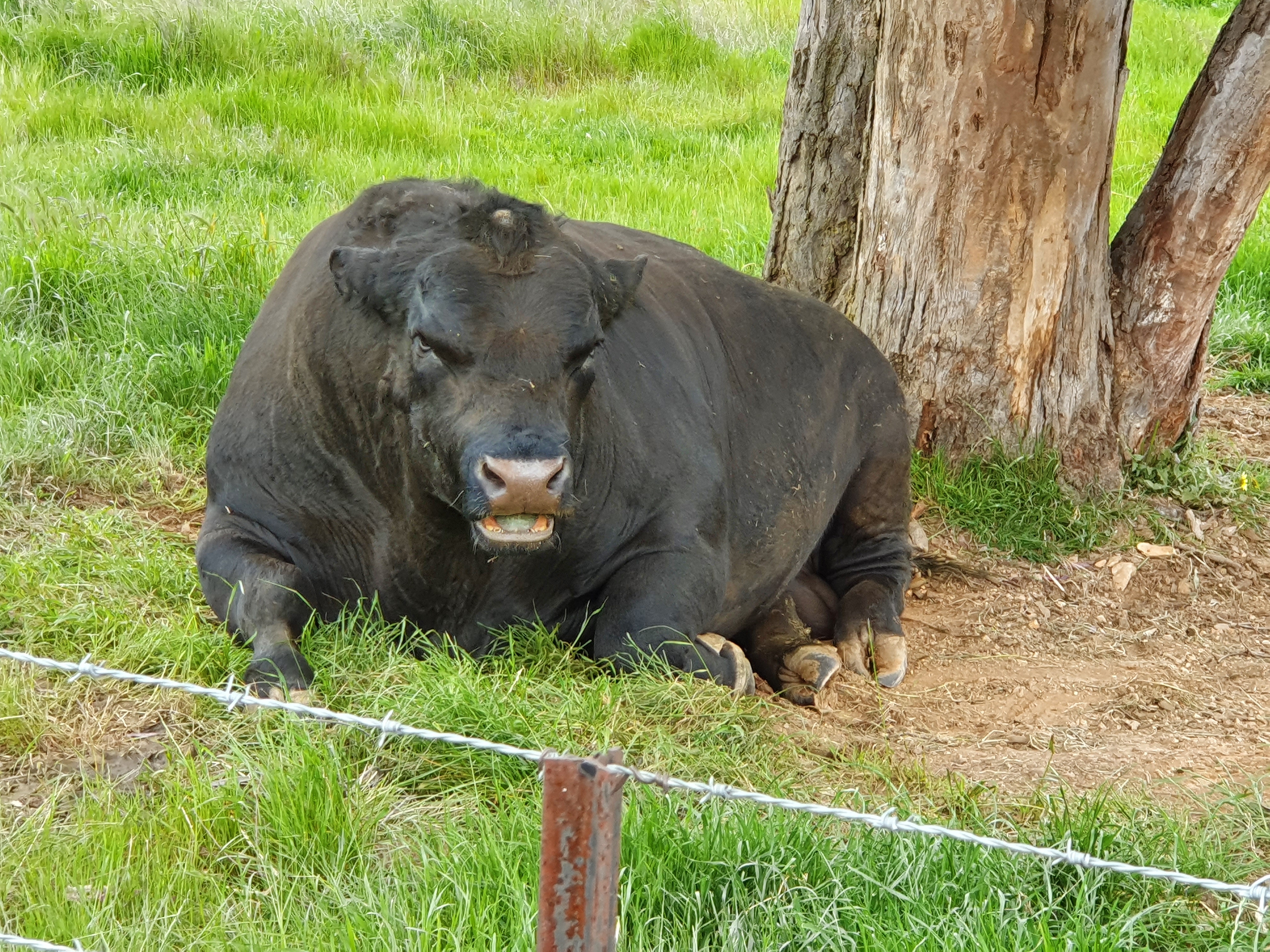
‘No Bull’ – A personal encounter

No Bull
No bull, this is real 
he looks at me chewing cud
I look at him
you have quite a bit of muscle
I’m glad the fence is in-between
how many press-ups, weights? 
or is all just natural with you
he doesn’t ruffle to my thoughts
and just goes on a-chewing
but I can imagine action, 
I wouldn’t want to get in his way! 
it reminded me, as a boy, when camping 
with the ‘Scouts’ in Scotland
No bull, this is true history 
we pulled up late at dusk
and hurriedly put the tents up in the corner
of a field and were soon fast asleep
it was in unsuspecting morning light 
and you can guess!
when opening the tent flap door
to be confronted so!
No bull, it was shock of the first degree
then ‘Scout’ action never seen before 
and ever since then I have, what can I say 
a certain face-to-face respect.
Richard Scutter October 2021

The context of this poem is embedded in the text, what is more interesting is what prompted these words. We were visiting an historic cemetery in Canberra which entailed walking along a path adjacent to a paddock with this bull close by and the photograph above is of that animal. And by association it took me back to camping with the Scouts in Scotland. This triggered a latent experience long forgotten. And Scottish highland cattle are quite something to behold but this animal certainly had a touch of menace as I looked at him with interest.

Ancient Egyptian Love Poems – John L Foster translator

Ancient Egyptian Love Poems – John L Foster translation

We explored some Egyptian Love Poems created 3,000 years ago at a recent U3A Poetry Appreciation session.

They were translated from the Ancient Egyptian by John L Foster from the book Love Songs of the New Kingdom (Charles Scribner’s Sons – New York 1974)

In 2003 the ABC Radio National program ‘Poetica’ explored this work … the summary text –
Four small collections of anonymous poems have survived from the New Kingdom of pharaonic Egypt. Written on papyri and a stone vase, they are approximately 3,000 years old, but John L Foster’s translations make them seem very contemporary, fresh and erotic. This program presents a selection of the poems accompanied by music from Michael Atherton and the Musicians of the Nile.

Here are two of the poems …

How clever my love with a lasso  

How clever my love with a lasso -  
she'll never need a kept bull!  
She lets fly the rope at me  
(from her dark hair),  
Draws me in with her comehither eyes,  
wrestles me down between her bent thighs,  
Branding me hers with her burning seal. 
(Cowgirl, the fire from those thighs!) 

… this example is quite contemporary … and makes that universal statement on how passionate love flows endlessly through the years

Your love, dear man, is as lovely to me 

Your love, dear man, is as lovely to me  
As sweet soothing oil to the limbs of the restless,  
as clean ritual robes to the flesh of gods,  
As fragrance of incense to one coming home 
It is like nipple-berries ripe in the hand,  
like the tang of grain-meal mingled with beer  
Like wine to the palate when taken with white bread.  
While unhurried days come and go,  
Let us turn to each other in quiet affection,  
walk in peace to the edge of old age.   
And I shall be with you each unhurried day,  
a woman given her one wish:      to see  
For a lifetime the face of her lord. 

… love, food wine nicely married … and oil is referenced so important in ancient times … and it does say something about the culture of the day and the place of woman in society … that very last word Lord … if it was changed to love it would remove the subservient nature

… but I do like the line – walk in peace to the edge of old age … taking quiet affectionate togetherness to the precipice … implying parting at death

It is interesting to see how love is articulated through the centuries in words. And the importance given to love by making it remembered by transcribing on material objects.

Surprised by Joy – William Wordsworth – comments

Surprised by Joy

Surprised by joy—impatient as the Wind
I turned to share the transport—Oh! with whom
But Thee, long buried in the silent Tomb,
That spot which no vicissitude can find?
Love, faithful love, recalled thee to my mind—
But how could I forget thee?—Through what power,
Even for the least division of an hour,
Have I been so beguiled as to be blind
To my most grievous loss!—That thought’s return
Was the worst pang that sorrow ever bore,
Save one, one only, when I stood forlorn,
Knowing my heart’s best treasure was no more;
That neither present time, nor years unborn
Could to my sight that heavenly face restore.
William Wordsworth (1750 – 1830)

This sonnet is based on Wordsworth’s daughter Catherine, who died in 1812, aged just three. The poem reflects on a moment of happiness that instinctively came to him in relation to the joy brought to him by his daughter. And it could be a moment long after the death based on long buried.


Looking at that memorable first line – Surprised by joy—impatient as the Wind. It appears that something has triggered remembrance and a joyful remembrance. It could have been an object associated with the infant or a word spoken by someone; but whatever it was it brought instant joy. And whatever it was love was at the core – love, faithful love, recalled thee to my mind. And the effect was a need for an expansion of this feeling. The Wind is personified; and the wind is impatient. It often comes rattling at your door demanding recognition. In the same way Wordsworth is impatient for an expansion to his joy. And then he states emphatically that it is impossible to forget his daughter – But how could I forget thee? Indicating perhaps that it is a renewed reflection, suggesting a little guilt.

The last six lines promote the grievous thought on never ever seeing Catherine again; and never ever being able to share again. And time does continually distance us from those we love and have died. And, like Wordsworth, we all must come to terms with this as time minimises the gold in our own personal life.

Metaphorically we collect gold coins over the years and quite often we forget we hold them in our pocket. However, from time to time we take them out and look at their face value.

vicissitude = change in circumstance or fortune


William Wordsworth on Wikipedia

Watercolour of Grantchester Meadows – Sylvia Plath – comments

Watercolour of Grantchester Meadows

There, spring lambs jam the sheepfold. In air
Stilled, silvered as water in a glass
Nothing is big or far.
The small shrew chitters from its wilderness
Of grassheads and is heard.
Each thumb-sized bird
Fits nimble-winged in thickets, and of good colour.

Cloudrack and owl-hollowed willows slanting over
The bland Granta double their white and green
World under the sheer water
And ride that flux at anchor, upside down.
The punter sinks his pole.
In Byron’s pool
Cattails part where the tame cygnets steer.

It is a country on a nursery plate.
Spotted cows revolve their jaws and crop
Red clover or gnaw beetroot
Bellied on a nimbus of sun-glazed buttercup.
Hedging meadows of benign
Arcadian green
The blood-berried hawthorn hides its spines with white.

Droll, vegetarian, the water rat
Saws down a reed and swims from his limber grove,
While the students stroll or sit,
Hands laced, in a moony indolence of love —
Black-gowned, but unaware
How in such mild air
The owl shall stoop from his turret, the rat cry out.

Sylvia Plath (1932 – 1963)

King’s College Cambridge owns Grantchester Meadows, a riverside beauty spot south of Cambridge. This area would be familiar to SP when at Cambridge. There may have been a Watercolour at the University. Apparently, it was written when she was in America in 1959 after returning there with Ted Hughes after their marriage.

The Granta is a tributary of the Cam.

Byron’s Pool is a well-known beauty spot where Byron used to bathe.

It is an ekphrastic poem before that word had poetic coinage. According to the Poetry Foundation, “an ekphrastic poem is a vivid description of a scene or, more commonly, a work of art.”. You can appreciate the text without needing a sighting of the Watercolour. And it is an SP poem which is easy to understand.

Students would be familiar with punting on the Cam. It is a nursery plate image; a quintessential image associated with England by those overseas.

Nimbus – a luminous vapor, cloud, or atmosphere about a god or goddess when on earth. I do like that line – bellied on a nimbus of sun-glazed buttercup – it conjures up bright summer meadow flower sunshine relevant to my England heritage.

And we learn that water rats are vegetarians. I am always impressed by SP in how she uses her wide vocabulary in the choice of appropriate words. In the case of the water rat the verb saws = rapid two and throw motion, and the adjective limber = lithe. Implying skill in movement in the water.

Students and tourists often travel from Cambridge by punt to picnic in the meadows or take tea at The Orchard tea-rooms. But do the students really listen to the environment; especially when minds are locked in thought or otherwise engaged in romancing with a lover. And today locked in mobile use while walking.

Sylvia Plath on Wikipedia.

The Thought-Fox – Ted Hughes – Analysis

The Thought-Fox
I imagine this midnight moment’s forest: 
Something else is alive
Beside the clock’s loneliness
And this blank page where my fingers move.
Through the window I see no star: 
Something more near
Though deeper within darkness
Is entering the loneliness:
Cold, delicately as the dark snow 
A fox’s nose touches twig, leaf;
Two eyes serve a movement, that now
And again now, and now, and now
Sets neat prints into the snow 
Between trees, and warily a lame
Shadow lags by stump and in hollow
Of a body that is bold to come
Across clearings, an eye, 
A widening deepening greenness,
Brilliantly, concentratedly,
Coming about its own business
Till, with a sudden sharp hot stink of fox 
It enters the dark hole of the head.
The window is starless still; the clock ticks,
The page is printed.
Ted Hughes (1930 - 1998)

This poem was included in ‘The Hawk in the Rain’ publication (1957) which brought prominence to Ted Hughes as a poet.

Animals, especially a fox, were significant to Ted Hughes. As a boy he spent many hours with his older brother hunting and shooting animals. When he was preparing an essay late at night he fell asleep and had a dream involving a fox.

This is how he described that moment – ‘the door opened, and a creature came in with a fox’s head and a long skinny fox’s body – but erect and with huge hands. He had escaped from a fire – the smell of burning hair was strong and his skin was charred and in places cracking, bleeding freshly through the splits. He came across. and set his hand on the page and said “Stop this. You are destroying us.” He lifted his hand away and the blood-print stayed on the page. The hands, in particular, were terribly burnt.’

Hughes listened to this dream and immediately stopped writing ‘teacher-pleasing’ essays. In a way this poem is a partial recollection of that fox dream. He clearly states the nature of the creative process. The fact that a poem cannot be summoned or controlled but awaits the arrival of the words from the forest of the mind. And when Hughes gave a talk, he compared the writing of his poetry to the capture of animals.

Looking at each stanza …

S1 … The midnight dark is equated to his imagination, this is equated to his mind as he processes his thoughts. Thoughts are the initial keys to the creative work. They are alive and he is searching through the forest for something. There is little else happening apart from the lonely tick of a clock. And the blank page awaits. Well, you do need full focus and time to yourself to release that internal creativity.

S2 … Through the window of his mind something is happening. There is a stirring albeit of an imperceptible intuitive feeling within. The fox or the words are about to break into the loneliness. When TH was writing these words his dream above must have come alive again.

S3 … What is this animal? That is the question – what is this poem that is being formed? It comes out of the cold slowly making movement. The touches twig, leaf mirrors the soft pad of the paws. And the fox’s nose touches snow or should we say the blank paper is touched with its invisible inking. From his thought the words will eventuate. But there is much repetition in this creative process as seen in the repetition in the last line of the stanza. And the ‘eyes seeing’ can be likened to his mind in realising the full extent of his creative thought. Seeing or expanding what he wanted to convey.

S4 … And then there are prints in the snow. There are actual words on the blank sheet. And something bold takes place. A poet must be bold and address the wild nature of the animal.

S5 … Out of the black dark of night there is a greenness. Green indicating growth in the materialisation of the poem. And it is coming out of its own business. The visitation of this animal, this poem, has now to be articulated in the form of transference to words. A poet tries to capture such visitations when they occur. And if they occur at night while in darkness and in bed, the morning light often dissolves the once promising thoughts.

S6 … This hot stink creative happening occurs. It indicates something dramatic and something immediate, something impressive hopefully. There is a sense of completion – the page is printed. The initial wording often takes much work in finalisation.

Footnote …

Later in his life, in 1960, a fox cub came into his life. At the time he was still in his marriage with Sylvia Plath. He was walking in London over Chalk Farm Bridge when he saw a young man with a fox cub under his coat. The man had brought it into the city to sell. TH could have bought it for a pound but there was no place for it in the home. In fact, Sylvia had recently given birth to their daughter Freida.

The last lines from the poem Epiphany in Birthday Letters (1998), where this event is described, show the difficulties at that time in blending his domestic family life with that of creative writing as a poet.

If I had grasped that whatever comes with a fox 
Is what tests a marriage and proves it a marriage –
I would not have failed the test. Would you have failed it?
But I failed. Our marriage had failed.

Epiphany – a moment of sudden and great revelation or realization.

In these lines a fox can be equated to many other activities that are compromised in relationships – would you have failed it?

Ted Hughes on Wikipedia

The Trees – Philip Larkin – Analysis

The Trees 
The trees are coming into leaf
Like something almost being said;
The recent buds relax and spread,
Their greenness is a kind of grief.
Is it that they are born again
And we grow old? No, they die too.
Their yearly trick of looking new
Is written down in rings of grain.
Yet still the unresting castles thresh
In full grown thickness every May.
Last year is dead, they seem to say,
Begin afresh, afresh, afresh.
Philip Larkin (1922 – 1985)

It is spring in Canberra, so these words are very apt. And as it is now Australian spring so May translates to September.

S1 … I do like that second line of the first stanza – like something almost being said – it articulates that almost opening of buds and leaves and gives voice to the season; personifying. The last line of this stanza catches you in thought, why grief?  There is a kind of greenness – I guess they don’t know quite what they are in for and what mother nature will throw at their fragility. And with so much extreme weather happening and it is not so easy to be a tree. They may feel sorrow too for all their dead family leafage on the ground.

S2 … Hopefully we will experience many years of seeing seasonal changes. And no, they are not born again. We know they are not dead although, metaphorically, we call them dead in winter. They have a hidden dormant time, and it is well known that the age of tree can be measured by counting the rings in a section of the trunk. So, they are not born again but the transition into new life which is a kind of birth. The tree is coming into green life, at least the deciduous variety. PL states that we die too like the tree. So PL alludes to the question of a possible human transition.

S3 … I do like the idea of trees being unresting castles. They grow continually and get stronger and stronger. So, they are increasingly capable of weathering the vicissitudes of climate, but not human interference of course. It is that last line that gives voice to the whispering of the wind in the branches; again; highlighting the personification. And I have learnt an innovative word to my vocabulary in that regard – ‘susurration’ thanks to our poetry appreciation group. This equally has that onomatopoeia effect.

susurration = whispering or rustling.

Rustling would be my choice in relation to trees, though they can indeed whisper which has a more communicative sense.

personification = the attribution of a personal nature or human characteristics to something non-human.

onomatopoeia = the naming of a thing or action by a vocal imitation of the sound associated with it

Philip Larkin on Wikipedia

Philip Larkin’s ‘Whitsunday Weddings’ is one of my favourite poems.

A Valediction: Forbidding Mourning – John Donne

A Valediction: Forbidding Mourning 
As virtuous men pass mildly away,
   And whisper to their souls to go,
Whilst some of their sad friends do say
   The breath goes now, and some say, No:
So let us melt, and make no noise,
   No tear-floods, nor sigh-tempests move;
'Twere profanation of our joys
   To tell the laity our love.
Moving of th' earth brings harms and fears,
   Men reckon what it did, and meant;
But trepidation of the spheres,
   Though greater far, is innocent.
Dull sublunary lovers' love
   (Whose soul is sense) cannot admit
Absence, because it doth remove
   Those things which elemented it.
But we by a love so much refined,
   That our selves know not what it is,
Inter-assured of the mind,
   Care less, eyes, lips, and hands to miss.
Our two souls therefore, which are one, 
   Though I must go, endure not yet
A breach, but an expansion,
   Like gold to airy thinness beat.
If they be two, they are two so
   As stiff twin compasses are two;
Thy soul, the fixed foot, makes no show
   To move, but doth, if the other do.
And though it in the center sit,
   Yet when the other far doth roam,
It leans and hearkens after it,
   And grows erect, as that comes home.
Such wilt thou be to me, who must, 
   Like th' other foot, obliquely run;
Thy firmness makes my circle just,
   And makes me end where I begun.
John Donne (1572 – 1631)

Valediction = the action of farewell … a statement or address made at that time

S1 … well this sets the scene on the way you should say farewell … it also illustrates the spiritual journey from earthy presence to that of eternity … a gentle passing of the soul … a farewell from one state to another.

S2 … Do not sound trumpets of sorrow and moaning when making a farewell to a loved one. This only cheapens that love. Let it be an internal grief rather than a display to the public combined with a spiritual recognition of the love

S3 … Then the metaphor of describing the physical earthly relationship with that of the spirit in terms of world natural happenings that are seen such as earthquakes with what is happening in the far-flung regions of the universe where nought can be seen with the human eye. Interesting that JD regards the distant regions as innocent, I suppose not contaminated by human existence.

S4 … Concentration on the sensual aspect and the loss of physical contact. This is a non-acceptance of the absence. For those more spiritually inclined there is no absence because a spiritual connection exists. Holding on the spiritual connection is not easy at the time of immediate grief.

S5 … The physical aspect of love is defined by – the eyes, lips, and touch of hands. This is compared with the spiritual aspect held in the mind by thought and prayer.

S6 … Two souls as one … an expansion – like the beating of gold. Apparently, gold can be beaten into very thin sheet … a transformation process, is likened to that of the separation process … properties remain but in a different ‘shape’

S7 … The compass is used as a way of defining a permanent relationship between the two people. The fixed part is the one left behind / the one loved. You then circle around this central figure. The central arm of the compass always following and facing you as you move. It is poetic to think of our creator acting like this, following and supporting us in every move.

S8 … The fixed part leans towards the lover if far away from centre. And the two arms of a compass can come together for close contact.

S9 … JD declares the importance of the circle. The circle is seen as perfect. It is only perfected by the firmness of the central arm. And, of course, the circle is endless; back to the starting point again; the origin love.

This is a poem all about contrasting physical and earthly love with that of the spirit. At the same time advising not sounding trumpets of sorrow and moaning when making a farewell to a loved one. And that there should be no mourning because a spiritual identity is on-going in the relationship based on love. There is a difference between mourning and grief.

mourning = the expression of an experience that is the consequence of an event in life involving loss, causing grief.

grief = intense sorrow, an emotional state

The spiritual connection is often a very background compensation.

There is plenty of analysis of this well-known poem on the Internet – A Valediction: Forbidding Mourning Poem Summary and Analysis | LitCharts

John Donne on Wikipedia

And when thinking of the circle I remember the T. S. Eliot plaque in the church at East Coker, Somerset commemorating his life. His famous well-known words – in my beginning is my end … in my end is my beginning.

Parting is such sweet sorrow. I will say goodbye until tomorrow.

Canberra Can – Canberra Speaking

Canberra is speaking

Canberra and the beauty of Canberra is speaking loudly at this time of year! Canberra is such a fine city in so many ways apart from benefitting from the relatively low impact of the virus. I do hope those local readers can get out in the spring sunshine and enjoy the colour flush and associated return to warmer days. We have an abundance of recreational areas and nature parks. It raises the spirit no end; especially for those that have been confined at home! And isn’t it wonderful that the majority of those infected have recovered and are now able to get out and appreciate the change!

Here is an image from our garden of the crab-apple saying a white hello.

Unfortunately, the Australian media often uses ‘Canberra is speaking’ in a different context. I say unfortunately because those that have never experienced the delights of Canberra can have a coloured image associated by the political life of our city.

I wonder to what extent this stereotype is changing and how much people can Canberra in this way. It is in this light that I encourage the uninitiated to come see and for themselves in the following sonnet …

Canberra Can
Canberra can be quite annoying 
the polies are soul destroying
they come from a different place
to give our fine city a tainted face
please do not send rubbish here 
to rape their time in sex and beer
we care about our reputation!
we are the Capital of the Ozie nation!
so, peel off this superficial skin 
place firmly in the rubbish bin
and come to Canberra yourself to see
the abundancy of our city
then I am sure you will discover 
that this fair city is like no other!
Richard Scutter

For those readers outside Australia the unacceptable sexual behaviour by some politicians has come to the fore, including inappropriate behaviour and lack of respect for women generally. Interesting, the ‘Profumo / Christine Keeler Affair’ documentary has recently been on television. This was a major scandal in British Politics in the early sixties.