Not just a birthday! – Some Christmas Day Words 2014

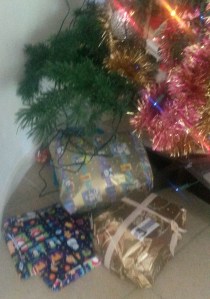
XmasPresents

If I could roll

If I could roll with all my strength
all the love in this wide world
I’d gather it up into one sweet ball
to give to eight children deserving more.

But these children are no more
their presents unopened on the floor.

Remembering the eight children who died last week at the hands of a disturbed mother in Cairns, Queensland – and as the mother is still alive she is one person who is very much in need of prayer.

Christmas Day

not just a birthday
but the birth of life eternal!
never forgotten

Enjoy life, enjoy Christmas, enjoy this special day with all your family and friends.

Richard Scutter

The Latest Forecast – Predicting Life

The Goat

The Latest Forecast

today will be fine with
temperatures in the low twenties
at 9:00am cloud will build up but
the sun will break through by 10:00am
to a full rich blue sky

just after mid-day clouds from the south
will enter with the chance of just a little rain
expect about 3-4mm in the form of light drizzle
if you live in suburbs to the west of Main Street
expect only a touch of moisture

the skies will be totally clear again by 3:00pm
the mild temperatures will continue …

early this morning Mr R G
who always takes his dog for a walk first-thing
was seen walking back home along Ocean Road
accompanied by a well-endowed billy goat
currently there is no explanation …

Richard Scutter 16 December 2014

We will never be able to predict what will happen to us in life.

In the day after the ‘Sydney Seize’ I pray that we will always have the resources within to deal with any situation that befalls us.

Summer – Judith Wright : Analysis

Summer is here again and already we have had a few very hot days in Canberra. This poem by Judith Wright relates to Edge, her former home in Braidwood, and to the Australian summer and how nature must accommodate the disturbance by man and the effect of bush fire. It was written towards the end of her life.

Summer

This place’s quality is not its former nature
but a struggle to heal itself from many wounds.
Upheaved ironstone, mudstone, quartz and clay
drank dark blood once, heard cries and the running of feet.
Now that the miners’ huts are a tumble of chimney-stones
shafts near the river shelter a city of wombats.
Scabs of growth form slowly over the rocks.
Lichens, algae, wind-bent saplings grow.
I’ll never now it’s inhabitants. Evening torchlight
catches the moonstone eyes of big wolf-spiders.
All day the jenny-lizard dug hard ground
watching for shadows of hawk or kookaburra.
At evening, her pearl-eggs hidden, she raked back earth
over the tunnel, wearing a wide grey smile.
In a burned-out summer, I try to see without words
as they do. But I live through a web of language.

from Judith Wright Collected Poems – The Shadow of Fire (Ghazals)

JW shows strong identity to the land commenting on the effects of man  … a land which drank dark blood once … the killing of Aborigines … and a land once  subject to mining … her words describe the attempted recovery by nature  … the attempt to revert to previous conditions – which of course can never happen.

JW also shows strong empathy with the natural environment … with knowledge of local animals and insects seen at Edge. The environment adjusts to the disturbance by man … shafts near the river shelter a city of wombats … and the environment must adjust to the destruction of nature by bush fire … suggesting this is a greater problem …  trying to see without words … … creating words always detracts … many survivors of bush fires would identify with the intensity of thought conveyed by such words.

… it is fascinating to see how diversity manifests through continual evolution … species adapting to changes to environment and the resultant changes to other species … the total connectivity of life as it creates a future by the process of the survival of the fittest … or put another way survival by those best able to adapt to change.

… now this may be Ok when evolution is gradual, although of course some species become extinct, but what happens to this evolutionary process under sudden dramatic disturbances, humanity-made or not … and more important how can humanity act to ‘better the evolutionary process’ … humanity being the prime custodian of the world … having the key role in the very determination of the nature of existence. Global warming is of course one consideration for attention.

… there may of course be other influences at play in the evolutionary process such as spiritual connectivity … but a little foolish and quite a cop-out to think that God will protect the world from destruction … however this could become an indirect truth … if humanity allows God to work through humanity … by humanity listening and responding as appropriate.

… I really love the first two lines … This place’s quality is not its former nature / but a struggle to heal itself from many wounds … the quality of nature is in its resilience and ability to adapt to change and to heal … I am an an optimist of course.

Here is a link to the ‘Braidwood property Edge’ where Judith Wright lived.

and a link  to Judith Wright on Wikipedia

Feeling a little ‘mimsy’ perhaps? – Lewis Carroll

Looking at humour in poetry … the Victorian-age did produce some creative light relief from the conservative life of text … one of the most famous pieces being …

Jabberwocky
the first and last stanza …

“Twas brillig, and slithy toves
Did gyre and gimble in the wabe;
All mimsy were the borogoves,
And the mome raths outgrabe.

From Through the Looking-Glass, Chap 1

Lewis Carroll (1832 – 1898) = Charles Lutwidge Dodgson (Anglican deacon and lecturer in mathematics)

Humpty Dumpty’s explication:
Brillig = 4 O’Clock in the afternoon … the time for broiling things for dinner
Slithy = lithe and slimy … two meanings packed into one word -a portmanteau word
Toves = a combination of badger/lizard/corkscrew … make nests under sundials and live on cheese
Gyre = to go round and round like a gyroscope … it does in fact mean circular motion
Gimble = make holes like a gimlet = a small tool for making holes
Wabe = grass plot around a sundial … it goes a long way before it and a long way after it
Mimsy = flimsy and miserable
Borogrove = thin shabby looking bird with its feathers sticking out all around
Mome = short for ‘from home’, Rath = green pig
Outgrabe = outgribing = something between bellowing and whistling with a kind of sneeze
From Through the Looking-Glass, Chap 6

Out of all the nonsense words above slithy and mimsy have a wonderful feel and quite an acceptable explanation or should I say they are quite texplanable.

If you are feeling creative have a go at creating portmanteau words. (Portmanteau = a large suitcase consisting of two parts that fold together.) See if you can come up with something really interesting. For example – gentle and kind = kindle. However, a word of warning when working with children … work with an Alice who knows what is right and proper … we do not want to destroy the spelling of the correct words! … i.e. before becoming too proright.

You could also try the reverse and take a genuine word and break it into two components e.g. bright = brilliant and light … I’m not sure what you call this – the unpacking of the suitcase to view the contents?

It is no surprise though that such creative (all be it nonsensical) words were the result of writing for children who love such play and it is a wonder that more new words did not migrate to colloquial use.

… and here’s truly hoping you are not having a mimsy day!

and this is a Website link to the full Jabberwocky poem

An Arundel Tomb – Philip Larkin – Analysis

ArundelTombChichester

An Arundel Tomb

Side by side, their faces blurred,
The earl and countess lie in stone,
Their proper habits vaguely shown
As jointed armour, stiffened pleat,
And that faint hint of the absurd–
The little dogs under their feet.

The sculpture is of the Earl of Arundel and his second wife Eleanor of Lancaster and it resides in Chichester Cathedral … in art dogs are a sign of fidelity … apparently over the years the sculpture has been vandalised and repaired

Such plainness of the pre-baroque
Hardly involves the eye, until
It meets his left hand gauntlet, still
Clasped empty in the other; and
One sees, with sharp tender shock,
His hand withdrawn, holding her hand.

In all the cathedrals and churches Larkin visited he never saw such tenderness depicted in stone and he was quite moved by the sight … generating this poem.

They would not think to lie so long.
Such faithfulness in effigy
Was just a detail friends could see:
A sculptor’s sweet commissioned grace
Thrown off in helping to prolong
The Latin names around the base.

They have been together for centuries in stone whereas in life they would never lie so close given that marriages were very much a political arrangement … there is a double take too on the word ‘lie’ as there probably would have been a lot of deceit in the arrangement. The Latin names around the base probably ignored by those visiting the cathedral today – but the holding of hands an attraction to the eye.

They would not guess how early in
Their supine stationary voyage
Their air would change to soundless damage,
Turn the old tenantry away;
How soon succeeding eyes begin
To look, not read. Rigidly they

Well, the nature of marriage has changed over the years and those visiting today would view the holding of hands perhaps as a more loving union. Supine = lying on the back without energy.

Persisted, linked, through lengths and breadths
Of time. Snow fell, undated. Light
Each summer thronged the grass. A bright
Litter of birdcalls strewed the same
Bone-riddled ground. And up the paths
The endless altered people came,

I like the view of the outside while the tomb is fixed and oblivious to the changing seasons. Apparently the grounds of Chichester Cathedral are known for bird song.

Washing at their identity.
Now, helpless in the hollow of
An unarmorial age, a trough
Of smoke in slow suspended skeins
Above their scrap of history,
Only an attitude remains:

People today don’t understand the history and context … washing over the sculpture … history becomes a scrap – unarmorial = not decorated with a coat of arms

Time has transfigured them into
Untruth. The stone finality
They hardly meant has come to be
Their final blazon, and to prove
Our almost-instinct almost true:
What will survive of us is love.

Philip Larkin

We have the contrast – the truth of love – the reality of love being something different from what this time-frozen stone fixture might suggest … the important things that survive are not so much the physical –but ‘love’ (whatever this means to the reader) … but then the physical may be needed as a catalyst or prompt. It certainly prompted Larkin to think about love – and he was certainly not a ‘love’ poet – but it has been said that he was haunted by such notions although of a melancholic nature.

A YouTube video of Philip Larkin reading this poem

Only Two Lips – A Spring Poem

Floriade is the name of the  spring flower festival in Canberra in the Commonwealth Gardens near the centre of the city. Mainly a showing of bulbs including of course tulips. It is quite a tourist attraction and many come to Canberra to see the displays.

OLYMPUS DIGITAL CAMERA

The U3A ‘Arts’ Exhibition had a theme of tulips, poppies and spring. I wrote the following poem for the opening day (see the previous post) …

Tulips in a vase, focus on flower in foreground

Only Two Lips

who do you think you are
standing so pert and penal
asserting yourself in rich colour
arrogant, obvious
demanding my attention

well I’m not falling for it!
such a brazen showing
with your closed-mouth talk
I will give you what you deserve –
lip service, and just you wait

your day will come
believe me, you will bend
becoming quite dishevelled
falling to kiss the ground
in total disarray

Richard Scutter  2 August 2014

It is always very interesting when you read a poem in public because you never quite know what reception will follow. The audience was mainly  women and  in the older bracket, so that was appropriate. A few realized that I was not actually talking about tulips so much and there were a couple of wry smiles – which was encouraging!

There were a few hangups on the word ‘penal’. Well penal = punishing – and from a male perspective the beautiful can be quite punishing in many ways especially when young, ‘manipulative’ and of a demanding nature.

London Rain – Louis MacNeice

This year many of the the poets visited in our U3A (University of Third Age) sessions have had some connection with religious ministry. When you come to think about it it is not surprising. Ministers are thought-full people – don’t you think!

Louis MacNeice was no exception. His father was a Protestant minister who later became a bishop of the Anglican Church of Ireland. Below is Louis MacNeice’s poem ‘London Rain’, written at a time of conflict in Europe. He wrestles with thoughts on God as he looks out late at night on the rain. Sharing my comments which are shown in italics after each stanza.

 London Rain

The rain of London pimples
The ebony street with white
And the neon lamps of London
Stain the canals of night
And the park becomes a jungle
In the alchemy of night.

London night-time rain … I love that word pimples and the catch of light in the pimple from the street lamps … ebony = rich dark black wood … giving a little gloss to the dark … and there is a whole new mapping of the streets … as in a chemical reaction …the light staining, leaving it’s mark

My wishes turn to violent
Horses black as coal–
The randy mares of fancy,
The stallions of the soul–
Eager to take the fences
That fence about my soul.

This looks like dissatisfaction on where he is in life … in terms of violent horses … he wants to break free … and this may be a spiritual unrest when we look at later stanzas

Across the countless chimneys
The horses ride and across
The country to the channel
Where warning beacons toss,
To a place where God and No-God
Play at pitch and toss.

Well his thoughts travel across the channel to the war and this occupies his mind … God and No-God (the Good and the Bad) playing pitch and toss = a game of skill and chance

Whichever wins I am happy
For God will give me bliss
But No-God will absolve me
From all I do amiss
And I need not suffer conscience
If the world was made amiss.

He is talking about the God/No-God battle going on in his mind. If there is a God – everything will be OK and if No-God then it doesn’t matter about all the conscience problems … these are his on-going thoughts as he watches the rain … his logic…dare I say late-night logic!

Under God we can reckon
On pardon when we fall
But if we are under No-God
Nothing will matter at all,
Adultery and murder
Will count for nothing at all.

Expounding his thoughts from the previous stanza … bad behaviour will not matter … no accountability… and under God we will be absolved of all our missdemeanours.

So reinforced by logic
As having nothing to lose
My lust goes riding horseback
To ravish where I choose,
To burgle all the turrets
Of beauty as I choose.

So his logic suggests to him that this horse can ride amuck with no consequence … taking the No-God ride so to speak … and using this to justify any course of action

But now the rain gives over
Its dance upon the town,
Logic and lust together
Come dimly tumbling down,
And neither God nor No-God
Is either up or down.

It looks as though it has stopped raining for a while … and in sync. with this his God/No-God thinking seems to fall away too … well it is late night and he is a little confused

The argument was wilful,
The alternatives untrue,
We need no metaphysics
To sanction what we do
Or to muffle us in comfort
From what we did not do.

The argument was very wilful = headstrong … and indeed ‘we need no metaphysics = abstract thinking’ … and in his case no ‘God/No-God’ thoughts to work out what we should be doing or to justify our actions. (I might add that those that shout God is on our side are often using God to justify their ungodly actions.)

Whether the living river
Began in bog or lake,
The world is what was given,
The world is what we make.
And we only can discover
Life in the life we make.

Bog and lake are references to his Irish / English heritage. For me this is the key stanza … it is up to us to make what we will of the world, of this gift … and we can only discover how we should live in living life. In a sense it is up to us – our responsibility to create our own God (and if we do happen to believe in an external God then perhaps our understanding of God may come clearer). Focus on the gift of the present, the here and now…don’t worry about what is happening overseas!

So let the water sizzle
Upon the gleaming slates,
There will be sunshine after
When the rain abates
And rain returning duly
When the sun abates.

Well, rain and sun one will follow the other in an endless cycle (good and bad) – that is the way of the world and we have to accept it – (hopefully life improves over time!)

My wishes now come homeward,
Their gallopings in vain,
Logic and lust are quiet,
And again it starts to rain;
Falling asleep I listen
To the falling London rain.

His mind is now back on where he is … in his room looking out on the falling rain … the logic/lust distraction of thought in vain … and the wild horses that took his thoughts away at the beginning of the poem bring him home again … he notices it has started to rain again … falling rain and enough thinking for one night falls asleep… let’s hope he has pleasant dreams!

(The rhyming scheme is a b c b d b – with a repeat end word in lines four and six of each stanza).